Inspiration
Small freelance jobs run on trust. Clients fear paying for work that misses the brief; freelancers fear delivering and never getting paid. Marketplaces solve this with escrow and human reviewers — too slow and too expensive for a $25 product description or a $60 landing page.
Almost every dispute comes down to one question: did the delivery meet what was asked? That is a question an AI can answer with evidence — and PayPal can act on instantly.
What it does
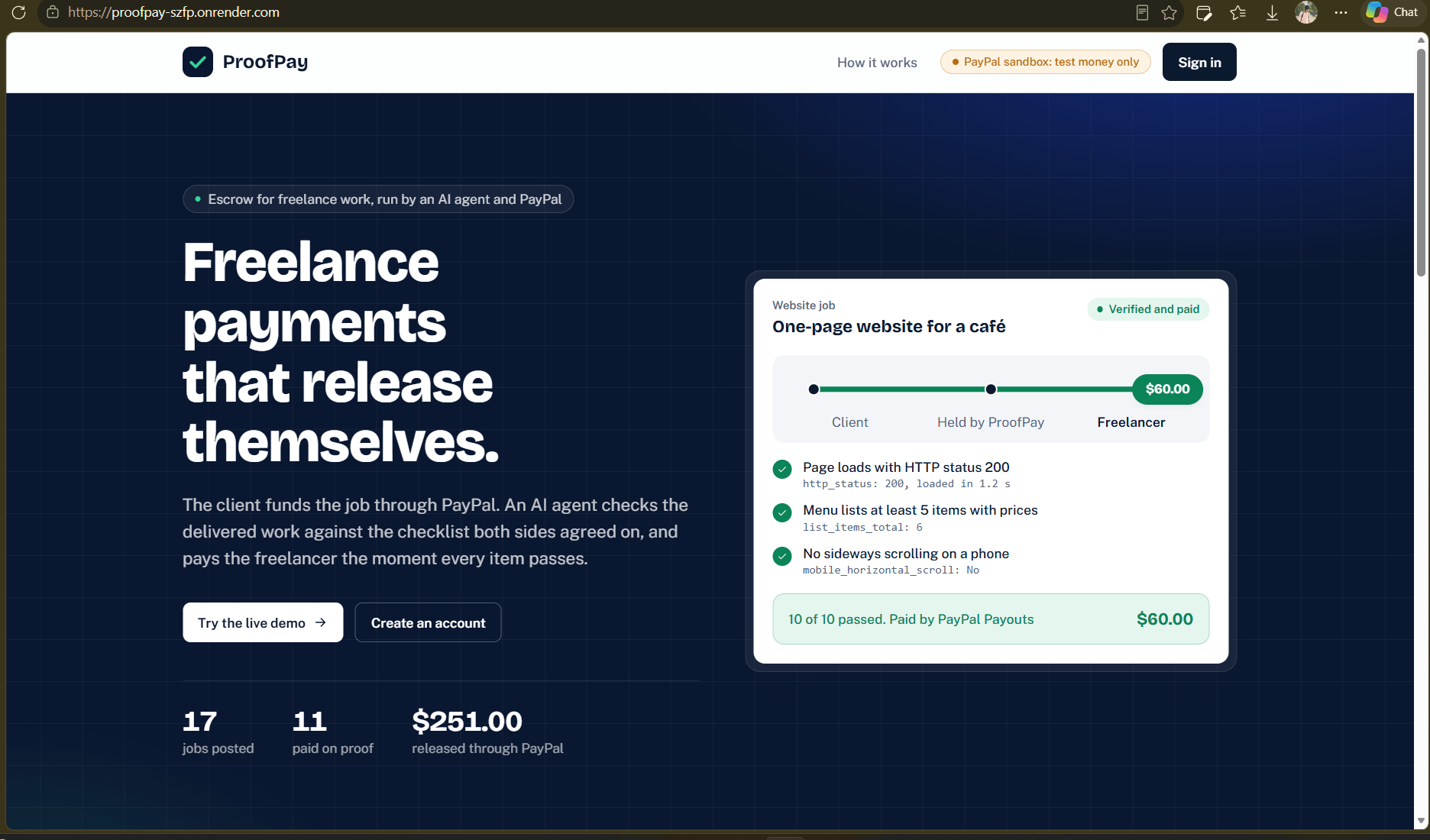
ProofPay is an escrow where the release condition is proof, not a promise.
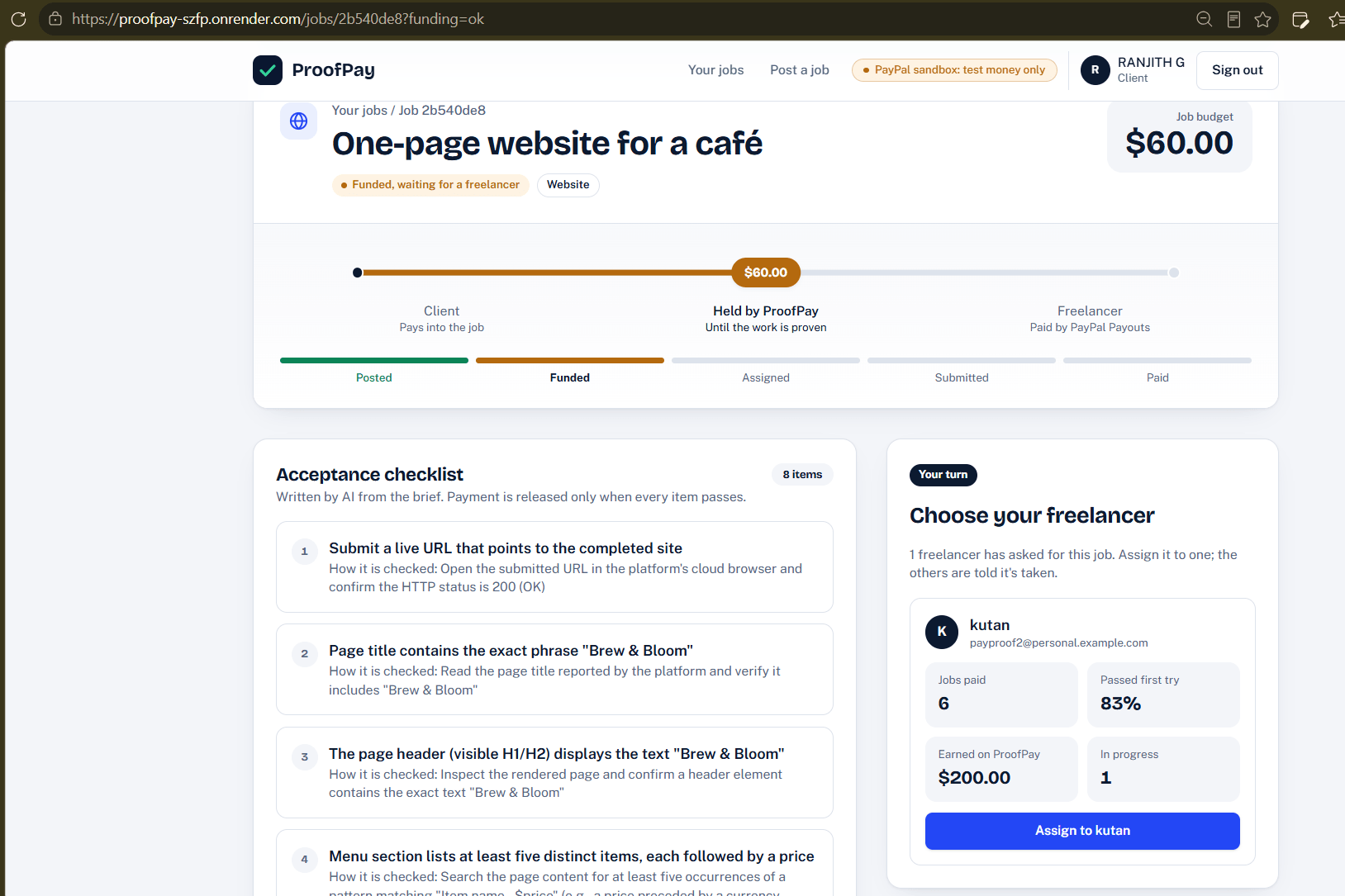
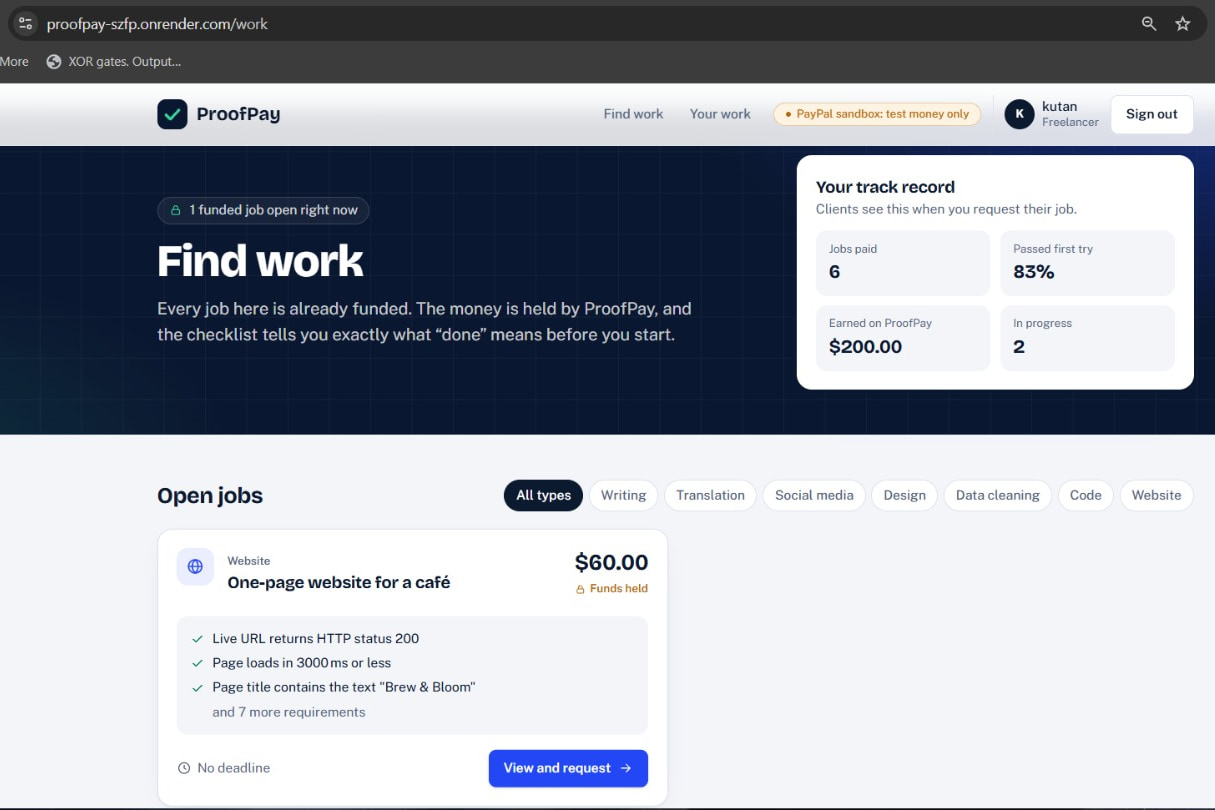
- Post and fund. A client picks a job type (website, copywriting, social media, logo, spreadsheet cleaning, code, translation) and describes the work. An AI brief coach flags requirements no one could objectively check and suggests a fair budget. The AI turns the brief into a locked, numbered acceptance checklist. The client funds the job with PayPal, and the money is held.
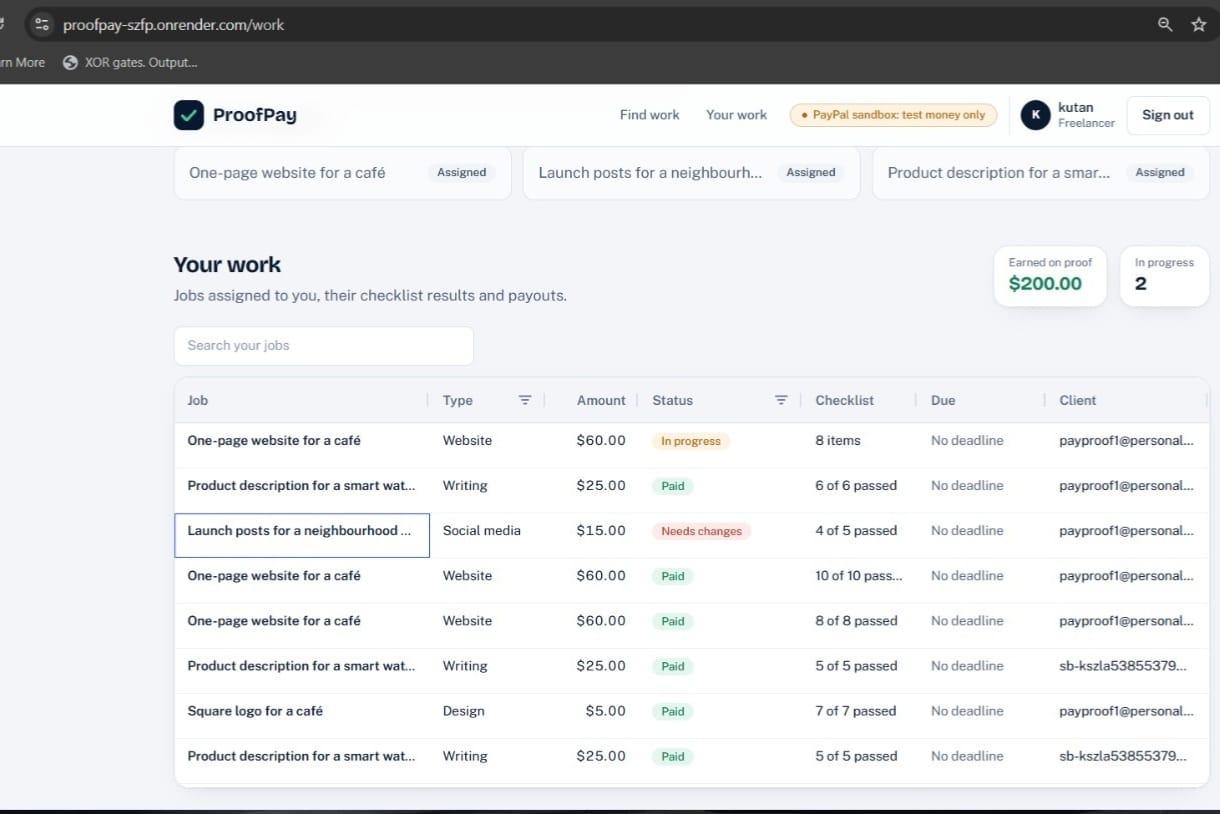
- Request and assign. Freelancers browse a board of funded jobs with the checklist visible up front and request the ones they want. The client sees each applicant's track record and assigns the job to one. From then on, only those two can open it.
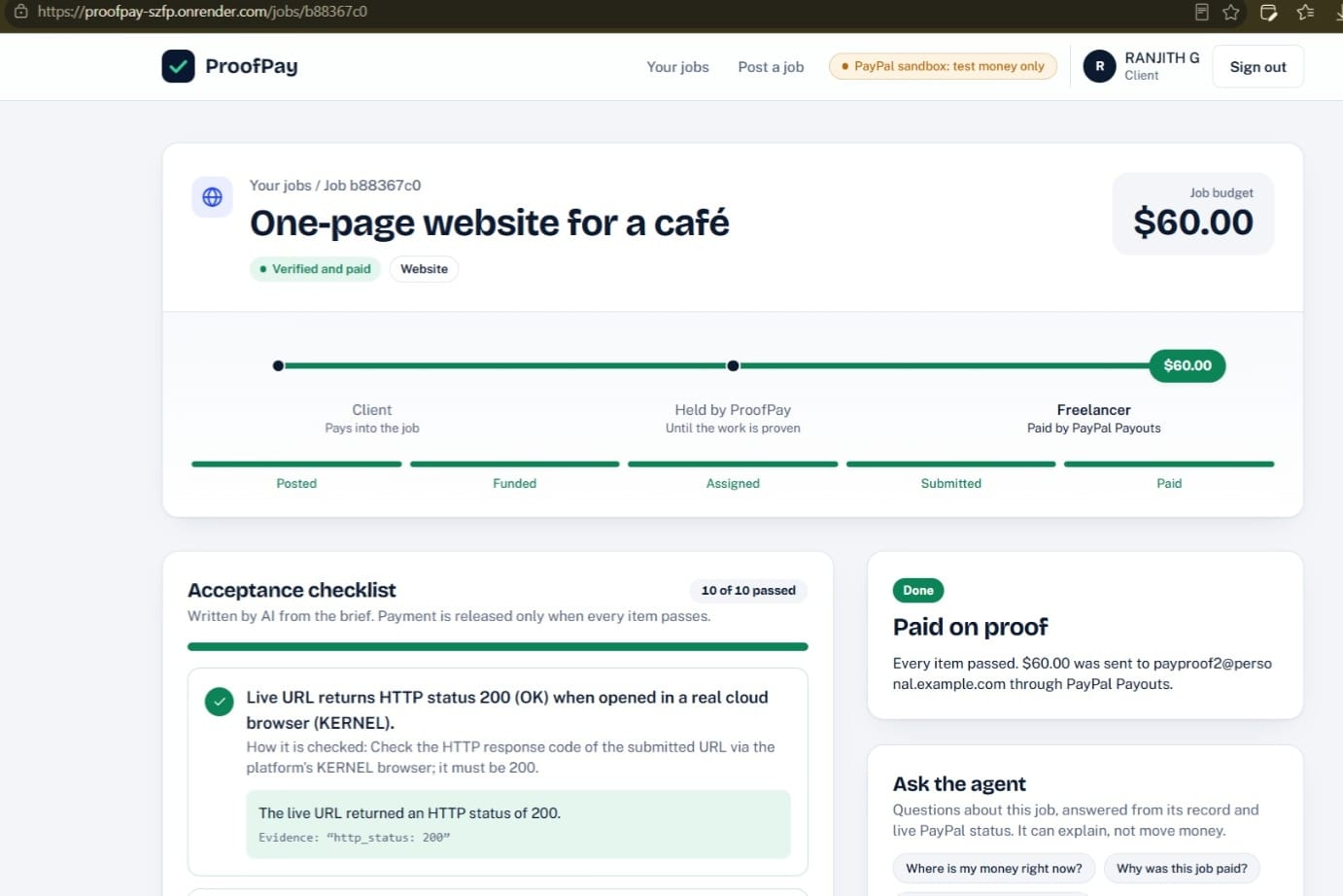
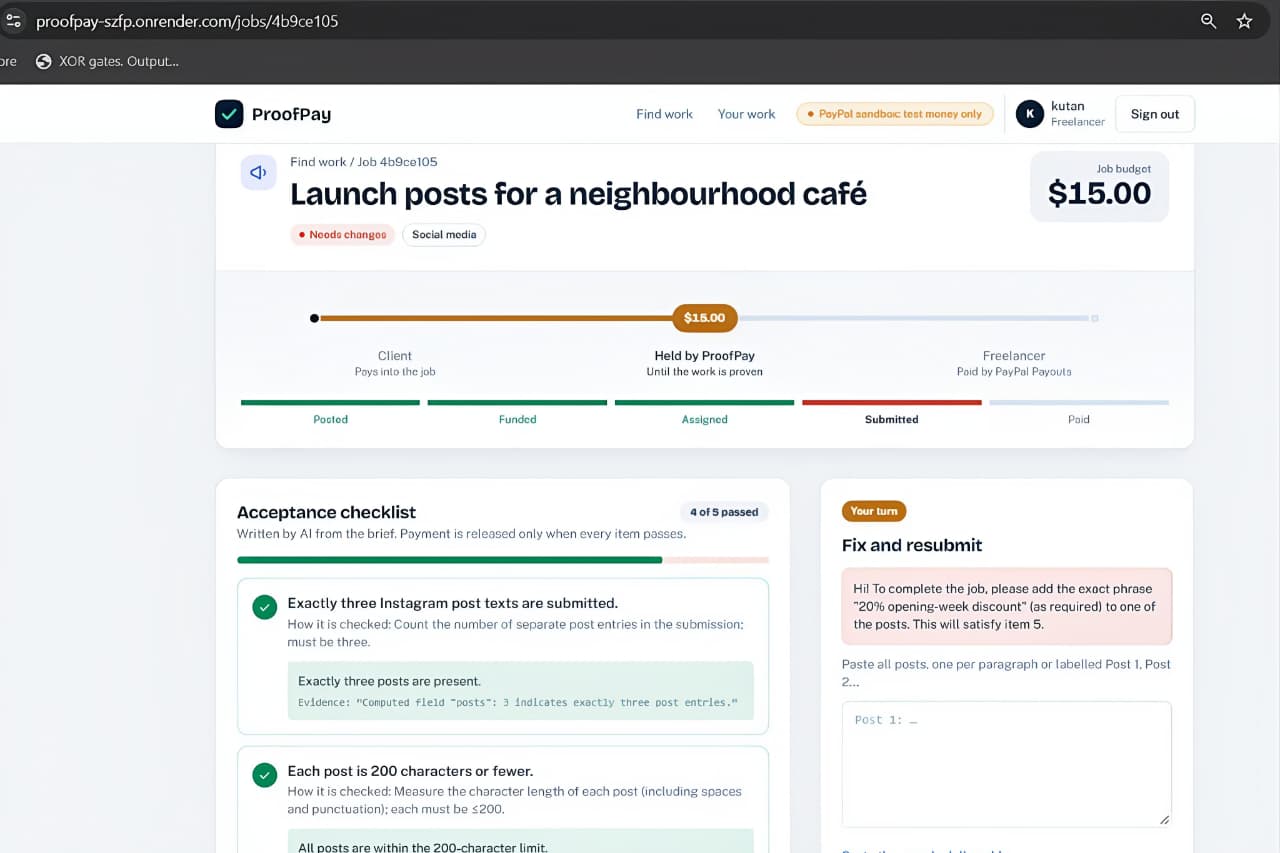
- Verify with evidence. On delivery, code measures the work exactly — word counts, image pixels, CSV rows and duplicates, functions and tests in code — and the AI checks every checklist item against those facts, with a reason and quoted evidence.
- Websites tested in a real browser. For website jobs, a KERNEL cloud browser opens the live site on desktop and mobile, measures status, load time, broken links, contact forms and sideways scrolling, and takes screenshots. Both sides see what the agent saw.
- Money moves itself. A settlement agent confirms the funds with the PayPal Agent Toolkit and pays the freelancer through PayPal Payouts — or sends the work back with exactly what to fix.
- A person has the last word. A freelancer who disagrees can request a second opinion from a different AI model; if it passes, the client decides.
- Everyone stays informed. Every money event — funded, requested, assigned, paid, changes needed, refunded — triggers a Zapier workflow that emails the right person.
- Ask the agent answers "Where is my money?" or "What do I still need to fix?" from the job record and live PayPal status.
How we built it
- Next.js + TypeScript on Render, Postgres on Neon
- PayPal Orders API (create, approve, capture), PayPal Agent Toolkit (
get_order,create_refund) inside our agents, PayPal Payouts API for freelancer payments — all in the PayPal sandbox - KERNEL cloud browsers driven with Playwright over CDP for desktop and mobile website checks with screenshots
- Zapier webhook → Gmail for notifications, fire-and-forget so email can never block a payment
- Vercel AI SDK for structured output and tool calling: checklist writer, brief coach, verifier, settlement agent (
verify_funding,release_payment,request_revision), independent second-opinion reviewer, and a read-only job assistant - Google Gemini as the main model, with automatic fallback across models and providers (Groq, Claude) so a busy model never blocks a payment
- AG Grid dashboards for clients and freelancers; scrypt-hashed passwords and signed sessions
Challenges we ran into
- Trusting AI with money. Every hard rule lives in code, not in the prompt: no payout without a full pass (recomputed from item results), no payout without confirmed funds, one payout per job, a spend cap, role checks on every action, and instructions hidden inside submissions are ignored.
- LLMs can't count. Early tests estimated "approximately 535 words." We now measure everything in code — and for websites, in a real browser — and hand the AI facts. Evidence cites real numbers, pixel sizes and HTTP codes.
- Model availability. The newest model was overloaded during development and one request hung for five minutes. We added timeouts, cross-provider fallback and a rule-based settlement path.
- "What if the AI is wrong?" An independent second opinion, with the client as final decision-maker, means the AI never has the last word against a person.
Accomplishments that we're proud of
- A complete money loop on a live URL for seven kinds of work — post, coach, fund, request, assign, deliver, verify, pay, dispute, refund — with real PayPal sandbox transactions and reference IDs.
- A website verified end to end in a real cloud browser and paid automatically: 10 of 10 checks passed, $60 released through PayPal Payouts.
- Verdicts that show their working: every item has a reason, evidence, exact measurements and, for websites, screenshots.
- Agents that are autonomous but cannot pay out wrongly, because their tools enforce the rules.
What we learned
- Agentic commerce works best when the agent's tools carry the guardrails, not its instructions.
- Objective acceptance criteria agreed before work starts remove most disputes — and AI can help clients write them.
- Giving an agent real eyes (a browser) turns "looks fine" into evidence.
What's next for ProofPay
- PayPal multiparty onboarding for true held funds, and Log in with PayPal for verified identities
- Milestone jobs with partial payouts
- Running code submissions against the client's tests in a sandbox; clicking through multi-page sites with KERNEL
- PayPal webhooks for real-time sync; Slack and WhatsApp alerts through the same Zapier event
Built With
- ag-grid
- gmail
- google-gemini
- groq
- kernel
- neon
- next.js
- node.js
- paypal
- paypal-agent-toolkit
- paypal-payouts
- playwright
- postgresql
- react
- render
- tailwindcss
- typescript
- vercel-ai-sdk
- zapier


