-
-
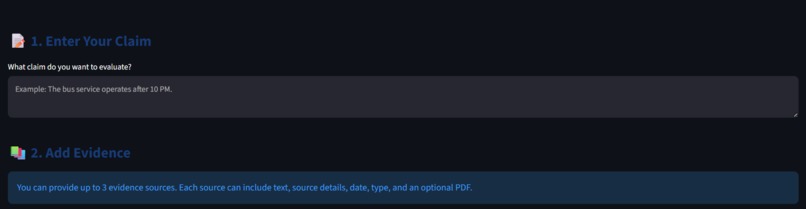
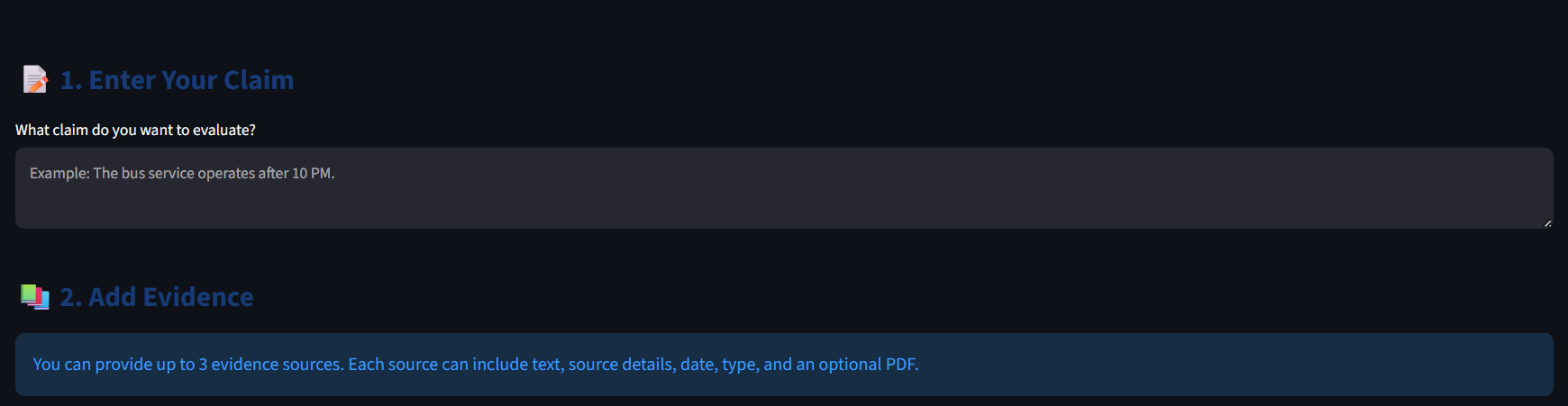
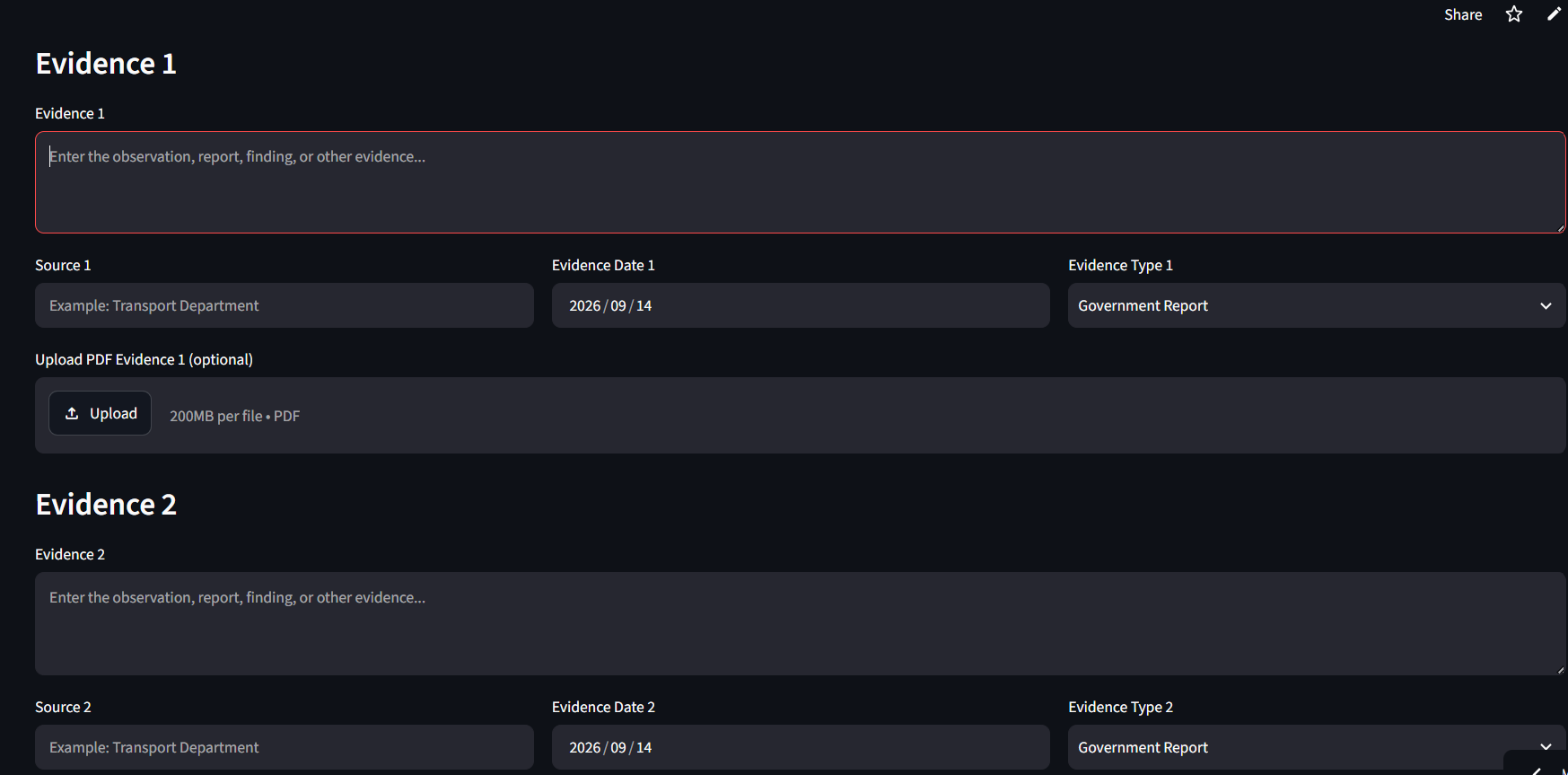
Users can enter a real-world claim and prepare multiple evidence sources with relevant source details and supporting information.
-
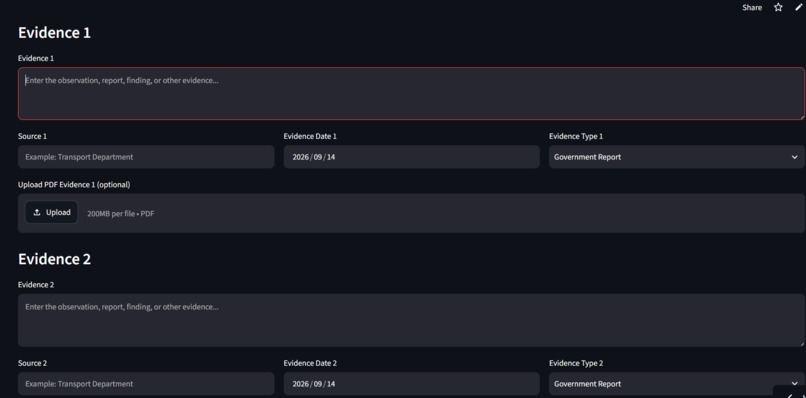
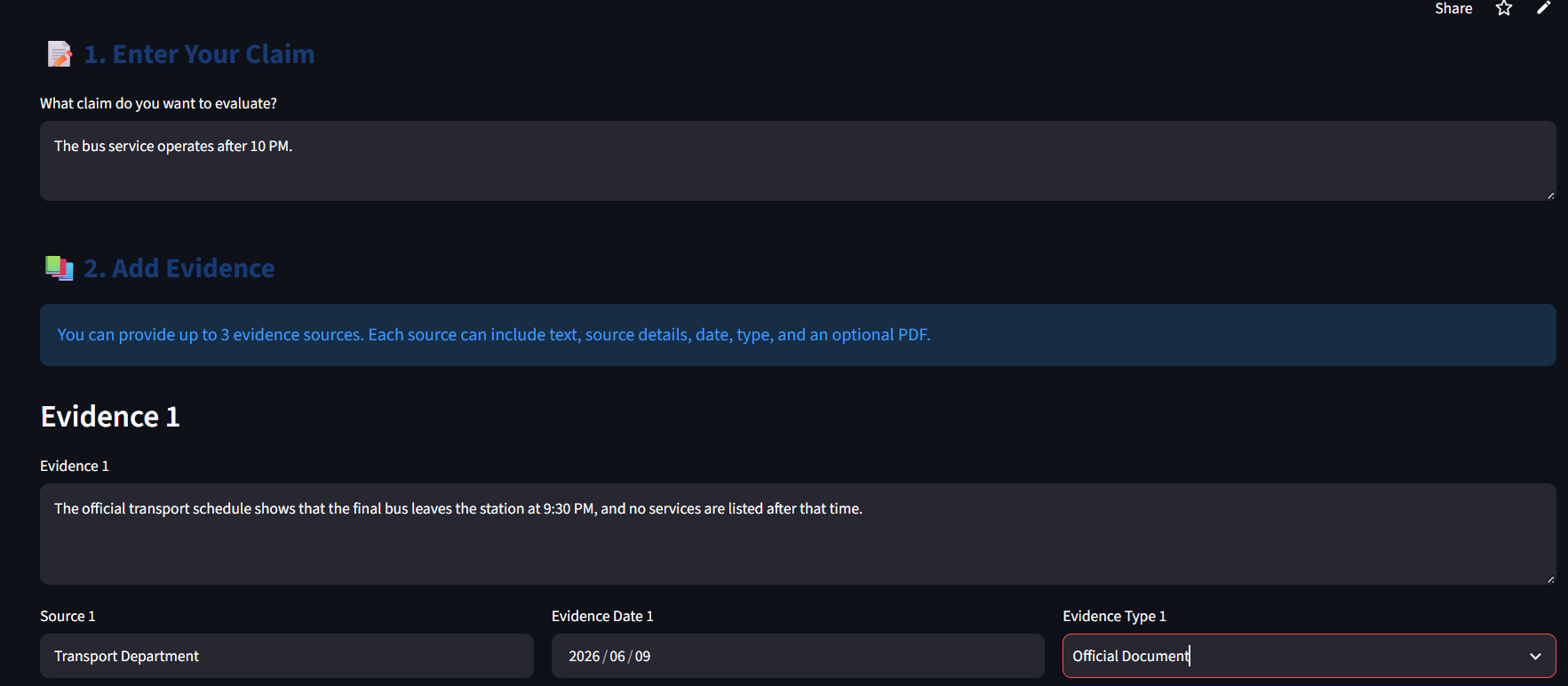
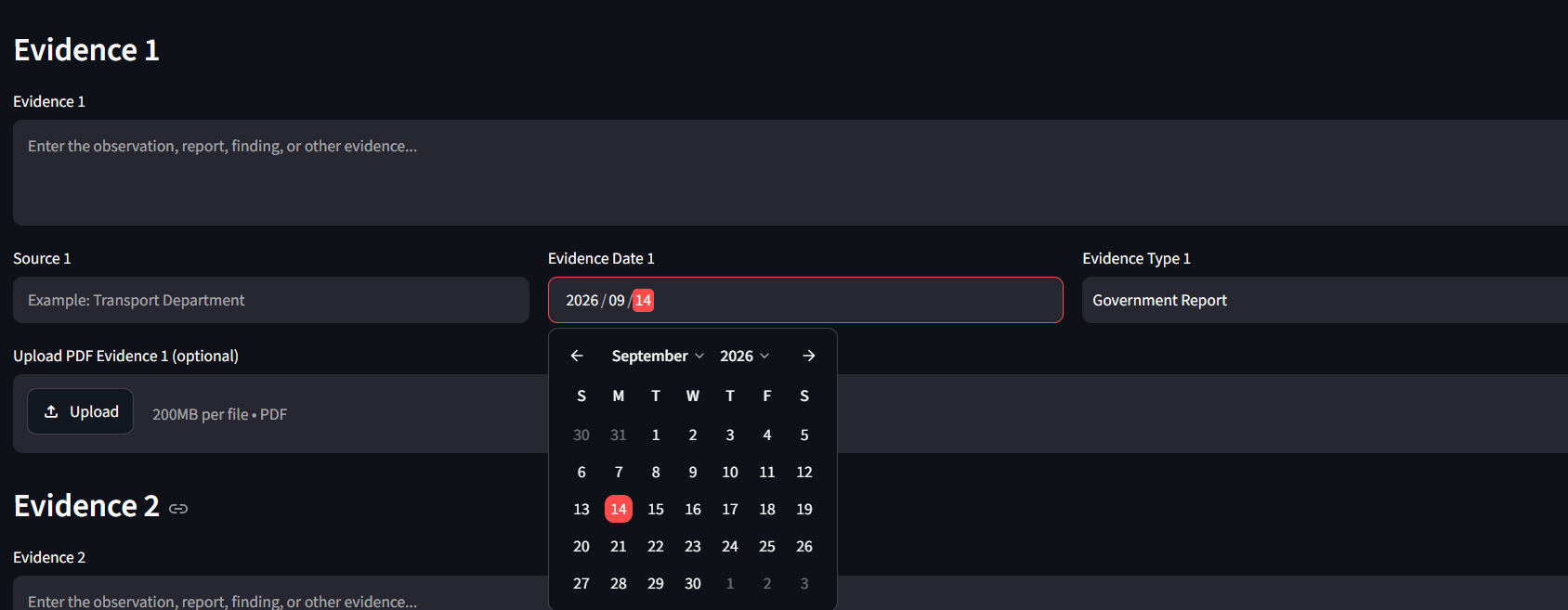
Users can provide detailed evidence along with its source, date, type, and optional PDF documentation for analysis.
-
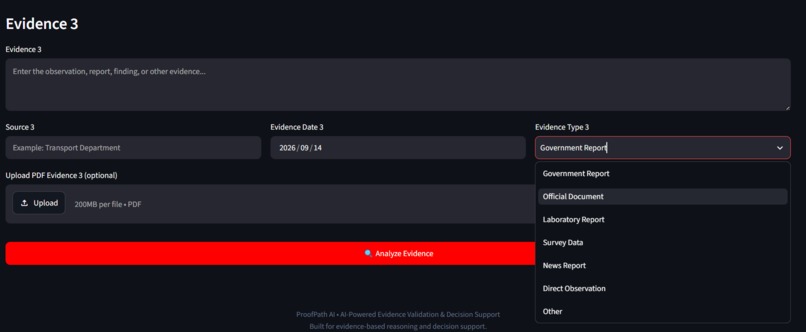
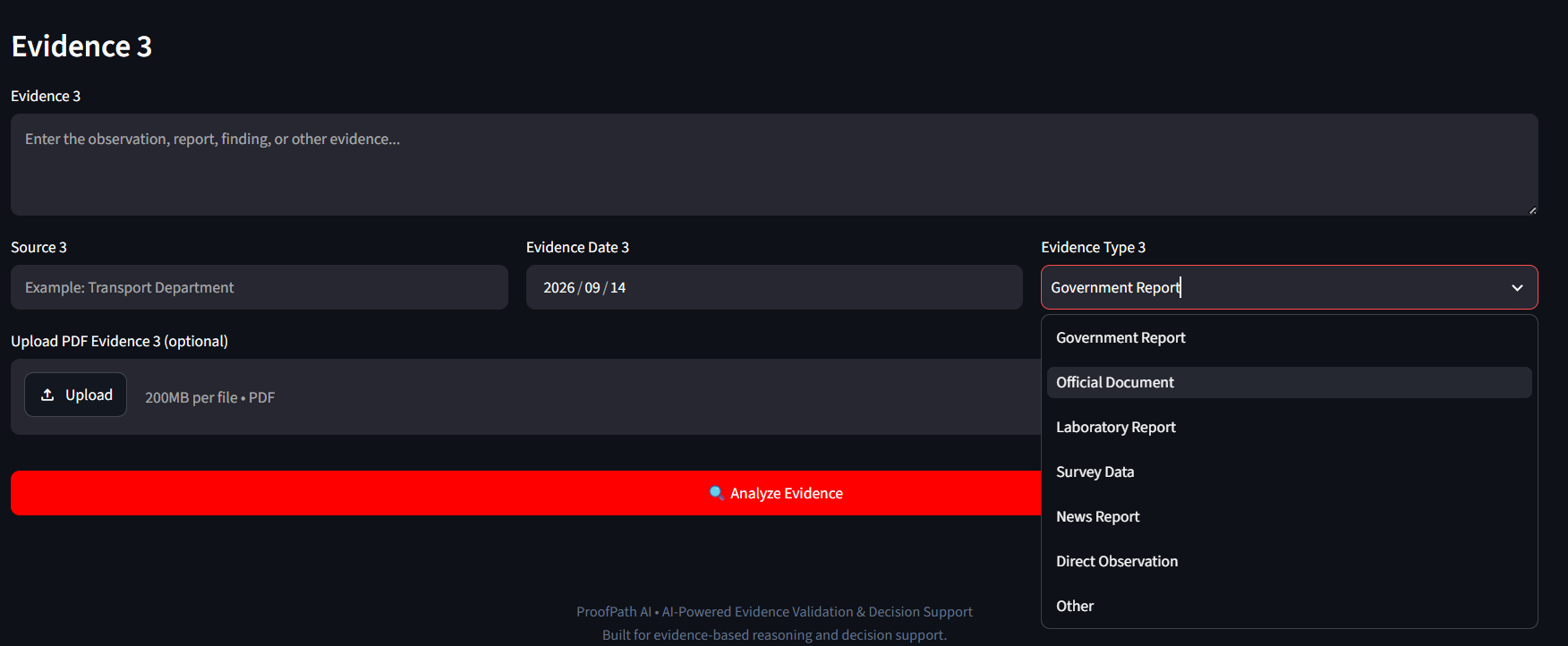
The system supports different evidence types and allows users to analyze the collected information to evaluate the claim.
-
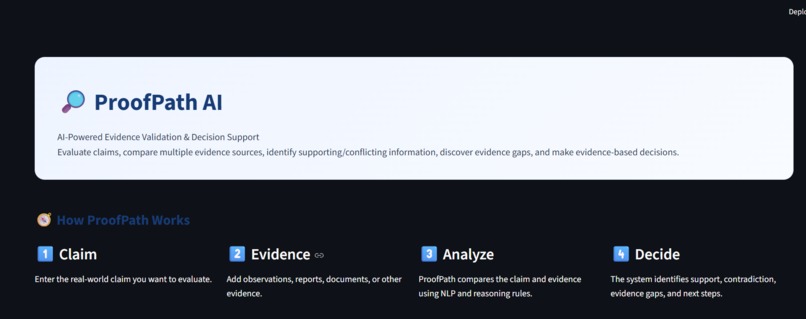
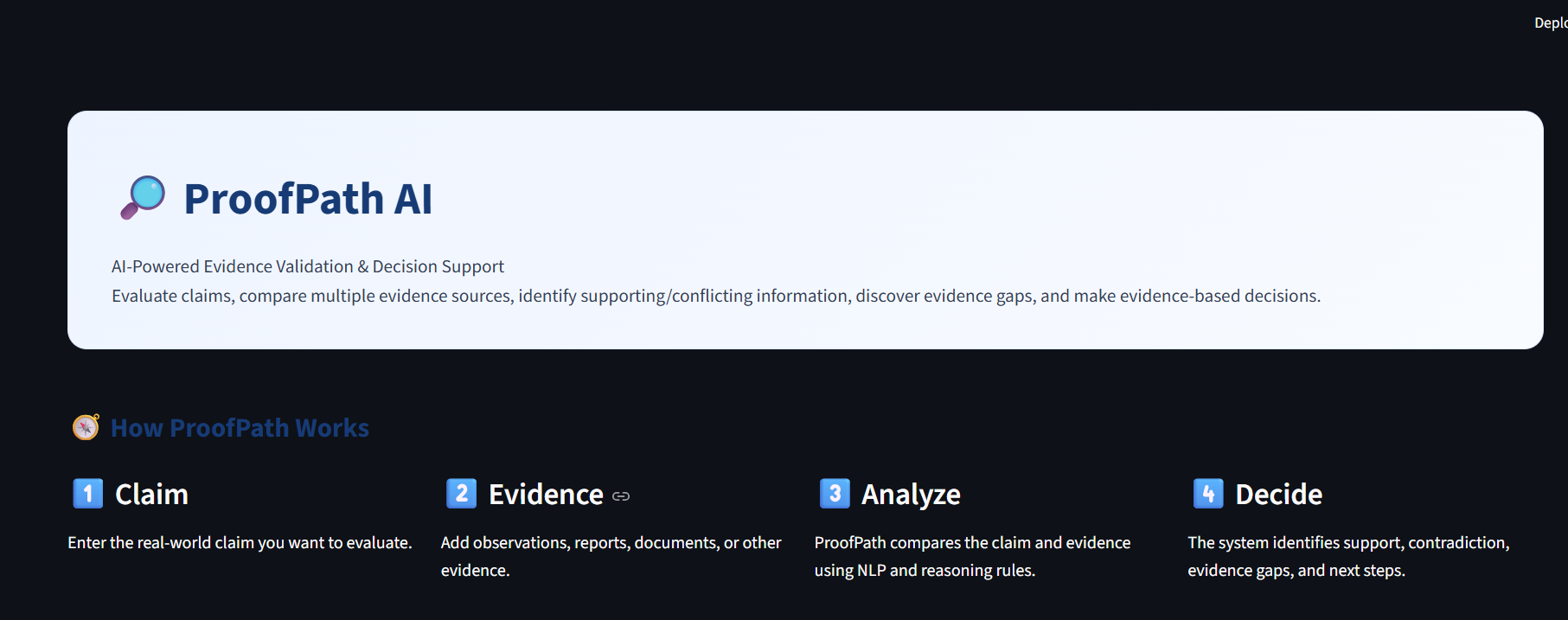
ProofPath AI introduces the evidence-validation workflow, showing how claims are evaluated through evidence analysis and decision support.
-
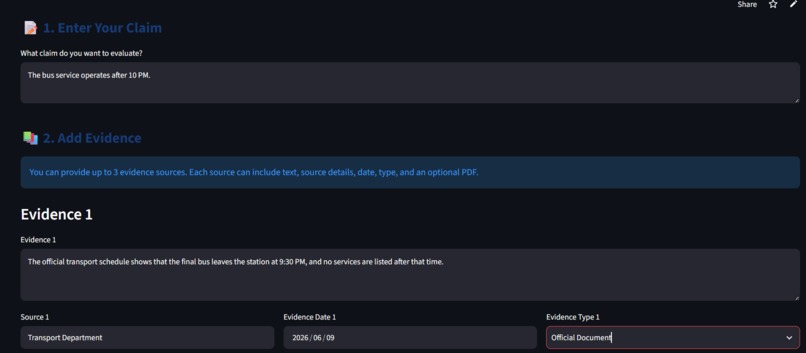
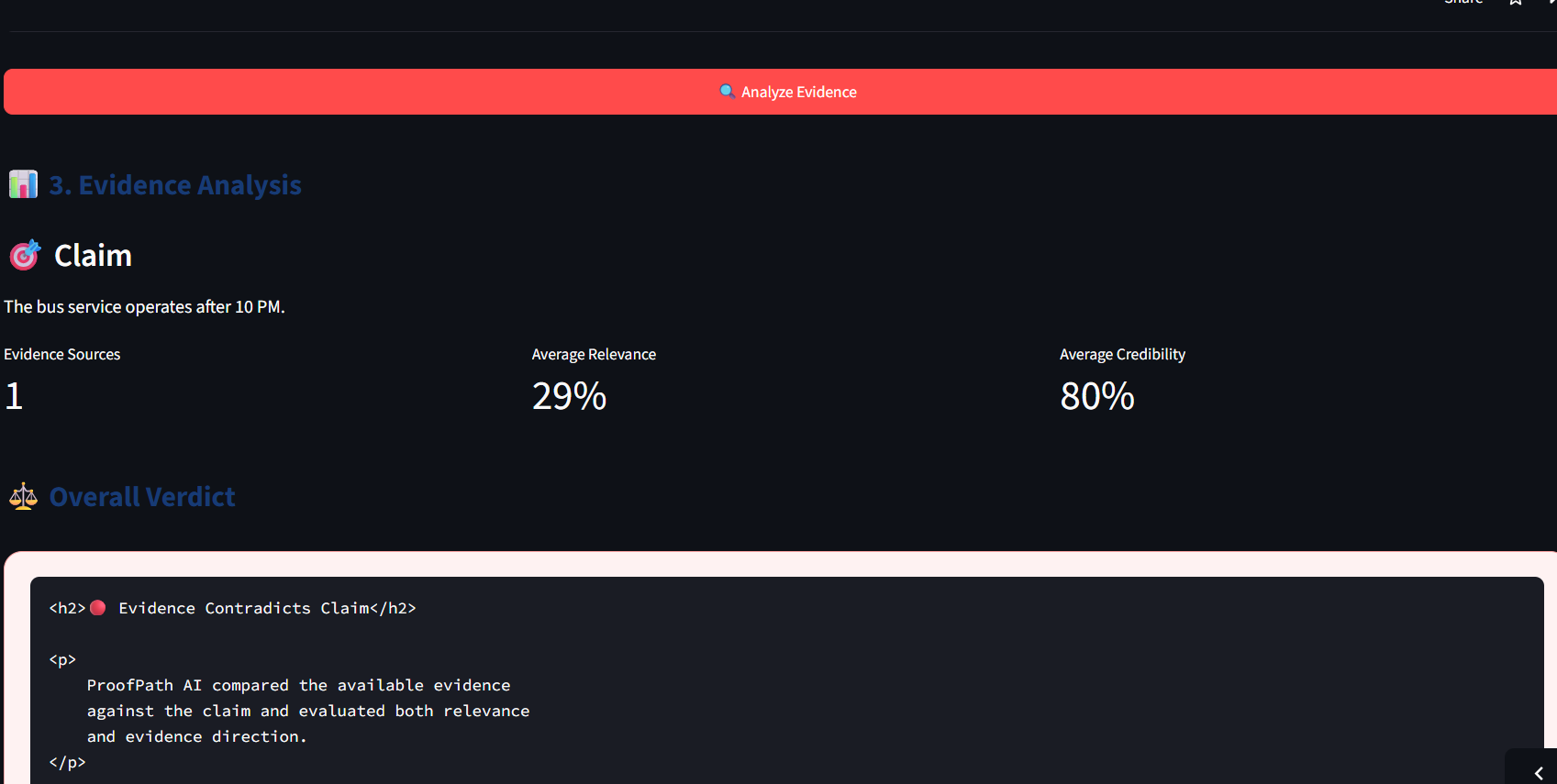
A real-world claim is compared with official transport schedule to determine whether the available evidence supports or contradicts claim.
-
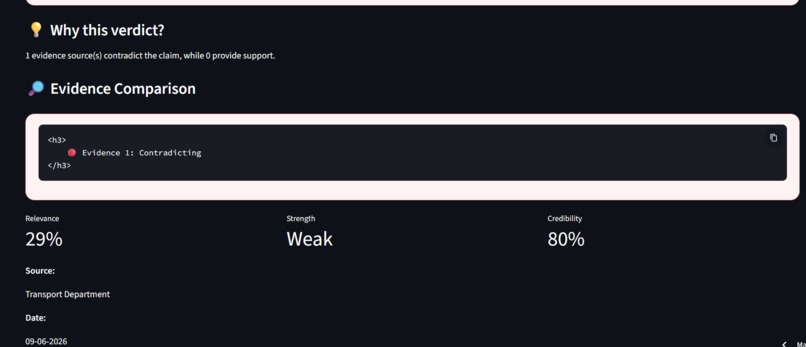
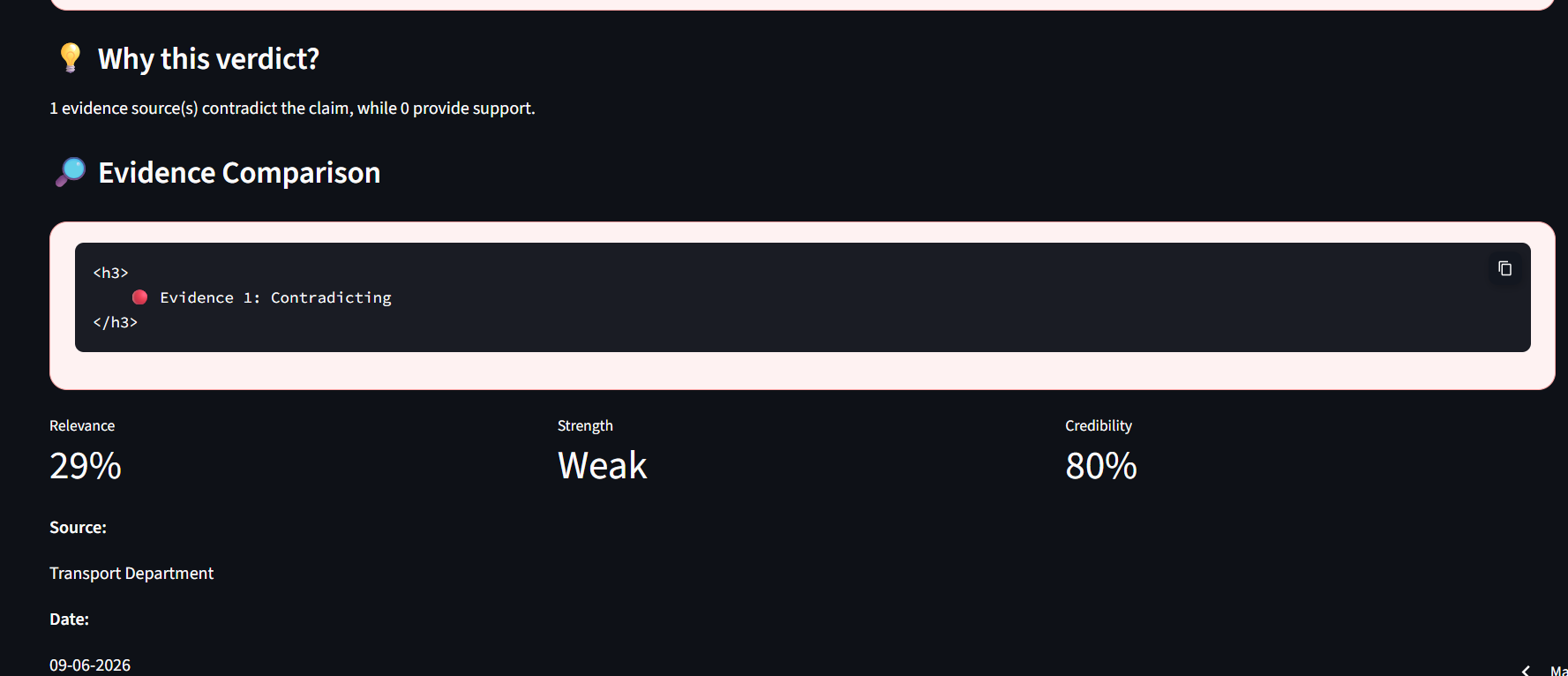
The evidence comparison explains why verdict was reached and shows the evidence direction, relevance, strength, credibility, source, date.
-
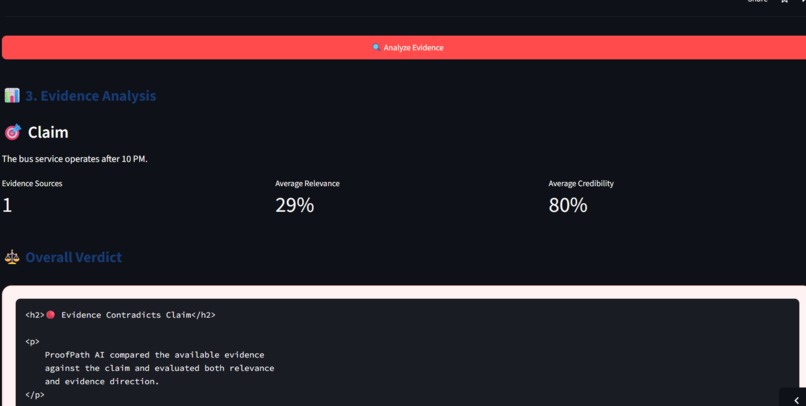
ProofPath AI analyzes the submitted evidence and presents its overall verdict along with relevance and credibility scores.
-
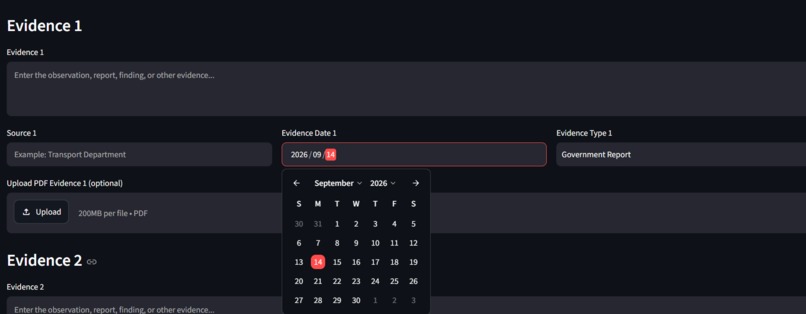
Users can select the evidence date, choose the evidence type, provide source details, and optionally upload a supporting PDF document.
-
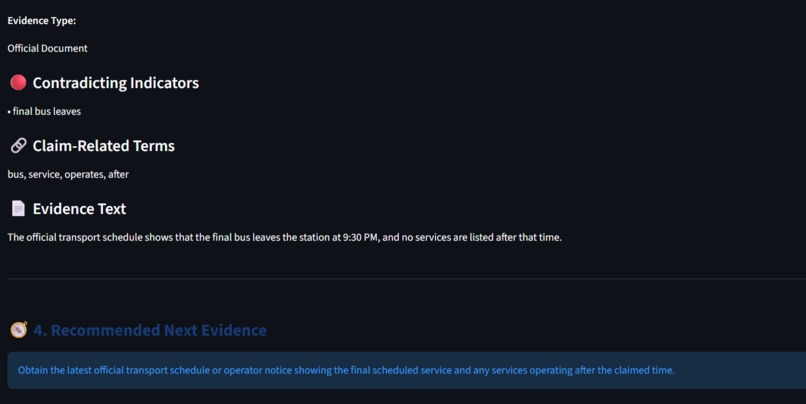
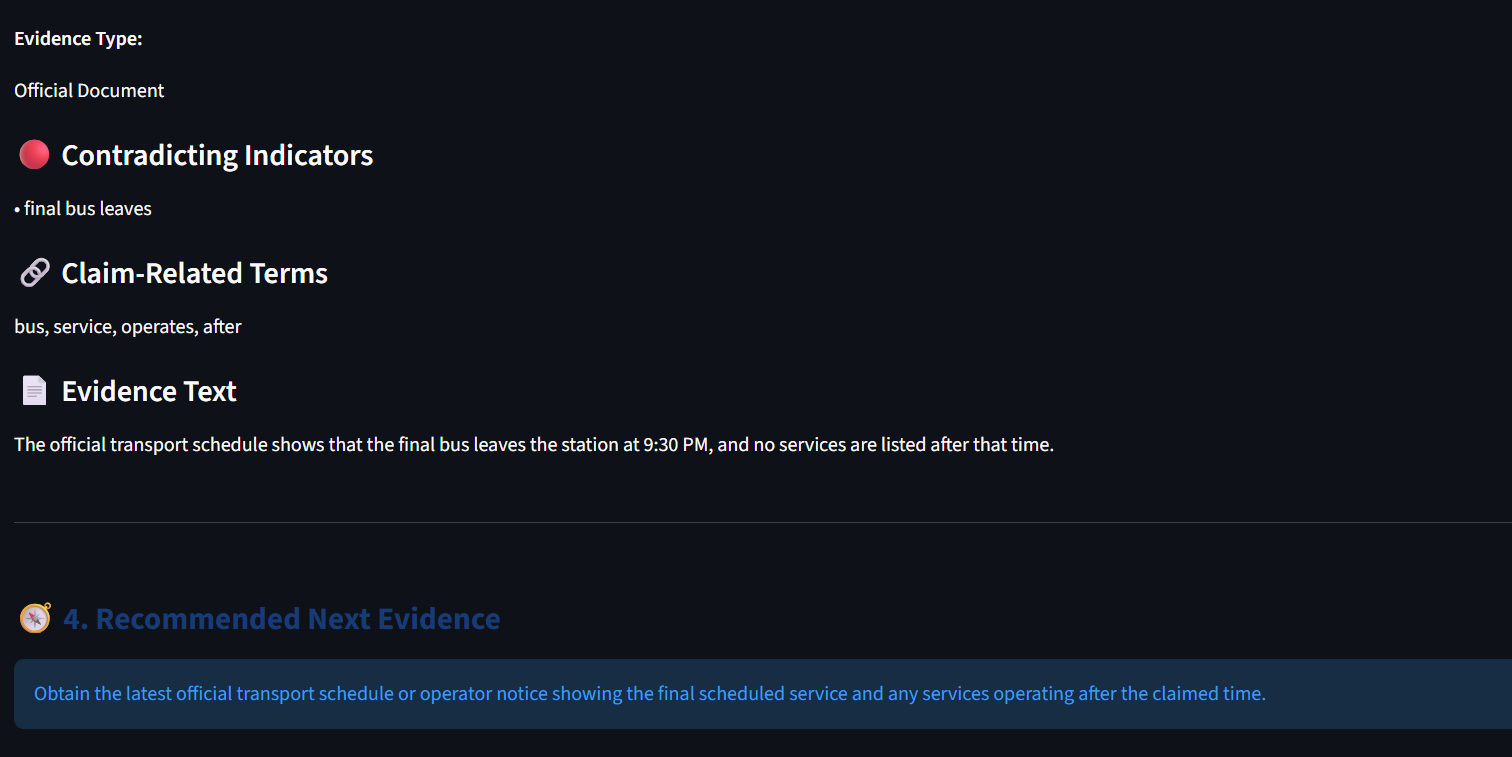
ProofPath AI highlights the specific contradicting indicator,recommends additional evidence that can be collected for further verification.
-

The system recommends the next evidence needed for stronger verification,provides option to download the completeevidence validationreport.
-
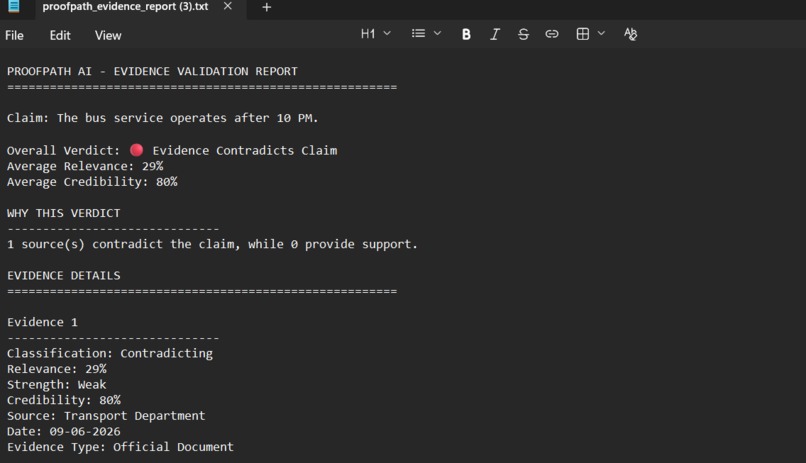
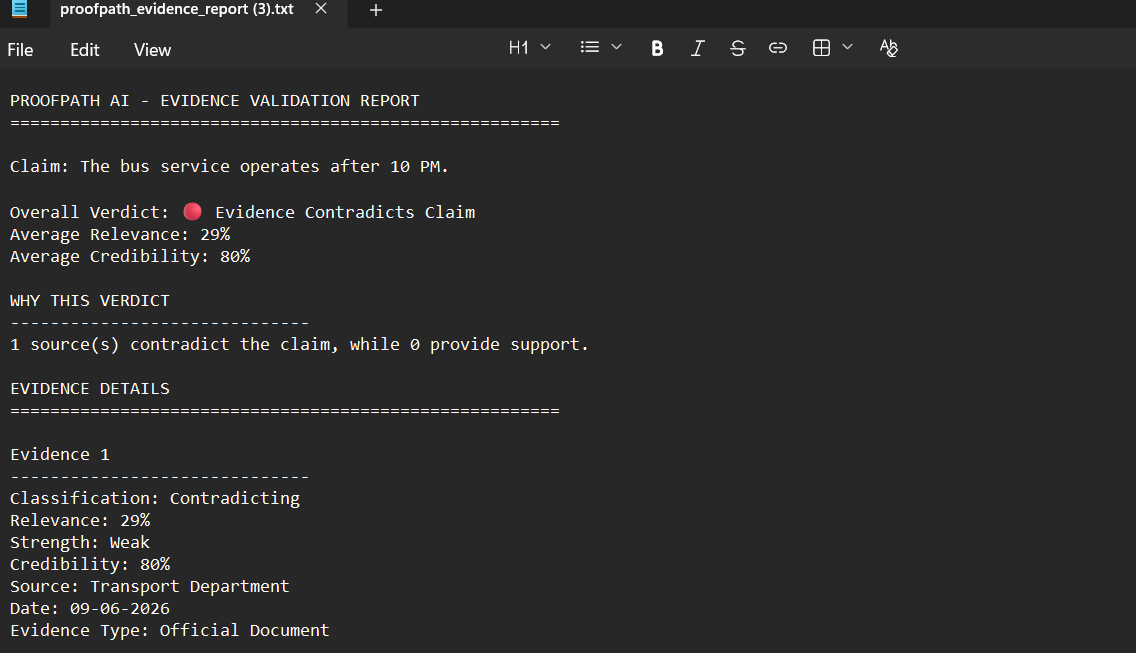
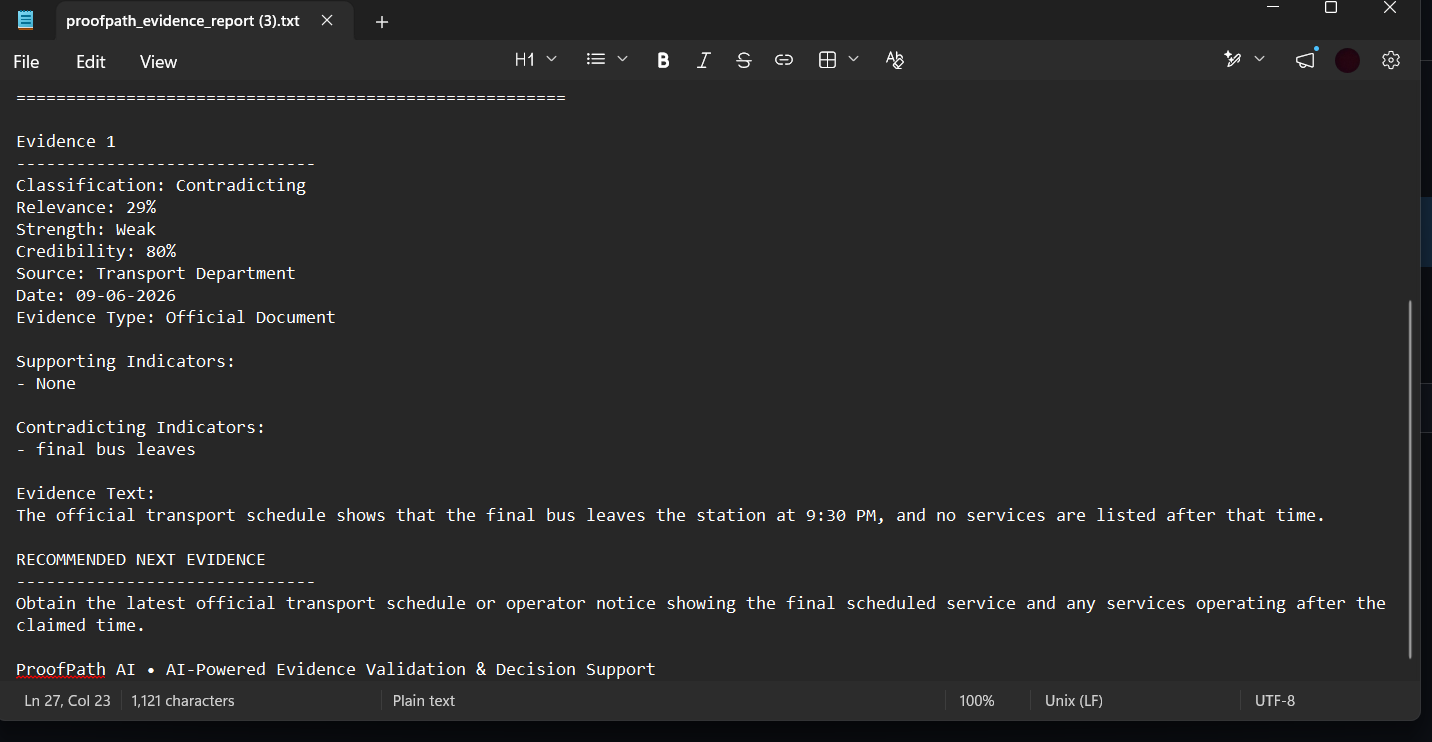
The exported evidence report summarizes the claim, overall verdict, relevance, credibility,detailed classification of the analyzed evidence.
-
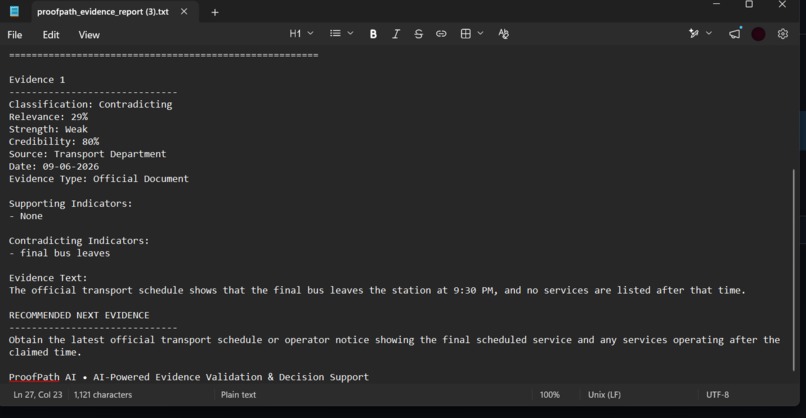
The report includes supporting,contradicting indicators, the original evidence text, and recommended next evidence for further verification.

Inspiration
Real-world claims are often evaluated using incomplete, conflicting, or weak information. We wanted to build a tool that focuses on the evidence behind a claim, rather than simply giving a True or False answer.
The idea behind ProofPath AI came from a simple question:
What if a system could show what evidence supports a claim, what contradicts it, what is missing, and what should be verified next?
This led us to build an evidence-first decision-support system.
What it does
ProofPath AI is an AI-powered evidence validation and decision-support application.
Users enter a claim and provide up to three pieces of evidence. Each evidence item can include its source, date, evidence type, and evidence text. PDF documents can also be uploaded and their text extracted for analysis.
ProofPath AI:
- Compares claims with evidence using NLP.
- Measures evidence relevance.
- Identifies supporting and contradicting indicators.
- Detects conflicting evidence.
- Identifies insufficient evidence.
- Estimates evidence strength.
- Evaluates source credibility.
- Compares multiple evidence sources.
- Identifies missing evidence.
- Recommends what evidence should be collected next.
- Generates a downloadable evidence report.
Instead of only answering “Is this claim true?”, ProofPath AI helps users understand why the available evidence supports, contradicts, or fails to sufficiently establish a claim.
How we built it
We built ProofPath AI using Python and Streamlit.
For NLP-based analysis, we use:
- TF-IDF to represent claim and evidence text.
- Cosine similarity to measure their textual relationship.
- Rule-based reasoning to identify supporting and contradicting indicators.
- Topic-specific reasoning for different types of claims.
- A credibility scoring system based on evidence type and source information.
We also integrated pypdf to extract text from uploaded PDF evidence.
The application combines these components into a single workflow:
Claim → Evidence → NLP Analysis → Evidence Verdict → Decision Support
The prototype runs locally and does not require a paid external AI API.
Challenges we ran into
One of our biggest challenges was handling evidence that does not simply fall into a binary True or False category.
Evidence can support a claim, contradict it, contain conflicting indicators, or be related to the claim without providing enough information to establish it.
We therefore designed ProofPath AI to distinguish between different evidence outcomes instead of forcing every input into a simple binary decision.
Another challenge was making the analysis understandable to users. We wanted users to see not only the final verdict, but also the relevance, strength, credibility, indicators, missing evidence, and recommended next steps.
Accomplishments that we're proud of
We are proud of building a complete working prototype that brings several evidence-analysis capabilities together in one application.
Some of the key accomplishments are:
- Built a functional interactive Streamlit application.
- Implemented claim-evidence NLP similarity analysis.
- Added supporting and contradicting evidence detection.
- Added conflicting and insufficient evidence handling.
- Added evidence strength evaluation.
- Added source credibility scoring.
- Added PDF evidence extraction.
- Added evidence comparison across multiple sources.
- Added missing-evidence identification.
- Added recommended next evidence.
- Added downloadable evidence reports.
- Designed a structured interface for explaining the reasoning behind the result.
Most importantly, ProofPath AI moves beyond simply producing an answer and focuses on making the reasoning from available evidence visible to the user.
What we learned
We learned that building an evidence-based AI system requires more than measuring text similarity.
A useful decision-support system needs to consider:
- How relevant the evidence is.
- Whether it supports or contradicts the claim.
- Whether multiple sources agree.
- How credible the source appears.
- What information is missing.
- How confident a conclusion should be based on the available evidence.
We also learned how NLP techniques and transparent rule-based reasoning can work together to create a practical and explainable prototype.
What's next for ProofPath AI
We want to expand ProofPath AI into a more advanced evidence-verification platform.
Future improvements include:
- Multilingual evidence analysis.
- Tamil and Tanglish support.
- More advanced NLP models.
- Automated trusted-source verification.
- Real-time evidence retrieval.
- Improved contradiction detection.
- More sophisticated source reliability analysis.
- Timeline-based evidence comparison.
- Evidence relationship visualization.
- More advanced decision-support analytics.
The long-term goal is to make ProofPath AI a system that helps people move from:
Claim → Evidence → Understanding → Better Decision
Built With
- cosine-similarity
- explainable-ai
- git
- github
- machine-learning
- natural-language-processing
- python
- scikit-learn
- streamlit
- tf-idf

Log in or sign up for Devpost to join the conversation.