-
-
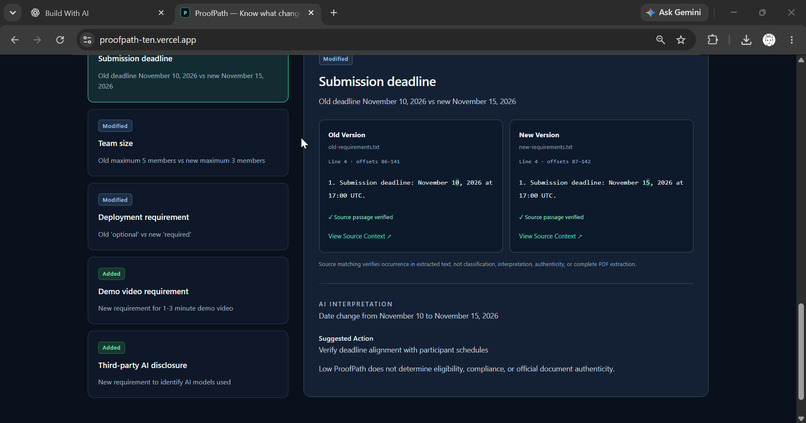
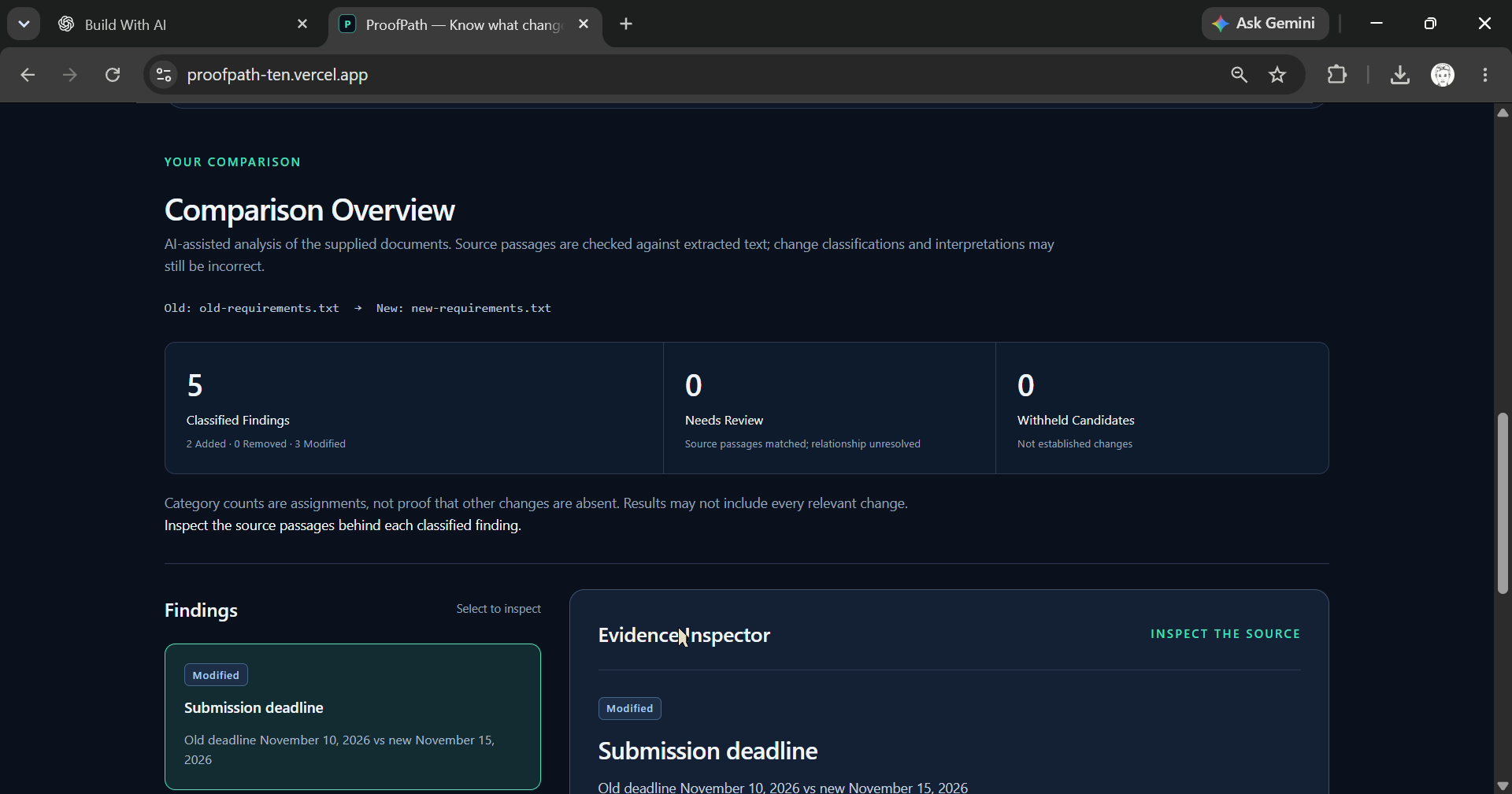
Evidence Inspector
-
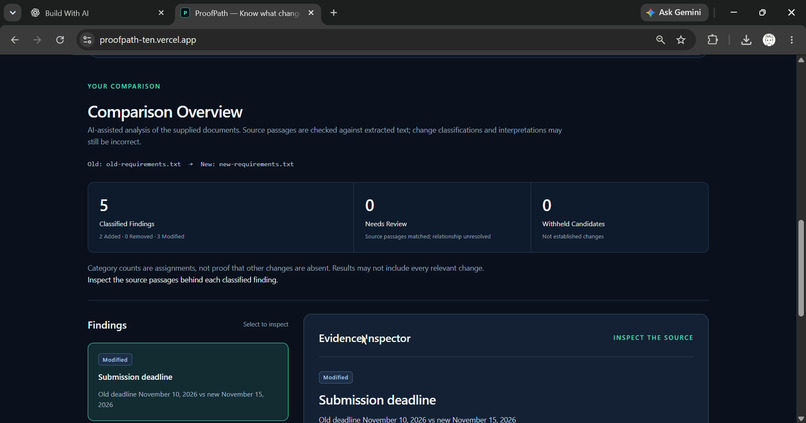
Comparison Overview
-
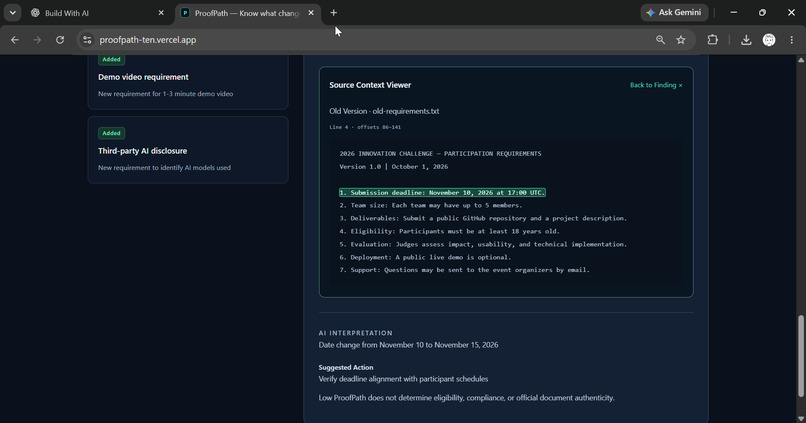
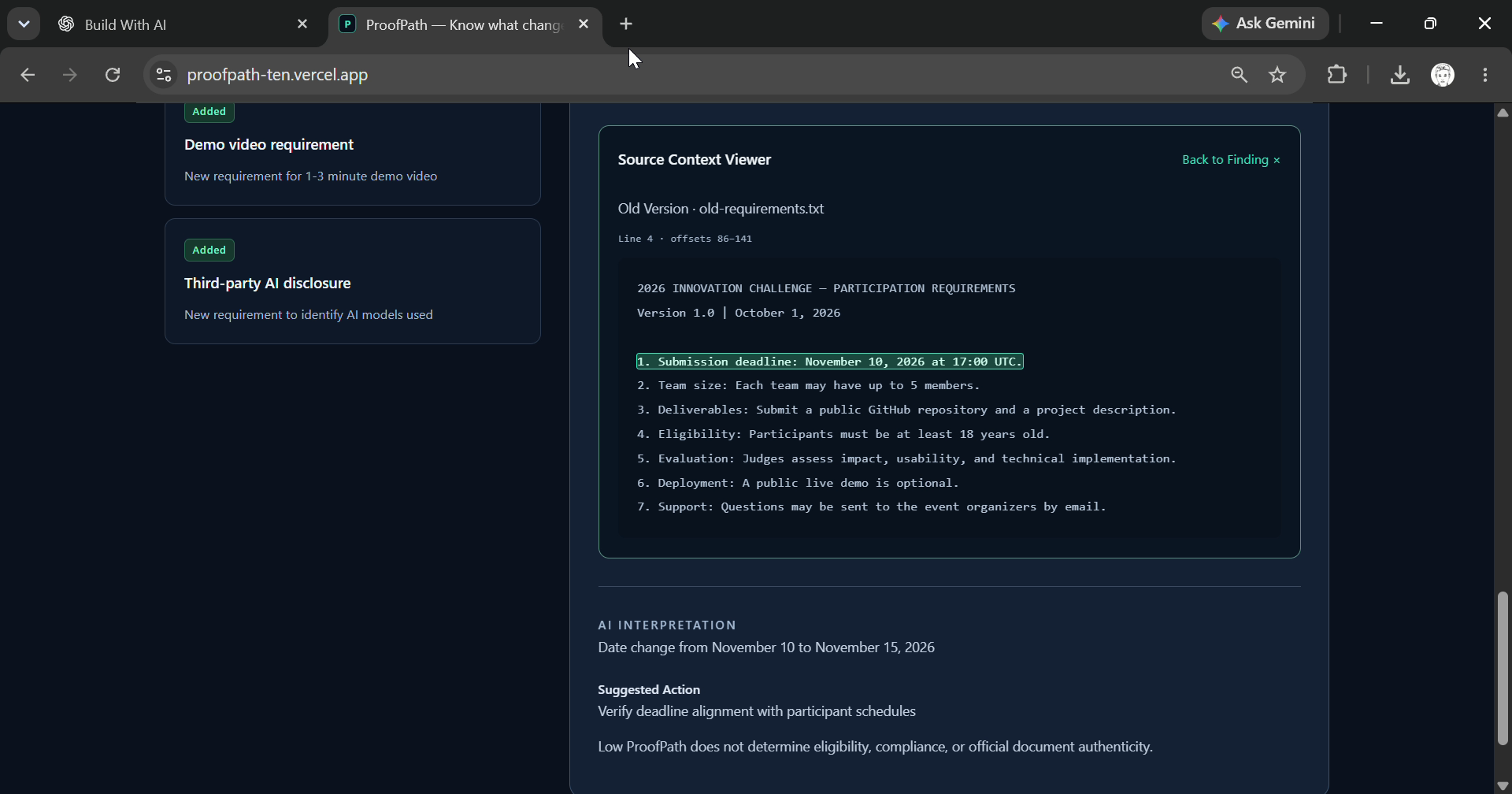
Source Context Viewer
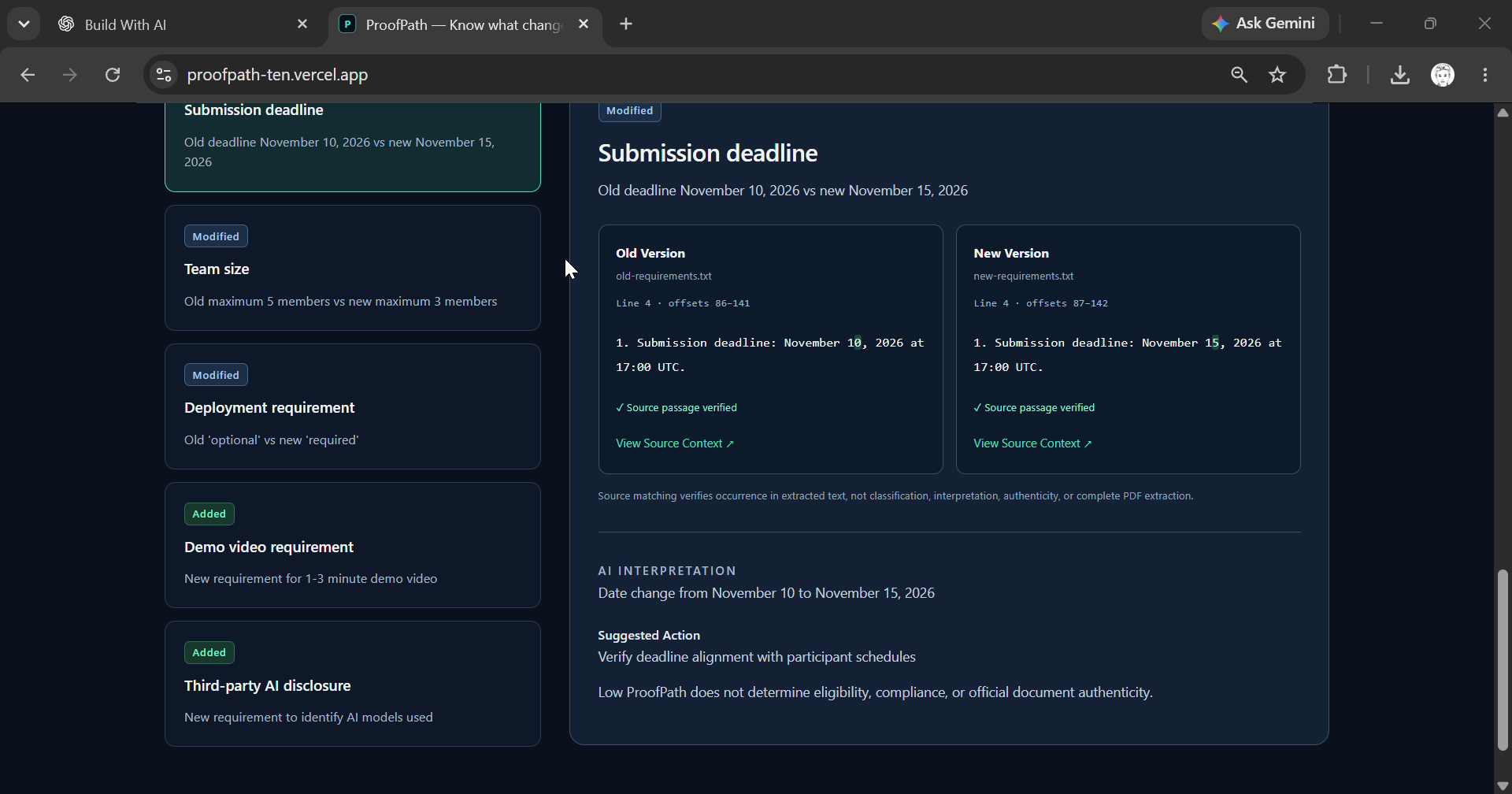
ProofPath — Know What Changed. See the Proof.
Inspiration
Important decisions often depend on documents that change over time: hackathon rules, contracts, policies, compliance requirements, and application guidelines.
The problem is not simply identifying that two documents are different. It is understanding what changed, why it matters, and where the evidence comes from.
Traditional document comparison tools highlight textual differences, while AI assistants can produce convincing summaries without clearly connecting their conclusions to the original source.
We built ProofPath to bridge that gap: an AI-assisted document comparison tool where users can inspect the evidence behind every finding.
What it does
ProofPath compares two versions of a document and helps users identify meaningful changes.
Users upload an old version and a new version in TXT, Markdown, or text-based PDF format. ProofPath extracts the text, runs a live AI-assisted comparison, and organizes the findings into categories such as:
- Added: Newly introduced requirements.
- Removed: Requirements identified as removed.
- Modified: Existing requirements that changed.
- Needs Review: Findings where the relationship between passages is uncertain.
Each finding includes supporting quotations from the source documents, allowing users to inspect the old and new wording directly.
The Evidence Inspector is the core experience. Instead of asking users to trust an AI-generated explanation, it lets them examine the passages supporting each finding and open their surrounding source context.
ProofPath also distinguishes verified source-text matches from AI interpretation. A quotation matching the uploaded document does not automatically mean the AI's conclusion is correct.
How we built it
We developed ProofPath as a public web application using Next.js, TypeScript, React, and Tailwind CSS.
For live AI analysis, the application integrates Cloudflare Workers AI, using the Qwen3-30B-A3B-FP8 model through a server-side API.
The document-processing pipeline uses PDF.js for text-based PDF extraction and Zod for structured validation.
The comparison workflow includes:
- Uploading and validating both documents.
- Extracting their text.
- Sending the comparison request to the AI model.
- Validating the structured response.
- Checking quoted evidence against the extracted source text.
- Presenting findings in the Evidence Inspector.
We deployed the application on Vercel so judges can test it directly without installing software or running a local server.
We also added server-side request protection using Vercel Firewall rate limiting.
During development, we used Codex as a coding agent to help implement, test, and refine the application. We maintained project planning and specification documents to guide the implementation and keep the scope manageable.
Challenges we ran into
One of the biggest challenges was making AI-generated findings more trustworthy.
A language model can produce plausible explanations while misunderstanding the relationship between two passages. For example, equivalent wording may be incorrectly classified as a removed or modified requirement.
We addressed this by validating source quotations, distinguishing uncertain findings, and making the original text accessible for human review.
Another challenge was delivering live AI functionality within a free infrastructure budget. We integrated Cloudflare Workers AI's free allocation, added request limits, and designed explicit error handling for temporary service or quota unavailability.
We also worked through PDF extraction, production deployment, and browser-based testing to ensure the public application was usable beyond the development environment.
Accomplishments that we're proud of
- Built and deployed a publicly accessible document comparison application.
- Integrated live AI analysis using Cloudflare Workers AI and Qwen3.
- Created an interactive Evidence Inspector with source quotations and context.
- Implemented structured validation and source-text verification.
- Supported TXT, Markdown, and text-based PDF uploads.
- Added request protection for the public AI endpoint.
- Built automated tests and validated the production build.
- Created a demonstration that shows real document comparison rather than relying exclusively on predefined sample results.
What we learned
We learned that building with AI is not only about connecting a model to an interface.
A useful AI application needs clear requirements, controlled inputs, validation, testing, deployment, and transparent communication of uncertainty.
Most importantly, evidence verification and interpretation are different things. A system can confirm that a quoted passage exists while still being wrong about what the passage means.
That distinction shaped ProofPath's design.
What's next for ProofPath
Future improvements could include:
- Better semantic comparison for paraphrased or equivalent requirements.
- More comprehensive evaluation against challenging document pairs.
- Improved handling of larger and more complex PDFs.
- Exportable evidence-backed comparison reports.
- More advanced navigation between related clauses.
- Additional document types and multilingual support.
Our long-term goal is to make AI-assisted document review more transparent, inspectable, and useful for real-world decisions.
ProofPath — Know what changed. See the proof.
Built With
- cloudflare-workers-ai
- codex
- github
- next.js
- node.js
- pdf.js
- qwen3
- react
- tailwind-css
- typescript
- vercel
- vercel-firewall
- zod

Log in or sign up for Devpost to join the conversation.