-
-
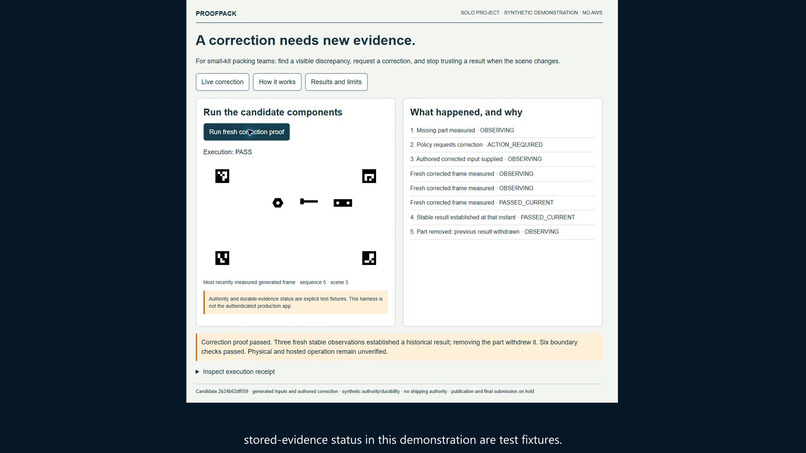
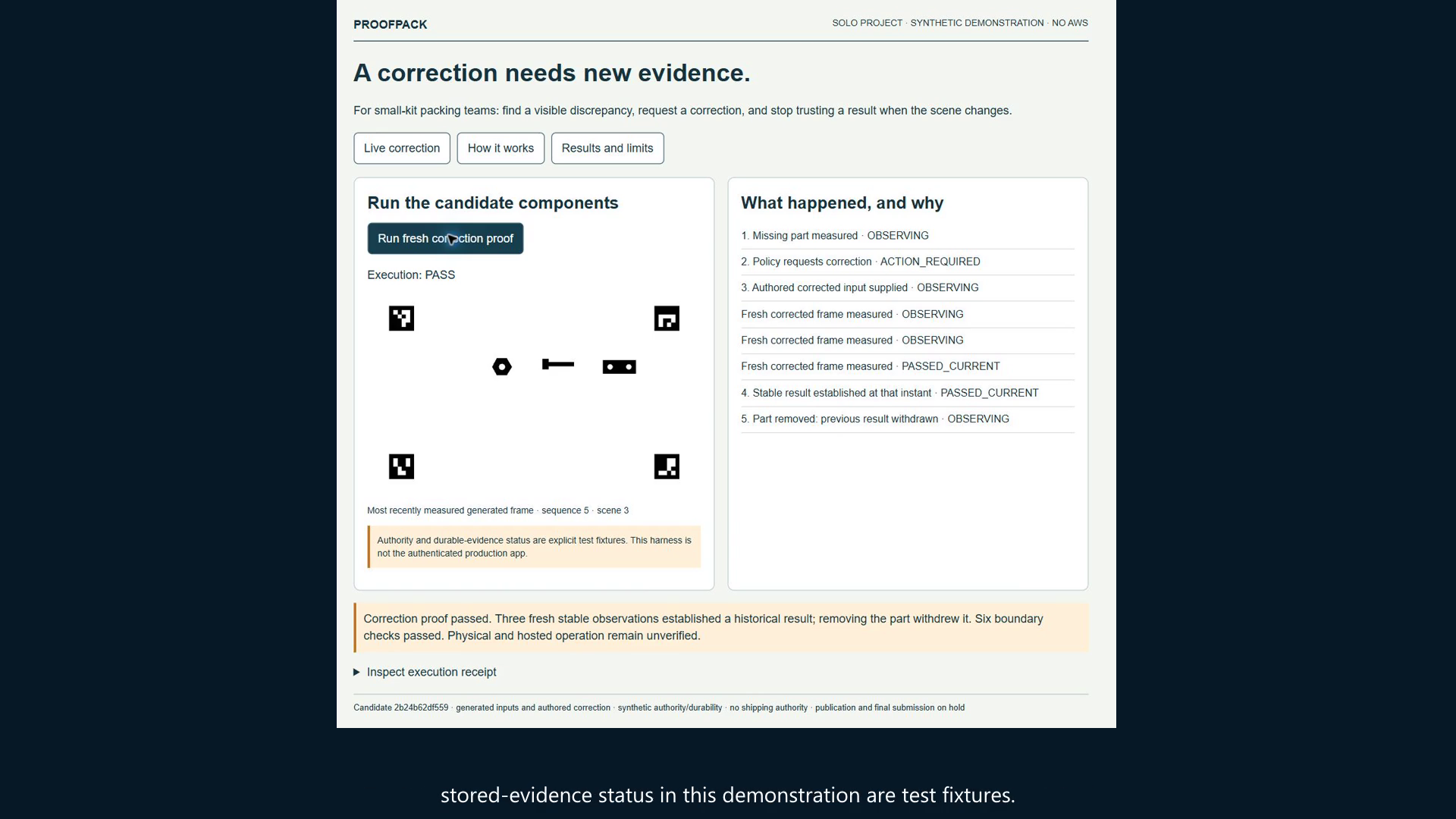
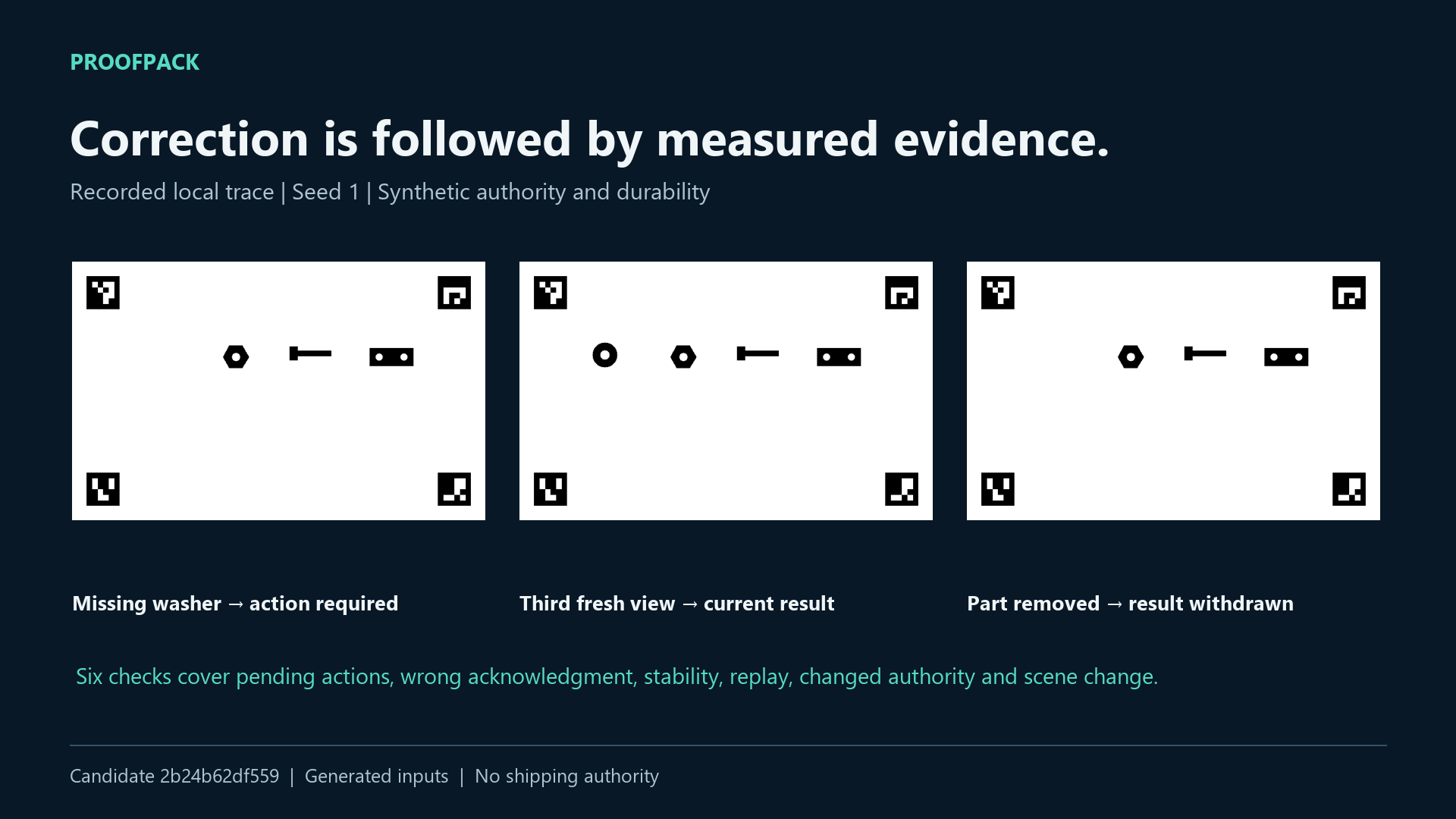
Synthetic correction run: missing washer, requested correction, three fresh observations, then result withdrawal after removal.
-
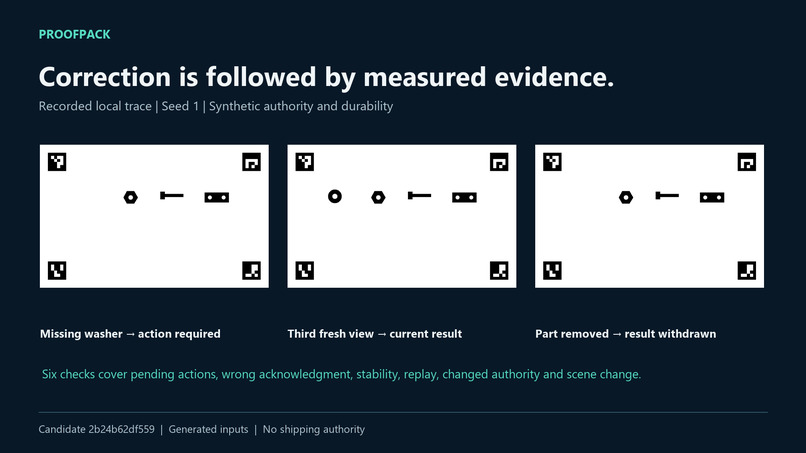
Recorded synthetic trace: correction needs three fresh stable observations; removing the part withdraws the result.
-
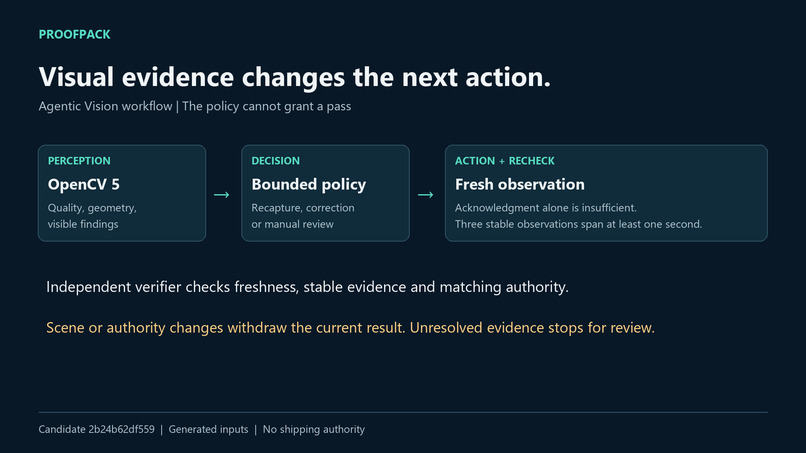
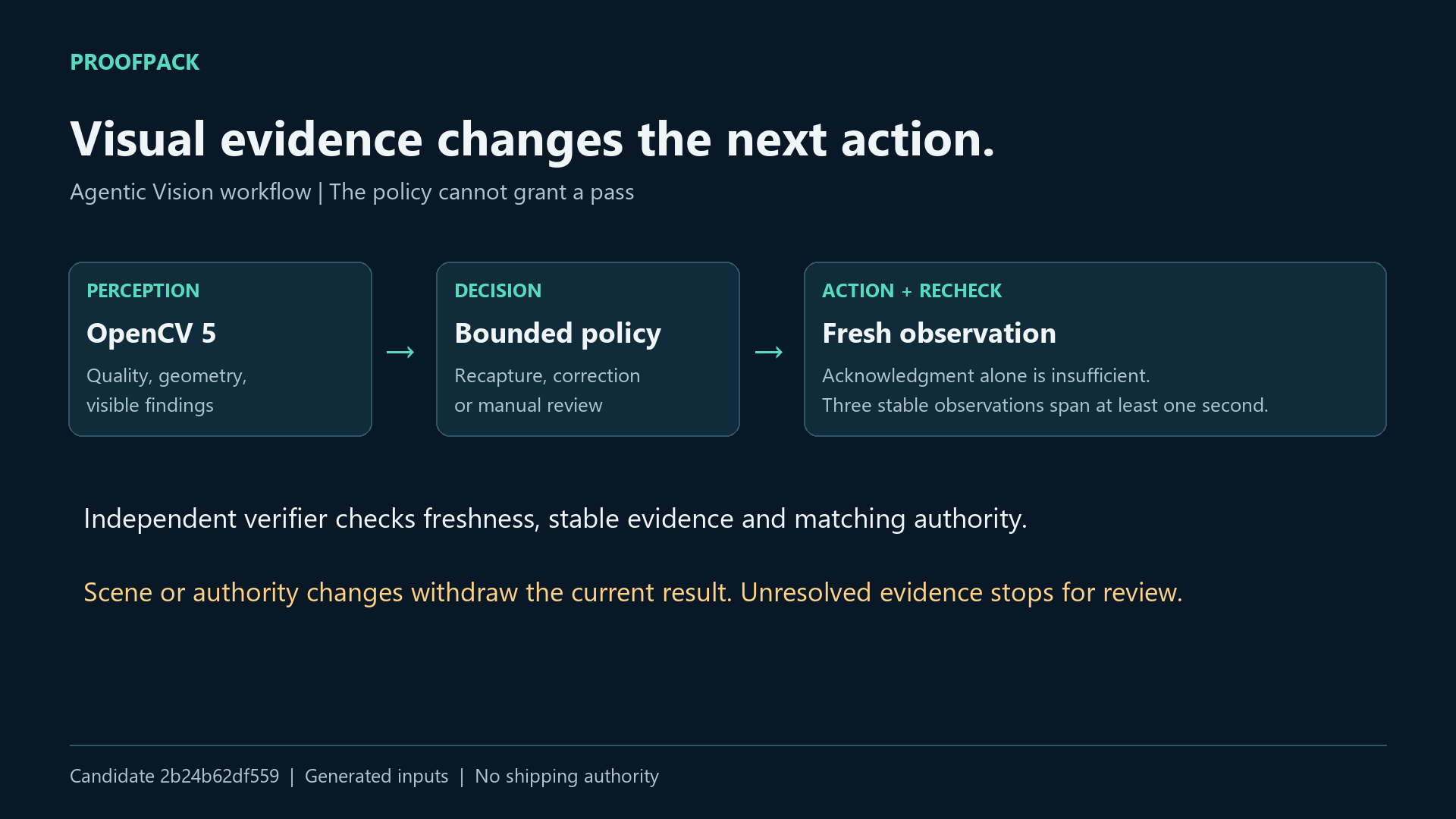
Agentic Vision workflow: OpenCV findings change the next action. A separate verifier checks fresh evidence and human control.
-
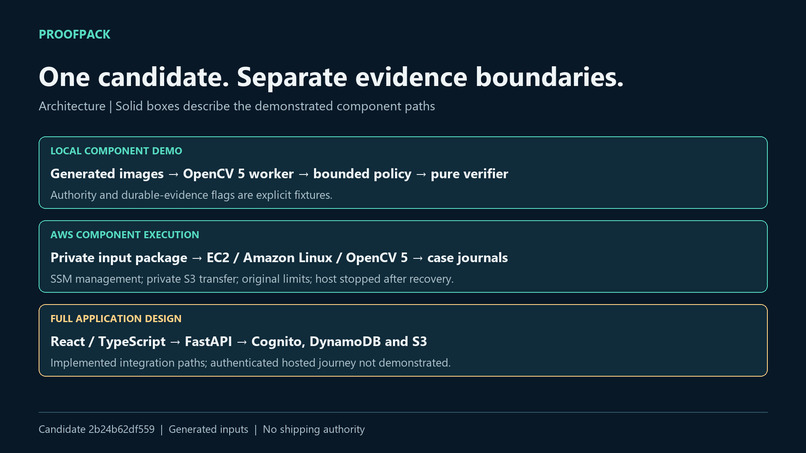
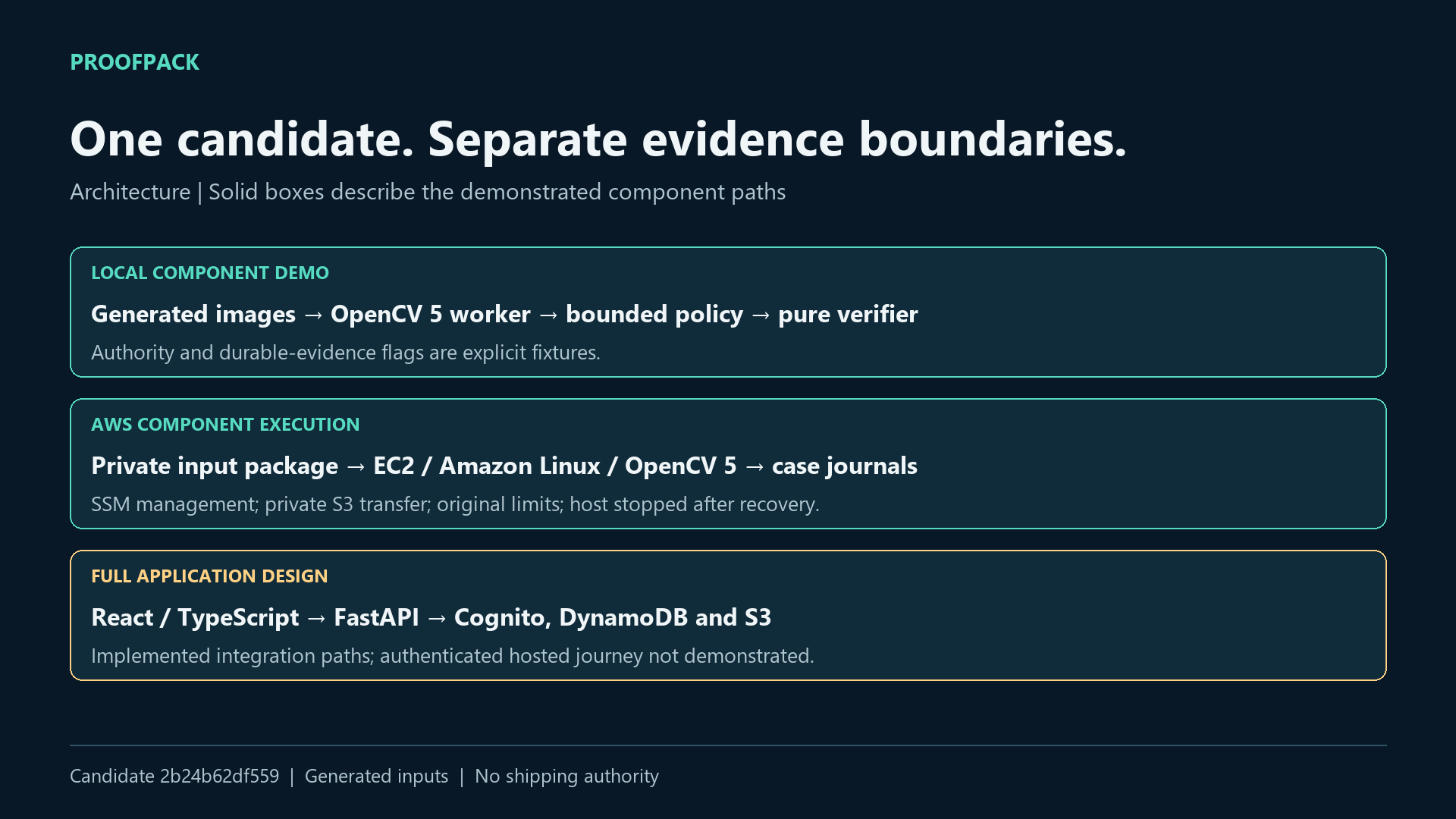
Architecture: demonstrated local components and AWS evaluation, with the full authenticated application clearly distinguished.
-
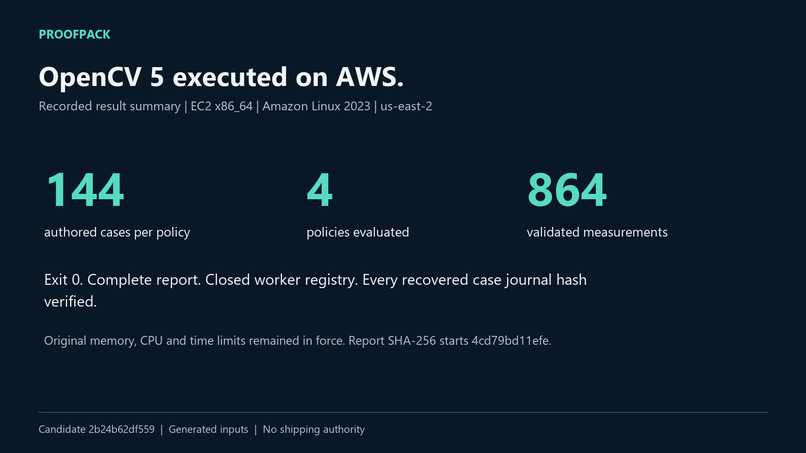
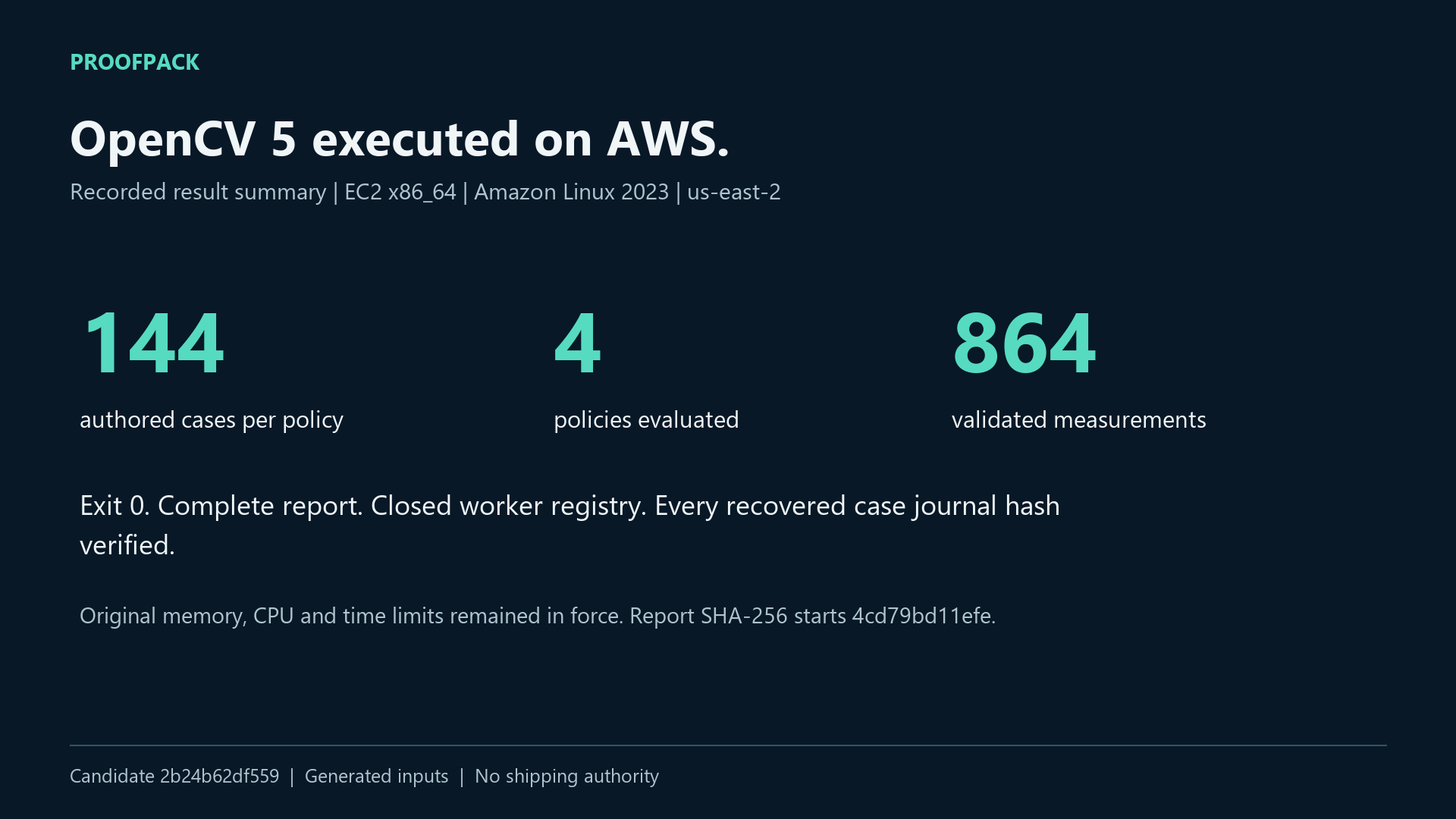
Recorded AWS component evaluation: 144 authored cases per policy, four policies and 864 measurements. Equal baseline outcomes.
-
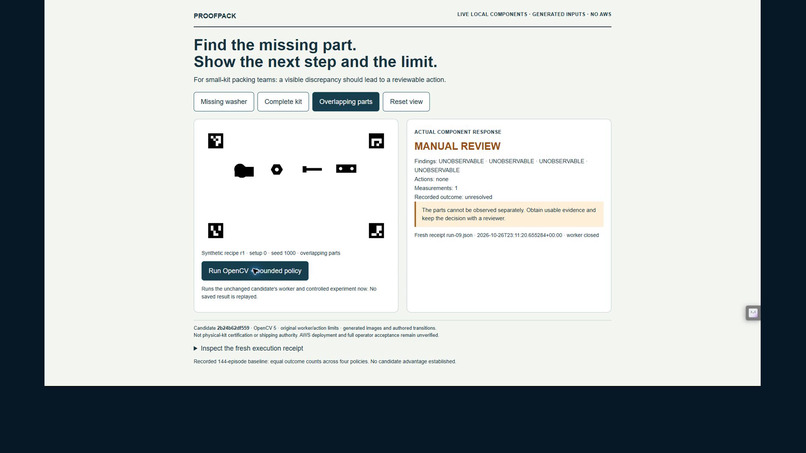
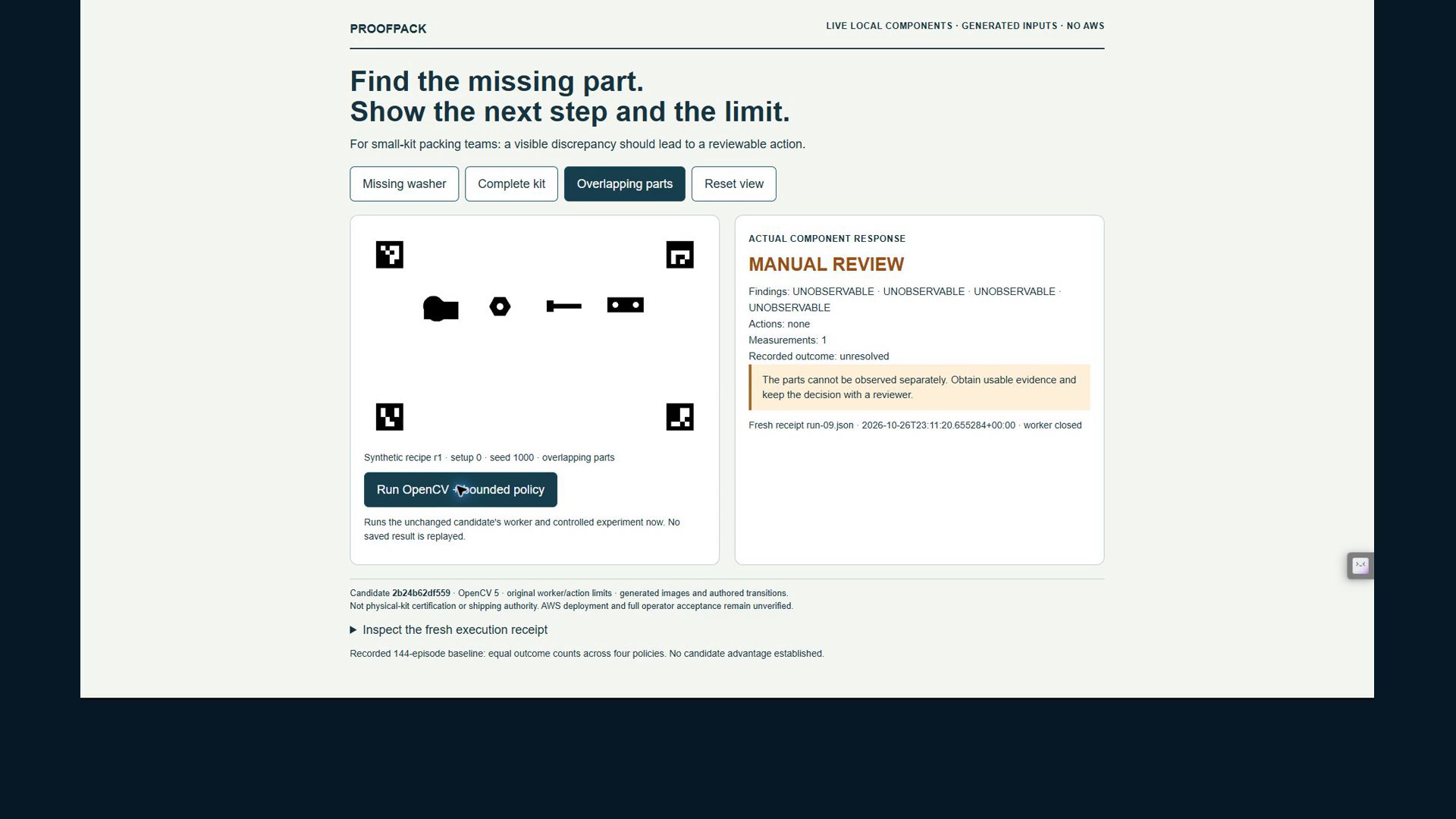
Recorded synthetic failure case: overlapping parts remain unresolved and require manual review. Local component demonstration.
Inspiration
A kit can look complete while one washer is missing. A correct check can also become stale when someone changes the contents. I built ProofPack for small packing teams that need to know what to check next and whether the result still describes the kit in front of them.
What it does
ProofPack is a prototype for checking configured, visible kit contents. OpenCV 5 measures an image against a recipe. A bounded policy uses the findings to request the next observation or correction. A separate verifier decides whether fresh evidence supports a current result.
The recorded synthetic correction loop starts with a missing washer. The measured discrepancy triggers a correction request. A corrected generated scene then supplies three fresh observations spanning at least one second. Only after those checks does the verifier establish a current result. Removing the part withdraws it.
The visual finding therefore changes what happens next. The operator can see the discrepancy, requested action and current result together. Acknowledging an action never substitutes for new evidence. When observations remain insufficient, the system can stop for manual review.
How I built it
The application combines Python and FastAPI with React and TypeScript. The dependency lock pins opencv-python 5.0.0.93; the native runtime reports OpenCV 5.0.0. OpenCV performs image-quality checks, calibrated plane rectification and contour-based measurements of supported visible shapes and dimensions.
Measurement, action selection and verification have separate responsibilities. The demonstrated policy is deterministic and uses a fixed set of permitted actions. It cannot grant a pass or override the verifier. Version checks, observation freshness, finite action budgets and process limits constrain the loop.
I ran the component evaluation on an x86_64 EC2 instance using Amazon Linux 2023 and Python 3.12.15 in AWS us-east-2. The run evaluated 144 generated cases under four policies and completed 864 validated measurements. Private S3 storage preserved the input package and results, and Systems Manager provided administrative access. The host was stopped after evidence recovery.
The full application's identity and data design uses Cognito, DynamoDB and S3. Its complete authenticated cloud journey has not yet been demonstrated. The completed AWS result covers the vision evaluation component. COOL and Graviton execution are not claimed.
I am the solo developer. Codex assisted with implementation, tests, diagnosis, documentation and demo preparation. The Agentic Vision workflow is the application's measured finding, action and fresh-verification loop. The prepared 4:20 demonstration opens with my on-camera introduction and shows the correction loop, architecture, failure cases and AWS results. The main demonstration uses local Kokoro computer-generated narration; the introduction retains my recorded speech.
Challenges I ran into
The hardest problem was keeping useful evidence from becoming stale approval. Scene changes, delayed observations, retries and access changes require explicit checks. The correction demonstration also exercises replay rejection, acknowledgment binding, pending-action holds and changed authority.
A configured worker initially exceeded its lease. Removing redundant work restored completion without extending the lease. On AWS, native worker startup required a C-locale launcher with Python UTF-8 enabled. The corrected run kept the original memory and time limits.
Accomplishments
The same candidate completed the local correction demonstration and the AWS component evaluation. The recorded local verification includes 6,571 Python tests, 422 browser tests and 92 installed-package support checks. Browser checks include intercepted synthetic APIs; those results do not establish a live authenticated application.
The controlled comparison used candidate-priority, fixed-recapture, rule-priority and single-frame policies. Each produced 24 correct satisfactions, 48 correct rejections and 72 unresolved outcomes across 144 authored cases. There were no incorrect decisions or technical failures in that fixture set. Equal outcomes do not demonstrate an advantage over the baselines.
Inputs, runtime identity, reports and case journals are bound to recorded hashes. The evaluated source revision is 2b24b62df559c581b446c1c23d80705ba1b4c792. A fresh checkout restored from its complete Git bundle passed the six-check correction proof. The prepared judge packet includes the technical report, diagrams, pinned setup instructions, original test receipts and evaluation records. The contest attachment supplies the evaluated source and approved video; the linked public repository contains an earlier snapshot. The unlisted video shows the recorded synthetic demonstration and AWS component results.
What I learned
An inspection result needs to explain both what it supports and when it expires. Asking for another observation can be useful, but that benefit must be measured against a simpler approach. Synthetic evaluation helped expose implementation problems; it does not establish physical-kit accuracy or reduced operator effort.
What's next
Complete the authenticated application journey, qualify real camera and kit combinations, and evaluate operators against a manual checklist and fixed inspection policy. Measure incorrect decisions, unresolved cases, retakes, completion time and setup effort.
The current demonstrations use generated images and synthetic scenarios. The local correction demonstration also uses fixture authority and evidence status. ProofPack does not verify hidden properties, certify product safety or authorize shipping. Physical-kit performance and customer benefit remain future evaluation work.
Built With
- amazon-ec2
- amazon-web-services
- aws-systems-manager
- fastapi
- opencv
- python
- react
- typescript


Log in or sign up for Devpost to join the conversation.