Inspiration
What it does
How we built it
Challenges we ran into
Accomplishments that we're proud of
What we learned
What's next for ProofMesh
Inspiration
Release decisions collapse into status meetings because Engineering, Security, and Support each hold a different piece of the truth. Centralizing that context is slow, invasive, and often impossible. ProofMesh verifies a launch claim without taking control away from the people who own the evidence.
What it does
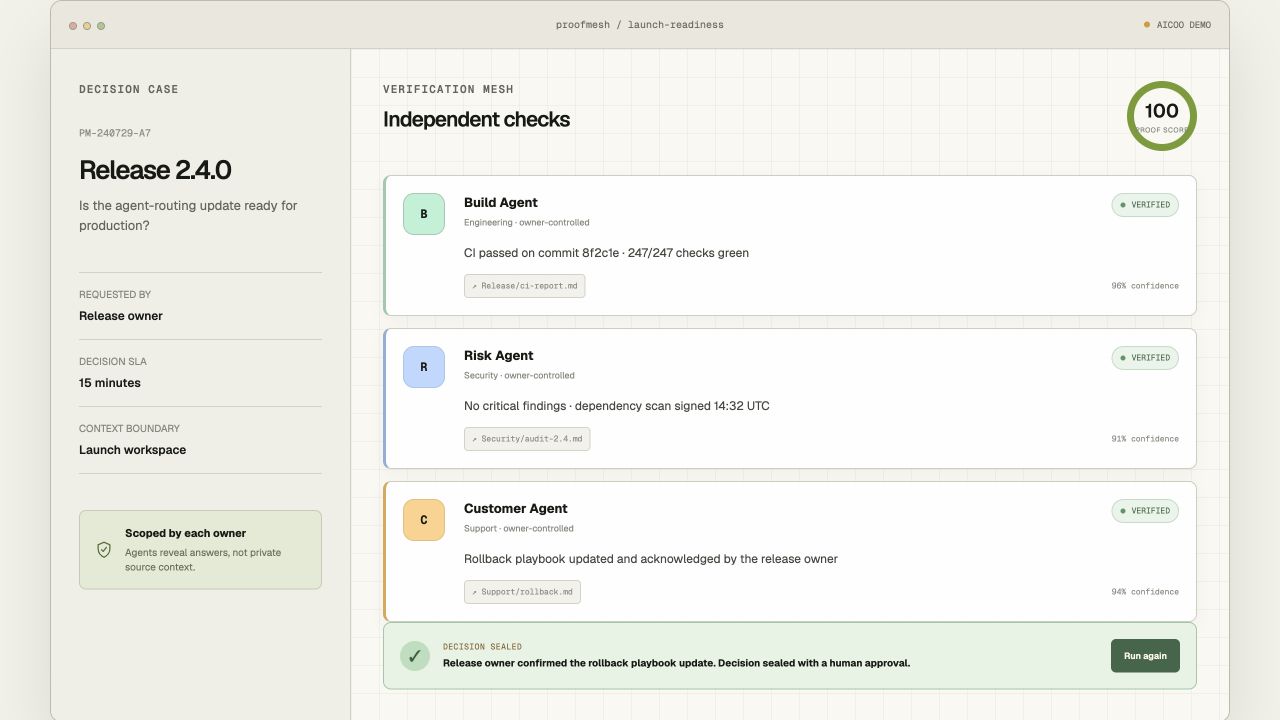
ProofMesh turns a release claim into bounded verification requests for user-owned Aicoo agents. Each agent answers independently from only the context its owner permits. ProofMesh compares verdicts, preserves evidence references, surfaces contradictions, and escalates only the unresolved edge to a human release owner. The final decision is sealed in a proof ledger.
The demo follows a complete case:
- Engineering verifies 247/247 CI checks.
- Security verifies no critical findings.
- Support blocks the release because its rollback playbook references a retired queue.
- ProofMesh escalates that contradiction instead of pretending consensus.
- The human owner resolves it and seals an accountable decision.
How we built it
ProofMesh is a Next.js, TypeScript, and React application with a server-side Aicoo integration deployed on Vercel. Its verification endpoint uses Aicoo's POST /api/v1/agent/message for synchronous, idempotent agent-to-agent requests when verifier handles are configured, and POST /api/v1/chat for coordinator analysis otherwise. The production protocol also maps durable evidence to /accumulate and discovers connected systems through /tools.
The Aicoo key is encrypted server-side in Vercel and never reaches the browser or repository. A deterministic signed case lets judges inspect the complete UX without credentials, while the live route proves the Aicoo integration.
Why Aicoo is essential
ProofMesh is not a chatbot wrapper. Its premise depends on Aicoo's owner-controlled agent network: one agent can ask another a bounded question while the recipient acts only within its owner's permissions. That provides routing, scoped context, agent execution, and durable workspace coordination without copying every team's private data into one system.
Using AI COO
I used Aicoo's AI COO as the finalization coordinator for this solo build. I gave it the deadline and asked for a risk-ranked go/no-go plan spanning live API verification, public demo and repository checks, the two-minute video, truthful Devpost copy, media, links, eligibility, and final submission confirmation. This made the highest-risk gates explicit while I retained the final human decision.
Challenges
The hardest product decision was resisting false consensus. A release gate that always returns green looks smooth but is dangerous. We designed the proof score, evidence references, and human escalation together so disagreement is a first-class outcome.
We also made live routing credential-safe and reviewer-safe: secrets stay server-side, inputs are fixed to the showcased scenario, and API failure degrades transparently to the signed demonstration rather than inventing a live result.
Accomplishments
- Complete interactive claim-to-decision flow
- Aicoo-native, permission-scoped routing
- Explicit contradiction and human-resolution paths
- Evidence-linked proof ledger
- Public responsive demo, repository, screenshot, and two-minute walkthrough
What we learned
Multi-agent systems become more trustworthy when they pass intent and evidence references—not authority—between agents. The best orchestration layer is not the one that sees everything; it asks the smallest useful question and knows when to escalate.
What's next
Durable /accumulate records, reusable verification policies, group deliberation, signed evidence links, and metrics for escaped-release risk and decision latency.
Built With
- aicoo

Log in or sign up for Devpost to join the conversation.