-
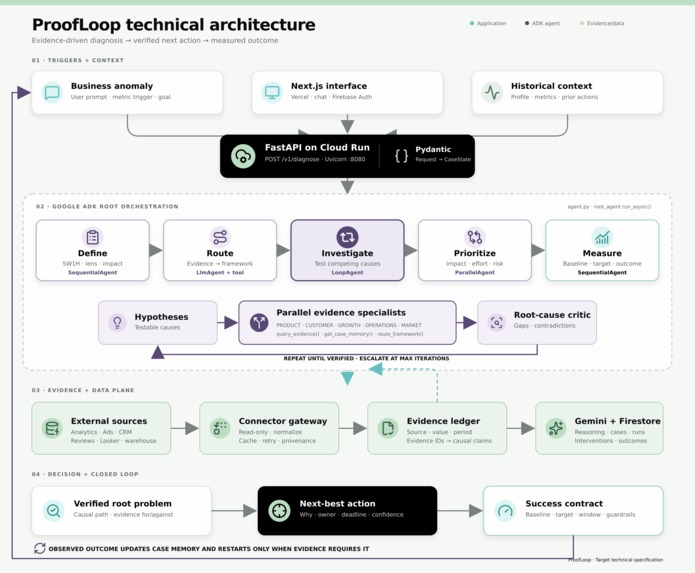
Architecture data model
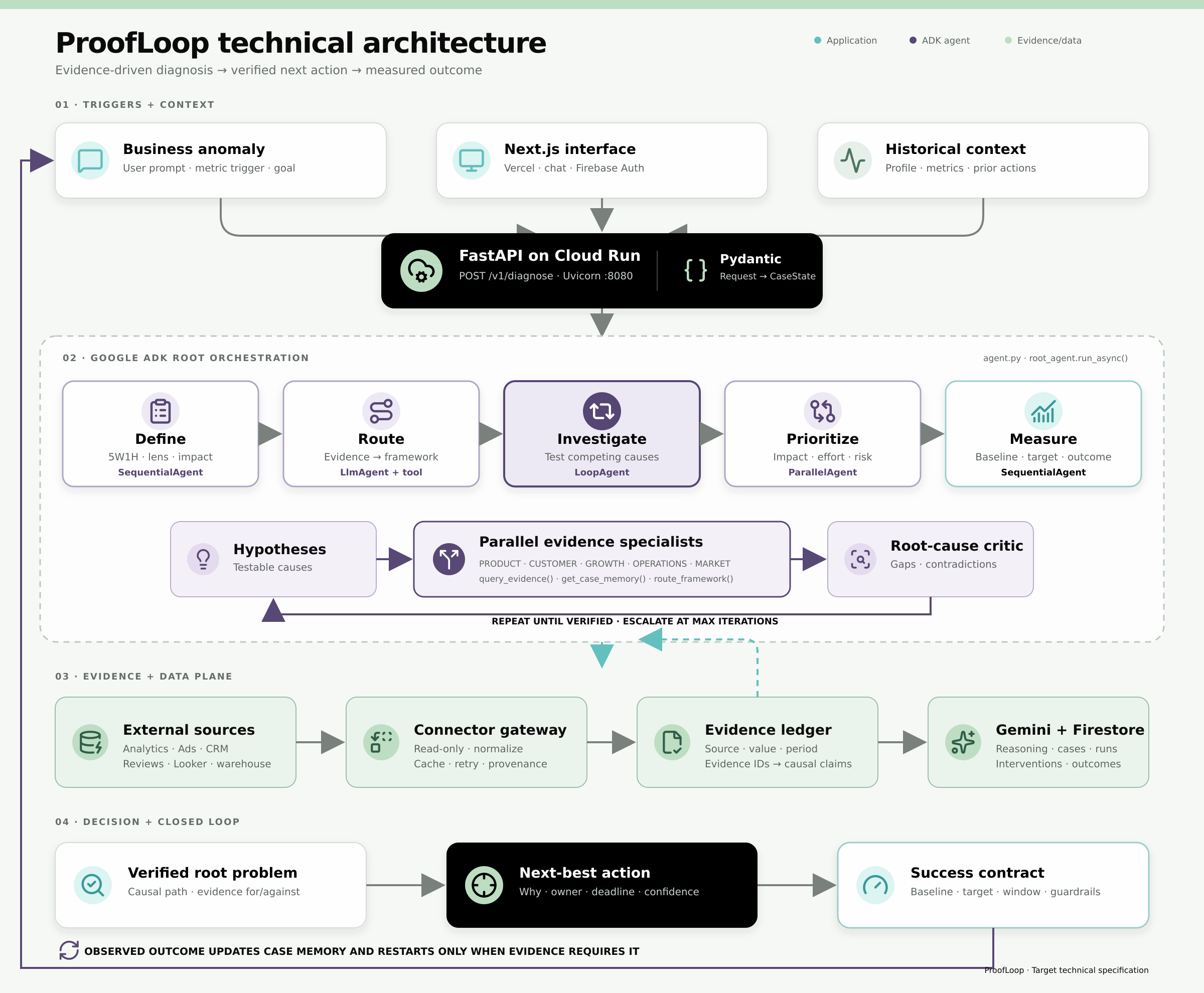
Inspiration
AI is enabling one person to do work that once required an entire team. As a solopreneur myself, however, I realized that having more tools, data, and ideas does not answer the most important question: What should I do next?
The inspiration came from my mom, who has spent 25 years applying management-consulting methods to help executives solve complex business problems. I began imagining how her experience—combined with proven frameworks created by leading management thinkers, institutions, and companies around the world—could become an accessible decision system for solopreneurs.
That idea became ProofLoop.
What it does
ProofLoop is an AI business investigator that helps solopreneurs determine which problem to solve next.
It begins with an observed problem—such as declining revenue, poor conversion, or customer churn—and structures the available evidence using 5W1H and economic-impact analysis. It then:
Prioritizes the most urgent, high-impact problem. Investigates the evidence until it identifies a defensible root cause. Examines the problem through relevant product, growth, customer, operational, and financial lenses. Routes the evidence to appropriate management frameworks. Recommends a prioritized intervention with supporting evidence. Defines success metrics and measures whether the intervention worked.
The core principle is: evidence selects the lens, the lens selects the framework, and the framework guides the next action.
How we built it
ProofLoop is built with Gemini and Google’s Agent Development Kit.
The multi-agent architecture includes:
A Sequential Agent that structures the investigation through problem definition, evidence validation, root-cause analysis, recommendation, and measurement planning. A Loop Agent that repeatedly generates hypotheses, checks evidence, identifies information gaps, and continues investigating until the root cause reaches an acceptable confidence threshold. A Parallel Agent that activates specialist agents across product, growth, customer, operations, and financial analysis. A synthesis layer that compares the findings and produces one prioritized, evidence-backed intervention.
The backend uses Python and FastAPI, with structured schemas for evidence, hypotheses, root causes, interventions, and evaluation results. Firestore supports persistent investigation state, while Cloud Run provides the deployment environment. The interface makes the investigation visible through 5W1H facts, selected and rejected lenses, economic impact, framework routing, and a decision trace.
Challenges we ran into
The biggest challenge was translating management judgment into an explicit agent workflow. Human consultants naturally move between questions, evidence, hypotheses, and frameworks; an agent needs clear state, responsibilities, confidence thresholds, and exit conditions.
We also had to solve several orchestration challenges:
Preventing a symptom from being presented as the root cause. Ensuring each “Why” was supported by evidence. Keeping parallel agents grounded in the same source data. Preventing irrelevant frameworks from being applied automatically. Defining when the Loop Agent had enough evidence to stop. Handling incomplete or conflicting business data. Producing a recommendation that was specific and measurable.
Designing the system to explain its decisions without overwhelming the user was another major challenge.
Accomplishments that we're proud of
I am proud that ProofLoop connects diagnosis, action, and learning in one continuous system.
The prototype can transform a loosely defined business problem into:
A structured 5W1H assessment. A quantified view of economic impact. A prioritized problem. An evidence-supported causal path. A validated root-cause hypothesis. A set of evidence-selected management frameworks. A measurable intervention and follow-up plan.
I am especially proud of the framework router. Instead of applying every available business framework, ProofLoop selects or rejects frameworks based on the evidence discovered during the investigation.
As a solo hackathon participant, I also designed the product, developed the agent architecture, structured the evaluation logic, and built the working interface.
What we learned
Thanks to Annie's courses and documentations on codelabs, colab and the youtube videos! I learned that adding more agents does not automatically produce better reasoning. Each agent needs a narrow responsibility, structured inputs and outputs, shared evidence, and a clear place within the investigation.
I also learned that identifying a root cause is not enough. A useful business agent must connect the diagnosis to an intervention, define what success means, and return later to determine whether the recommendation actually worked.
Most importantly, I learned that solopreneurs do not need more generic advice. They need a system that understands their evidence, challenges assumptions, explains its conclusions, and helps them commit to the next best action.
What's next for ProofLoop
Next, I plan to connect ProofLoop to the systems where solopreneurs already generate business evidence, including product analytics, advertising platforms, customer communications, app reviews, financial data, and operational dashboards.
Future development will include:
Live integrations with tools such as Google Ads, PostHog, Customer.io, Looker, app stores, and customer-support platforms. Stronger evaluation datasets for testing root-cause accuracy. Human approval checkpoints for high-impact recommendations. Automated intervention monitoring and follow-up investigations. Long-term memory that learns from previous decisions and outcomes. Industry-specific agents and framework libraries for creators, consultants, e-commerce businesses, and micro-SaaS founders.
The long-term vision is to give every solopreneur an always-available management intelligence system—one that helps them find the real problem, take the next best action, and continuously learn from the result.
Built With
- call-loop
- cloud-run
- docker
- fastapi
- firestore
- gemini
- gemini-api
- generative-ai
- github
- google-agent-development-kit-(adk)
- google-cloud
- llm-orchestration
- loopagent
- multi-agent-systems
- parallel-agents
- pydantic
- python
- react
- rest-api
- sequential-agent
- typescript
- uvicorn
- vercel

Log in or sign up for Devpost to join the conversation.