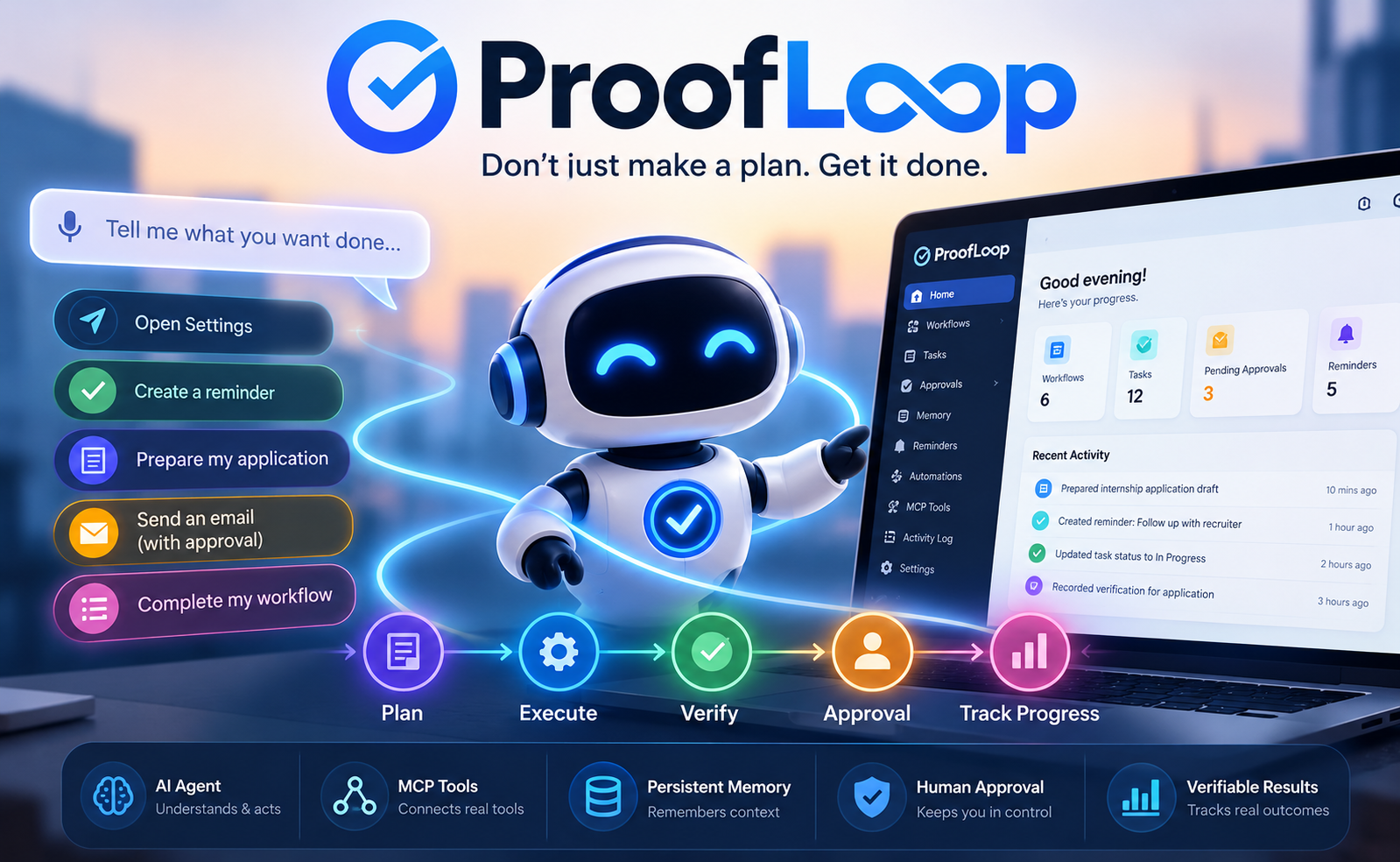
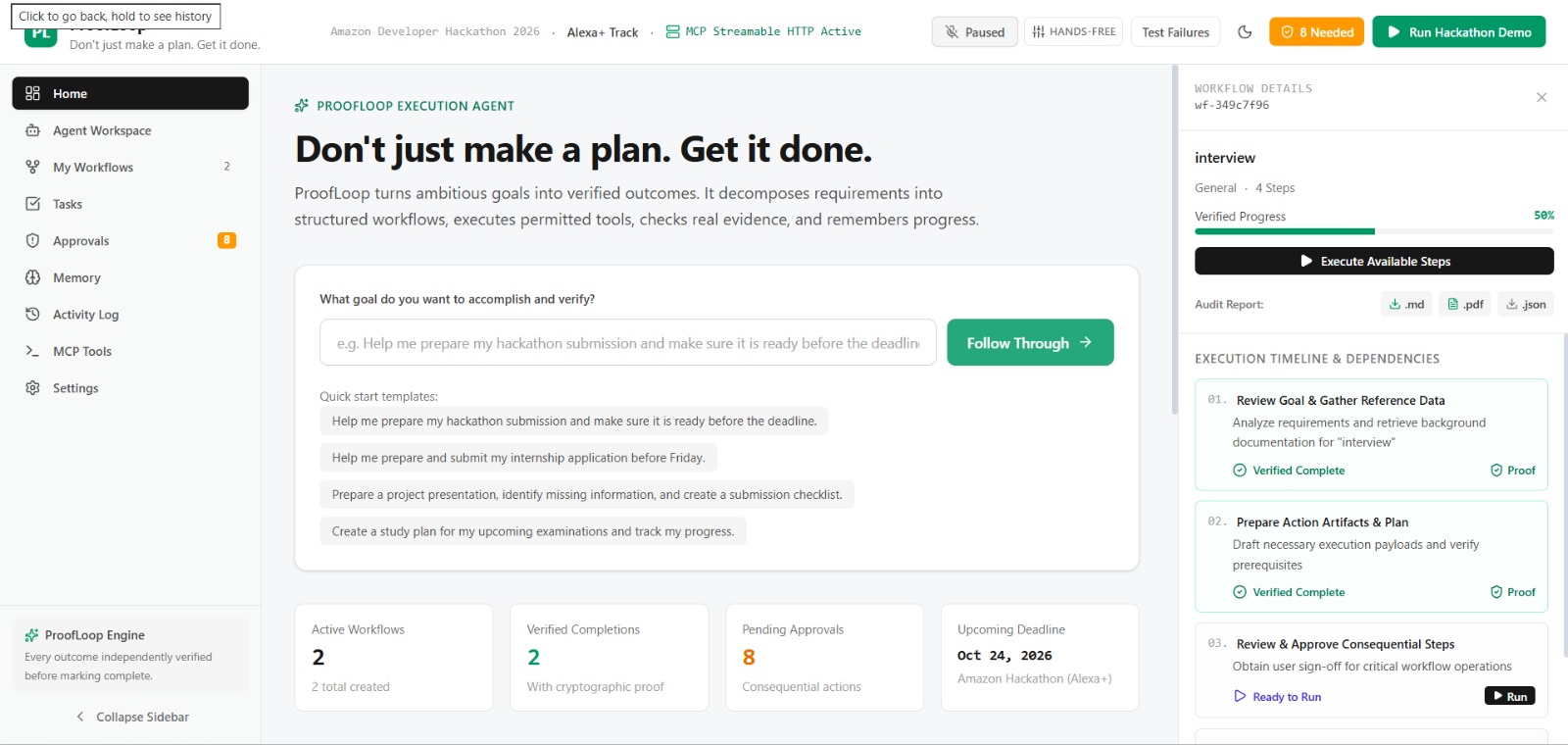
ProofLoop — Don't Just Make a Plan. Get It Done.
Inspiration
AI assistants are good at making plans, but turning those plans into completed, verifiable work is a different challenge. Tasks can remain unfinished, progress becomes difficult to track, and important actions need human oversight.
ProofLoop was built to bridge the gap between planning and execution. The goal is simple: an AI assistant should not only recommend what to do, but help carry out supported actions, track progress, and show evidence of the outcome.
What It Does
ProofLoop is an AI-powered work automation assistant that turns natural-language goals into actionable workflows and tracks them through completion.
Its key capabilities include:
- AI-powered planning: Converts goals into structured tasks, with a fallback planning path when AI services are unavailable.
- MCP tool integration: Provides a self-hosted Model Context Protocol server over Streamable HTTP, connecting the agent to supported workflow, memory, reminder, document, and activity-log tools.
- Persistent memory and progress: Uses SQLite-backed storage to retain workflows, task updates, reminders, and activity records.
- Human-in-the-loop approval: Protects consequential actions with explicit approval requirements and checks that approved application drafts have not been modified.
- Proof of completion: Records verification results and evidence references so execution and verification are treated as separate stages.
- Voice interaction: Includes a background voice assistant and Click-to-Explain controls to make supported actions easier to understand and operate.
- Downloadable records: Supports available document and report exports in formats such as PDF, CSV, JSON, and text.
ProofLoop aims to make automation more transparent: users should be able to see what was requested, what actually ran, what succeeded, and what still needs attention.
How We Built It
The application combines a React and TypeScript frontend with a Node.js and Express backend. SQLite provides persistent storage, while the Model Context Protocol SDK exposes tools through a Streamable HTTP MCP endpoint. Google Gemini 2.5 Flash supports AI-backed planning, with bounded timeouts and a deterministic fallback for supported demonstration scenarios.
The system uses structured tool inputs, controlled workflow transitions, activity records, and approval checks to keep automation traceable. The interface also includes code-split views and performance optimizations to reduce initial loading work.
Challenges and What We Learned
One of the main challenges was making the system responsive without sacrificing persistence or reliability. Database writes, external AI calls, frontend rendering, and MCP request handling required careful attention.
We also focused on separating action execution from proof verification. A requested action is not necessarily a completed action, and a successful service response does not automatically prove every required outcome. Similarly, consequential operations must not be reported as successful when required credentials, approvals, or external services are unavailable.
Building ProofLoop reinforced an important principle: useful AI automation needs more than intelligence. It needs reliable tools, persistent state, clear permissions, recovery from failure, and evidence that supports its claims.
What's Next
ProofLoop's next steps are to expand supported integrations, improve automation scheduling and recovery, strengthen verification coverage, and make longer voice-driven interactions more reliable while keeping users in control of consequential actions.
Built With
- ai-agents
- express.js
- gemini-2.5-flash
- google-gemini-api
- model-context-protocol-(mcp)
- node.js
- persistent-memory
- react
- sqlite
- tailwind-css
- typescript
- vite
- vitest
- workflow-automation

Log in or sign up for Devpost to join the conversation.