Inspiration
During multiple of my projects, the need to scientifically iterate over AI workflows and prompts kept coming up, and I usually found myself reading paper after paper trying to make sense of what often feels like the chaotic nature of LLMs.
This tool is the answer I wanted to try.
What it does
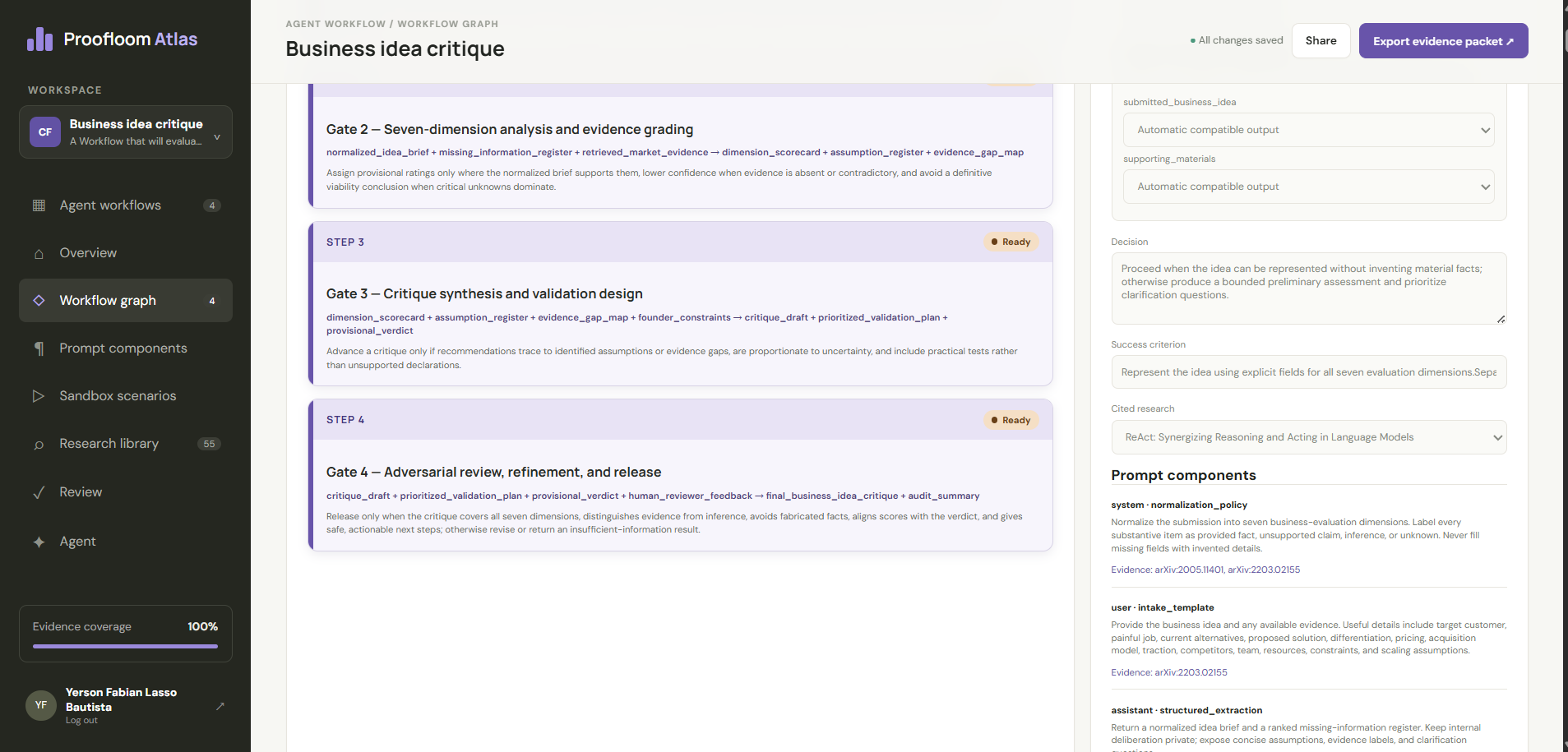
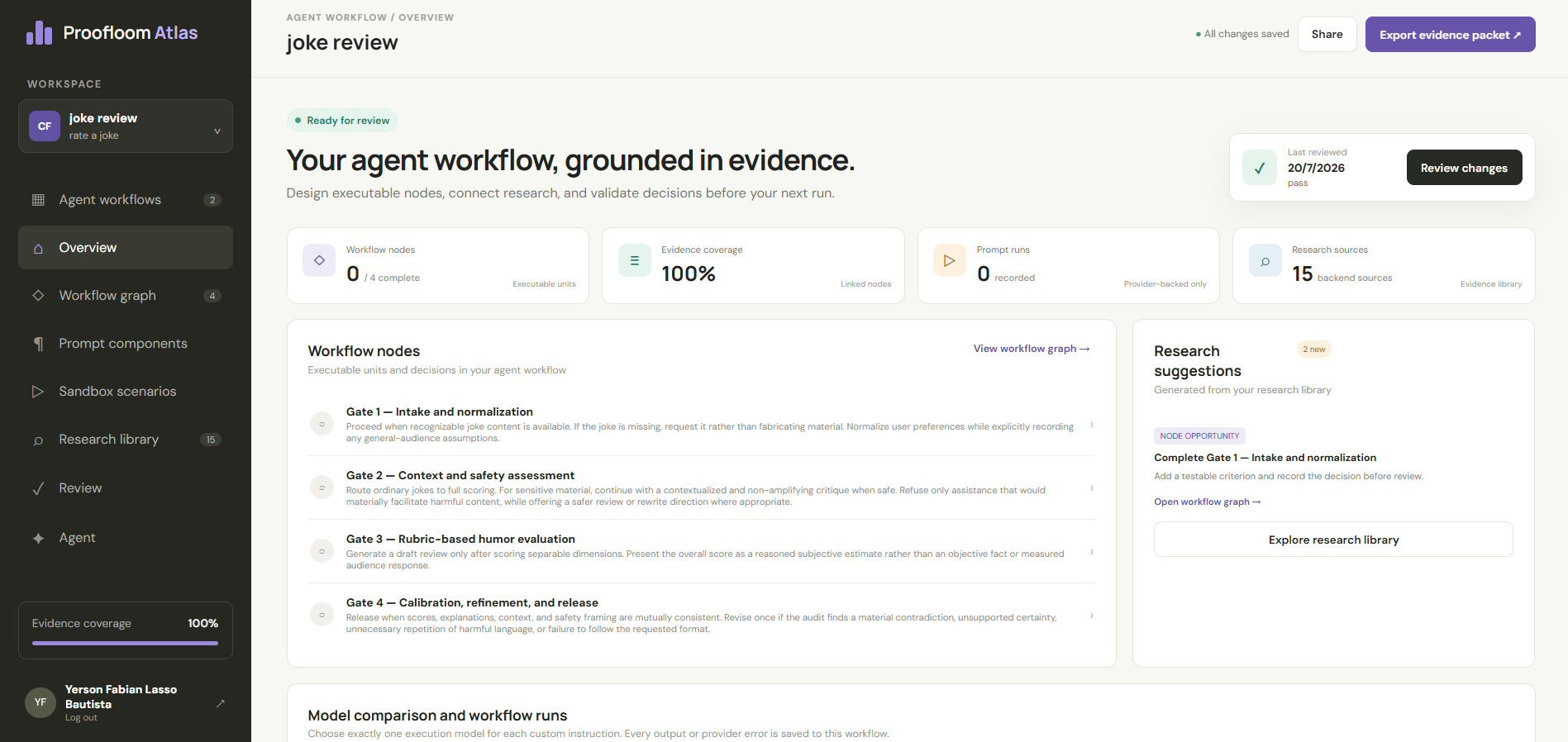
A user starts with an idea for an agent system, and the app helps turn it into a structured workflow: steps, required inputs, expected outputs, prompt components, evidence links, review criteria, and sandbox scenarios. Each workflow step can be run with GPT-5.6, and outputs from one step are passed into the next, so the user can test the full architecture instead of just describing it.
The project is focused on making agent design more rigorous. Instead of writing prompts informally, Proofloom Atlas connects each workflow decision to research evidence, lets users inspect the reasoning path, run scenarios, edit outputs, and review whether the system architecture is grounded, testable, and safe enough for its intended use.
About the Development
I used my own system, CodeSwarm, to manage the project from an assigned starting template into a working product. CodeSwarm is an AI software development workflow tool that turns product gaps into tracked backlog items, sends them to coding agents, records each execution, runs verification, and supports deployment.
Most codex runs were done via the exec tool as a result, but most of the prompting itself was done through API calls in my personal tool.
How we built it
The project started from a very small assigned template — essentially a basic runnable web app shell with deployment configuration, but not the final product. It didn't yet have the real Proofloom Atlas experience: persistent authenticated workflows, GPT-5.6-backed generation, editable workflow steps, research evidence links, runnable sandbox scenarios, agent chat, step-by-step execution, or polished result rendering.
I used CodeSwarm to break those missing pieces into individual tasks. Codex implemented each one with GPT-5.6 — backend persistence, authentication, workflow generation, model runs, handoff logic, the research library, UI states, deployment fixes, and regression tests. Before merging anything, I reviewed the generated work through CodeSwarm's task summaries, diffs, test output, and live deployed behavior. When a result was incomplete, I sent follow-up instructions and required another task or fix before accepting it.
Challenges we ran into
The main challenge came from my choice to lean on one-shot codex executions, which often required very context-heavy prompts. Part of that was deliberate — I wanted to push the models by designing an in-depth plan up front and then running parallel executions off of it to move faster.
That approach worked, but it also meant that even after automated tests passed, I ended up being the bottleneck as the reviewer.
Accomplishments that we're proud of
The project is at a usable state, and I've already used it internally to improve processes on a couple of other projects I'm working on — so real value came out of this experiment, not just a demo.
What we learned
The jump in usable UI/UX quality compared to previous models is enough that this now has a place in my toolset for future projects.
I also came away with a clearer sense of agent orchestration and coordination — how to keep a multi-agent system aligned with the original goal, and how critical it is to keep a human in the loop throughout.
What's next for Proofloom Atlas
Right now only 55 research resources are in the library, added mainly for testing. A bigger sweep of established and recent literature will meaningfully compound the tool's value, along with routing — matching each research source to the model type it's most relevant for.
I also want to build out a deeper workflow for the agent that generates the initial architecture, so it captures more detail from the original request and designs systems that are more scalable and reliable from the start.

Log in or sign up for Devpost to join the conversation.