-
-
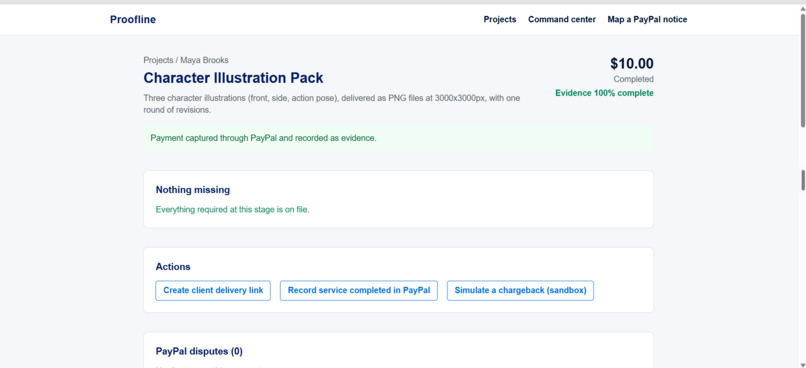
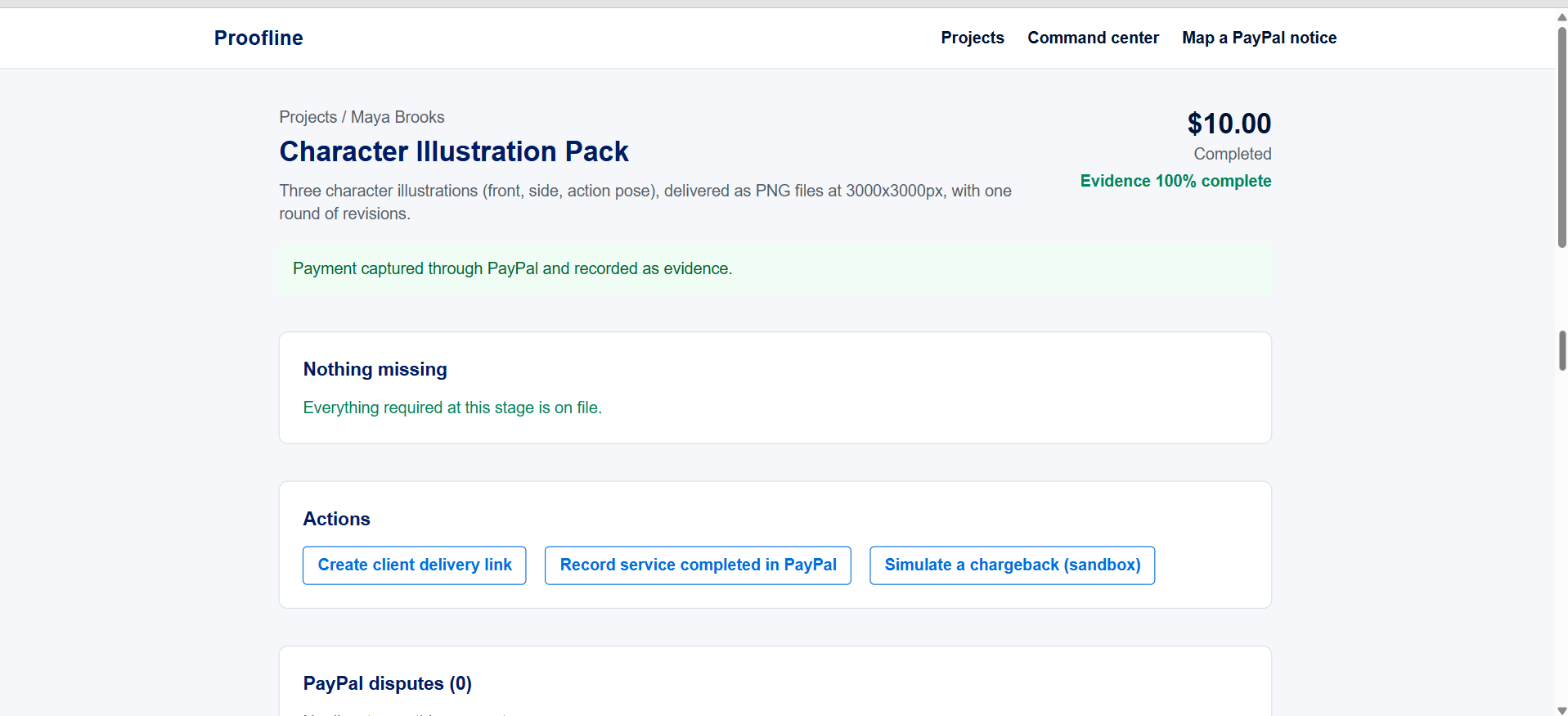
A fully proven project: paid, delivered, acknowledged, and recorded as completed in PayPal.
-
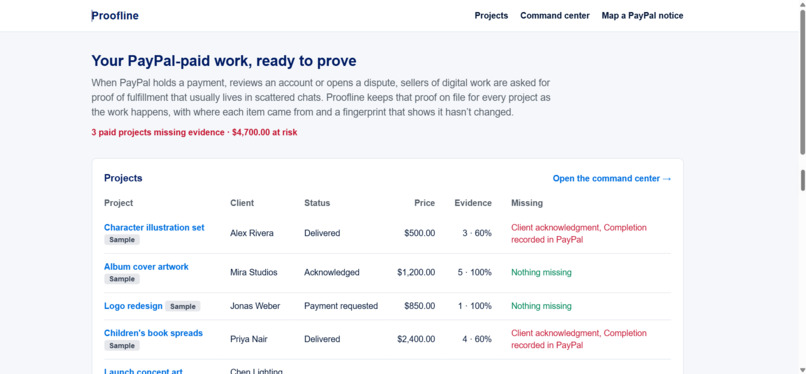
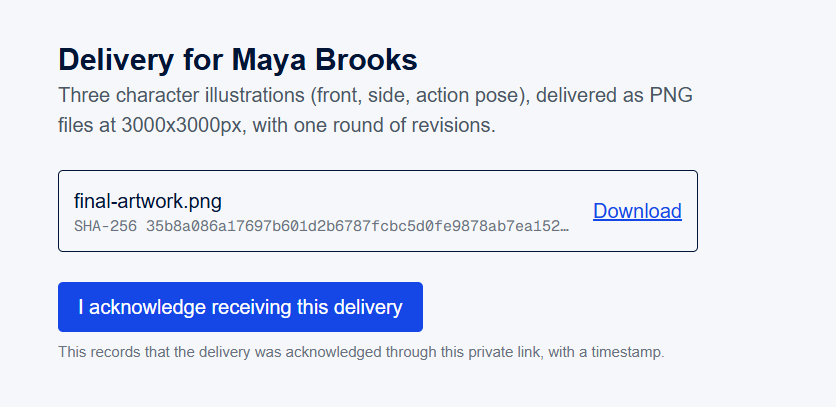
The server labels each item's source: System verified, Client confirmed or Self reported. Each file gets a SHA-256 fingerprint.
-
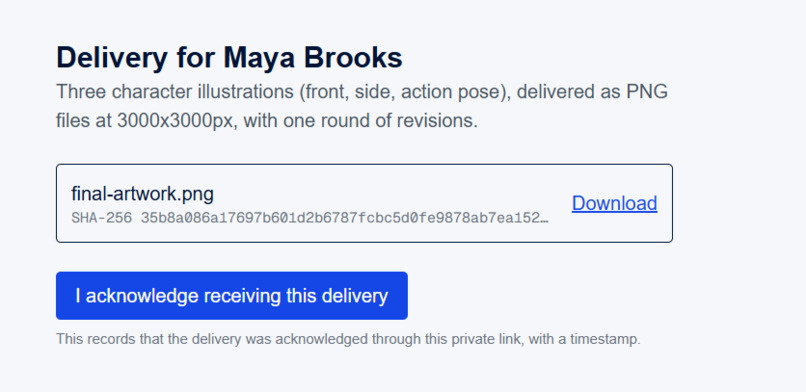
The client opens a private link, views the delivery and acknowledges it. Described honestly as acknowledged via the link, not identity.
-
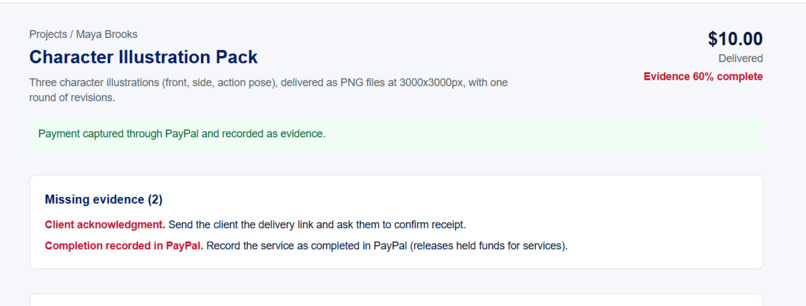
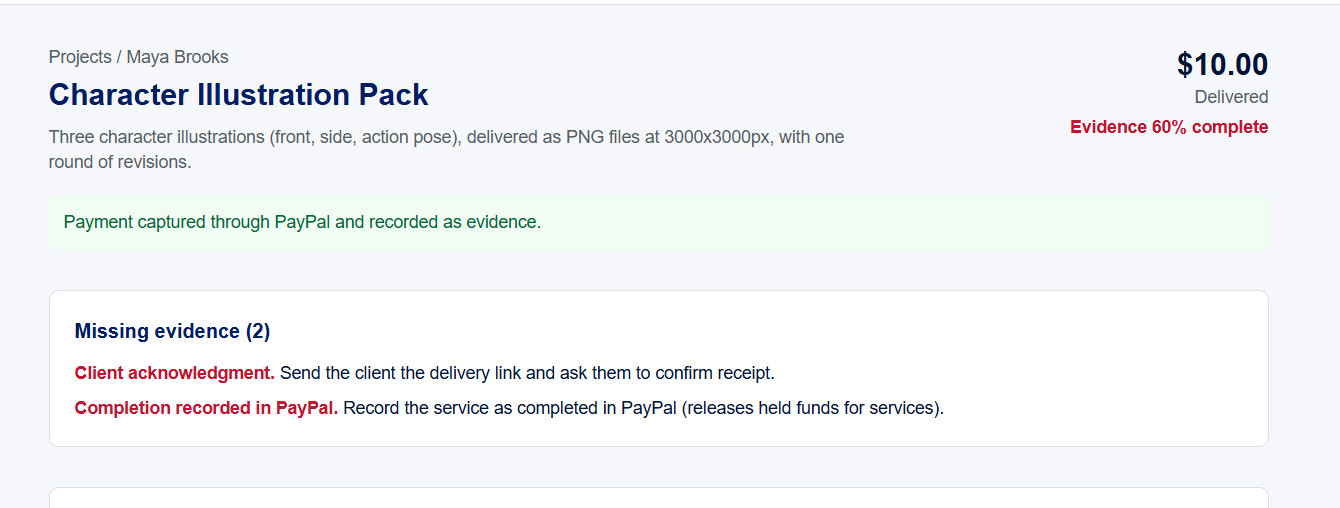
Plain rules, not AI, show what proof is still missing at each stage.
-
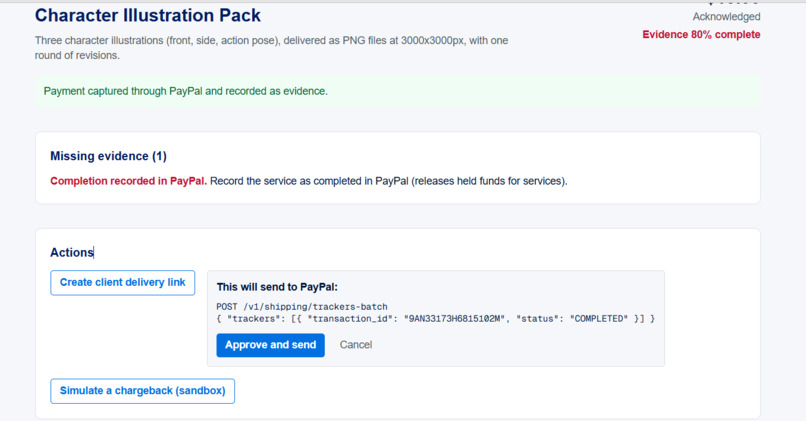
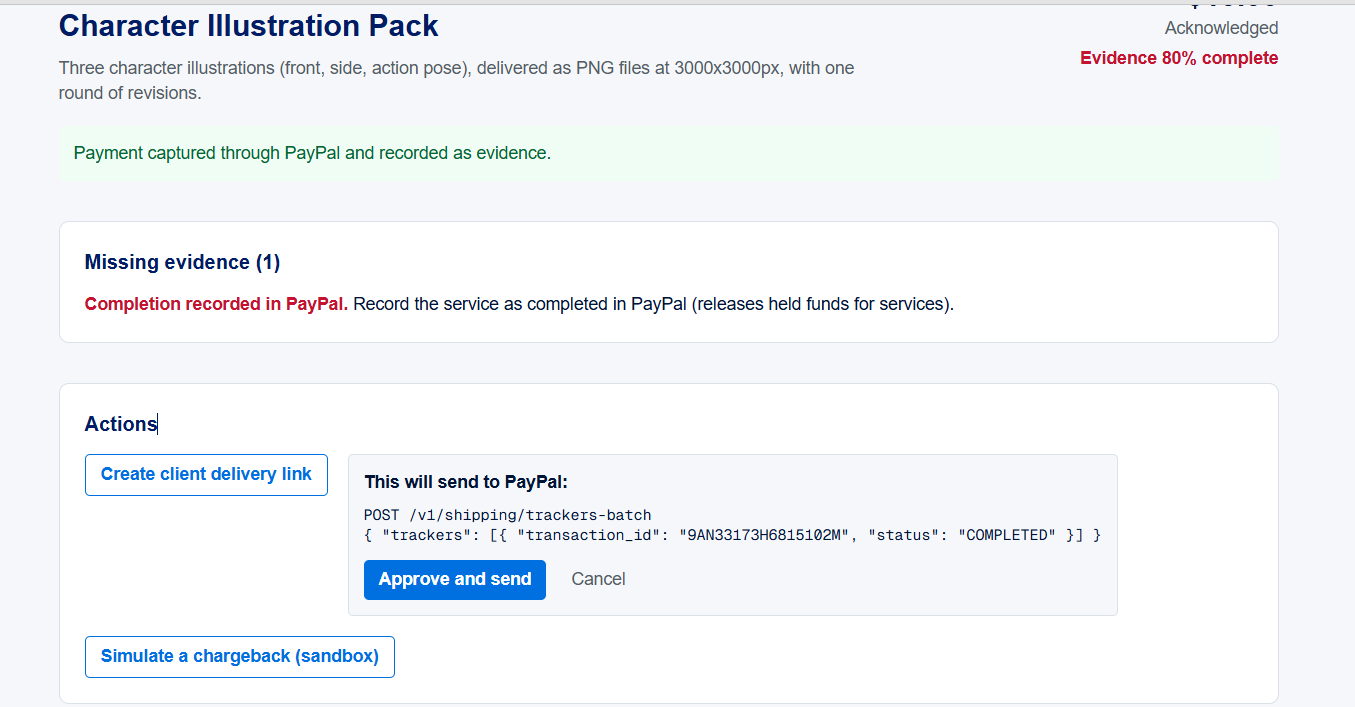
The seller sees the exact PayPal request and approves it before anything is sent.
-
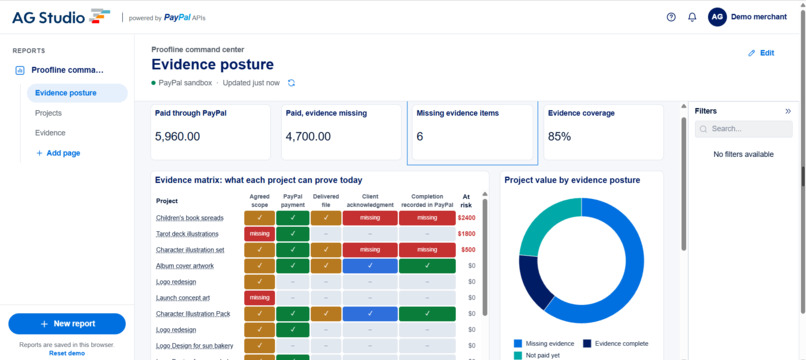
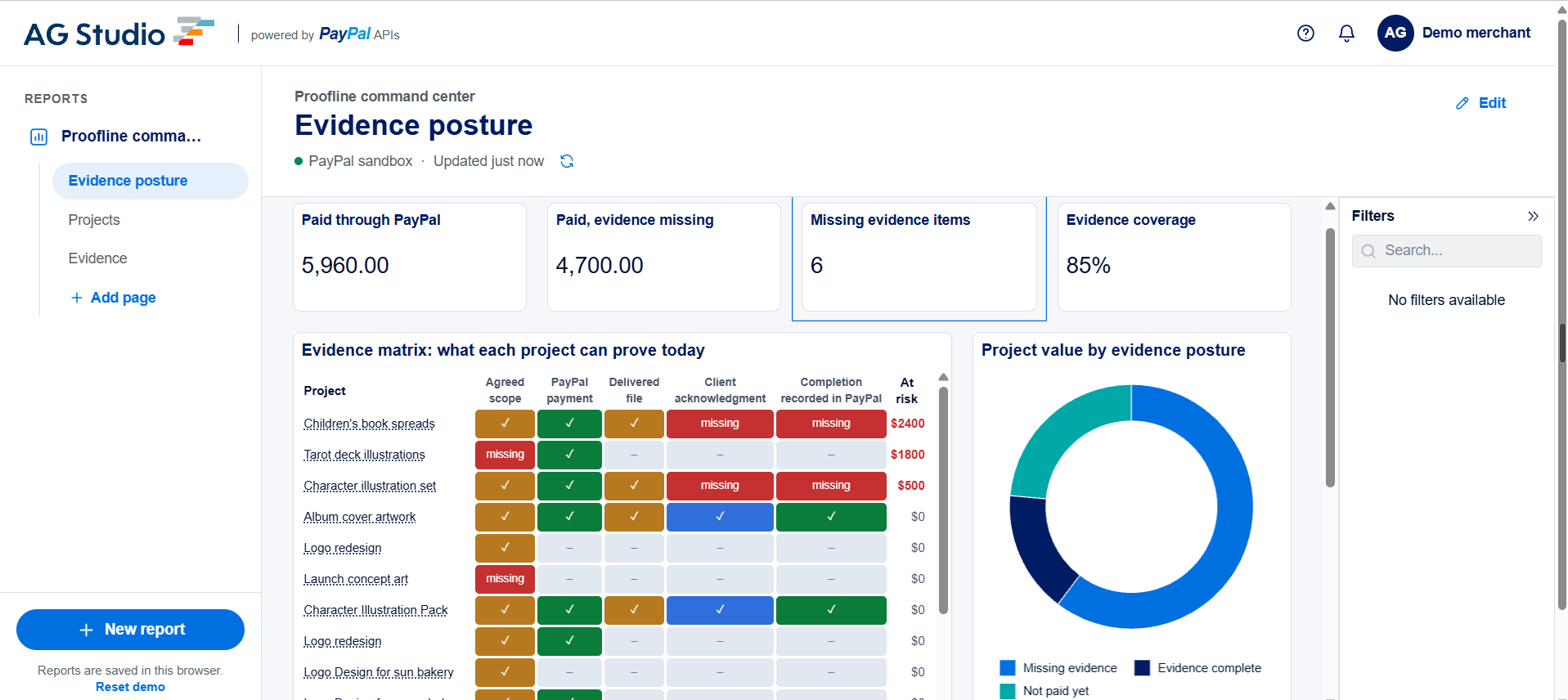
An AG Studio dashboard on AG Grid shows what each project can prove today, and the dollar amount at risk where proof is missing.
Inspiration
When PayPal holds a payment, reviews an account, or opens a dispute, sellers of digital work are asked for proof of fulfillment: the agreement, the delivery, the client's confirmation. For freelancers and artists, that proof is scattered across WhatsApp chats, email threads and download links. It's often gathered in a panic, after the money is already frozen.
We wanted the proof to exist before anyone asks for it, and to be something a reviewer can actually trust, not just a folder of screenshots.
What it does
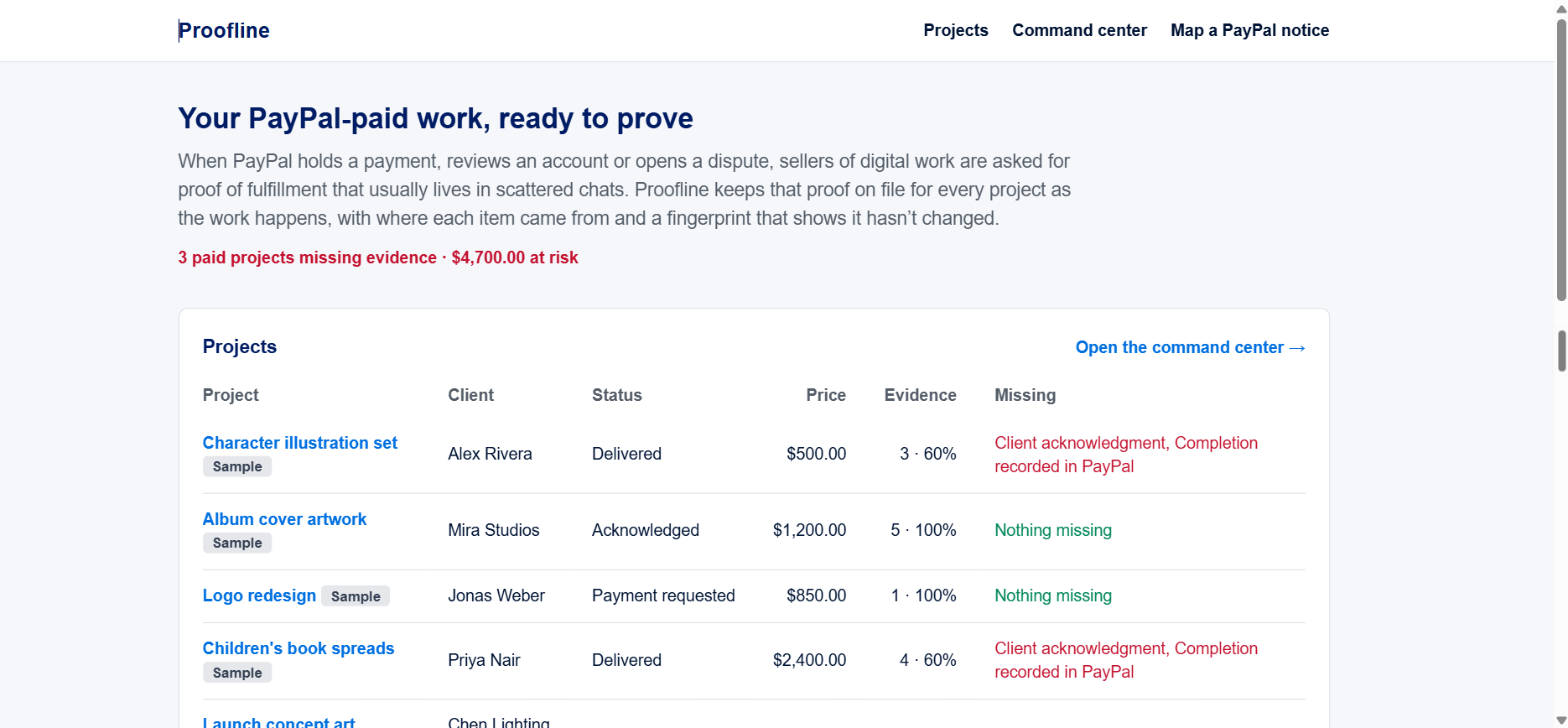
Proofline keeps PayPal-paid work ready to prove.
- PayPal Sandbox payments. A client pays through PayPal checkout. The payment is read back from PayPal's API, and a signature-verified webhook handler is in place for PayPal's notifications, so a project is only marked paid from PayPal's own data.
- Evidence with provenance. Every item is labelled by how it entered the system: system verified (PayPal), client confirmed (the delivery page), or self reported (uploaded by the seller). The server decides the label. The user and the AI can't.
- An integrity fingerprint. Each item gets a SHA-256 hash of its original bytes, so it can be checked later. A hash shows a file hasn't changed since we stored it. It does not prove the original screenshot was genuine, and Proofline says so.
- What's missing, deterministically. Plain rules, by project stage, list the evidence still needed. The AI never decides whether evidence exists.
- Client delivery page. The client opens a private link, views the deliverables and acknowledges them. That creates client-confirmed evidence, described honestly as "acknowledged via the delivery link". We don't claim a click proves identity.
- AI that helps without deciding. It classifies pasted chats and emails into evidence, and maps a PayPal notice to the evidence on file. Every quote it returns is checked word for word against the source text, and quotes that don't match are discarded.
- Human-approved PayPal writes. Recording "service completed" shows exactly what will be sent to PayPal and needs explicit approval. Every approved write is logged with a SHA-256 of the exact payload that was sent.
- A dashboard on AG Grid and AG Studio with an evidence matrix, a timeline and an AI assistant.
How we built it
- Next.js app with a SQLite data layer, kept behind a thin query module so it can be swapped for Postgres.
- PayPal Sandbox: Orders v2 checkout, capture details, a webhook handler with signature verification, the service-completion record, and dispute retrieval with a sandbox chargeback simulation.
- Evidence engine: SHA-256 hashing of the untouched original bytes, server-assigned provenance, status-aware completeness rules, and an allow-list so payment, acknowledgment and completion records can only be created by trusted server flows.
- Security details: delivery tokens are stored only as hashes and expire; uploaded files live outside the public directory under server-generated names; every webhook is verified with PayPal before it can change anything, and each event id is stored once so retries are harmless.
- AI: gemini-3.5-flash-lite for classification and notice mapping, and OpenAI through AG Studio's assistant. Model output is treated as untrusted and checked in code.
- AG Grid and AG Studio for the dashboard, and Render for hosting.
Challenges we ran into
- PayPal invoicing blocks India to India. Our first design used invoices, but our Sandbox seller account is in India, and PayPal won't send invoices to Indian customers. We switched to Orders v2 checkout, which also gave us the capture id immediately.
- App permissions. Our first API calls failed with a 403 until the Sandbox app's Invoicing and Transaction search features were actually saved. The token's scopes showed the missing permission.
- Trusting webhooks. A webhook arriving at your URL proves nothing. We verify every signature with PayPal, and an event that fails verification is recorded but never changes any project.
- Honest claims. The hardest design problem was wording: what does a hash prove, and what does a click prove? We label each item's provenance and avoid claiming more than the data supports.
- Free-tier hosting. Our hosted demo runs on Render's free tier, which resets its filesystem on restart, so the sample data is re-seeded on start. A paid disk and a reconcile cron job are included in the repo (
render.paid.yaml) for durable use.
What we learned
- Verification should come from PayPal, never from where a request arrived.
- AI is most useful when code checks its output. Here the model classifies and quotes, and code decides what counts.
- Small honesty details, such as provenance labels and what a hash does and doesn't prove, make evidence far more credible than a bigger feature list.
What's next
- Persistent storage and the reconcile job in production, so webhooks that are missed are recovered automatically.
- Real seller authentication. The demo has none.
- Dispute handling beyond the Sandbox, once the evidence flow has been hardened.
