-
-
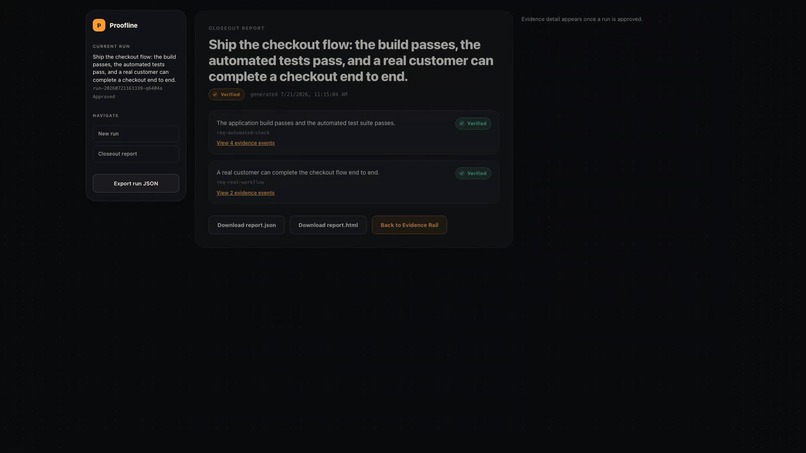
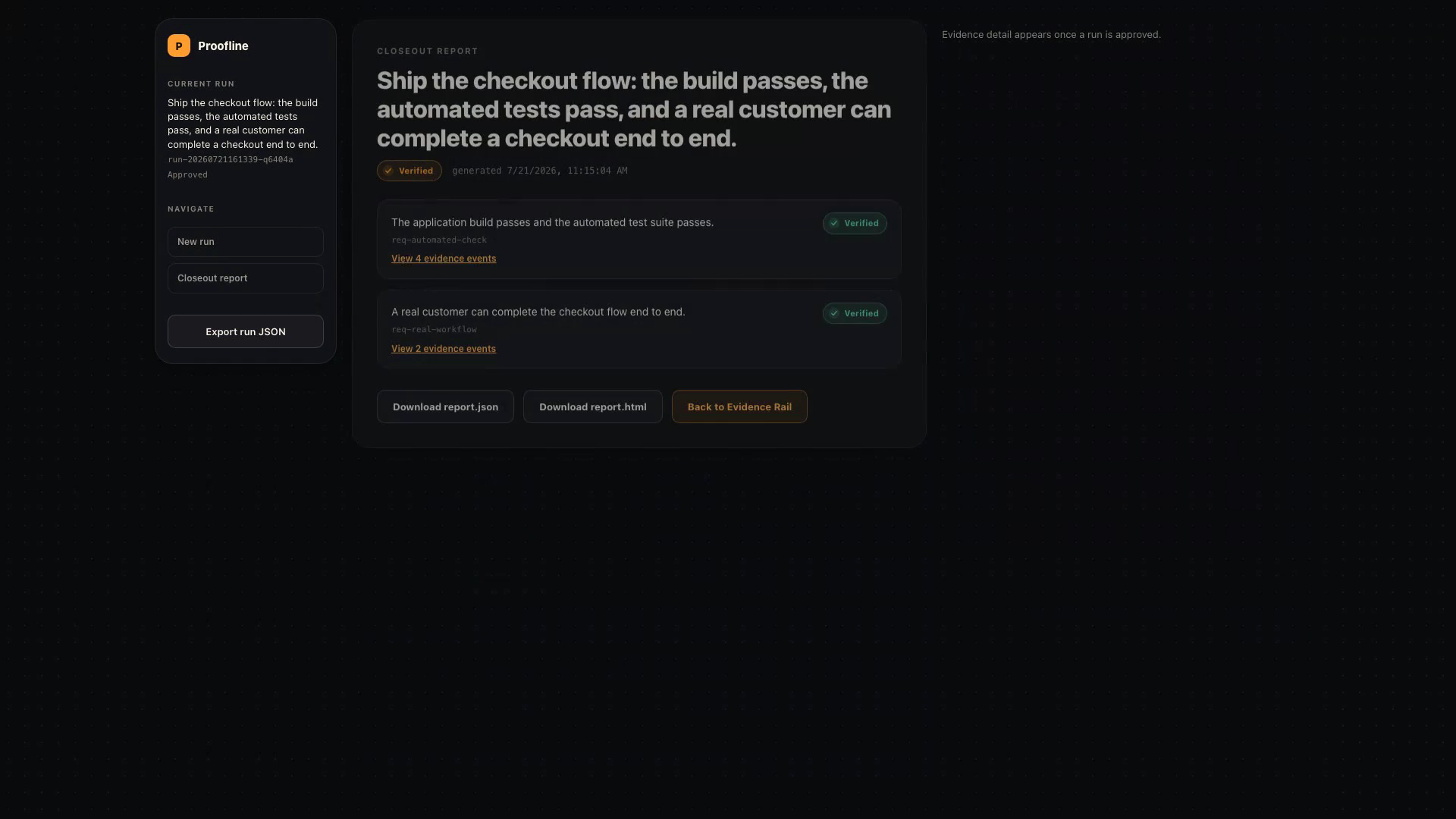
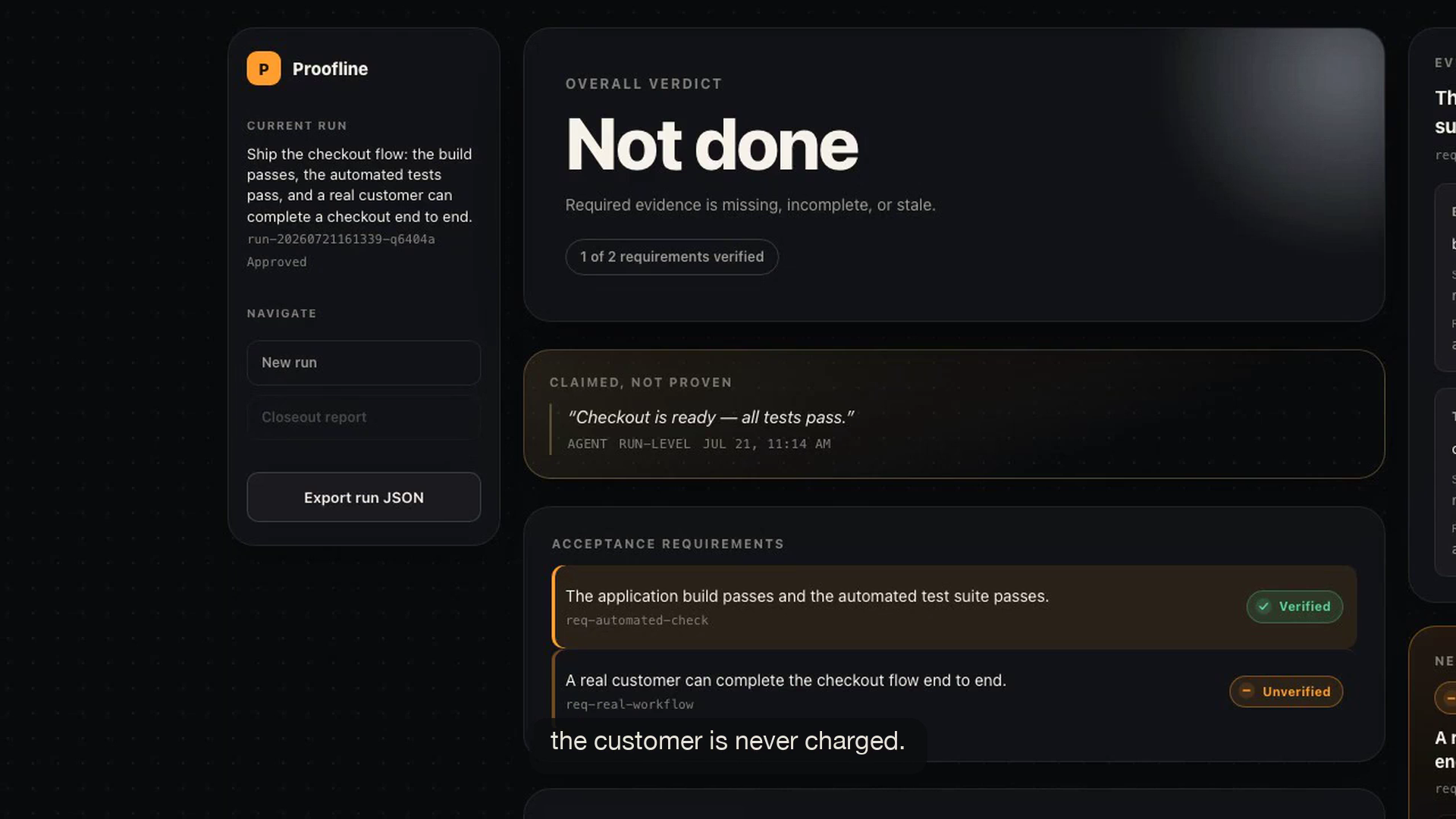
Only fresh, deterministic evidence earns Verified.
-
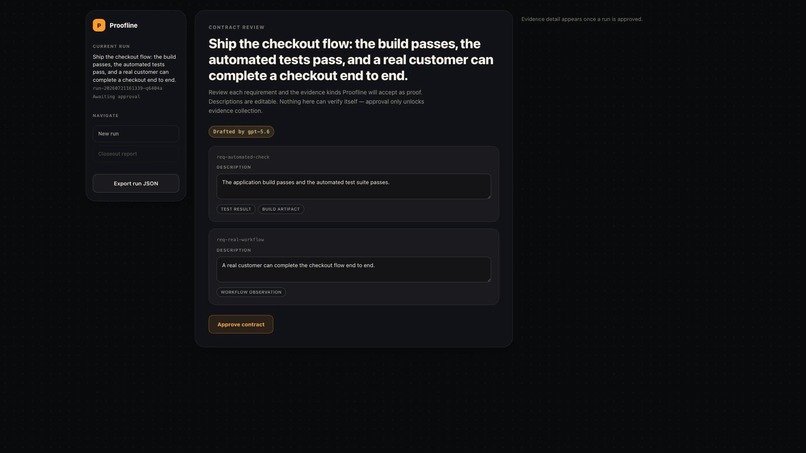
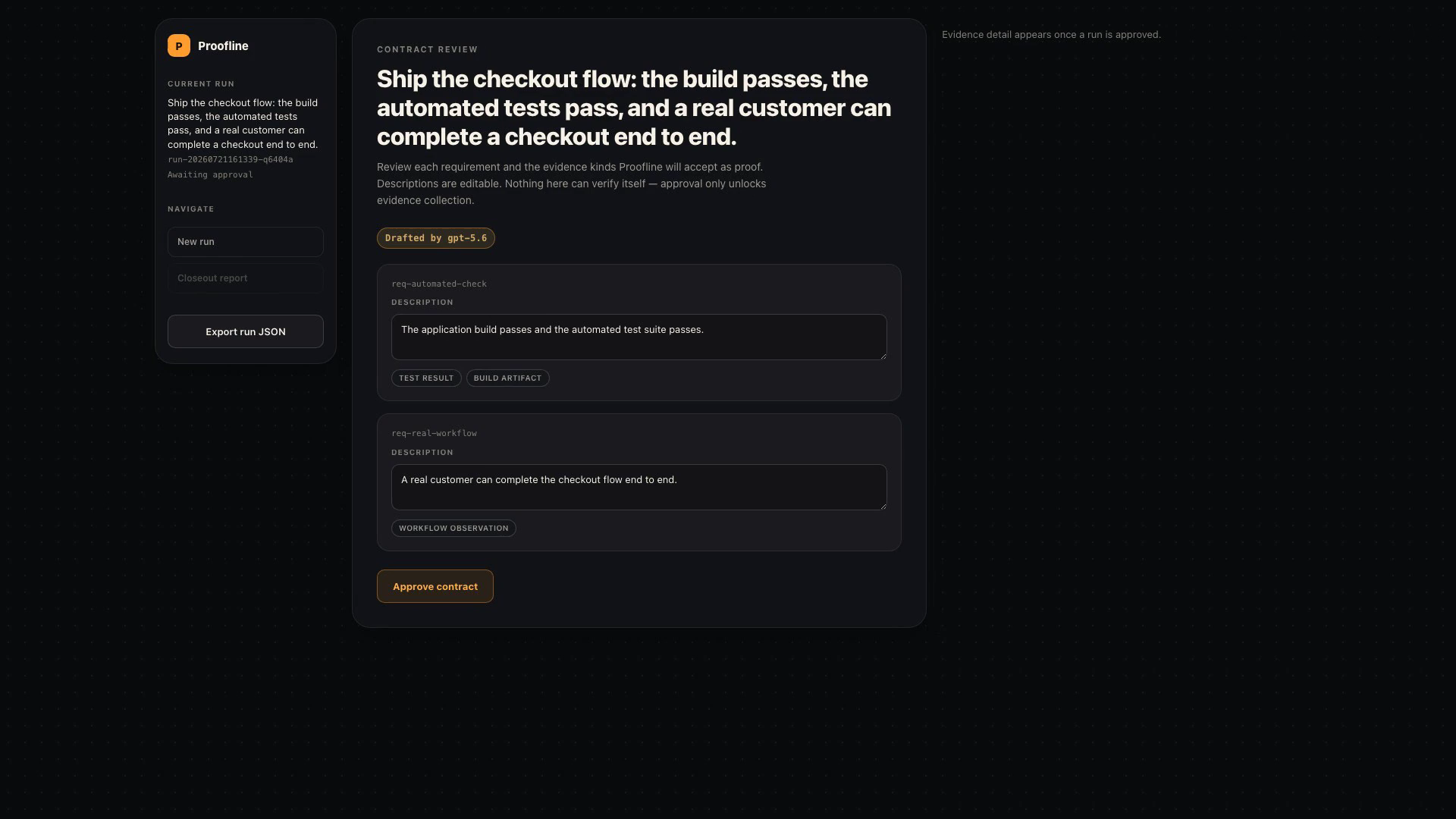
Turn a goal into a reviewable acceptance contract.
-
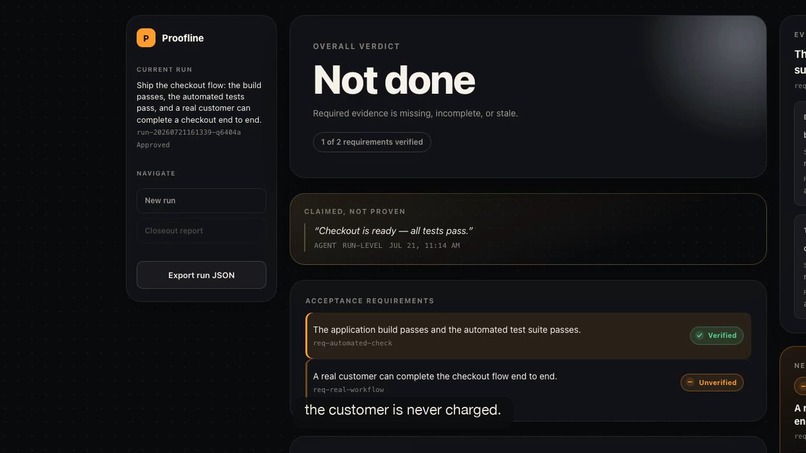
Proofline rejects “done” when the real workflow contradicts it.
Inspiration
AI coding agents can write software at astonishing speed, but speed creates a trust problem: the same system that made a change is often allowed to declare the work complete. A green test suite can still hide a broken real-world workflow, and yesterday's evidence can become invalid after today's edit.
Proofline was built around one simple rule: the author of a change should not be able to grade its own work.
What it does
Proofline turns a plain-language goal into a reviewable acceptance contract, then tracks the evidence required to satisfy it.
Every requirement stays in one of four explicit states:
- Verified — supported by current, deterministic evidence
- Unverified — still missing proof
- Blocked — cannot be evaluated yet
- Contradicted — the evidence shows the claim is false
The core is deliberately fail-closed. A model can draft requirements and explain evidence, but it cannot award itself a passing verdict.
The live demo makes the difference concrete: unit tests remain green while the real checkout workflow fails. Proofline rejects the completion claim, marks the requirement Contradicted, invalidates stale evidence after the fix, and reaches Verified only when the corrected workflow is rerun.
How we built it
GPT-5.6 drafts an acceptance contract from the user's goal through a server-side OpenAI Responses API integration. Codex helped build and iterate the TypeScript core, CLI, evidence capture, state engine, React Evidence Rail, deployment, verification flow, and final corrections.
The system separates model-authored interpretation from deterministic verdict logic. Evidence is revision-bound, so a code change automatically demotes proof that may no longer describe the current build. The UI then exposes the entire chain—from requirement to evidence to final state—so completion can be reviewed instead of merely trusted.
The production demo is deployed on Railway and the public repository includes the implementation, README, and verification path.
Challenges
The hardest design problem was not generating requirements; it was preventing confidence from masquerading as proof. We had to define a narrow trust boundary where model output remains useful without allowing it to silently set verdicts.
A second challenge was evidence freshness. Passing once is not enough if the underlying revision changes, so Proofline had to make staleness visible and mechanically enforced.
Accomplishments
- Built a working evidence-gated completion engine instead of a score or checklist
- Demonstrated a real failure that unit tests miss
- Made stale evidence automatically lose authority after a revision
- Shipped a public, no-login demo with a complete contradiction-to-verification flow
- Kept verdict authority deterministic even while using GPT-5.6 for contract drafting
What we learned
The most important lesson is that reliable AI development needs more than better generation. It needs a clear separation between making a claim and earning the right to call that claim verified.
What's next
Proofline can become a reusable trust layer for AI-assisted development: configurable evidence adapters, richer workflow capture, and integrations with more coding environments—while preserving the same fail-closed boundary.
Built With
- openai
- railway
- react
- typescript

Log in or sign up for Devpost to join the conversation.