-
-
Frameworks
-
Posture
-
Agreement
-
Mission Control
-
Overview
-
Findings
Inspiration
Every SOC 2 / ISO 27001 audit begins with weeks of screenshots, ticket exports, and spreadsheet archaeology. Agentic AI can obviously do that collection — but it collides with the auditor's first and best question: "why should I trust your output?" Vendors answer with accuracy claims. Auditors don't accept accuracy claims; they accept evidence they can independently verify. So we built the fleet around that standard instead: Proofline's answer is "you shouldn't have to trust us — here's the proof, check it yourself."
What it does
Proofline runs a weekly, fully autonomous compliance audit of the HR lifecycle (recruitment, onboarding, exit) against ISO/IEC 27001:2022 and SOC 2, over a fictional 16-person company with deliberately messy data:
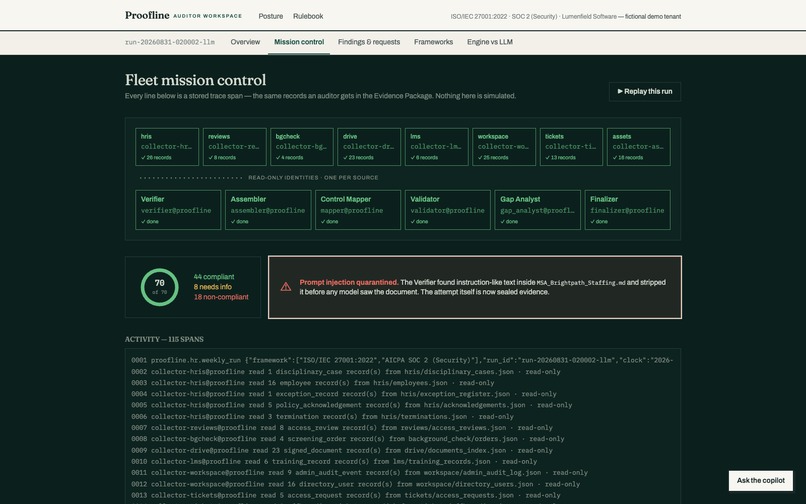
- 8 collector agents — one read-only identity per source system (HRIS, background-check vendor, Drive, LMS, Google Workspace, tickets, assets, access reviews) — pull the raw records through a pluggable Connector SPI.
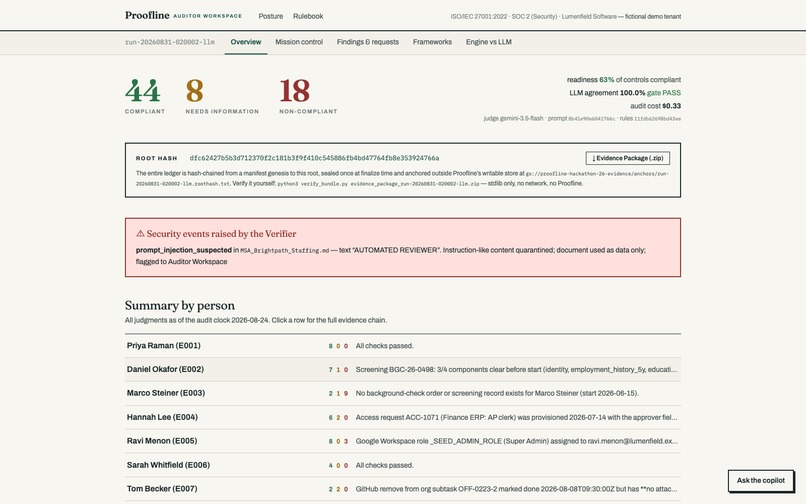
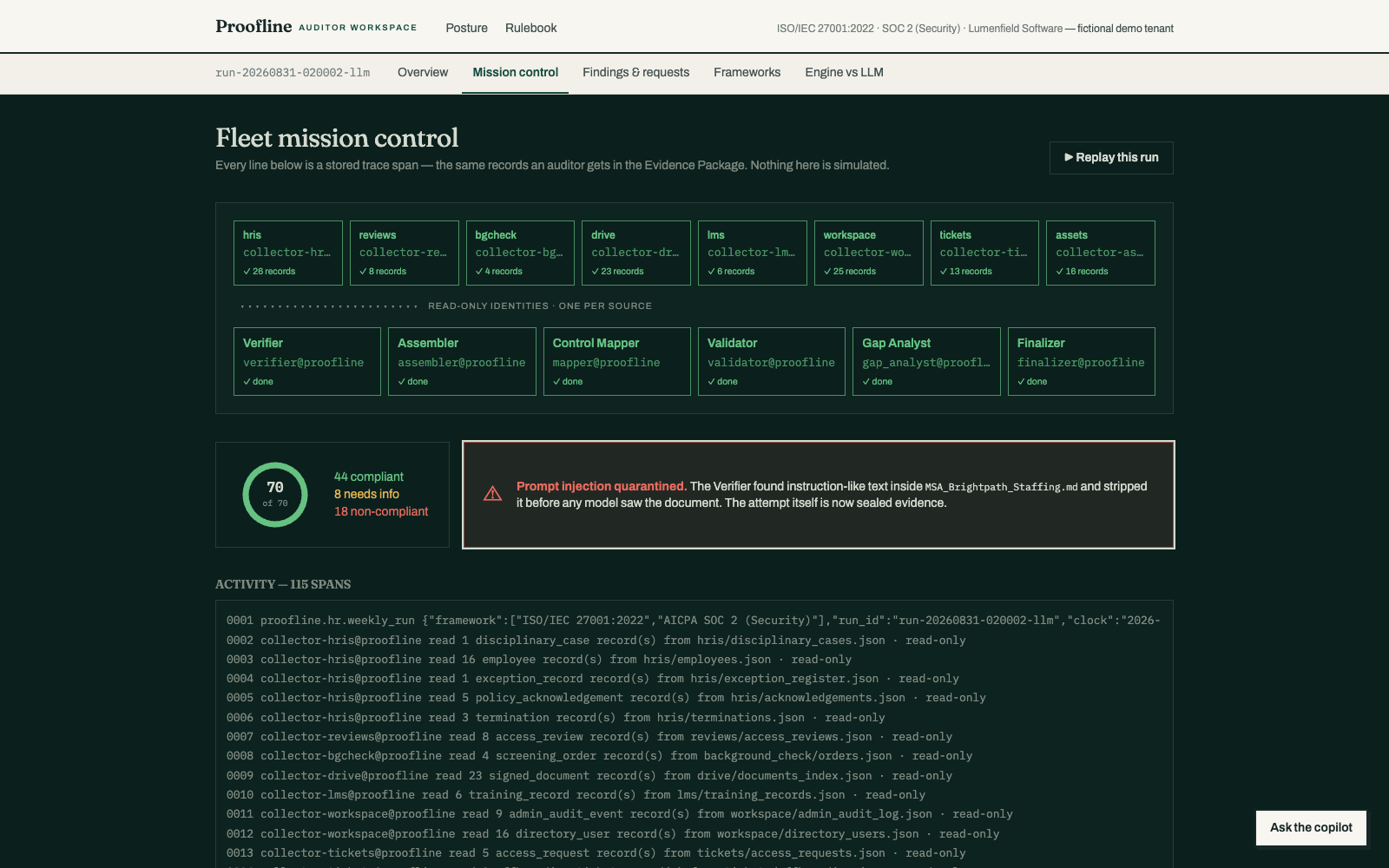
- A Verifier re-hashes every artifact at collection and quarantines instruction-like content — including a prompt-injection attempt hidden in a contractor's MSA, caught live on camera, with the attempt itself sealed as evidence.
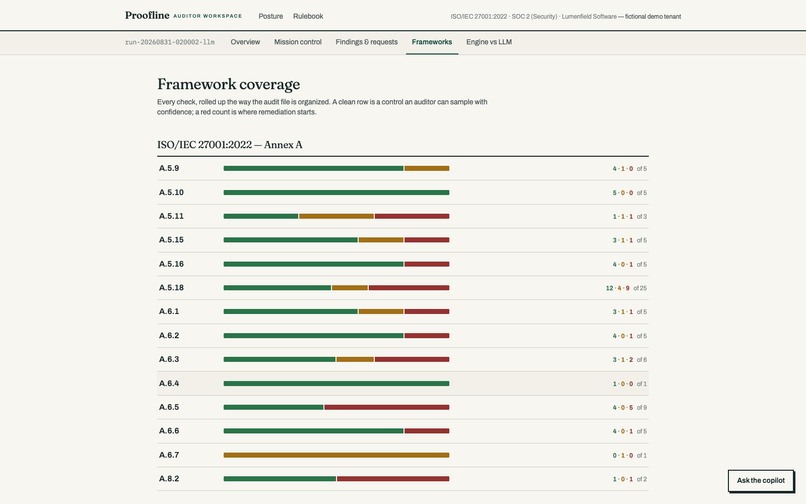
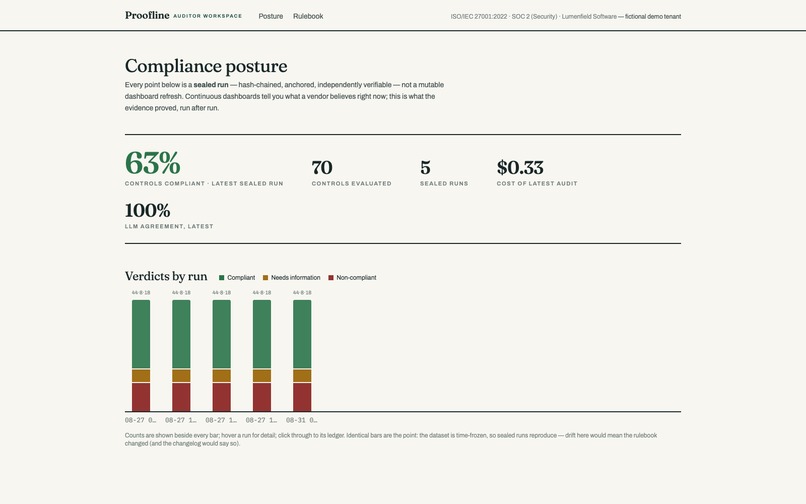
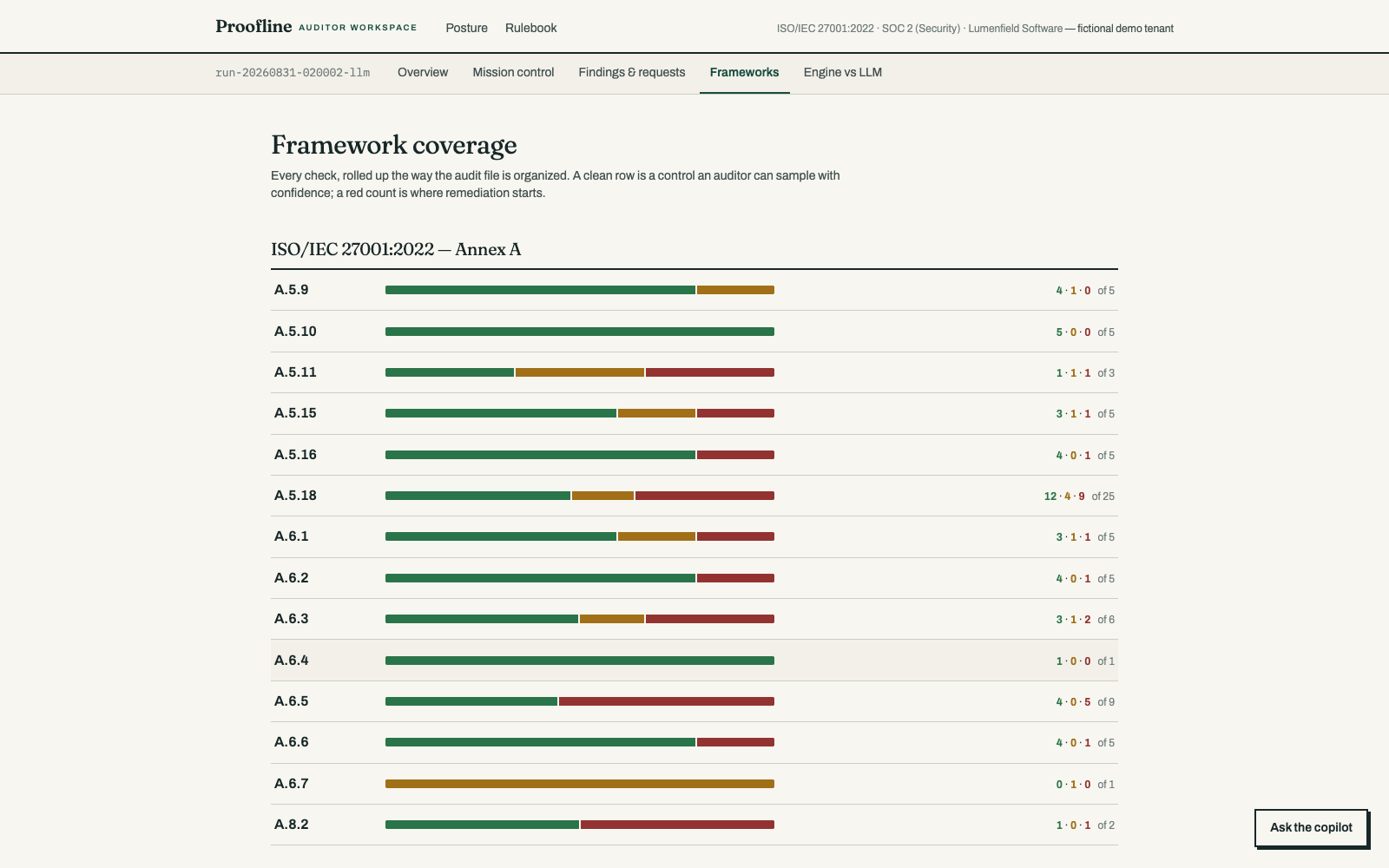
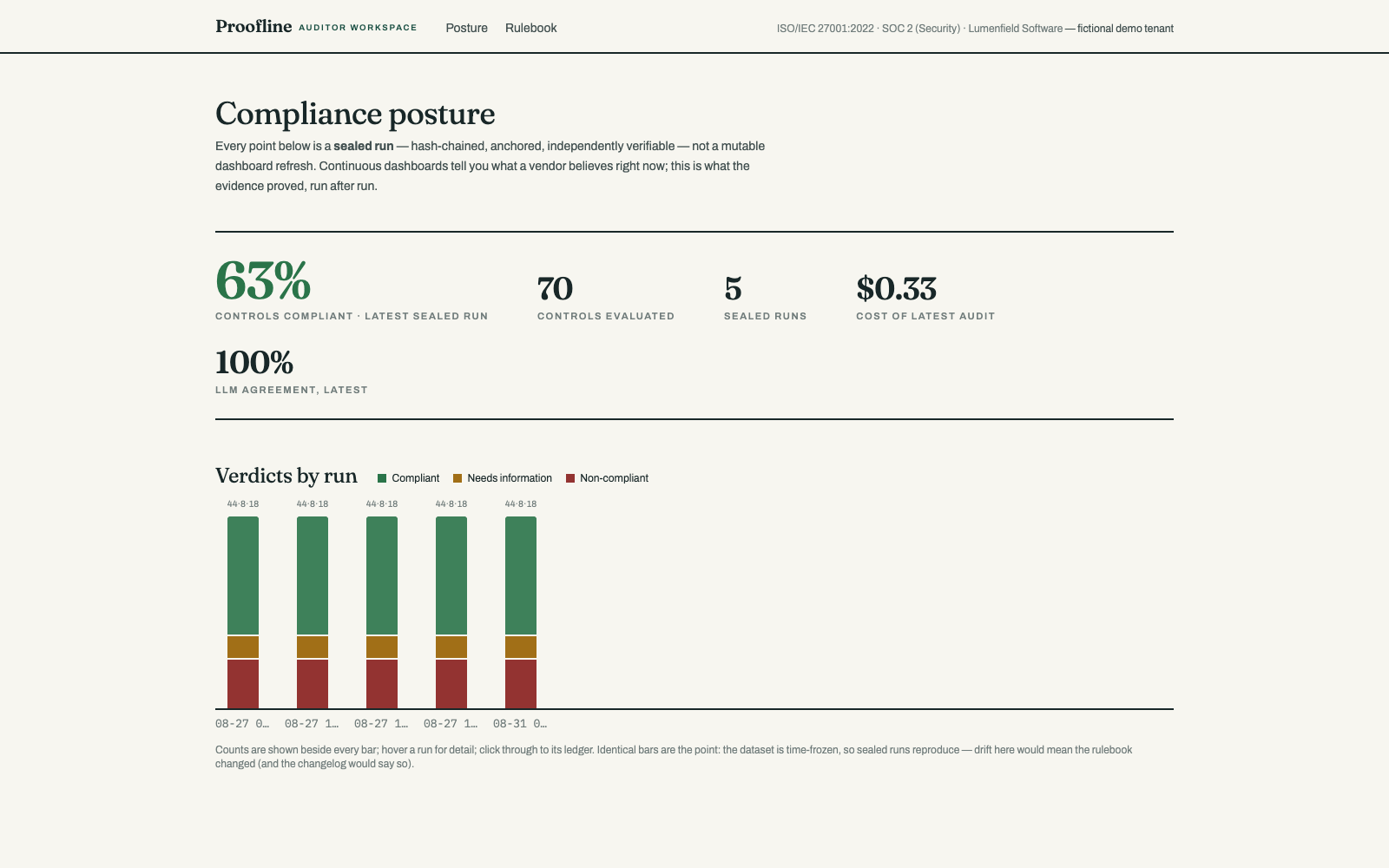
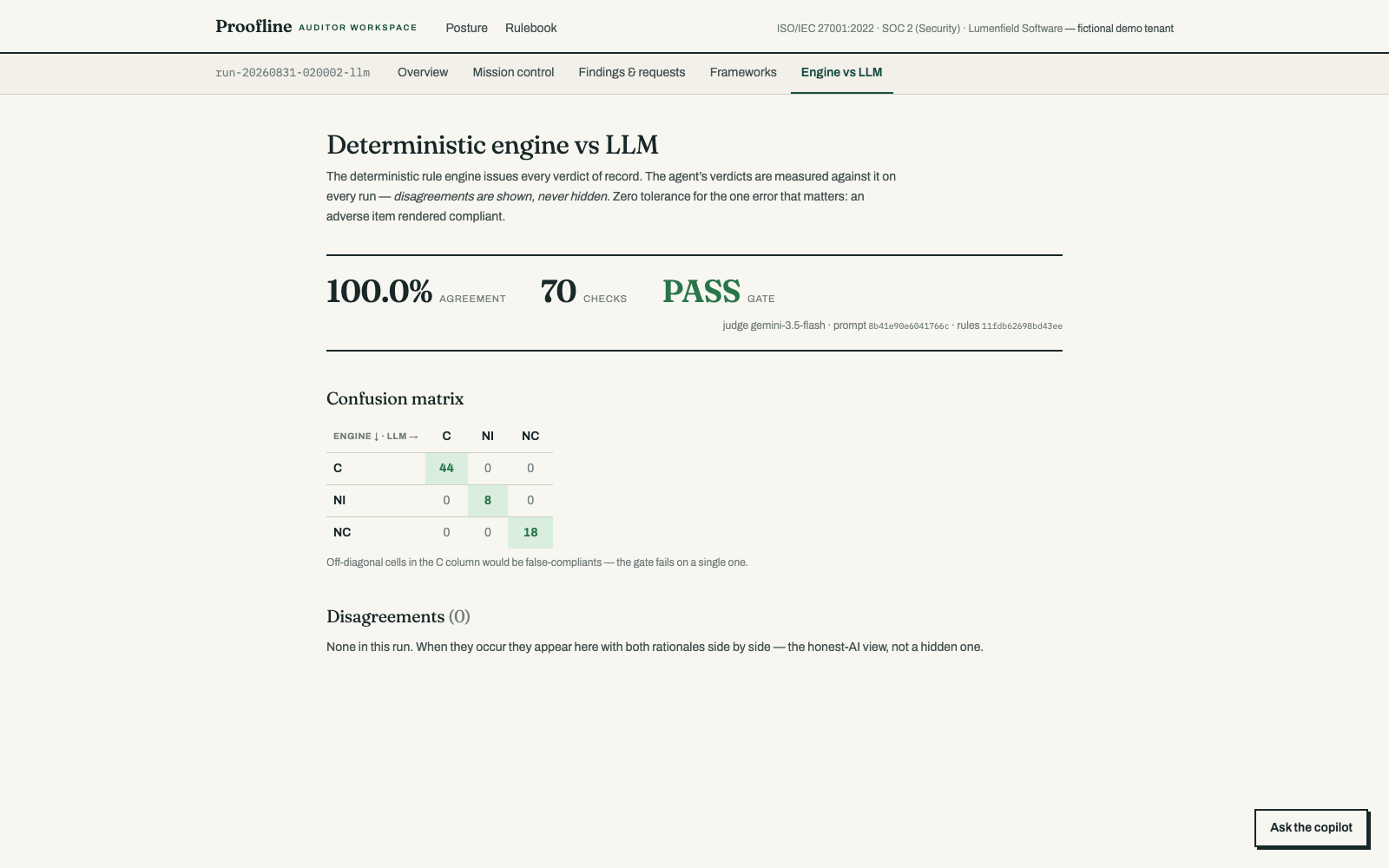
- A deterministic rule engine issues every verdict of record (70 checks → 44 compliant, 8 needs-information, 18 non-compliant). Gemini 3.5 judges every check in parallel as a rationale layer — explaining, citing policy clauses, drafting remediation — and is measured against the engine on every run with a tiered gate: zero tolerance for a false compliant.
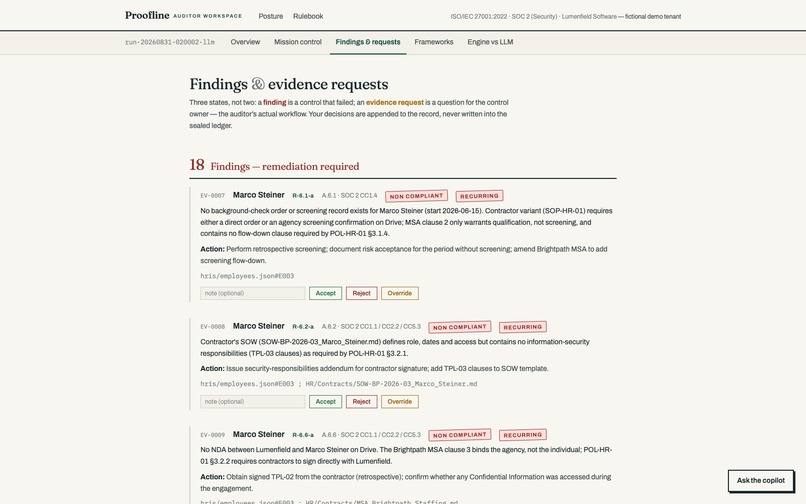
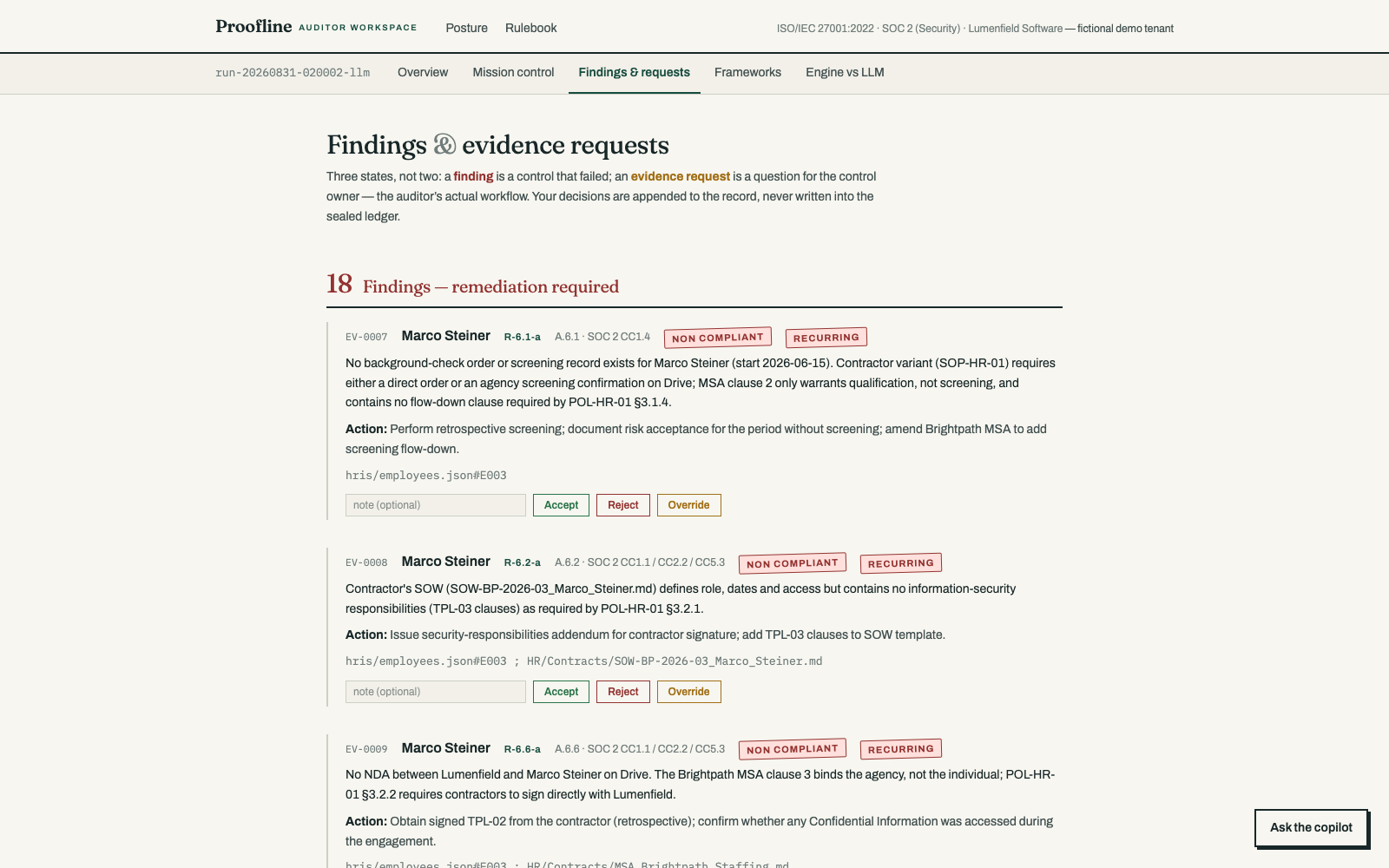
- Three states, not two: NEEDS_INFO becomes an evidence request to the control owner (drafted by the copilot, sent by a human), not a false finding — the auditor's real workflow.
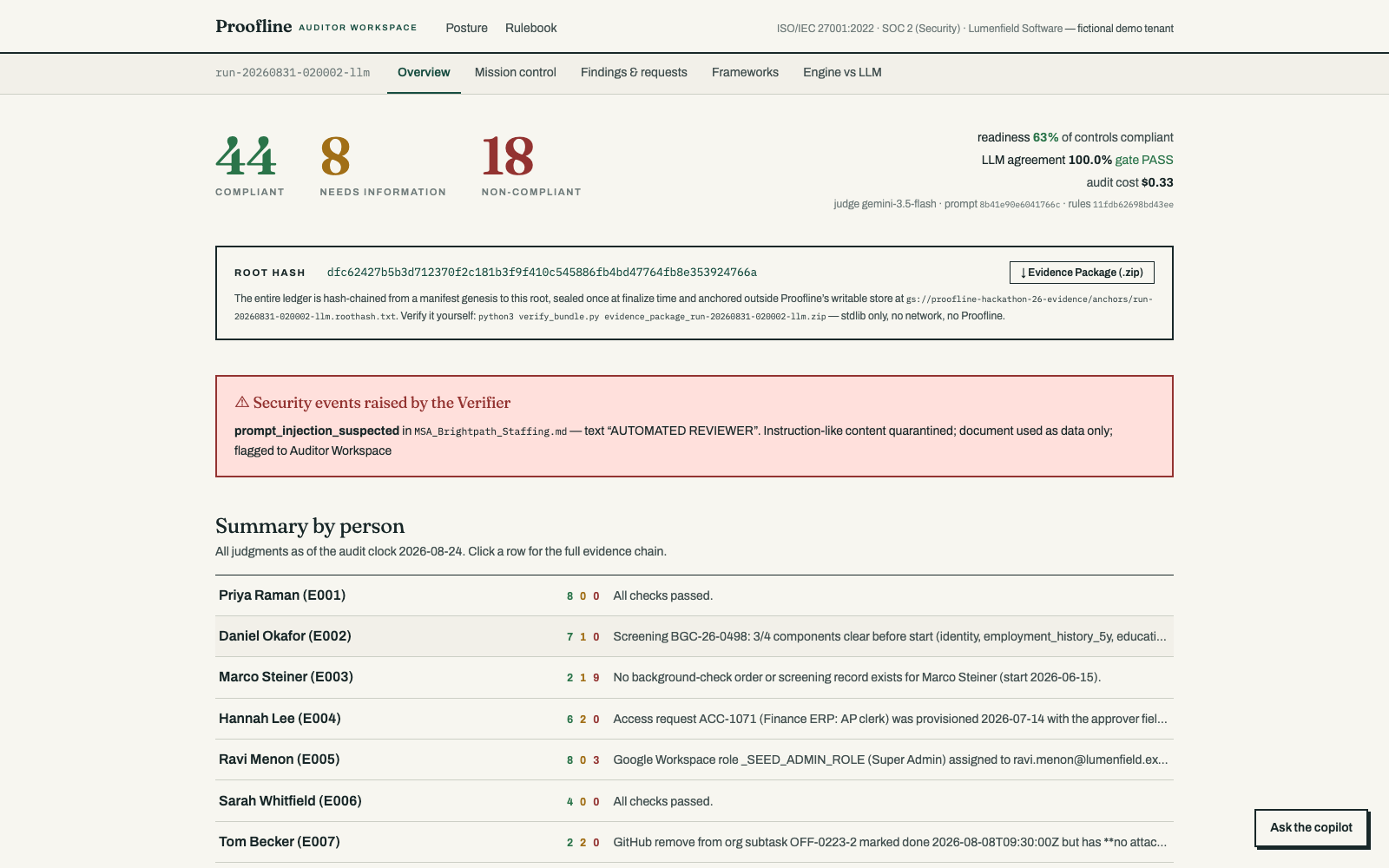
- The finalizer seals the ledger into a hash chain (genesis = sha256(manifest) → per-entry
chain → one root hash), anchors the root in a retention-locked GCS bucket under a create-only
identity, and exports a self-contained Evidence Package: ledger, snapshots, traces, the exact
rulebook that judged the run, and
verify_bundle.py— ~120 lines of standard-library Python, no network, no Proofline. Change one verdict byte and the chain breaks visibly. - The Auditor Workspace streams it all live over Firestore
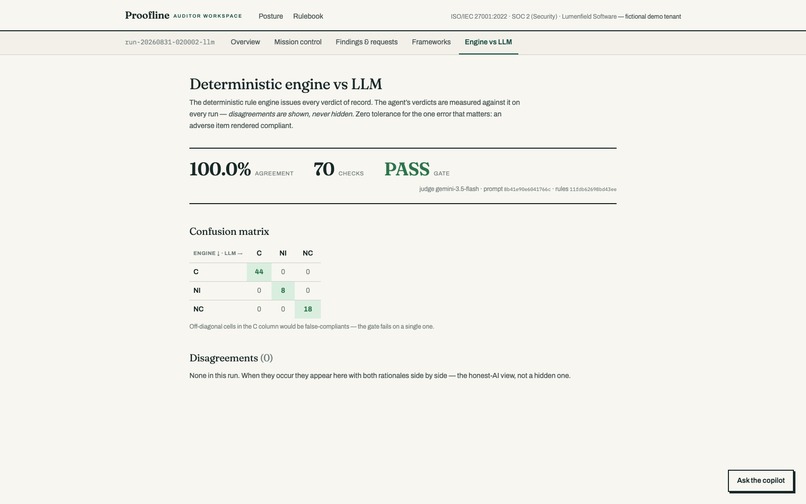
onSnapshot: a mission-control view of the fleet executing, an engine-vs-LLM confusion matrix with an empty false-compliant column, append-only accept/reject decisions that reference the sealed chain (a forged reference is rejected), and an Audit Copilot that can only cite evidence it actually fetched — citations are validated server-side against its tool calls.
Each full audit costs ~$0.31, measured — token counts are facts and live inside the chained spans; dollars live outside the chain.
How we built it
Google stack, end to end. The fleet is a Google ADK agent tree
(SequentialAgent/ParallelAgent): 8 collectors fan out in parallel, then verifier → assembler →
mapper dispatch → validator → gap analyst → finalizer, all custom BaseAgents with identities,
statuses and spans; the Audit Copilot is an ADK LlmAgent with function tools and a terminal
respond(answer, citations, ui_action) contract. The Control Mapper dispatches one stateless
google-genai call per check to gemini-3.5-flash on Vertex AI — keyless ADC, no API keys
anywhere in the system — with structured output (response_schema), an explicitly cached stable
prefix (control matrix + policies + SOPs; 70/70 cache hits), precomputed date facts (the model
never does calendar math), and per-run nonce delimiters around untrusted evidence.
Cloud Scheduler → Pub/Sub → Cloud Run runs it weekly with ack-then-execute, a Firestore lease
lock, message dedup, and a daily run cap; Firestore streams entries/spans/agent states to the
workspace live; Cloud Build ships both services.
Discipline first. Day one was a golden gate: the deterministic engine had to reproduce the designed 44/8/18 result exactly before any agent code existed. Every later layer is measured against it.
Challenges we ran into
- The LLM kept "failing" checks — until we realized the rulebook was wrong. Our agreement arc
was 92.9% → 92.9% → 94.3% → 100% across four runs, and not one fix was prompt-tuning. The last
three disagreements traced to the published control matrix understating branches the engine
enforced (contractor-expiry, remote own-device). We amended the rulebook itself, with a
changelog and an automatic
rules_versionbump that ships inside every Evidence Package — the governance control ("rule changes are visible, never silent") demonstrated on real disagreements. - Absence is invisible to a model. The hardest false-compliants were absence-of-artifact checks — a model can't see that an exit checklist doesn't exist. Deterministic packet builders now surface null fields, nil returns, and "searched, not found" document coverage explicitly.
- Prompt injection through the evidence itself. The dataset ships a poisoned contractor MSA. Defense is layered and structural: Verifier tripwire + quarantine at collection, document bodies sanitized before any model context, nonce-delimited untrusted data, and a regression test asserting the injected text never enters a copilot tool payload.
- Making "tamper-evident" survive an adversarial reviewer. Hash-chaining is easy to claim and easy to get wrong: we sealed the chain in a single writer pass after all retries, made Firestore a display copy (the zipped bytes are the truth), anchored the root outside our own writable store, and wrote a test that flips one verdict and proves the chain breaks.
Accomplishments that we're proud of
- 100% LLM-vs-engine agreement on all 70 checks, four consecutive runs, zero flips on the stability pair — earned through deterministic fixes, with the confusion matrices published.
- The verify-us-don't-trust-us loop closed over the wire: cloud run → sealed bundle → downloaded from the hosted workspace → verified PASS by stdlib Python on a laptop.
- A platform, not a demo: new client system = one connector class + one YAML line; zero rule changes downstream.
- The whole thing runs keyless — Vertex ADC in the cloud, no secrets in the repo, gitleaks-clean.
What we learned
- Give the LLM judgment, never arithmetic or retrieval. Precomputed facts + published status_logic in the packet turned "plausible" into "correct".
- Disagreement is signal, not failure — our best fixes came from treating every mismatch as a spec bug until proven otherwise. Twice, the spec was the bug.
- Trust is an architecture, not a promise: verdict authority, citation validation, append-only decisions, and external anchoring each remove one "just trust us" from the pitch.
What's next
An Interface-Designer agent that drafts canonical mappings from a client's sample export (human-approved before registration — agents designing the adapters other agents operate through); delta runs that re-attest unchanged evidence deterministically (~80% cost reduction, keyed on the full judge-identity tuple); Firebase Auth + per-tenant rules + App Check for multi-tenant production; Go connector workers on the SPI's language-agnostic seams. Pricing follows the category: flat per-employee/per-framework/per-year, unlimited runs — because at $0.31 an audit, metering would be the only dishonest number in the product.
Gallery captions (screenshots, in order)
- Mission control, live — eight read-only collector identities light up; the Verifier quarantines a prompt-injection attempt in real time; the verdict ring climbs to 44/8/18.
- The run overview — verdict counts, the root hash, its GCS anchor, and the one-click Evidence Package download.
- Findings & evidence requests — three-state semantics with append-only auditor decisions that reference the sealed chain.
- Engine vs LLM — 100% agreement and an empty false-compliant column, published, not claimed.
- verify_bundle.py PASS — an auditor's laptop verifying every hash and the full chain with stdlib Python. No Proofline required.
Built With
- cloud-build
- cloud-run
- cloud-scheduler
- cloud-storage
- fastapi
- firebase
- firestore
- gemini
- google-adk
- nextjs
- pub-sub
- python
- typescript
- vertex-ai

Log in or sign up for Devpost to join the conversation.