-
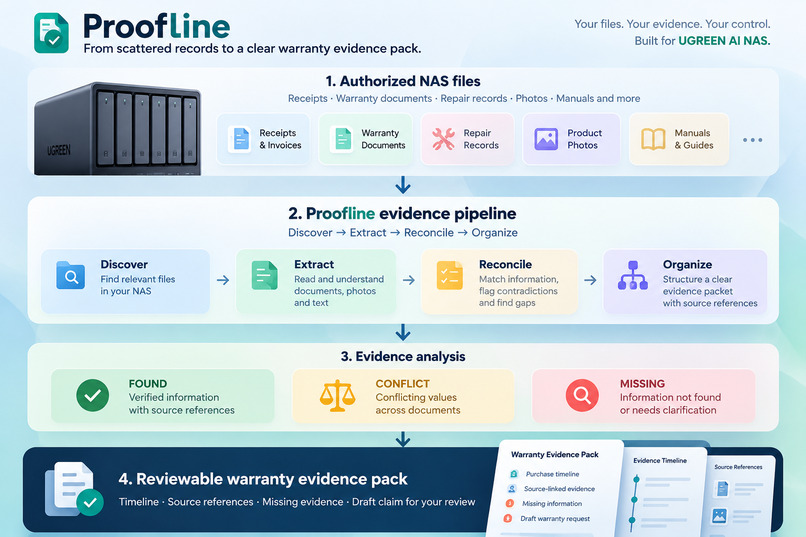
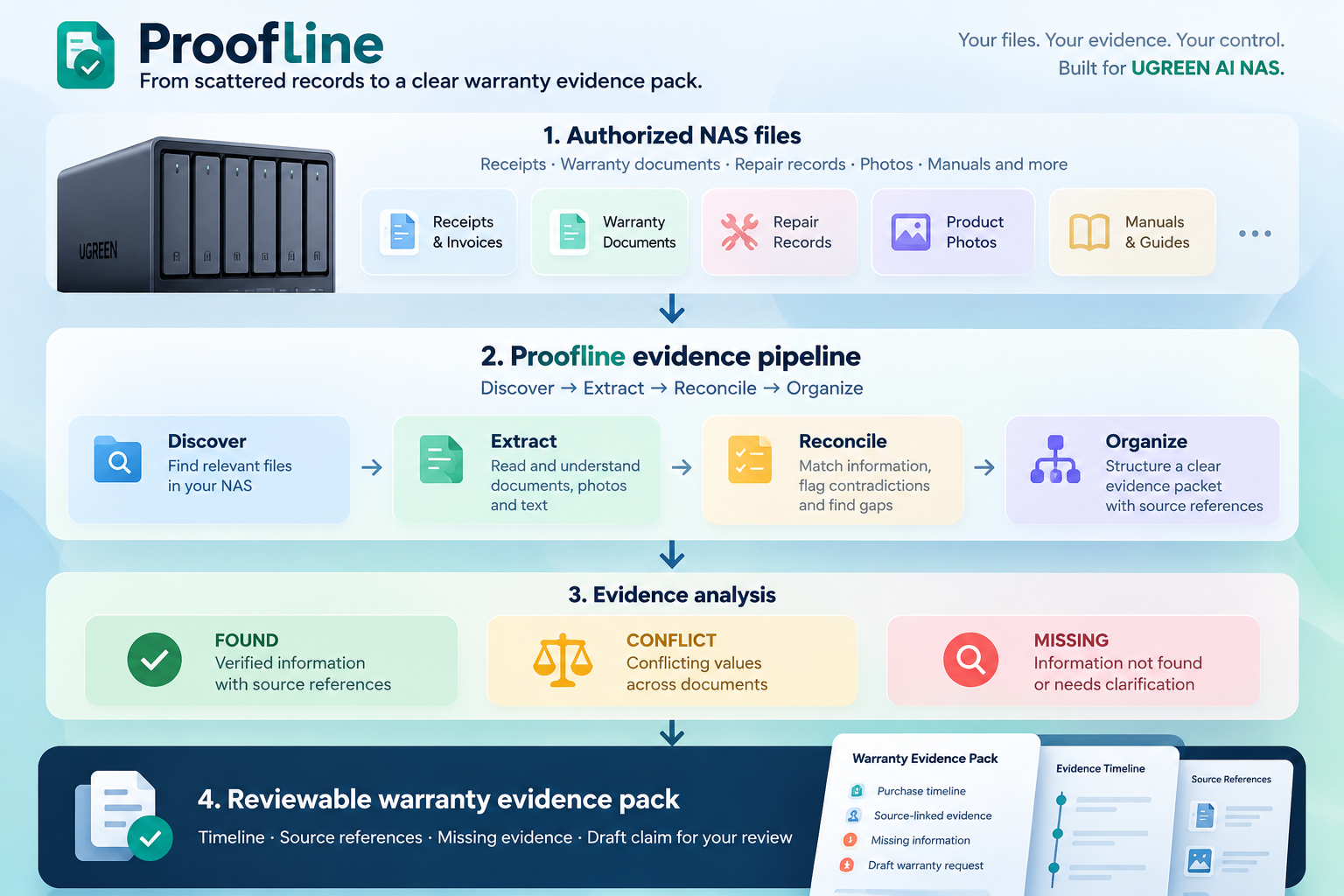
workflow diagram
Inspiration
When a device breaks, finding the receipt, warranty terms, purchase details, and repair history can become a frustrating investigation. The information is often scattered across folders, PDFs, and photos, and a single missing document can make preparing a warranty request unnecessarily difficult.
We wanted to explore a more useful role for AI: not simply summarizing files, but helping people build a reliable, verifiable case from the information they already own. That idea became Proofline, a private warranty evidence builder designed around one principle: every important fact should have a source, every contradiction should be visible, and missing information should never be invented.
What it does
Proofline transforms scattered product records into a structured, reviewable warranty evidence packet on UGREEN AI NAS.
Users specify a product, an incident timeframe, and the folders they authorize Proofline to search. The workflow is designed to locate relevant receipts, warranty documents, service records, and photographs, then organize extracted information into:
- A chronological incident and purchase timeline.
- A source-linked evidence ledger.
- Field-level FOUND, CONFLICT, and MISSING statuses.
- A checklist of missing information and follow-up questions.
- An optional draft warranty request for the user's review.
Unlike a generic AI summary, Proofline distinguishes source-backed facts from unresolved contradictions. It does not determine warranty eligibility, guarantee claim acceptance, or submit claims automatically. The user retains control over the evidence and the final output.
How we built it
We designed Proofline as a modular AI Skill using UGREEN's official Skill development workflow as the intended runtime environment.
The Round 1 pre-test package includes a structured SKILL.md, an evidence schema, a validation plan, and documentation covering privacy, permissions, and failure handling.
Its proposed workflow connects file discovery, document extraction, evidence reconciliation, and approved packet creation through the corresponding capabilities registered in UGOS. Each material fact should retain its source reference whenever available. Conflicting values remain visible instead of being silently resolved, and saving requires user confirmation.
The design prioritizes the NAS's built-in local model where supported, read-only access to source material, and explicit handling of unavailable or unreadable files. Exact capability mappings and runtime behavior must be verified through the official Skill Creation Tool and NAS environment.
Challenges we ran into
The hardest design challenge was deciding how an AI system should behave when its sources are incomplete or disagree.
A receipt and a warranty document might contain different product identifiers or dates. A missing service record might mean that the record was never created, not that the repair never happened. Treating these situations as ordinary summarization problems could produce misleading results.
We addressed this in the workflow design by separating FOUND, CONFLICT, and MISSING states, preserving source references, and requiring clarification when evidence cannot be reconciled. Another challenge is working within the actual capabilities of the NAS environment rather than assuming that every document, photo, or operation is supported.
Accomplishments that we're proud of
We developed a focused Skill specification with a complete proposed workflow, a structured evidence schema, privacy boundaries, explicit failure handling, and concrete validation scenarios.
We are particularly proud of making uncertainty a first-class part of the output. Proofline is designed to show users not only what the available records support, but also where the evidence is inconsistent or incomplete.
The result is a defined, testable approach to turning personal records into an actionable evidence packet without sacrificing traceability or user control.
What we learned
Useful AI automation is about more than generating a polished answer. It also requires reliable source attribution, predictable handling of failure, careful permissions, and a clear boundary between evidence and inference.
Designing Proofline reinforced the importance of making AI outputs auditable. A system that openly identifies missing information can be more useful than one that produces a confident but unsupported conclusion.
We also learned that an AI NAS should be treated as more than a place to store files: its combination of private storage, document access, media organization, and AI capabilities creates opportunities for workflows grounded in a user's own information.
What's next for Proofline
Our next step is to validate the Skill against the official UGOS Skill Creation Tool and map the proposed workflow to the capabilities actually available in the environment.
The planned validation includes a standard case containing a receipt, warranty document, and service record; a conflict case containing inconsistent product or date information; and an edge case involving inaccessible or unreadable files.
With access to a UGREEN AI NAS, we aim to verify source attribution, capability compatibility, permission boundaries, and save confirmation end to end. We also plan to improve the evidence packet's usability and evaluate how consistently it handles incomplete records.
Our long-term vision is to extend the same evidence-first approach to other record-heavy tasks while keeping every material claim traceable, every unresolved gap visible, and the user in control.
Built With
- aiagents
- artificialintelligence
- documentprocessing
- filemanagement
- informationextraction
- knowledgemanagement
- markdown
- ugos
- ugreenainas
- workflowautomation

Log in or sign up for Devpost to join the conversation.