Inspiration / problem
Reading should not end with a confident answer from a chatbot. It should help you understand what the author actually said and decide what you think about it.
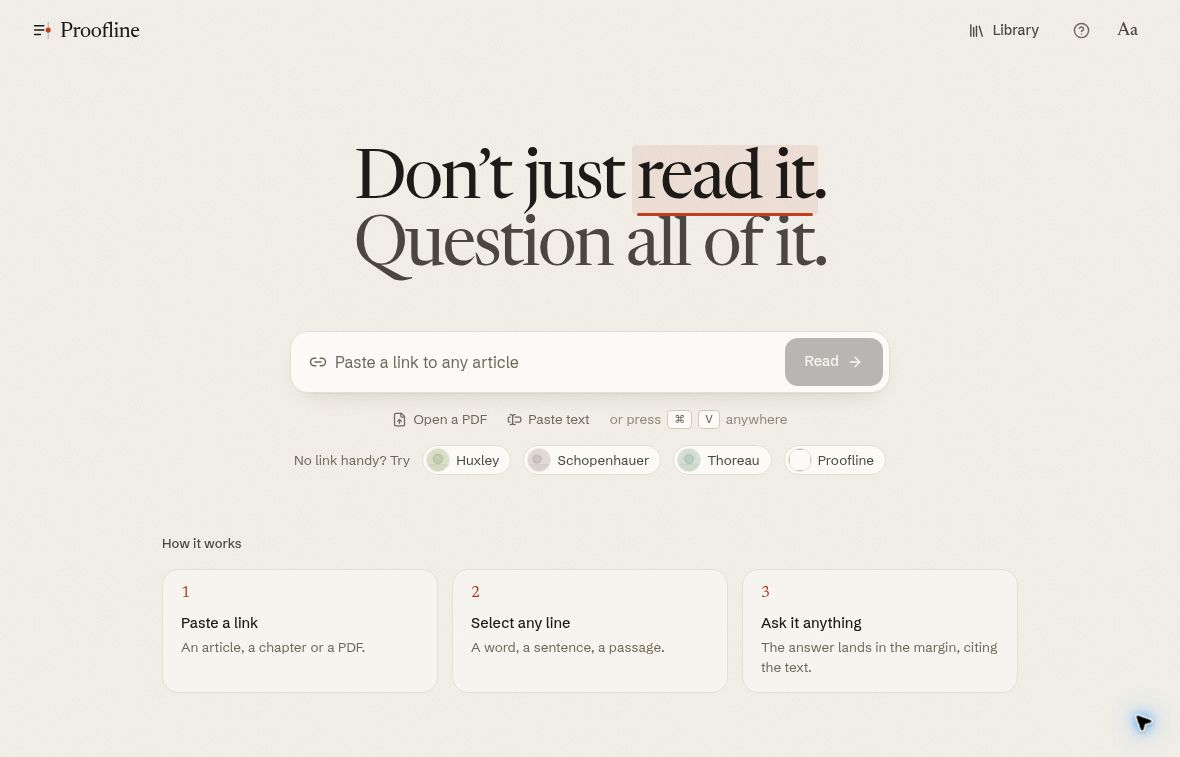
I wanted a reading space for students, researchers and curious readers who keep moving between a document, a chatbot and a notes app. Proofline brings those steps together: read, question, compare and keep the useful parts without losing your place.
What it does / solution
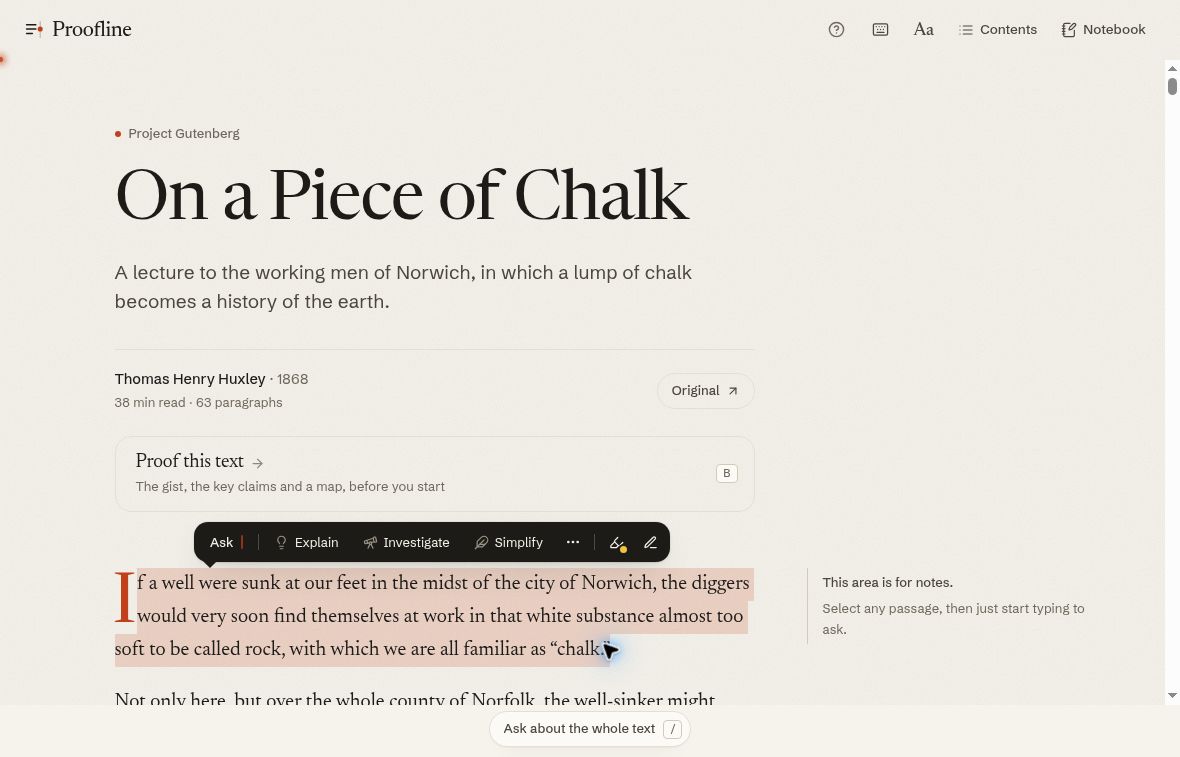
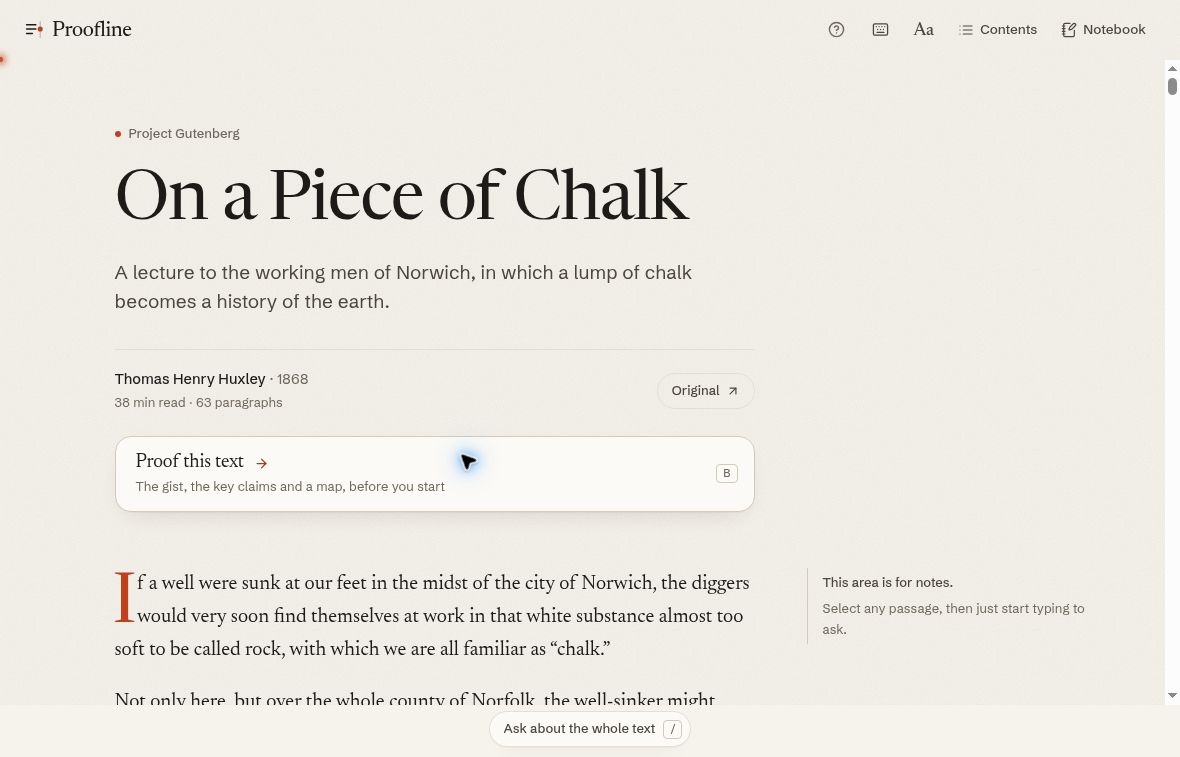
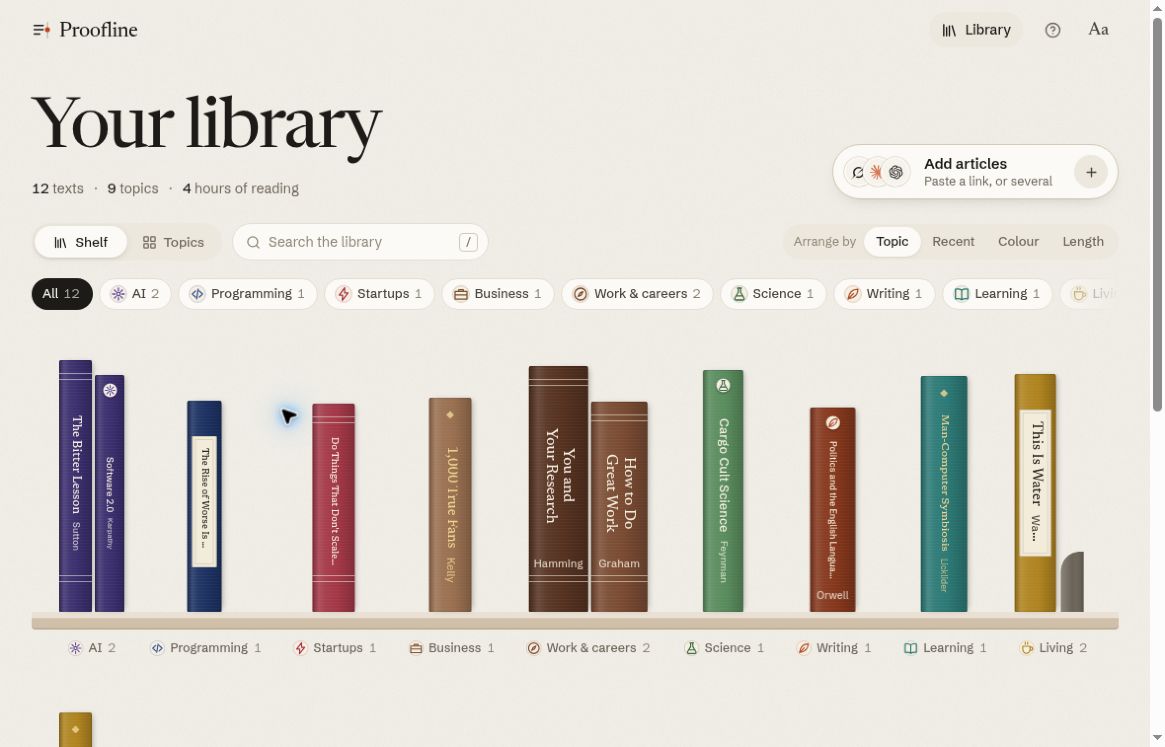
Proofline turns links, PDFs and pasted text into a personal reading library. Select a passage to ask a question or get an explanation in the margin, with paragraph links that take you back to the text. Keep highlights and notes beside the source instead of in a separate chat history.
Investigate compares a claim with selected texts in your library. It retrieves a small set of relevant passages, asks AI for findings, then checks the returned quotations against the stored source text. Quotations that cannot be located are left out and counted. Findings distinguish support, conflict and what the selected passages do not establish.
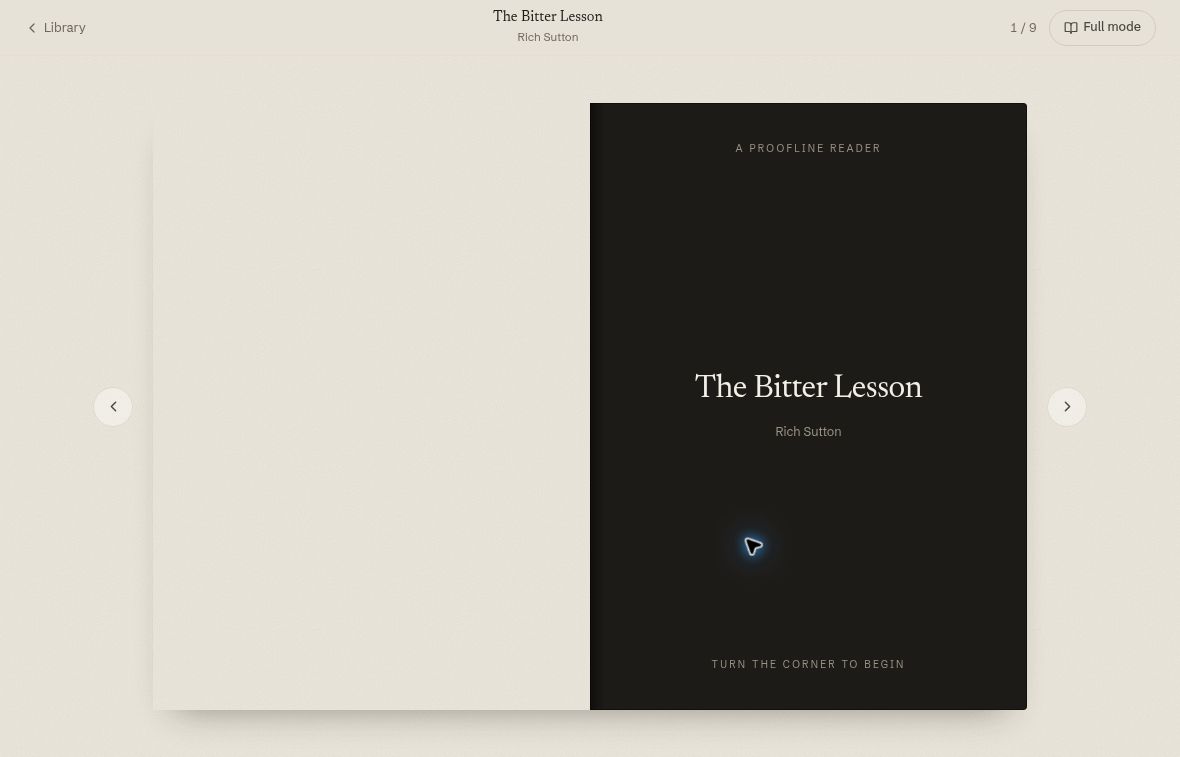
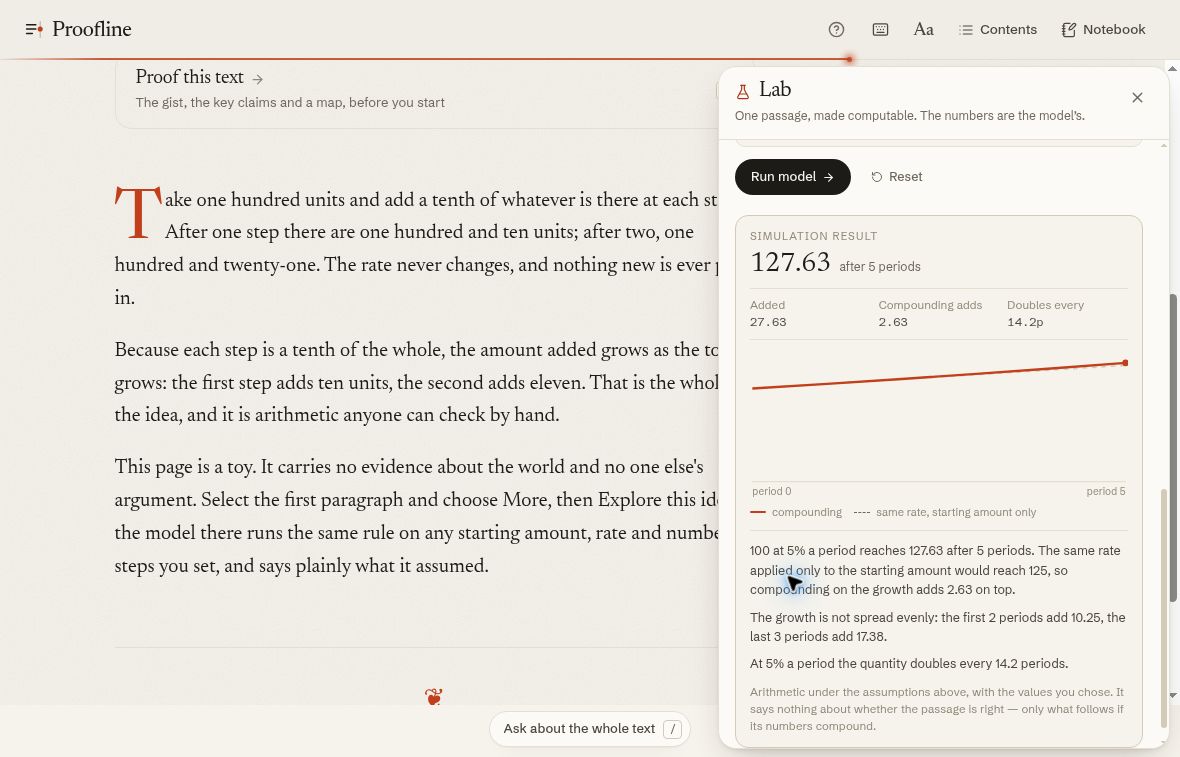
There is also a book-flip view and a small Explore lab for compound growth. The lab runs a reproducible calculation rather than asking a language model to invent the answer.
Why this matters
AI can help a reader think, but its answer should not become a substitute for the source. Proofline keeps the reading experience central and makes it easier to inspect the text behind a claim.
How I built it / architecture
Proofline adapts an earlier project called Gloss into a Base44-hosted reading app. I also entered Proofline in the Base44 Challenge on October 25–26, 2026; this is not a claim that every part of the project originated in this event.
The frontend uses React 18, TypeScript/JSX and Vite 8, with Tailwind CSS and Radix-based UI components. Base44 handles authentication and model requests through InvokeLLM. Dexie and IndexedDB keep the library and reading notes in the current browser. URL imports use Jina Reader; PDF text extraction uses unpdf/pdf.js. The book view uses react-pageflip.
The source represents a recovered backup of the Base44 project. GitHub commits do not automatically update the hosted app. The repository documents the recovery process and the limits of the backup.
Documentation provenance
The current scope.md, prd.md and spec.md were written from the existing code on October 26, 2026 using the Devpost Learn templates. They describe the implemented design and limitations, not dated records of the initial planning conversation.
How AI is used
AI provides passage explanations, reading questions, briefs and library organization. For Investigate, it evaluates passages selected from the user's chosen library texts; this feature does not search the web. The retrieval step selects up to three passages per source, each limited to 1,800 characters, so it is not an exhaustive review of every source.
Code checks whether returned evidence quotations can be located in the stored text and supplies source anchors. This verifies quote grounding, not whether an interpretation is true or an argument is sound. Ordinary margin answers are AI-generated and their paragraph links are not the same as verified evidence quotations.
Challenges I ran into
The central challenge is keeping AI interpretation separate from evidence. A model can produce a plausible quotation that is not actually in a source. Proofline's evidence path therefore checks returned quotations against the stored text instead of treating the model's response as proof.
Another tradeoff is scope. Selecting a few relevant passages makes comparison manageable, but it can miss evidence elsewhere. The interface needs to state that limit clearly. Browser-local storage keeps the prototype simple, but it also means signing in does not sync the library across devices.
Accomplishments I am proud of
The reading interface makes questions feel like margin notes rather than a second application. The library and book-flip view keep the experience recognizably about reading.
The evidence checker is the most important technical distinction: an unlocatable quote is dropped, not displayed as proof. The compound-growth lab also gives readers a small way to test an idea with a deterministic calculation.
What I learned
A useful AI reading tool needs more than fluent answers. It needs clear boundaries between an explanation, a source quotation and a verified fact. A quotation matching the source is valuable, but it still does not prove that the interpretation is correct.
Making the prototype reviewable also means being explicit about storage, source coverage, deployment and what has actually been demonstrated.
What's next
- Add account-backed library sync without losing the simplicity of the current reading flow.
- Improve passage retrieval and make evidence coverage easier to inspect.
- Improve handling of scanned PDFs and difficult imports.
- Expand reproducible Explore models beyond compound growth.
- Record a focused Investigate walkthrough showing comparison, source navigation and rejected quotations.
Built With
- base44
- dexie
- radix-ui
- react
- tailwindcss
- typescript
- vite

Log in or sign up for Devpost to join the conversation.