-
-
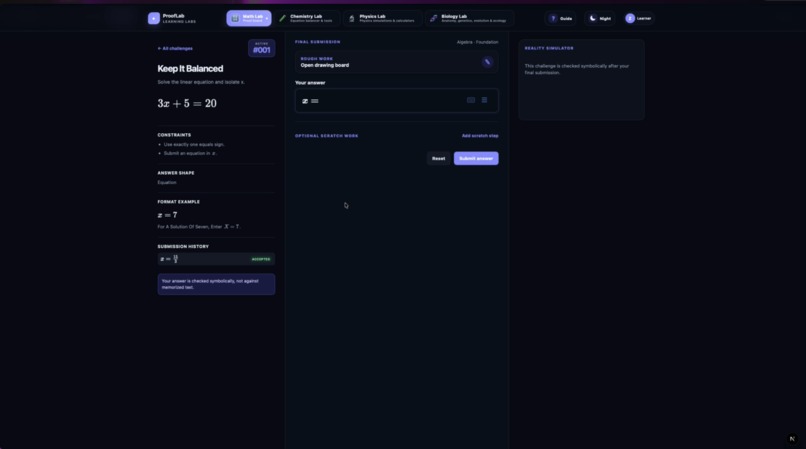
LeetMath Like LeetCode
-
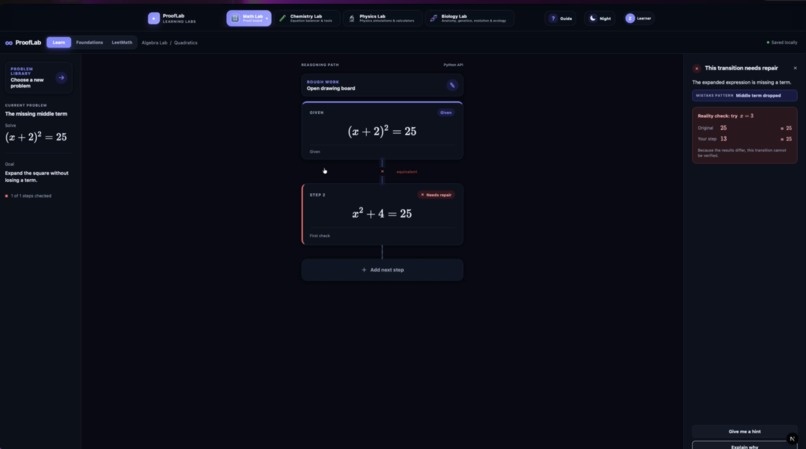
Math Learn
-
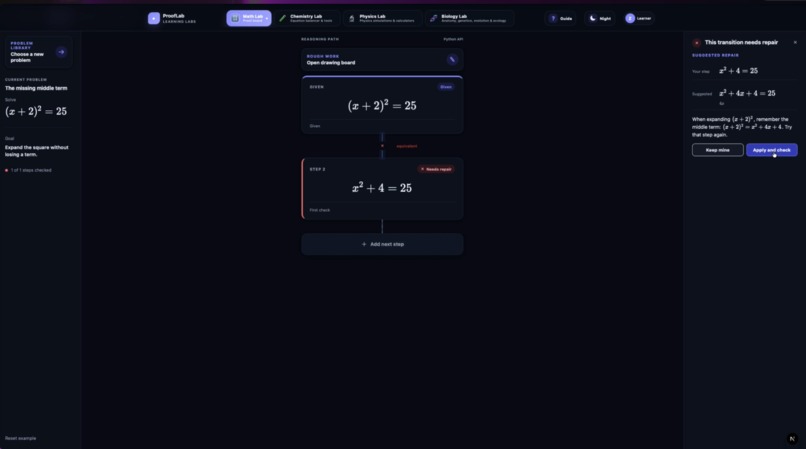
Math Learn AI Solution - Apply Directly
-
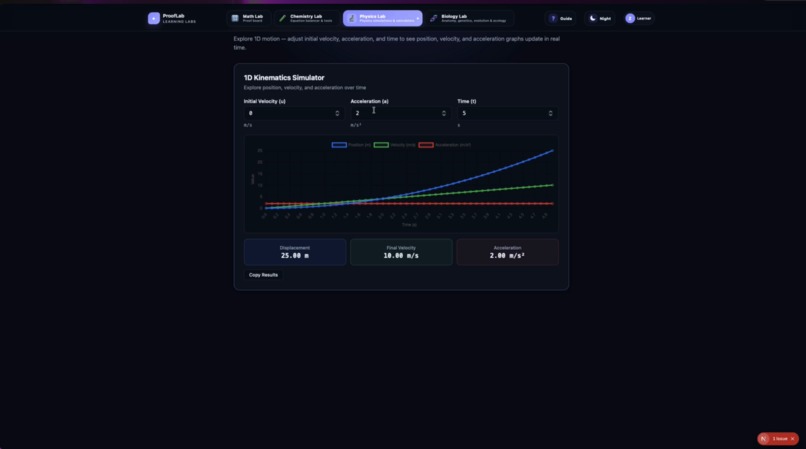
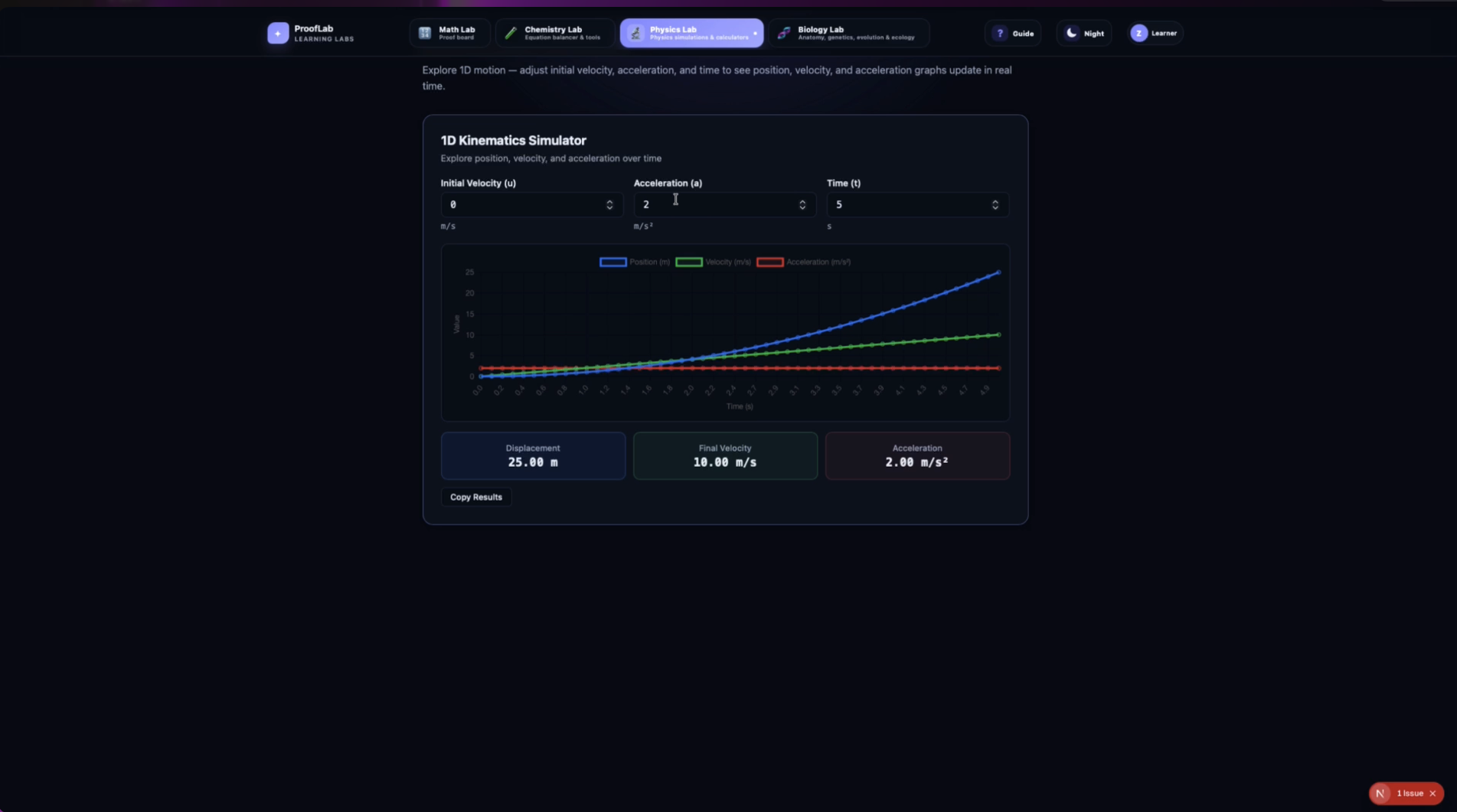
Physics Simulations
-
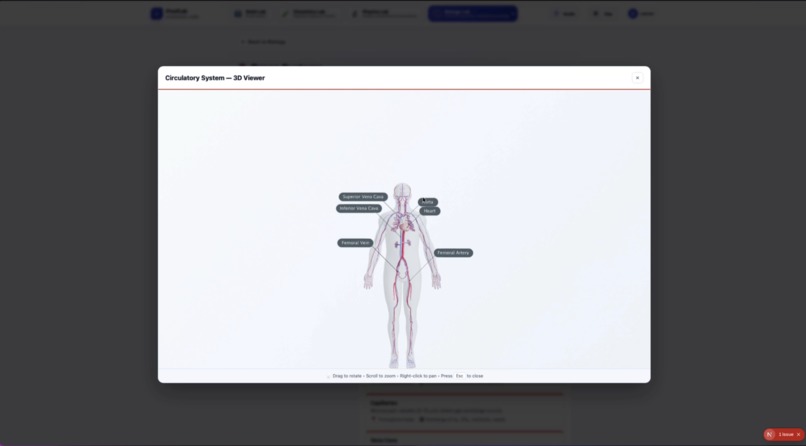
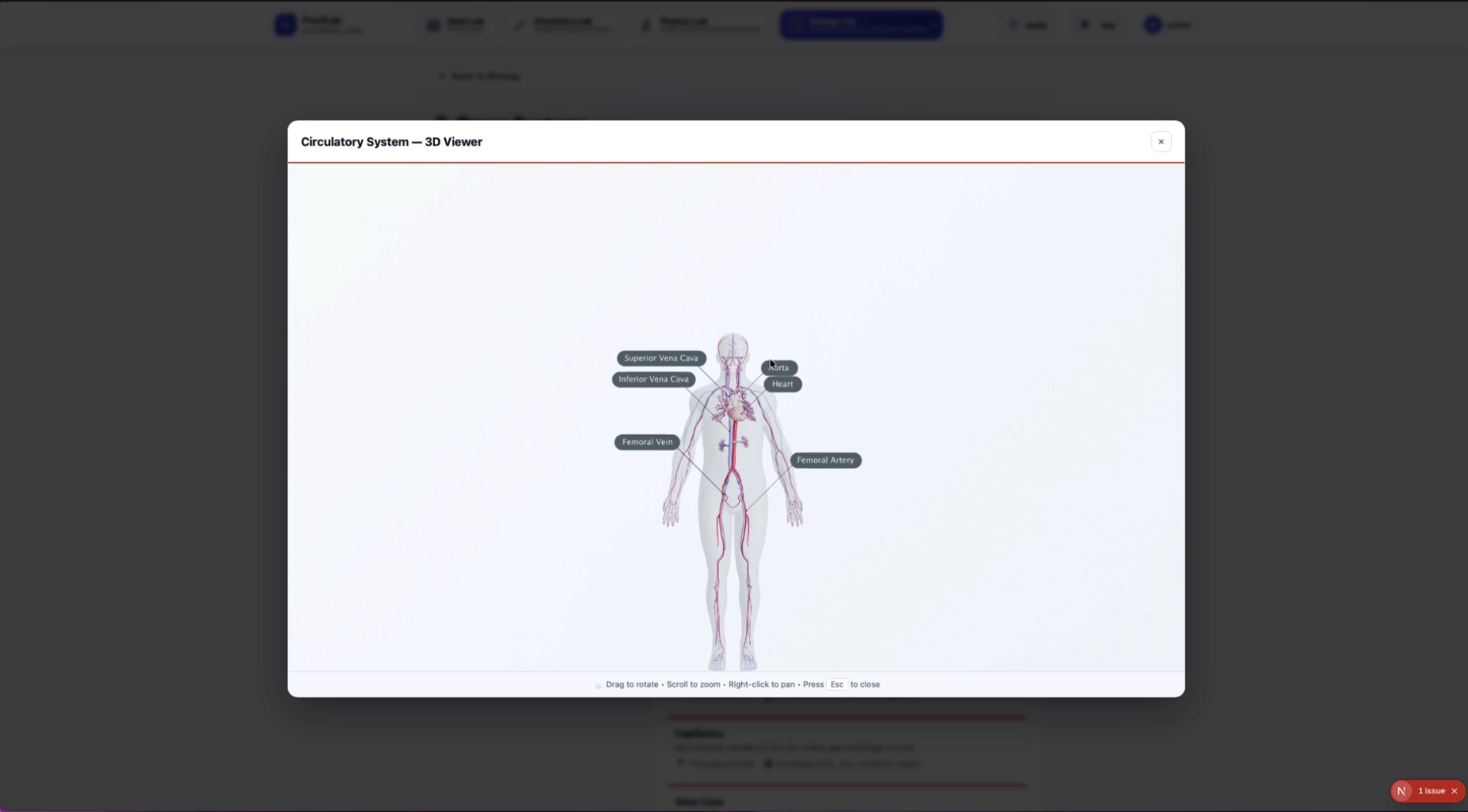
Biology Anatomy 3d Viewer
-
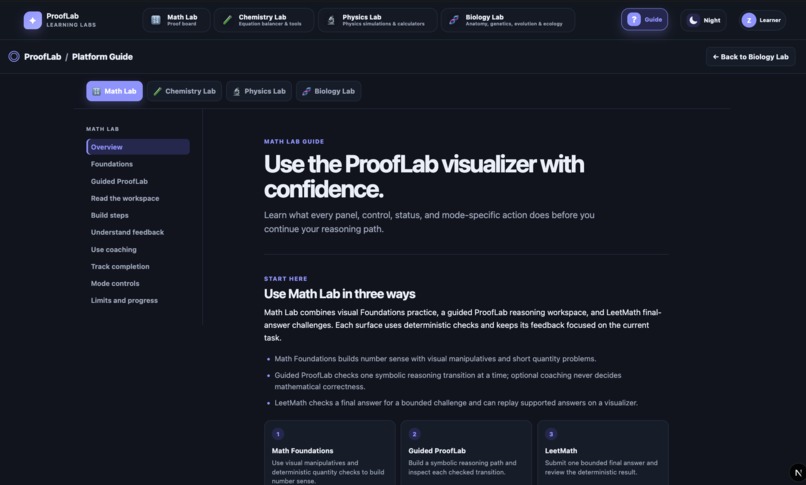
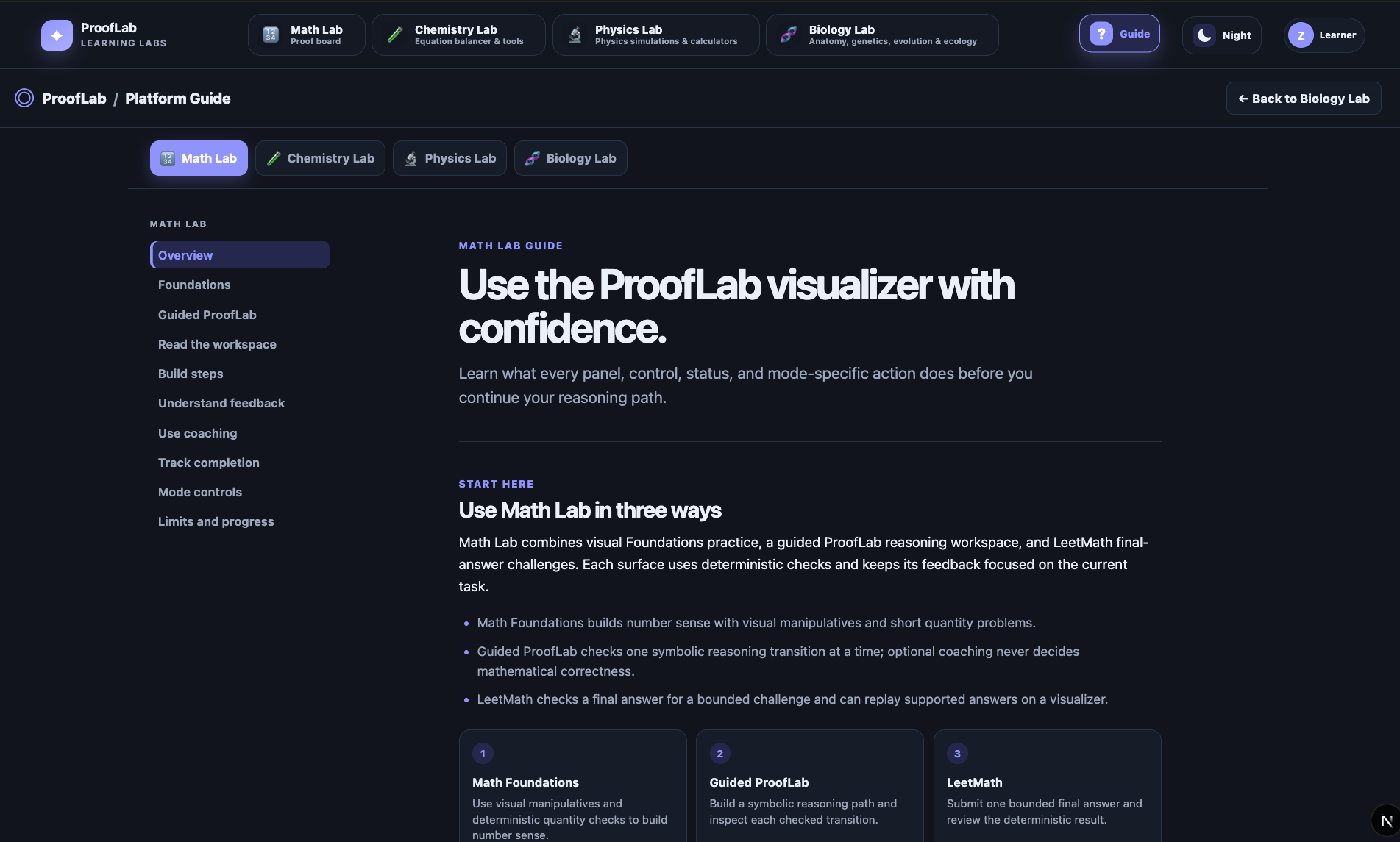
Platform Guide Section
-
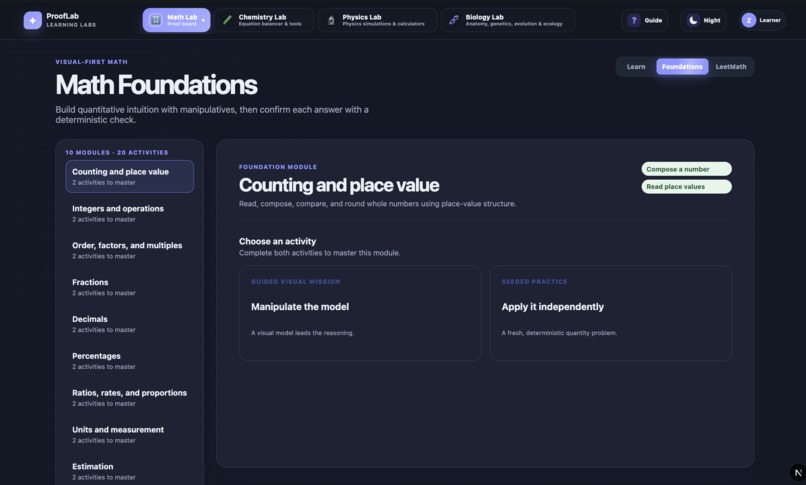
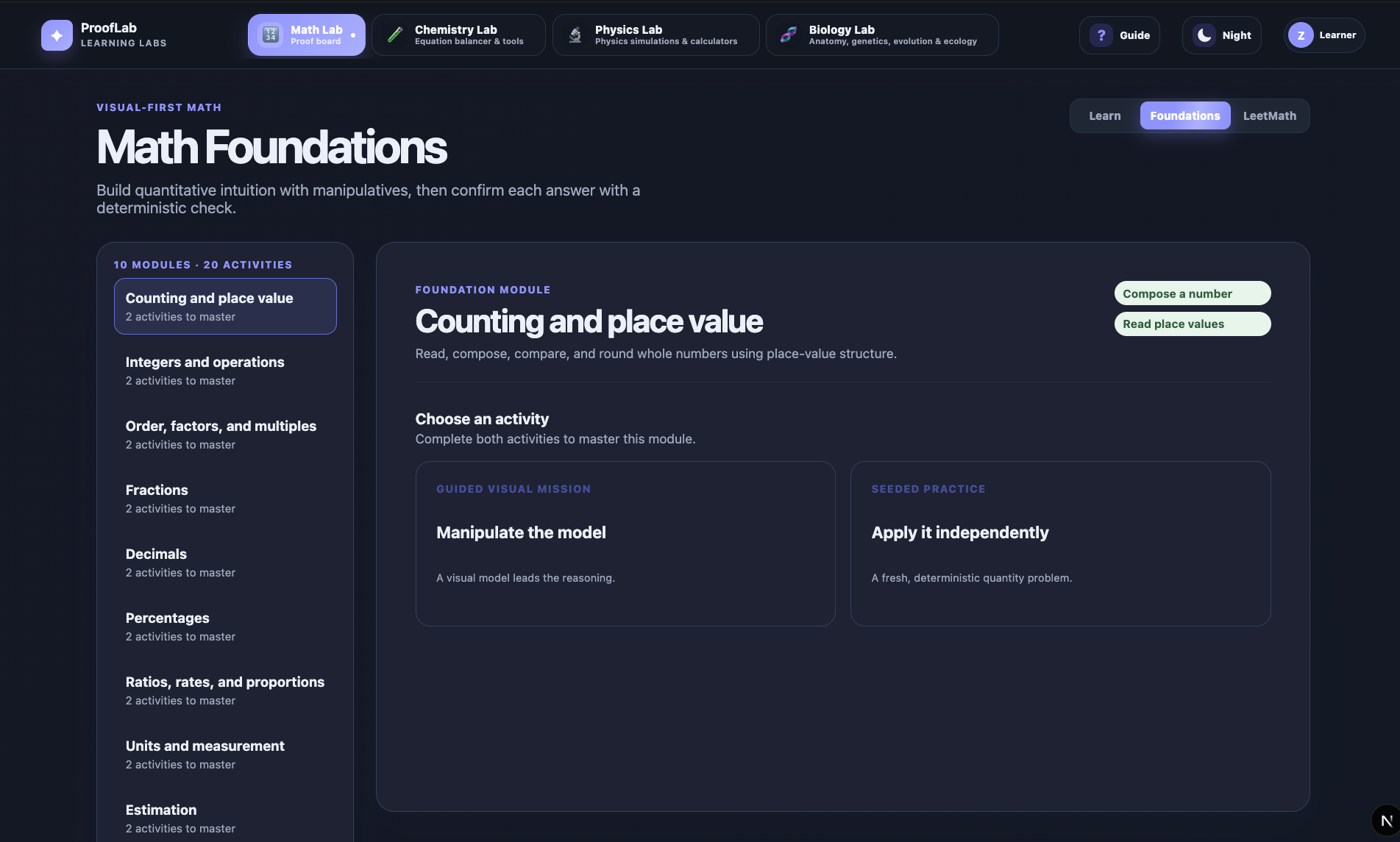
Math Foundations Section
-
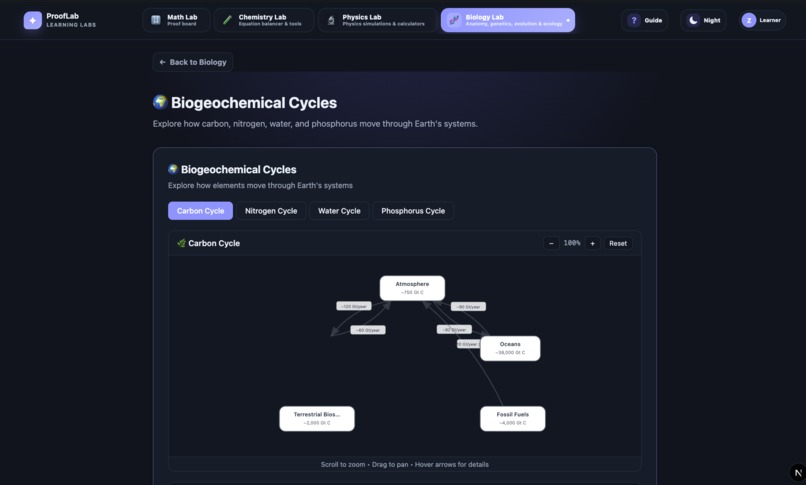
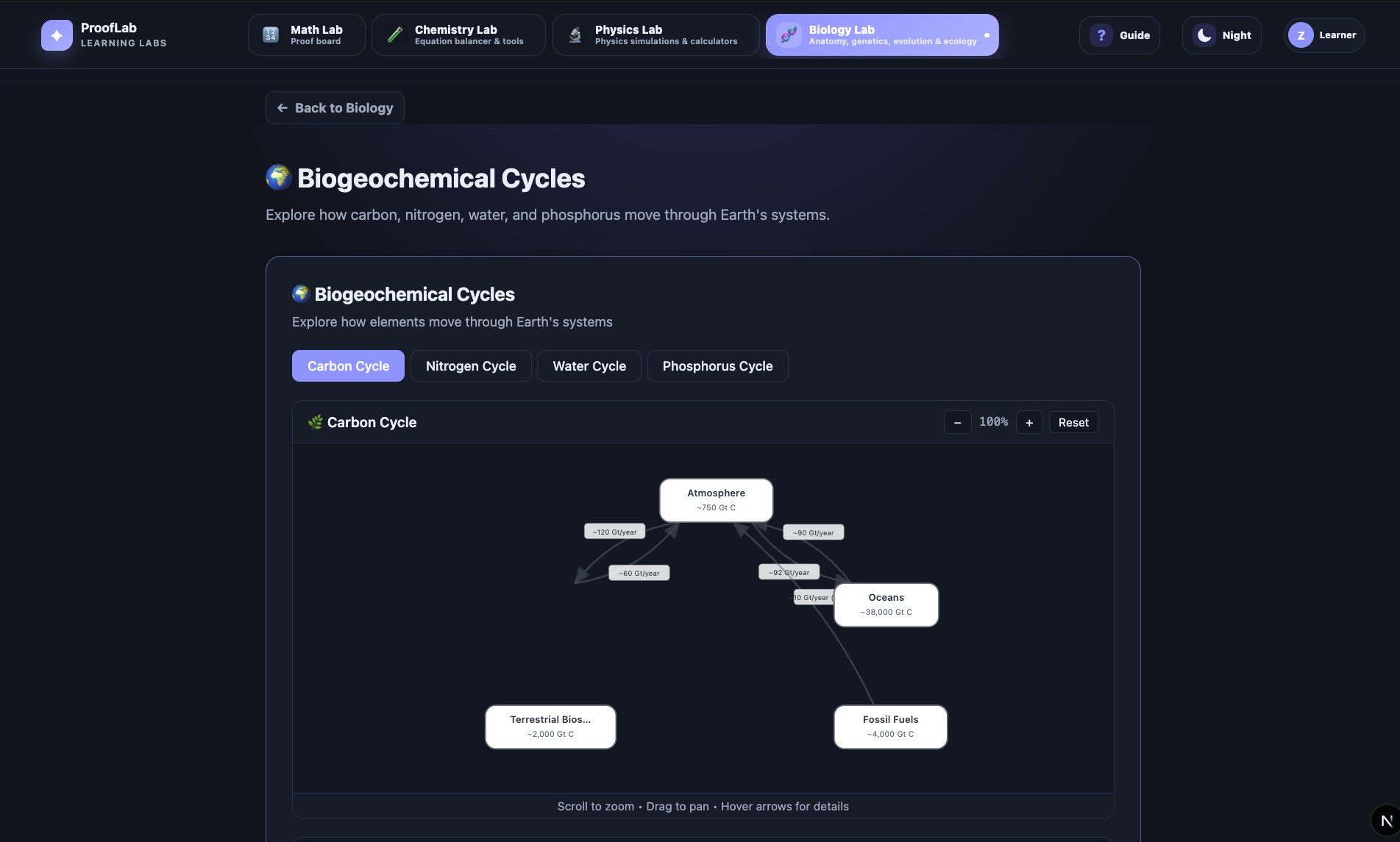
Biogeochemical Cycles
-
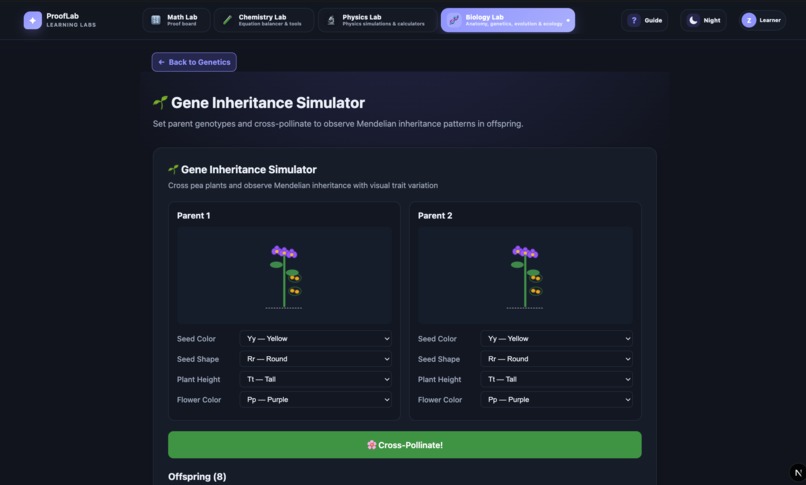
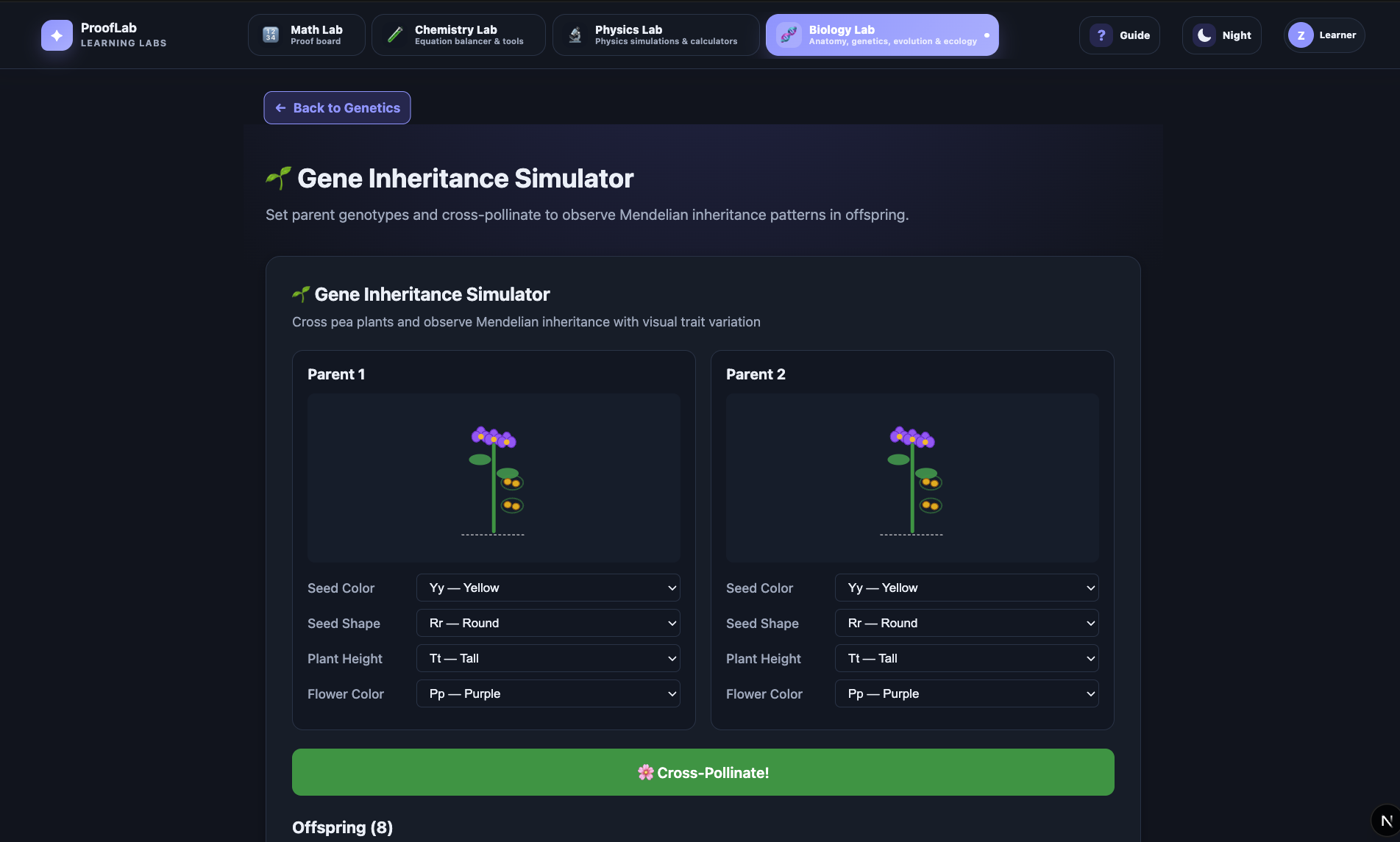
Bio - Gene Inheritance Simulator
Inspiration
Most learning tools can tell students that an answer is wrong, but they rarely show where the reasoning first failed. We wanted to make math feel more like debugging: trace each step, find the broken transition, understand why it fails, and repair it with confidence.
We also wanted one platform where learners can move from Math into Chemistry, Physics, and Biology through interactive exploration instead of static notes.
What it does
ProofLab is an interactive STEM learning platform centered on visual, verifiable reasoning.
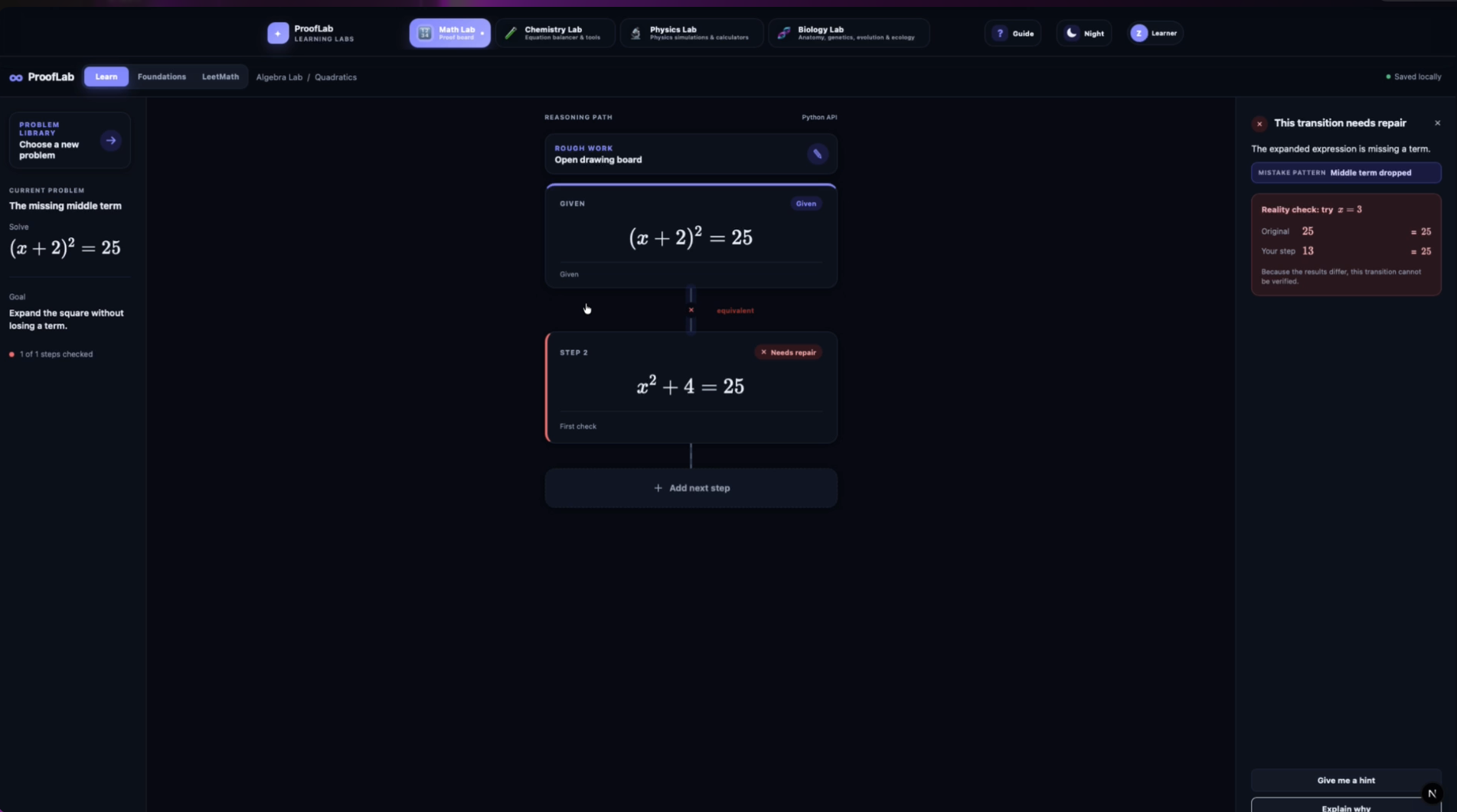
Its Math Lab supports step-by-step work in algebra, inequalities, introductory calculus, and complex numbers. Learners enter equations using natural math notation, build a reasoning path, and receive deterministic verification for each transition.
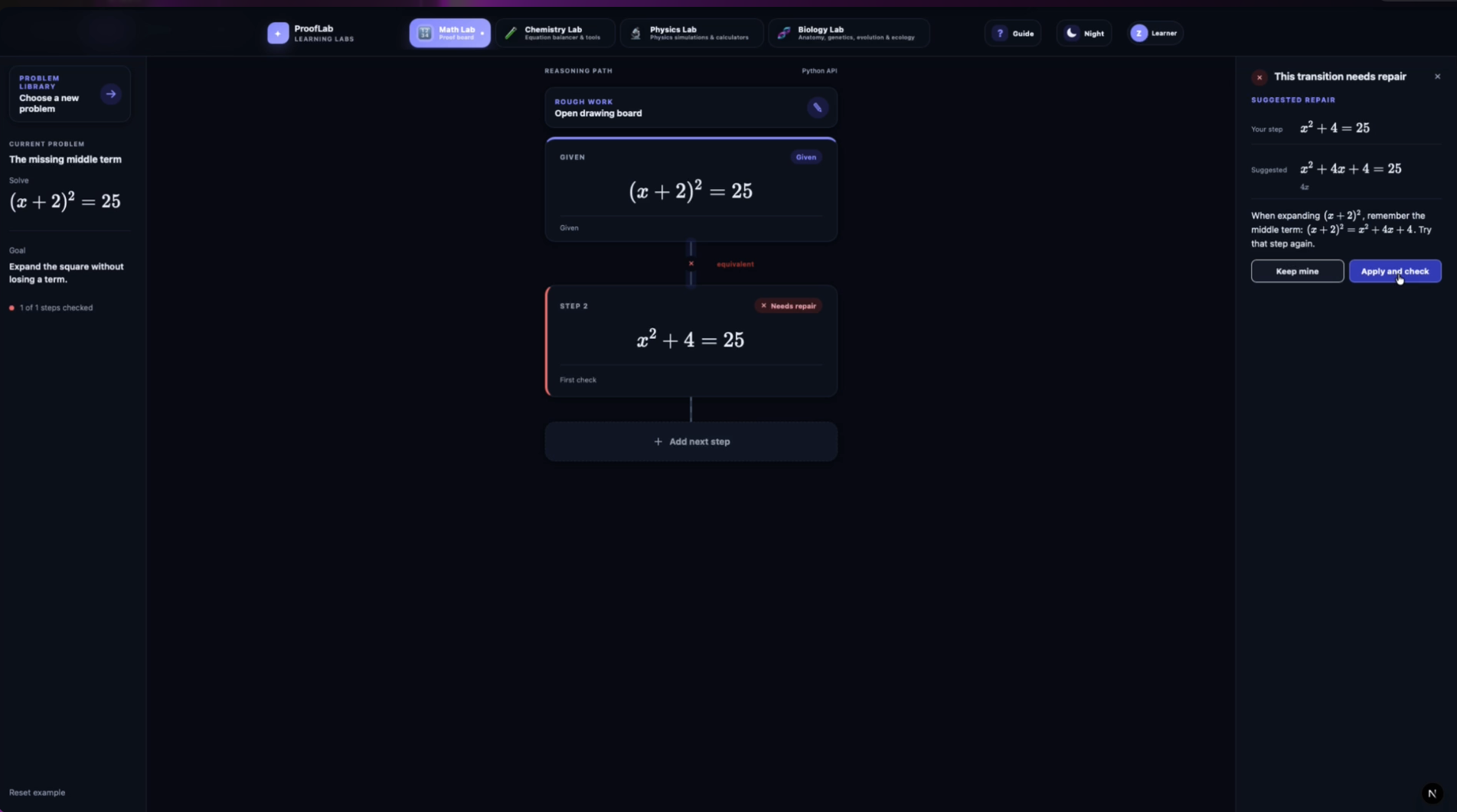
When a step fails, ProofLab identifies the first broken point and returns bounded evidence. For example, it can detect a dropped middle term while expanding a square, show an incorrect inequality region on a live number line, or reveal a missing complex root on the Argand plane.
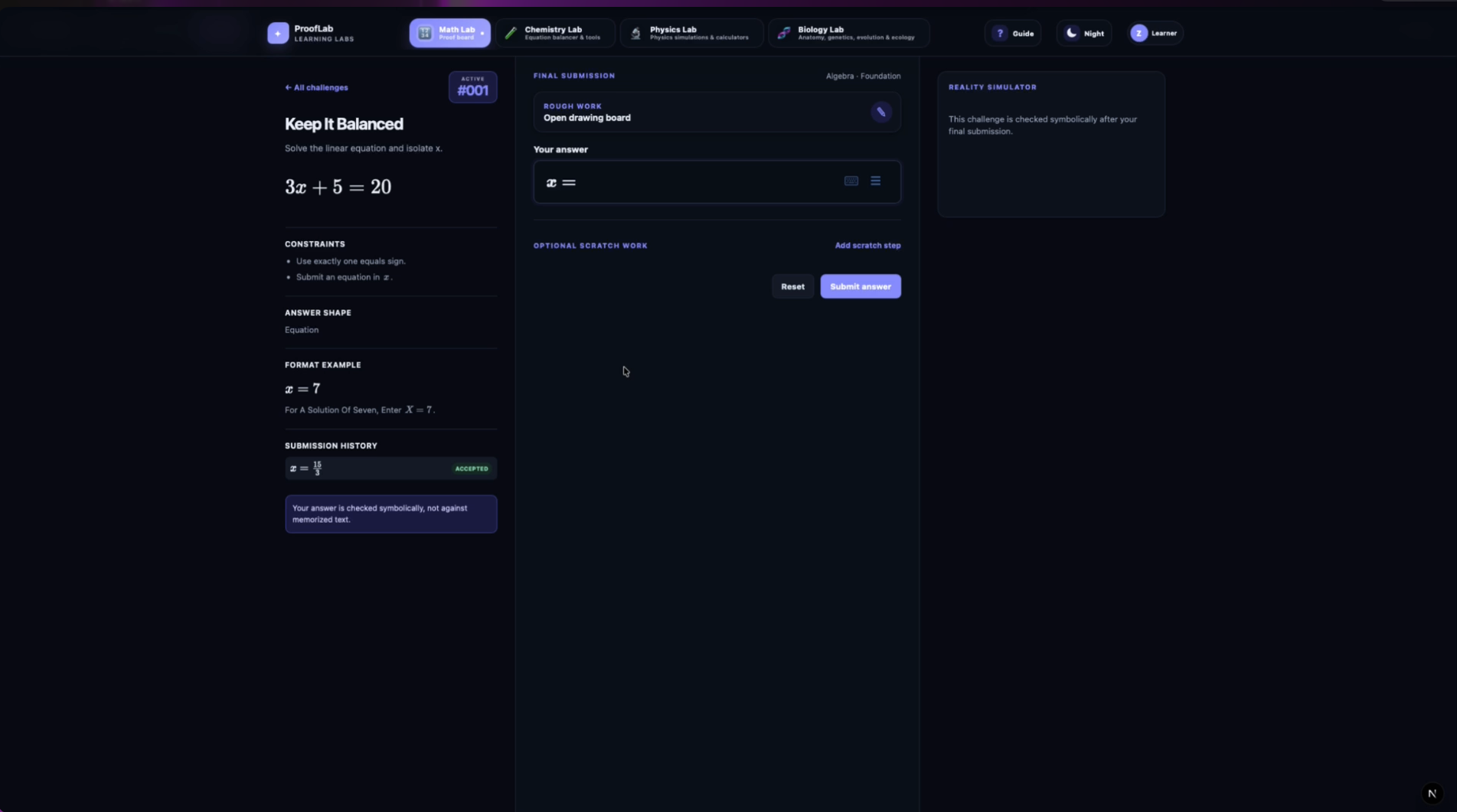
We also built LeetMath, a LeetCode-inspired independent challenge arena. Learners solve concise math problems, use scratch work, and submit one final answer for symbolic validation—without AI hints or answer leaks.
Beyond Math, ProofLab includes interactive Chemistry, Physics, and Biology modules for equation balancing, molecular concepts, motion, vectors, circuits, anatomy, genetics, evolution, and ecology.
How we built it
The frontend uses Next.js, React, MathLive, KaTeX, Excalidraw, Chart.js, and interactive visual components.
The Math verification service is built with FastAPI, Pydantic, SymPy, and a restricted custom parser. Rather than evaluating arbitrary input, the backend accepts only supported mathematical grammar and returns explicit valid, invalid, unsupported, or inconclusive results.
The architecture deliberately separates two responsibilities:
- Deterministic verification decides whether mathematics is correct.
- AI teaching explains verifier-confirmed evidence, offers hints, and can suggest a repair that is checked again before being applied.
We used Codex to accelerate development, connect the frontend and symbolic backend, expand the interactive STEM modules, and iterate quickly on the product experience.
Challenges we ran into
The hardest challenge was making feedback helpful without accidentally giving away answers.
A generic chatbot can sound confident while being mathematically wrong. We solved this by making the symbolic verifier the source of truth and limiting AI to explanations of verified results.
We also had to safely parse mathematical notation from the browser. Supporting everything in mathematics at once would create unreliable behavior, so we designed explicit grammar boundaries and return “unsupported” rather than pretending to understand notation outside the current verifier scope.
Finally, visualizations had to remain learning tools rather than decorative charts. Number lines and complex planes are driven by normalized backend results, so the frontend does not independently decide mathematical correctness.
Accomplishments that we're proud of
- A working step-by-step Math reasoning debugger, not just an answer checker.
- Live inequality number-line feedback that makes sign-flip mistakes visible.
- Deterministic derivative, integral, algebra, and complex-number verification.
- LeetMath, with final-answer symbolic contracts and visual replays.
- A clear boundary between AI teaching and mathematical correctness.
- A unified STEM platform with substantial Chemistry, Physics, and Biology interactions.
- Persistent Excalidraw rough-work boards for both guided Math and LeetMath challenges.
What we learned
We learned that the strongest AI learning experience is not necessarily the most conversational one. Students benefit more when AI is grounded in evidence and knows when not to claim an answer.
We also learned that different concepts need different interactions. Algebra may benefit from proof-step verification, while inequalities need number lines, calculus benefits from graphs, and probability needs simulation. A single “chat with your homework” interface is not enough.
What's next for ProofLab
Next, we are building an account-based adaptive learning journey with Explorer, Learner, and Professional tracks, mastery progress, XP, and saved work.
For Math, we plan to expand from foundational number sense through geometry, trigonometry, probability, statistics, linear algebra, optimization, numerical methods, and applied modeling. The goal is for ProofLab to grow with a learner—from their first fraction to real-world data, engineering, and decision-making problems.


Log in or sign up for Devpost to join the conversation.