Inspiration
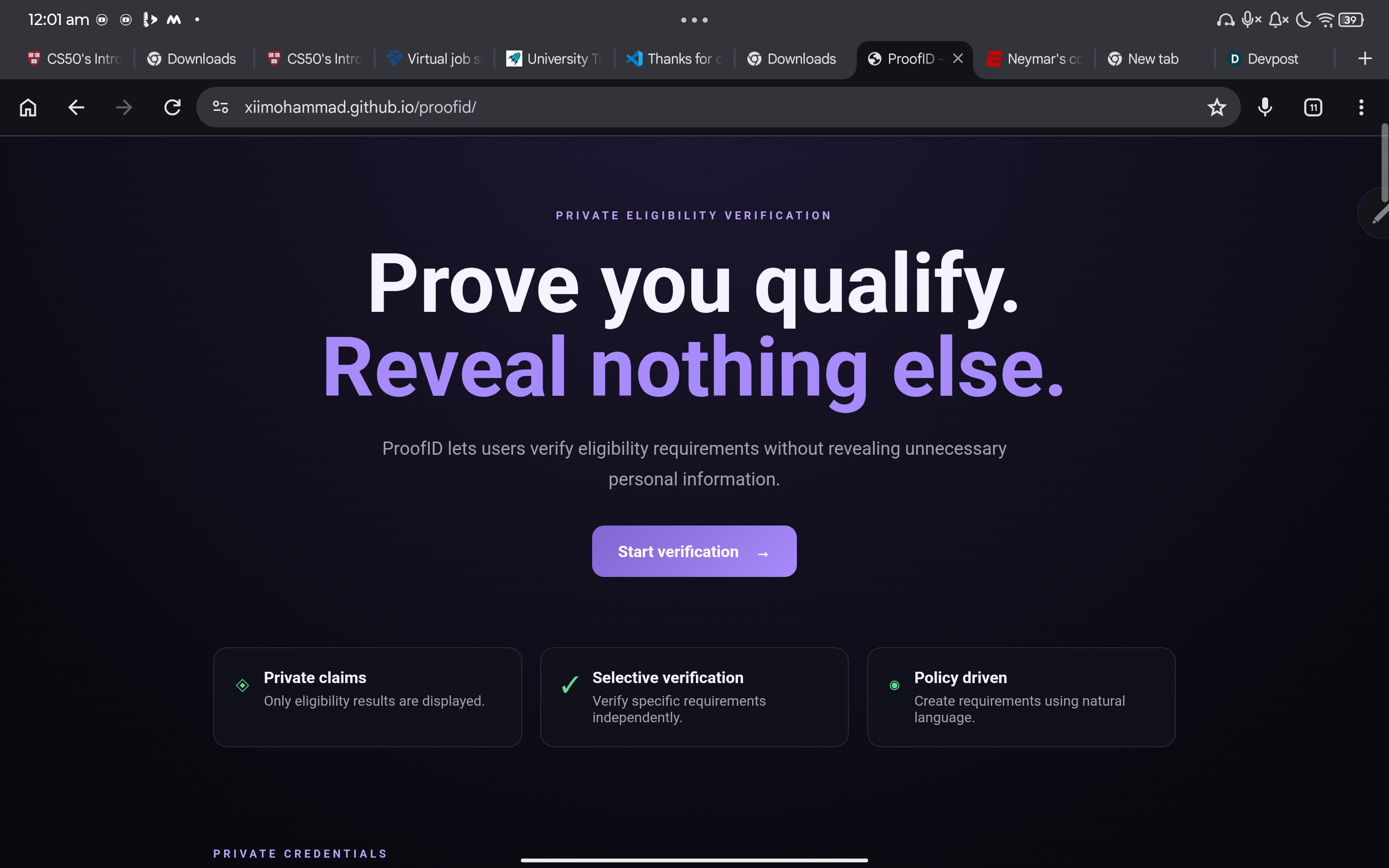
In today's digital world, people are constantly asked to share personal information to prove that they meet certain requirements. A person may need to prove that they are old enough, currently a student, or below a particular income limit. However, many verification systems collect more information than is actually necessary. This inspired us to build ProofID: a privacy-first eligibility verification prototype that explores a simple question: Can we verify whether someone meets a requirement without unnecessarily exposing their underlying personal information? The goal is to make verification more privacy-conscious by focusing on the result of a check rather than displaying every piece of personal data.
What it does
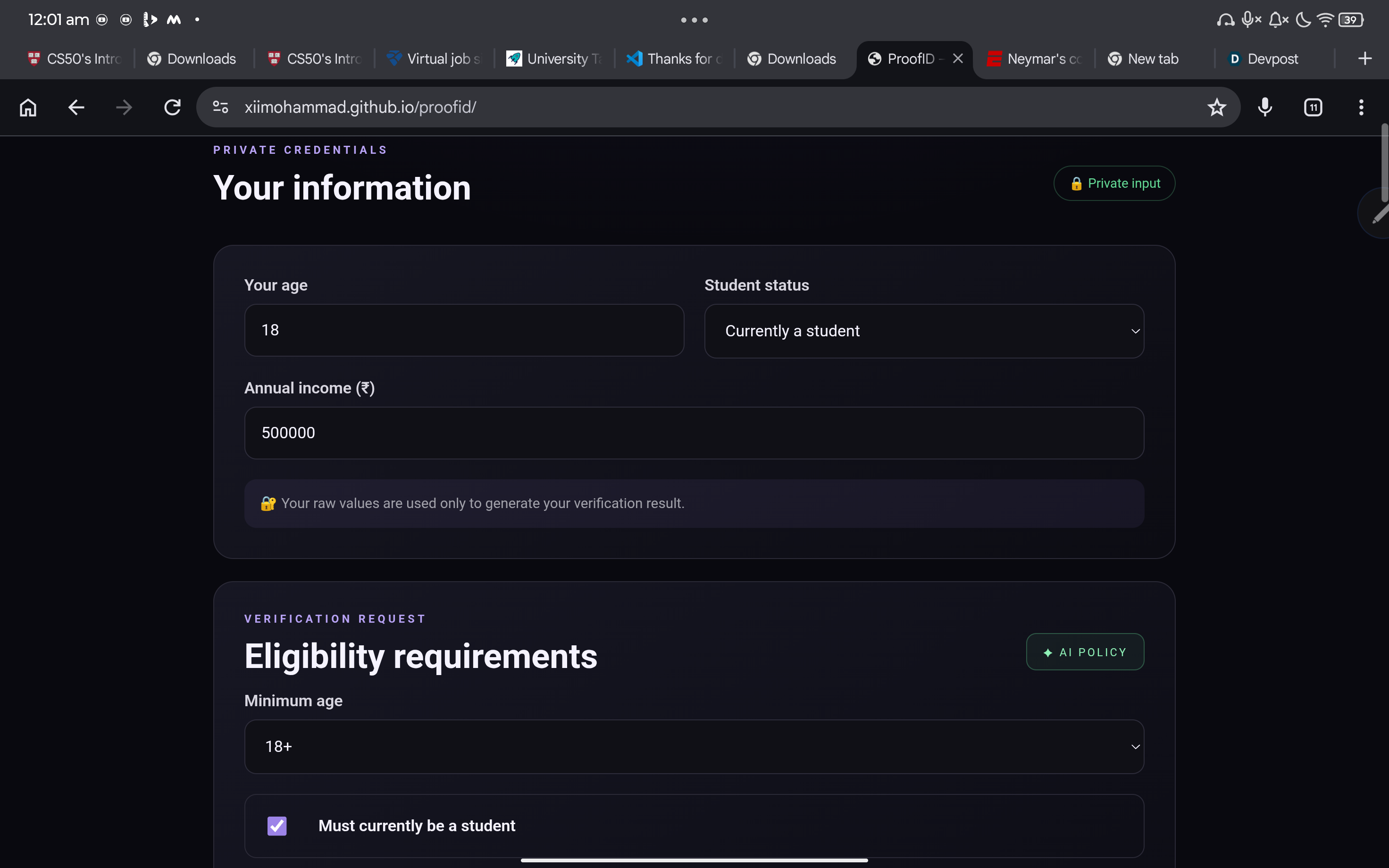
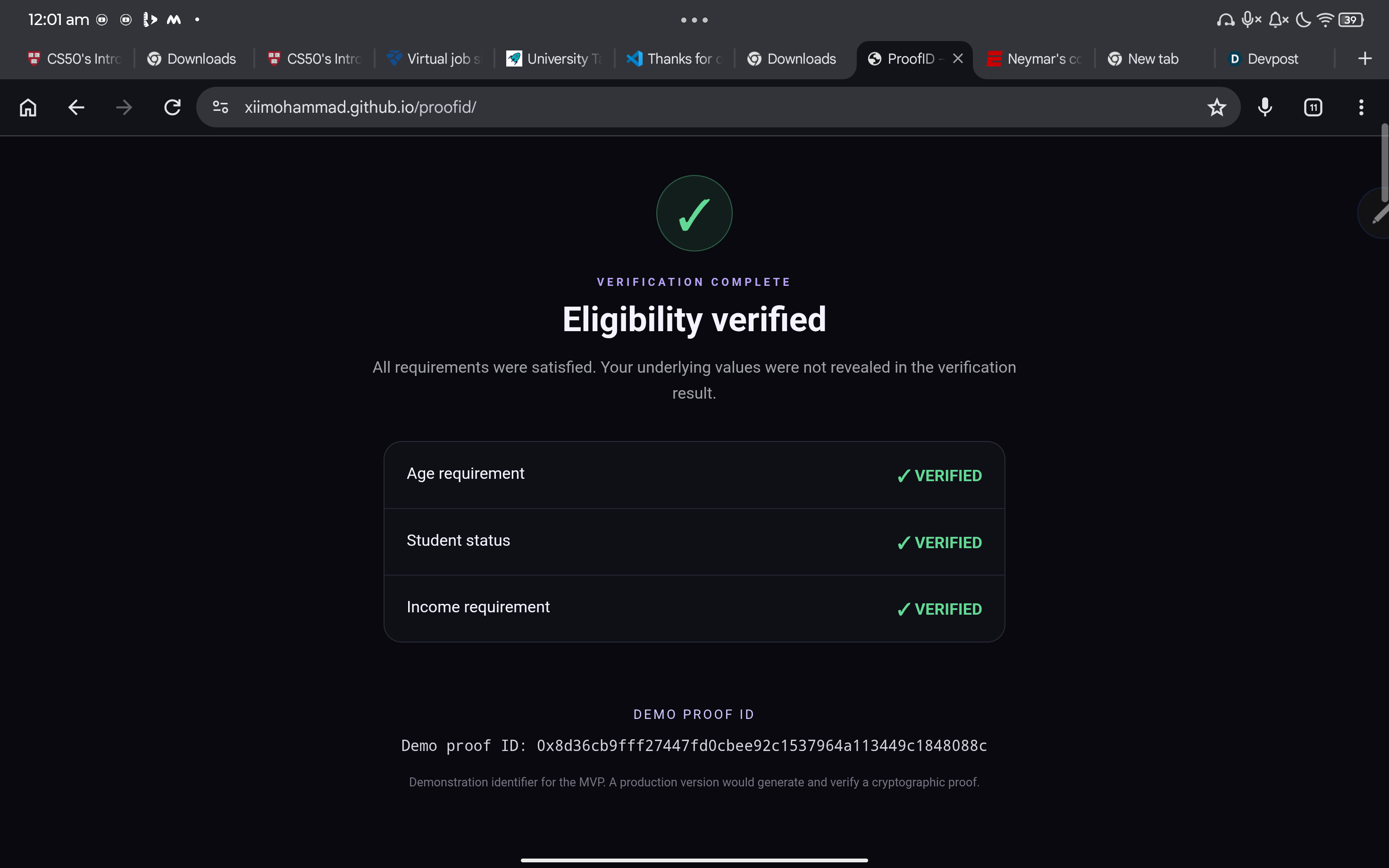
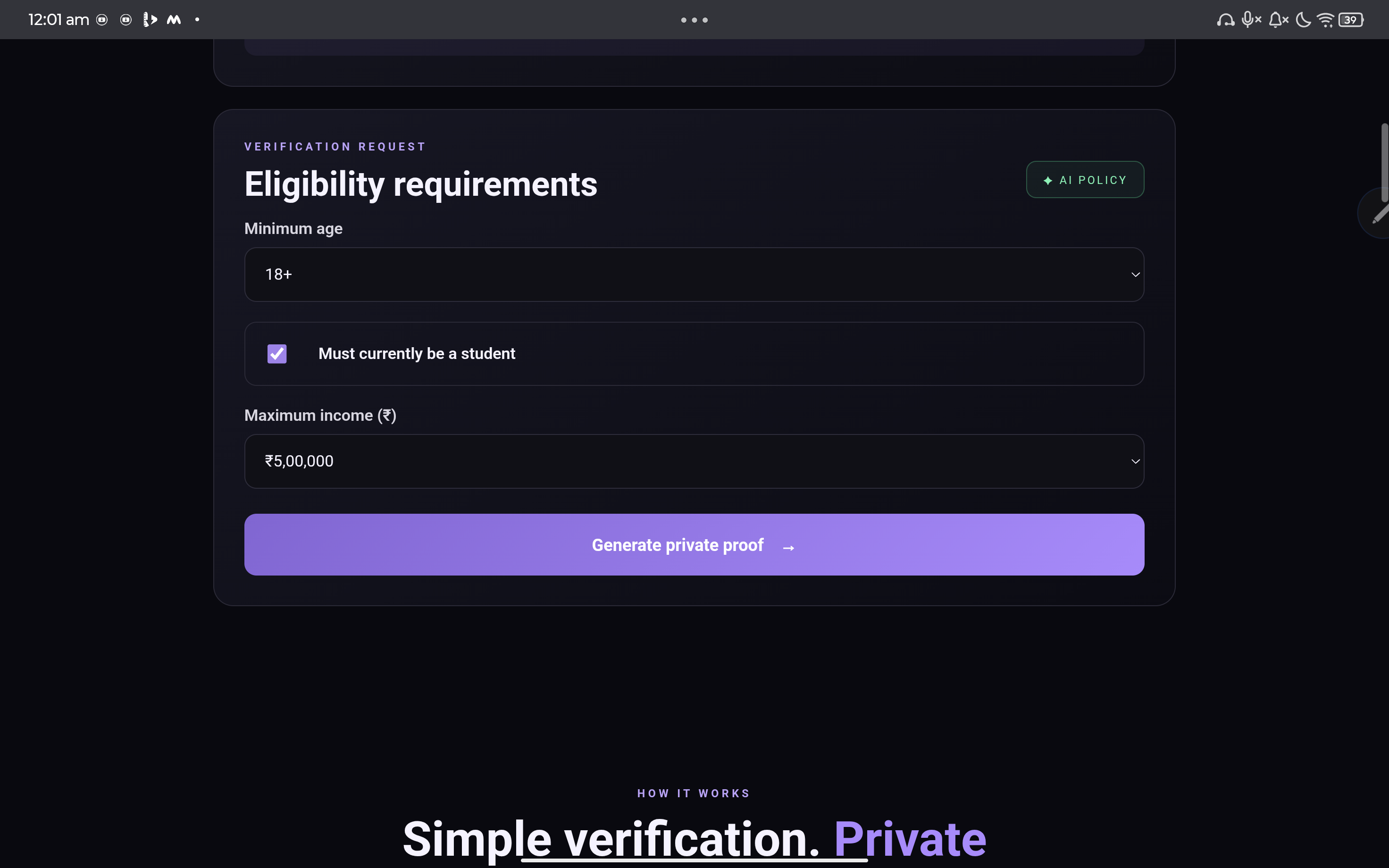
ProofID allows a user to provide private information and then checks that information against eligibility requirements defined by a verifier. For example, a verifier can define requirements such as: Age of at least 18 Currently a student Annual income below a selected limit The user then generates a private proof. Instead of presenting the entered values as the main verification result, ProofID evaluates the requirements and displays whether the conditions have been successfully verified. The result is a simple and understandable eligibility status, along with the requirements that were satisfied.
How we built it
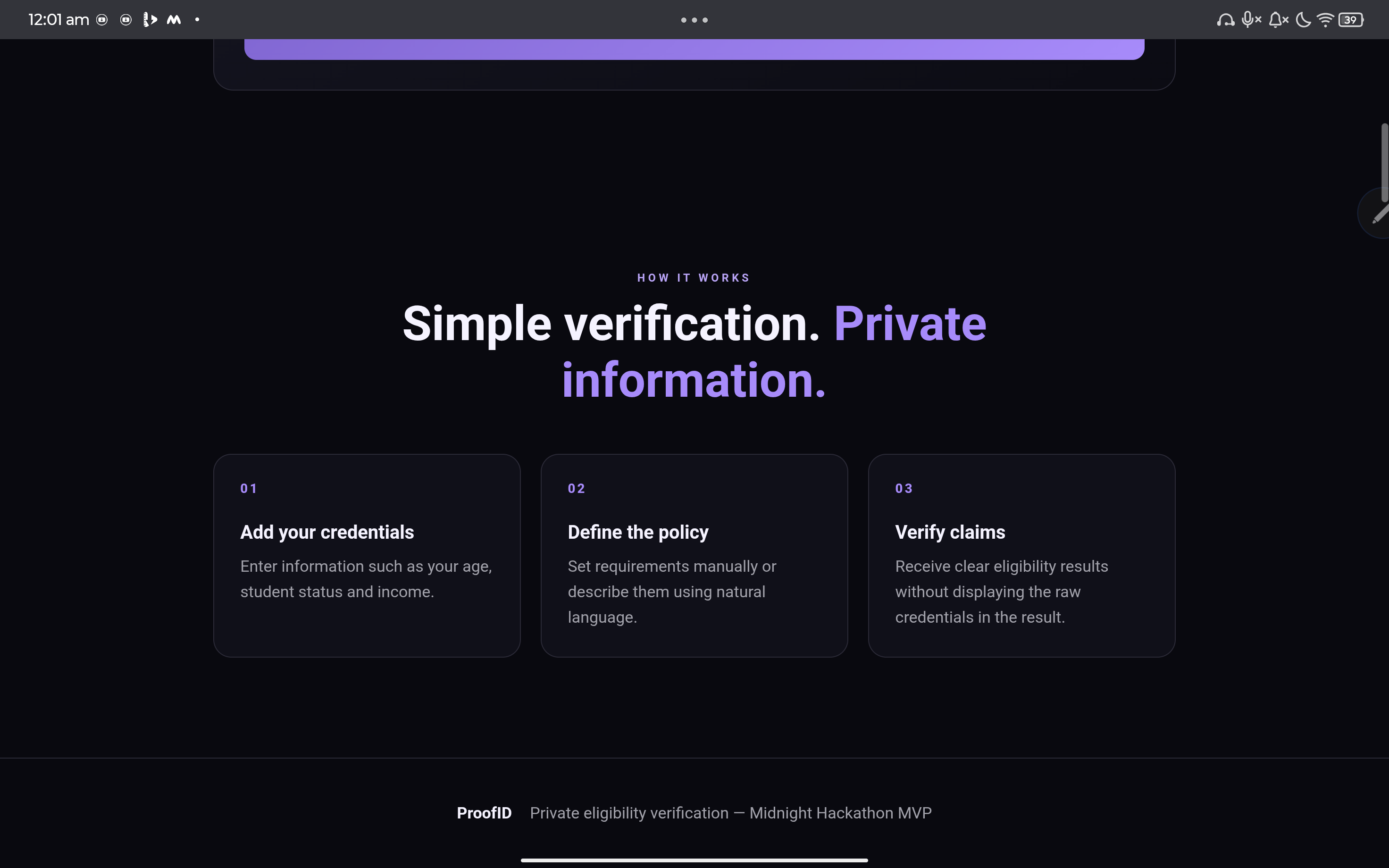
We built ProofID as a functional web prototype using HTML, CSS, and JavaScript. The interface is divided into three main stages: Private Information — the user enters the information required for verification. Eligibility Requirements — the verifier defines the conditions that must be satisfied. Private Proof — the application evaluates the conditions and produces a verification result. The verification logic compares the user inputs with the defined requirements. For example: [ \text{Eligible} = (\text{Age} \geq \text{Minimum Age}) \land (\text{Student Requirement Satisfied}) \land (\text{Income} \leq \text{Maximum Income}) ] The interface then presents the outcome as verified eligibility rather than making the underlying input values the focus of the verification result. We also designed the interface to make the complete process easy to understand through a clear, step-by-step flow.
Challenges we ran into
One of our biggest challenges was translating the idea of privacy-focused verification into something that could be demonstrated clearly in a simple prototype. Privacy and verification can easily become technically complex, so we needed to create an experience that showed the core concept without overwhelming the user. Another challenge was designing a clear separation between: Private information entered by the user Requirements defined by the verifier The final verification result We also had to make sure the demonstration did not make claims beyond what the prototype actually implements. Rather than presenting the project as a full cryptographic zero-knowledge proof system, we focused on demonstrating a functional privacy-conscious verification workflow.
Accomplishments that we're proud of
We are proud of turning a privacy-focused idea into a working and visually clear prototype. In particular, we successfully: Created a complete eligibility verification workflow Built an interactive interface for entering private information and defining requirements Implemented logic that evaluates multiple eligibility conditions Designed a clear proof-generation and verification flow Created a final result that emphasizes eligibility status instead of unnecessarily exposing personal information Most importantly, ProofID demonstrates a simple but important principle: verification should not automatically require unnecessary data exposure.
What we learned
Through this project, we learned more about the importance of data minimization and privacy-conscious system design. We also learned that a strong technical project is not only about building features. It is equally important to communicate what the system actually does, make the user experience understandable, and avoid overstating the capabilities of a prototype. The project improved our understanding of: Privacy-first design Eligibility and rule-based verification Front-end development User interface design Separating private inputs from verification results Translating complex technical concepts into understandable experiences
What's next for ProofID
ProofID is currently a functional prototype demonstrating the core verification concept. Our next goal is to explore stronger technical implementations. Future development could include: Cryptographic zero-knowledge proof technology Selective disclosure credentials Decentralized identity standards Secure backend verification Stronger data protection mechanisms Digital credentials issued by trusted institutions Real-world integrations for student, age, and financial eligibility checks Ultimately, we want to develop ProofID into a system where people can prove what is necessary without automatically revealing everything about themselves.

Log in or sign up for Devpost to join the conversation.