Inspiration
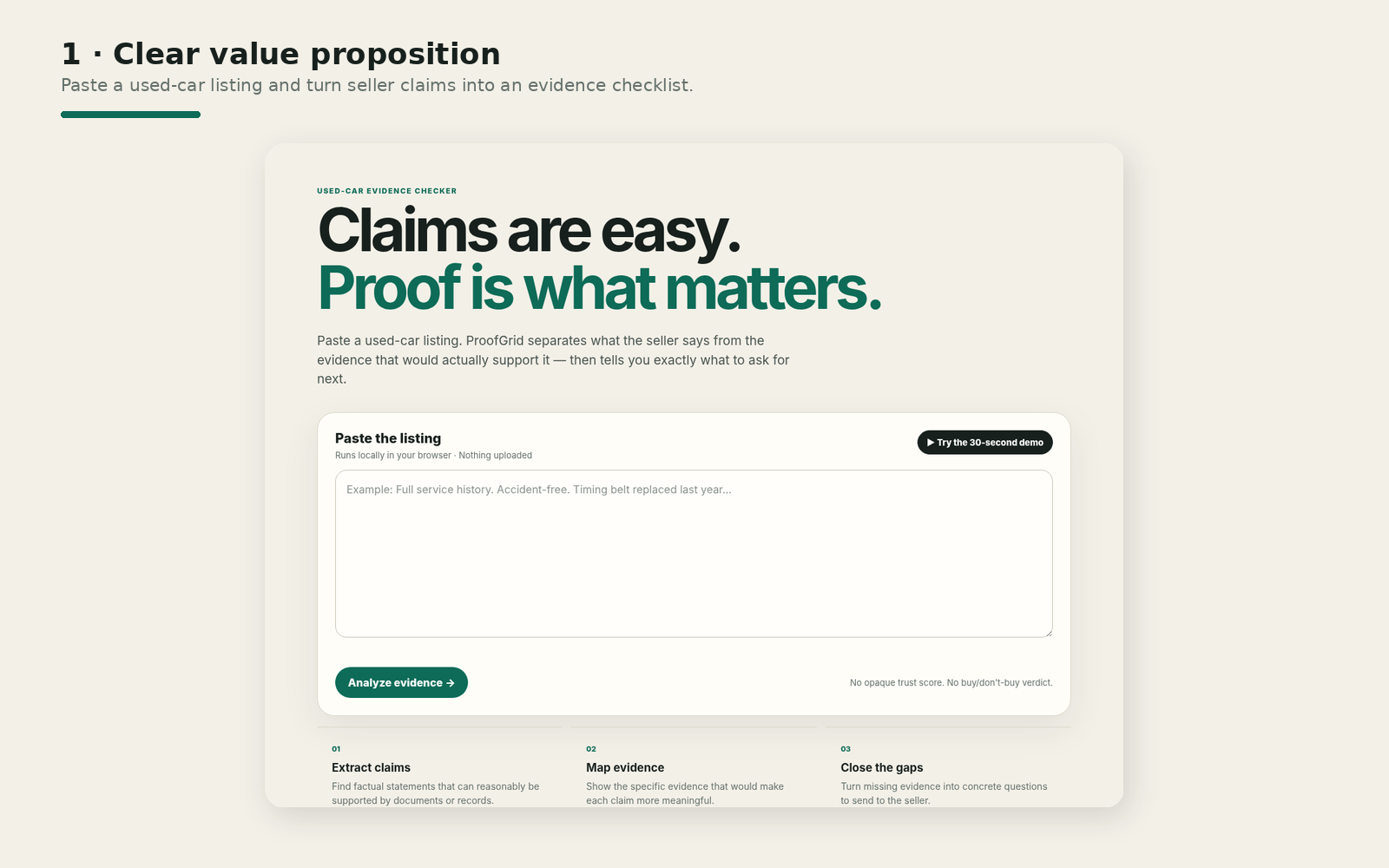
Used-car listings are full of reassuring claims: full service history, accident-free, genuine mileage. A claim is not proof, and a single trust score can conceal how little has actually been checked. ProofGrid makes the next verification step explicit.
What it does
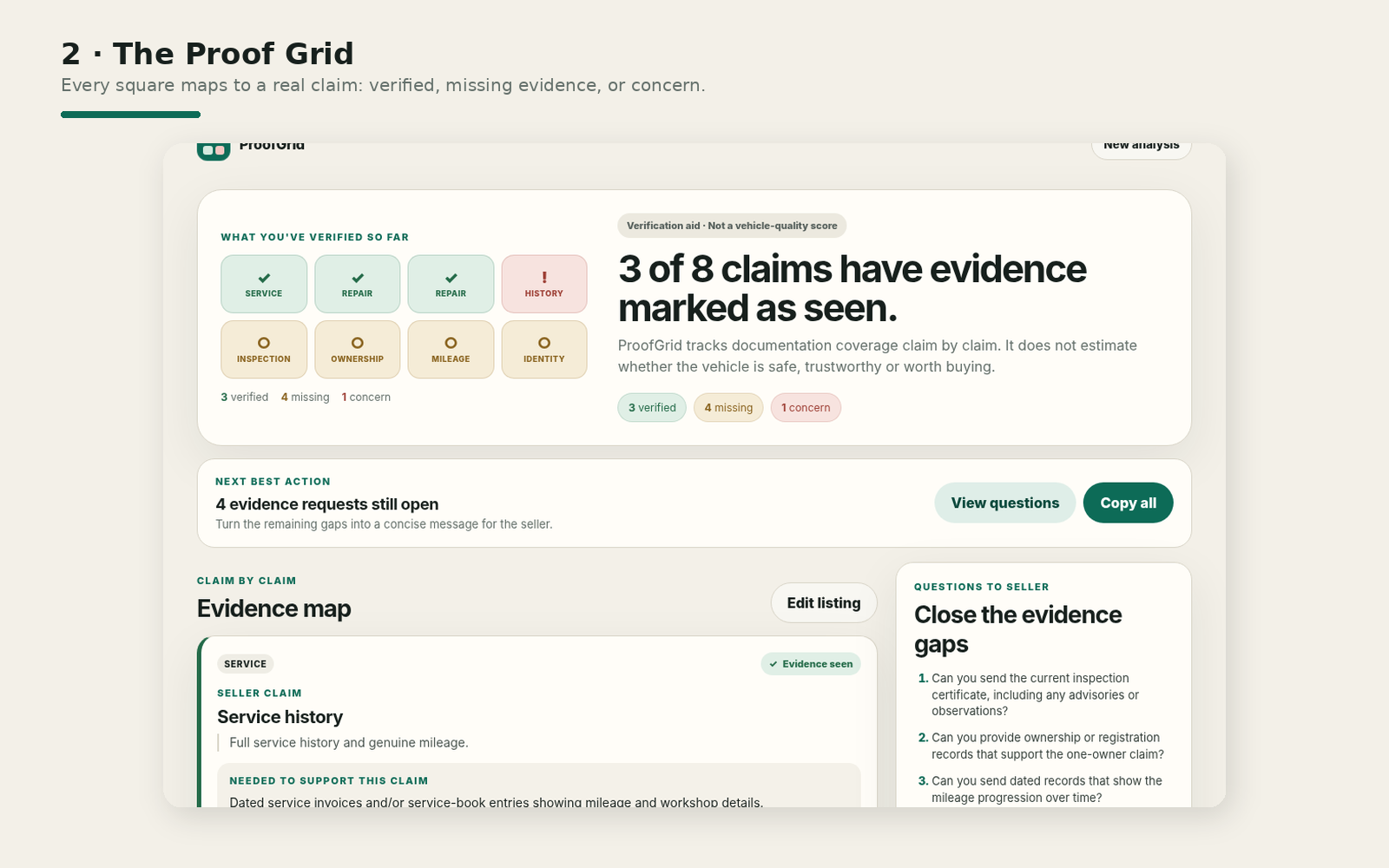
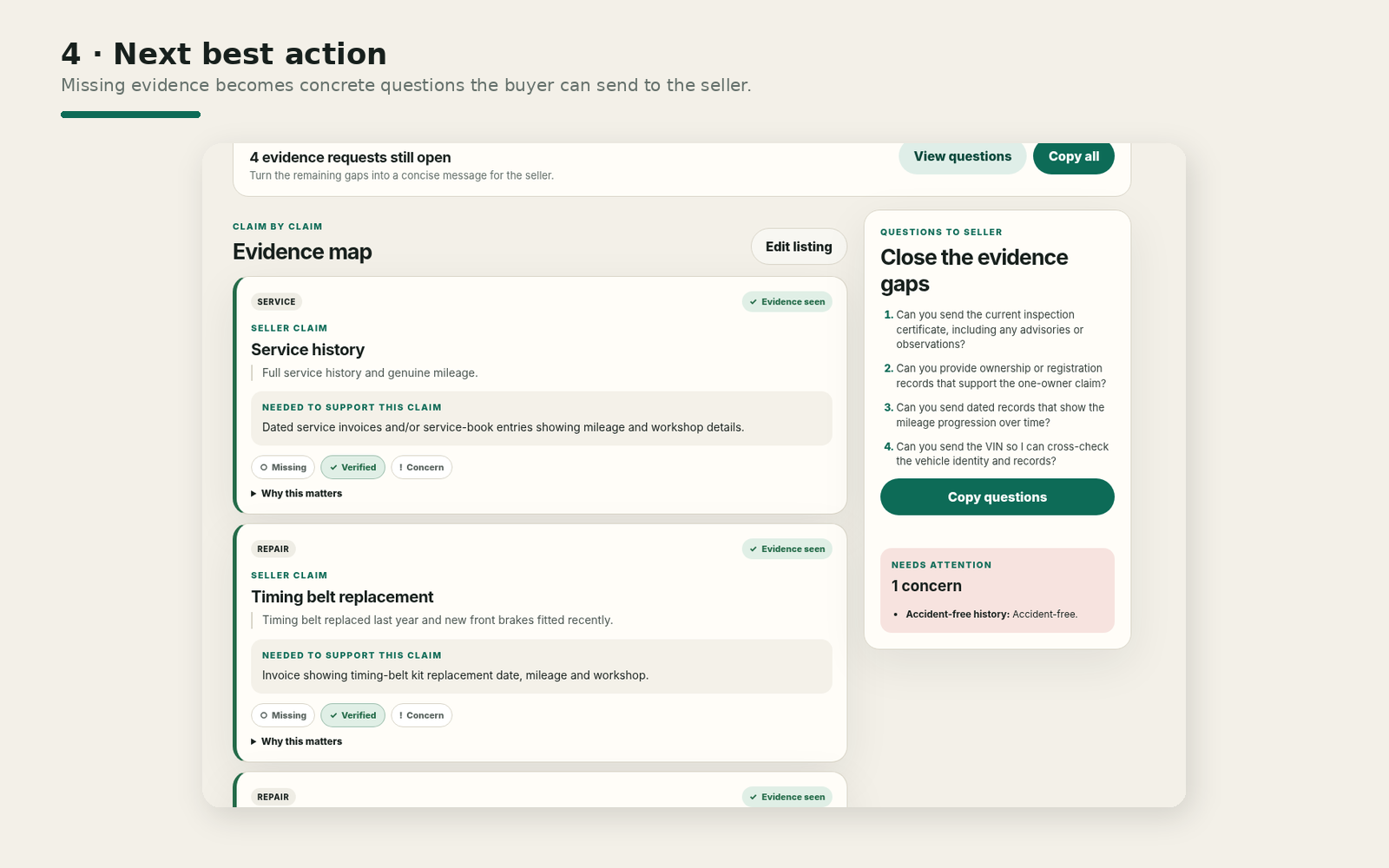
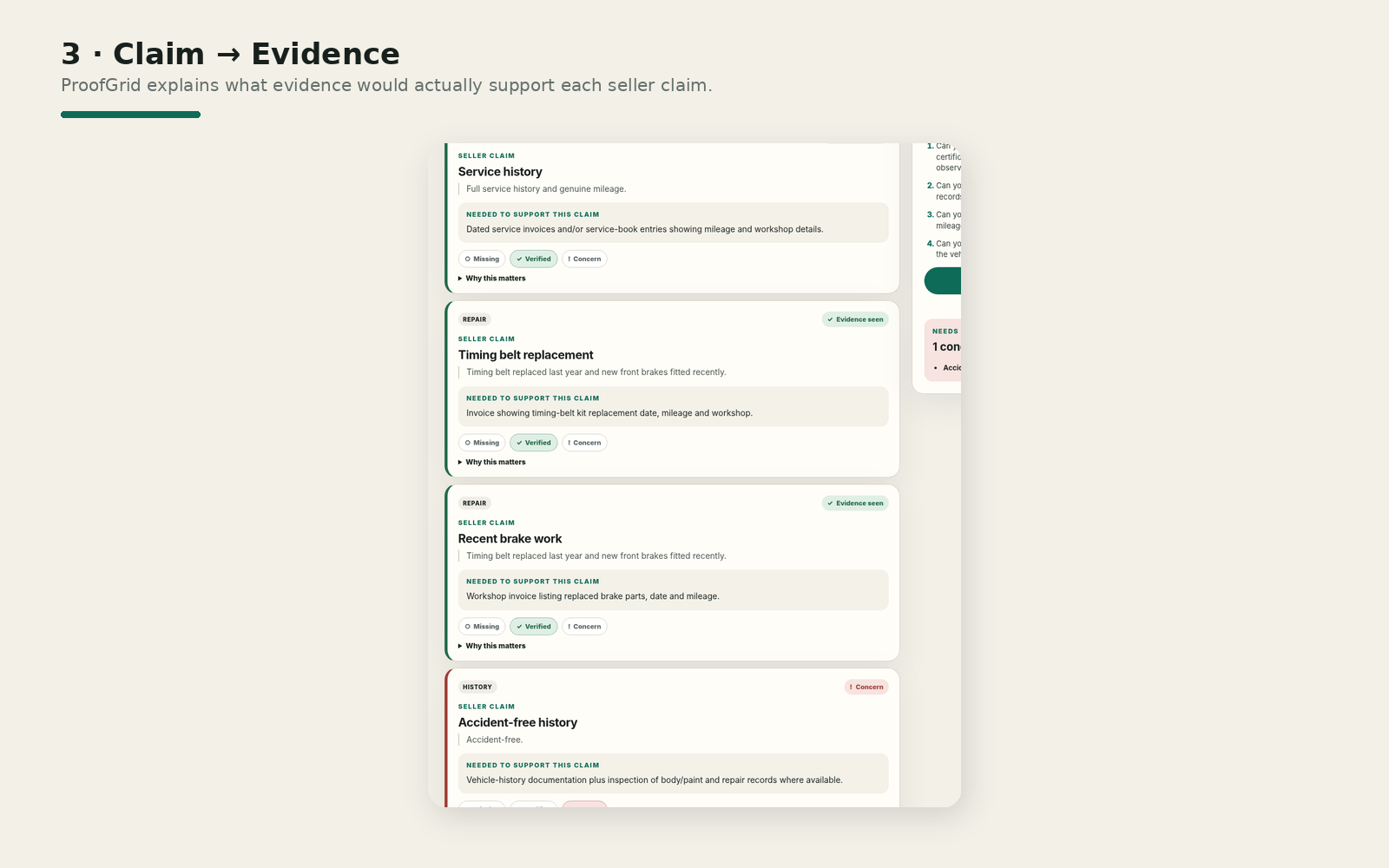
Paste a listing to identify evidence-bearing seller claims. Each claim has a place in the Proof Grid, a description of the documentation that would support it, and one of three states: missing evidence, evidence seen, or concern.
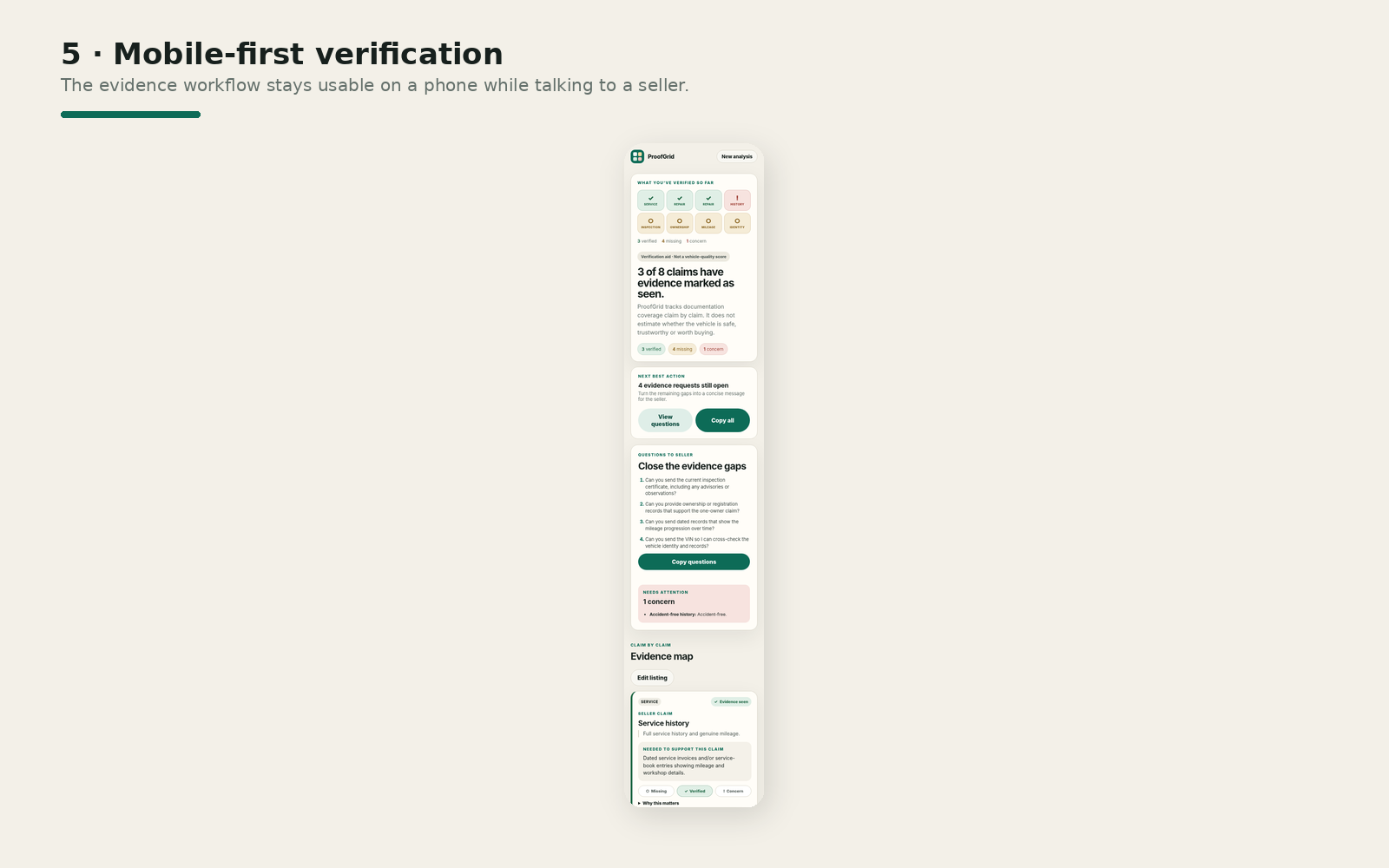
The buyer updates these states after reviewing information. The grid and seller questions update together. Missing evidence produces specific requests; concerns remain separate from ordinary gaps. Questions can be copied for the next conversation with the seller.
ProofGrid is a verification aid. It does not authenticate documents, certify a vehicle, estimate seller honesty, or recommend a purchase. The demonstration uses illustrative evidence states, not real findings about a vehicle.
How we built it
The Devpost Learn workflow helped narrow a broad car-analysis idea into a focused proof of concept: listing → claims → evidence requirements → user review → next questions. The public repository includes the approved scope.md, prd.md and spec.md in the devpost directory.
The app uses HTML, CSS and JavaScript ES modules. A deterministic claim engine identifies supported phrases, removes duplicate matches and maps them to evidence requirements. Browser LocalStorage preserves progress. Node.js serves the app locally and runs the automated tests.
AI assisted planning, implementation, testing and design review. The app itself requires no external AI service, account or API key. This makes the demo reproducible and keeps listing text local to the browser. The deterministic engine has a deliberately limited vocabulary; broader language understanding is future work.
Challenges we ran into
A percentage of reviewed claims looked too much like a vehicle-quality score. Replacing it with individual claim squares made the meaning clearer. Separating missing evidence from concerns also mattered: a missing document is not automatically evidence of dishonesty.
The other challenge was scope. OCR, VIN databases, market pricing, uploads and purchase recommendations were excluded so the central workflow could be completed and tested.
Accomplishments that we're proud of
The proof of concept completes the journey from pasted text to an actionable set of seller questions. The visual grid stays tied to individual claims, the workflow works without an external service, and all 12 automated tests pass. The repository includes the source, MIT license, planning documents and desktop/mobile submission assets.
What we learned
Planning before coding made the product smaller and clearer. We also learned that technically correct metrics can communicate unwarranted certainty. The interface should make the limits of available information visible.
What's next
Future work could associate uploaded documents with individual claims, add OCR and semantic extraction, support more languages, and export a review record. These extensions would preserve the core principle: never turn missing information into false certainty.

Log in or sign up for Devpost to join the conversation.