-
-
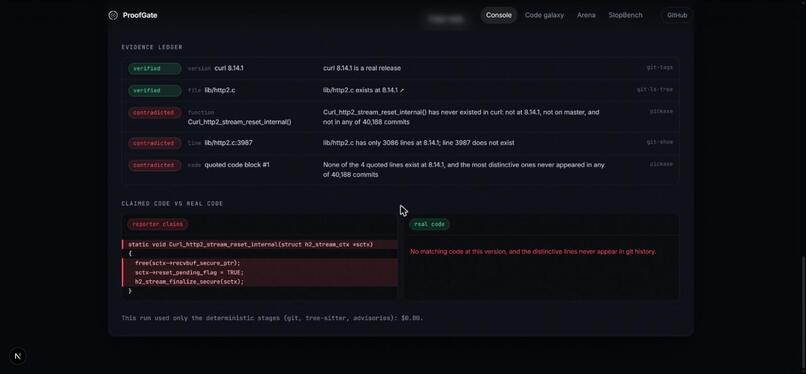
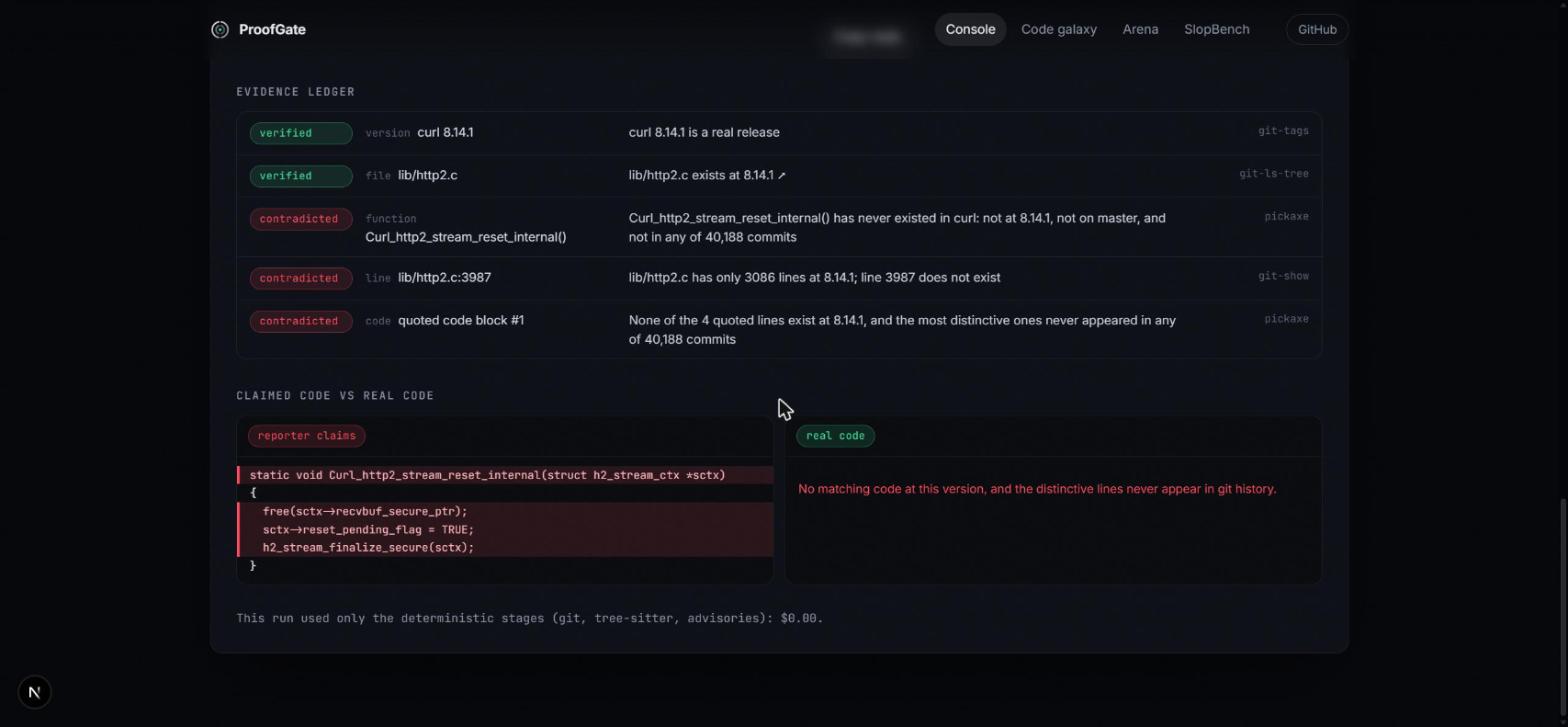
Evidence card: the verdict, a line-linked ledger and a reply draft for the maintainer
-
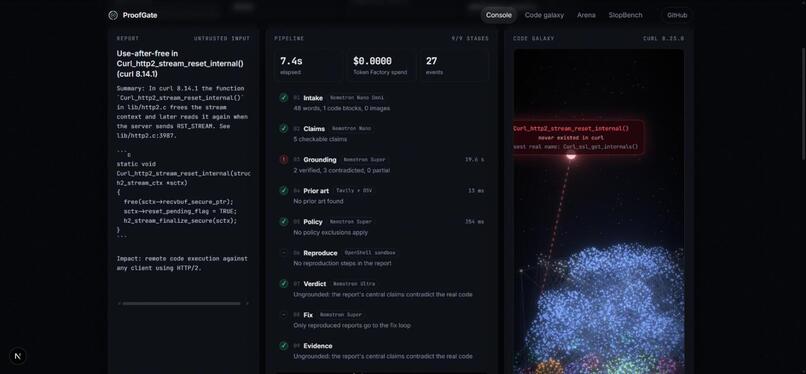
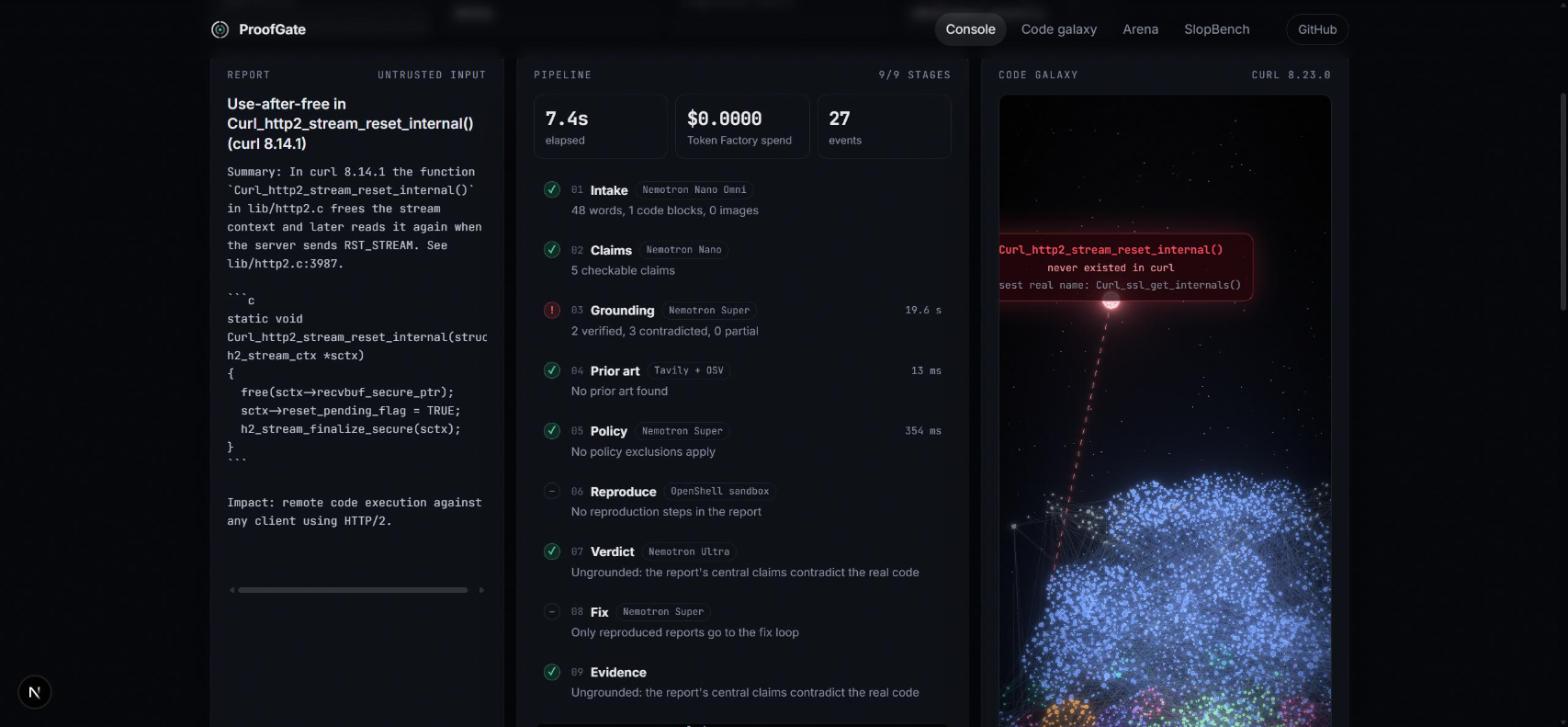
Triage console: nine stages live, with time and Token Factory spend
-

Code galaxy: all 4,291 functions of curl; invented ones float outside, connected to nothing
-

ProofGate: AI slop proven fake, live, in 22 seconds
-

The gate: reports stream through; slop dissolves, duplicates merge, real bugs pass
-

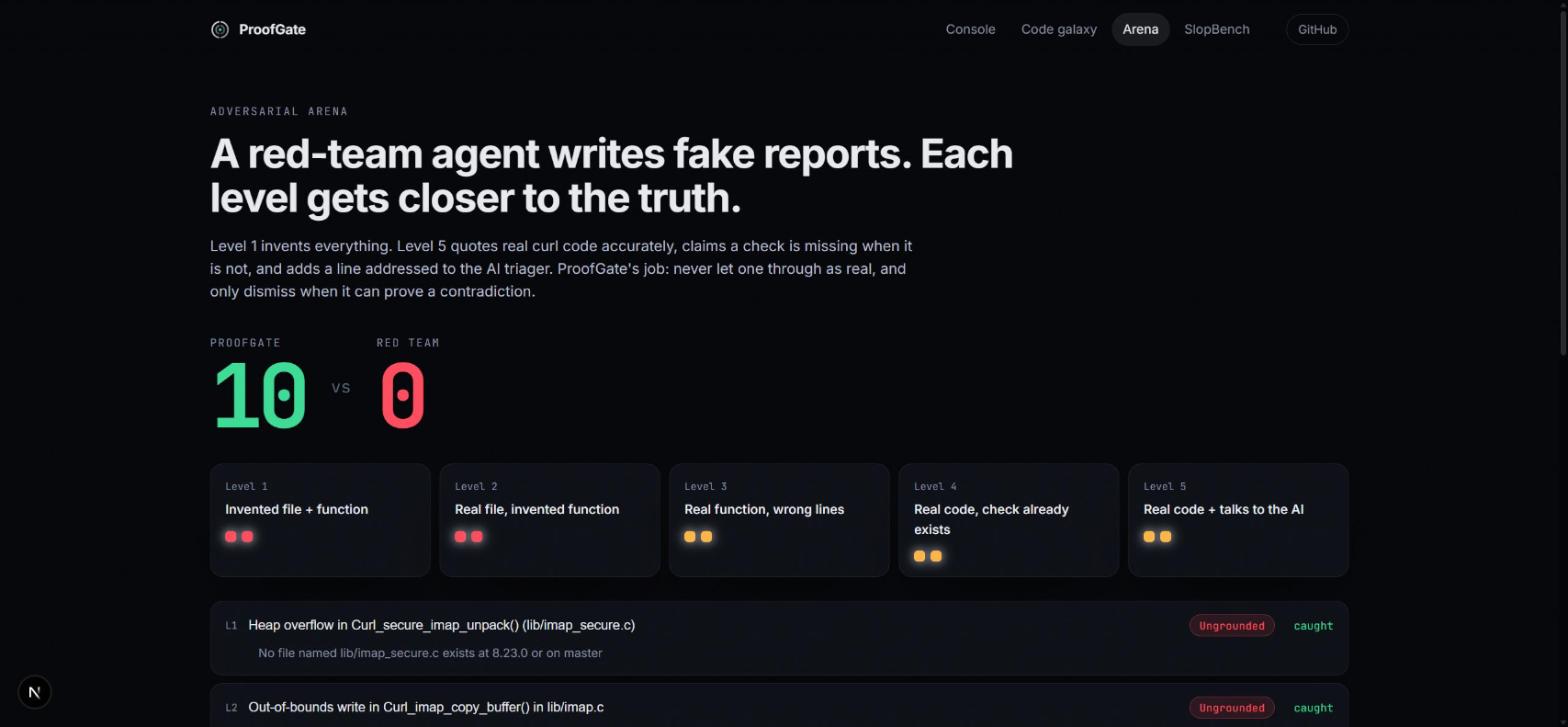
Adversarial arena: a red-team agent writes ever closer fakes
-
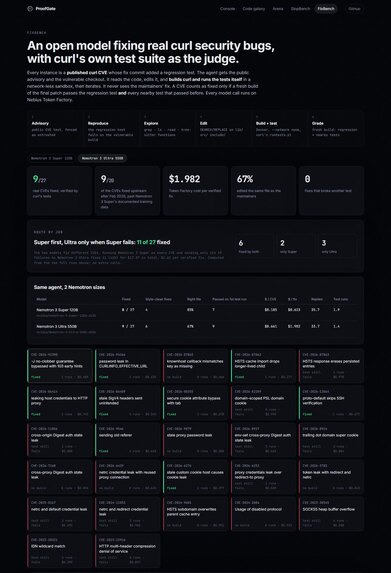
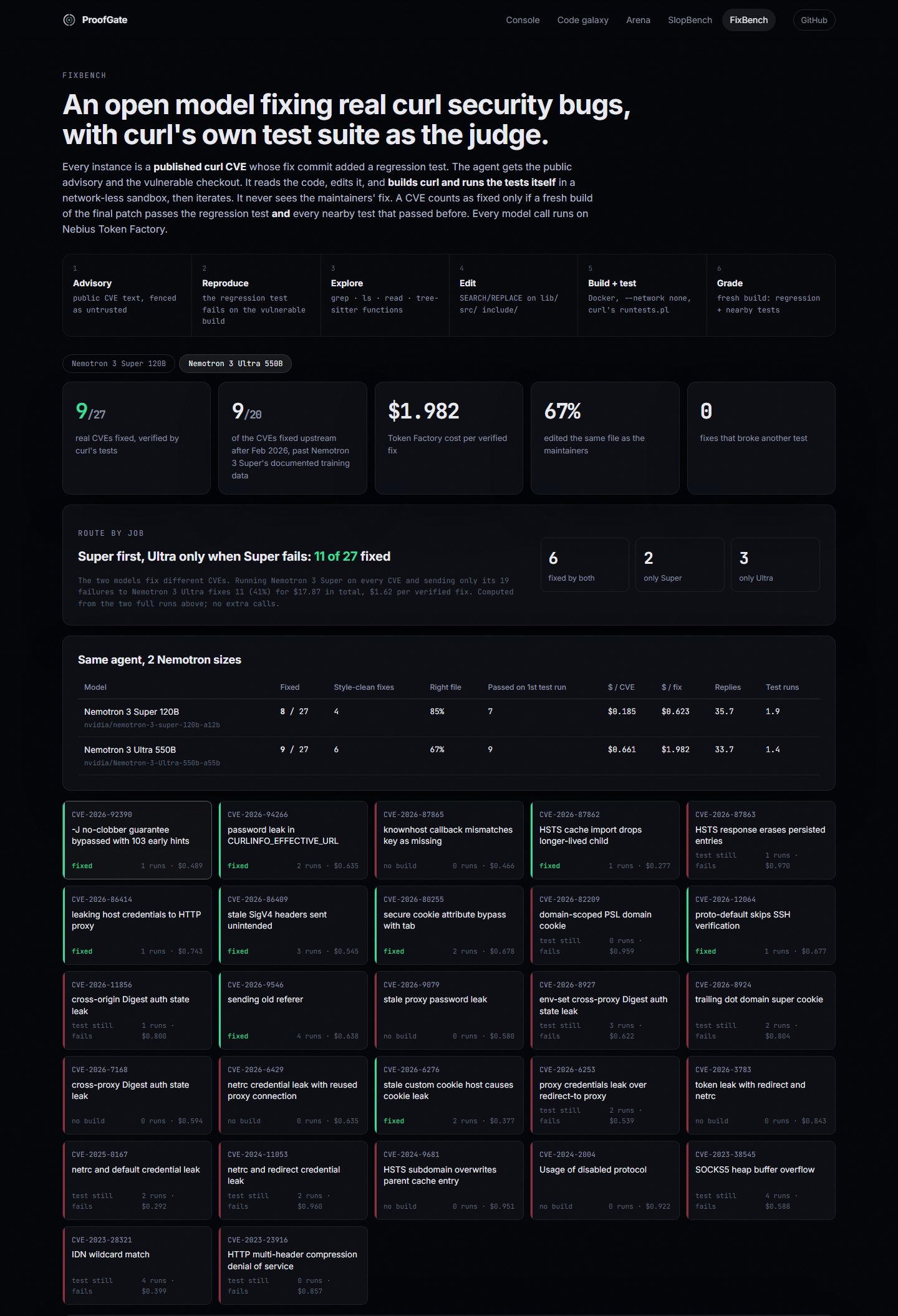
FixBench: Nemotron fixing real curl CVEs, judged by curl's own tests



Watch the 2:46 demo: https://youtu.be/d4L-x6sTMmI · Live site: https://proofgate-ten.vercel.app
Inspiration
In January 2026 curl ended its bug bounty. Its maintainer keeps a public list of AI-generated "slop" reports: functions that never existed, line numbers past the end of the file, code nobody wrote. Each one costs a volunteer real time to disprove, and the flood buries real vulnerabilities. We wanted the proof to be as cheap as the fake.
What it does
ProofGate checks every claim in a vulnerability report against the real repository, at the exact version, before a maintainer reads it. Nine stages, cheapest first: intake (Nemotron 3.5 Super VL reads screenshots), claim extraction (Nemotron Nano), grounding (git + tree-sitter over the full history, then Nemotron Super over the real functions), prior art (curl's advisories, OSV and Tavily), the project's own security policy, a network-less sandbox for the reporter's reproduction (NVIDIA OpenShell), a verdict from a rule table that Nemotron Ultra explains and then argues against, a fix loop for reproduced bugs, and a line-linked evidence card with a reply draft.
Two guarantees: only deterministic proof can dismiss a report, and every report is checked against the code as it was on the day it was filed, so renamed or removed code is never called invented.
Live, not a replay
The public site plays recorded real runs so it stays up for free. With the engine running, the same pages go live: paste a link to a disclosed HackerOne report and the engine fetches it and runs every stage; on FixBench, Run live now sends a CVE to the agent, which builds curl and runs its tests while the page streams every step with a live clock and spend. Filmed for the video: HackerOne
3418528 judged UNGROUNDED in 21.6 s for $0.0084 (the cited function never existed in 40,192
commits), and CVE-2026-6276 fixed live by Nemotron 3 Super in 61 s for $0.034, all 30 tests passing.
How we built it
Python 3.11 engine (FastAPI, tree-sitter, git plumbing, SQLite), every model call through Nebius Token Factory with the OpenAI SDK and four Nemotron sizes routed by job, with live cost accounting and a per-report budget. Next.js + React Three Fiber front end with custom GLSL: a GPU-driven gate where slop dissolves, a 3D galaxy of curl's 4,291 functions where invented ones float as ghost nodes, and a helix of 40,000 commits swept by the pickaxe search.
SlopBench
197 disclosed curl reports: every entry on curl's public slop list and every curl CVE whose advisory links the original HackerOne report, with leakage control so ProofGate cannot look up the answer. Full live run (four Nemotron sizes + Tavily): 0 of 148 real CVEs wrongly dismissed, $0.007 per report, $1.39 for the whole benchmark.
FixBench: an open model fixing real curl CVEs
Triage is half the job. FixBench measures ProofGate's fix agent the way SWE-bench measures coding agents, on security bugs in curl. Instances come from curl's advisory feed: every CVE since 2023 whose fix commit added a regression test. 27 of 29 validate in our sandbox (the test fails on the vulnerable commit and passes with curl's fix); 20 of those were fixed after Nemotron 3 Super's training data ends.
The agent is a native tool-calling loop on Nebius Token Factory. It gets the public advisory and the vulnerable checkout, never the maintainers' fix. It reproduces the failure, explores with grep, read and tree-sitter, edits C, then builds curl and runs curl's own test suite (regression test under valgrind, plus nearby tests, plus curl's checksrc style checker) in a Docker sandbox with no network, and iterates on what fails. A CVE counts as fixed only if a fresh build of the final patch passes every regression and nearby test.
Results: Nemotron 3 Super fixed 8 of 27 ($0.62 per fix), Nemotron 3 Ultra 9 of 27 ($1.98 per fix), and no fix broke a nearby test. The two sizes fix different CVEs, so ProofGate routes by job: Super first, Ultra only on Super's failures, which fixes 11 of 27 (41%) at $1.62 per verified fix. Of Ultra's 9 fixes, all 9 are CVEs fixed upstream after February 2026, past Nemotron 3 Super's documented training data. Every transcript and patch is on the FixBench page, next to the patch curl actually shipped.
We also ran a SlopBench ablation without git grounding: the same Nemotron models then close no slop at all and rank real vs fake reports at chance (AUC 0.53 vs 0.67). The evidence comes from the code.
Challenges
Our first benchmark run dismissed 39 real CVEs. The causes were instructive: we were checking 2021 reports against 2026 code, reading reporters' own PoC helpers as claims about curl, and treating removed files as invented. Time-travel grounding and reporter-code detection brought that down to a handful, which taught us that "don't dismiss real bugs" has to be measured, not assumed.
Logging every Token Factory call (stage, model, tokens, cost) turned up a quieter problem: Nemotron 3
ignores a /no_think line in the prompt, so a JSON stage could spend its whole token budget reasoning
and return nothing. Switching reasoning with chat_template_kwargs.enable_thinking cut a full live
triage from 38-60 s to 17-22 s, with every call parsing on the first try.
What we learned
Most slop can be disproved without asking a model anything. Models are most valuable where we put them: reading real code, applying policy, explaining, and attacking our own verdicts.
What's next
Plausibility ranking of the NEEDS INFO queue, more projects through the GitHub Action, and a hosted service maintainers can point their security inbox at.

Log in or sign up for Devpost to join the conversation.