-
-
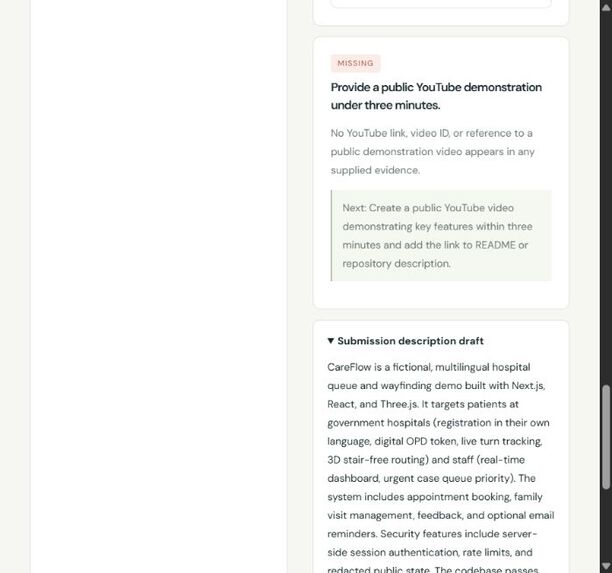
Generated Report
-
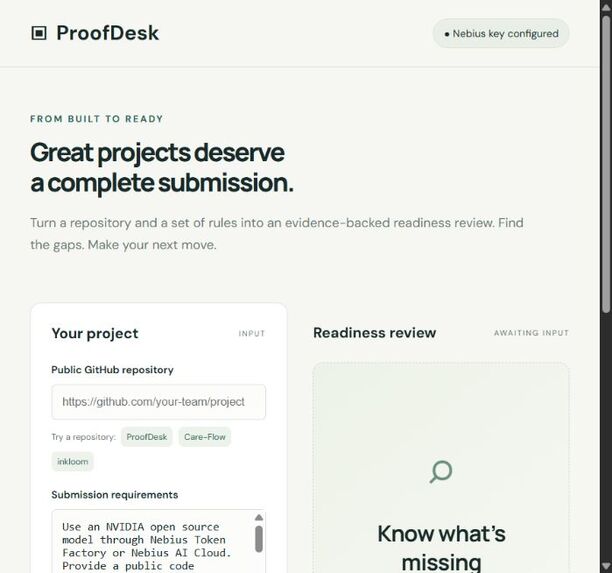
Live Care-Flow Review
-
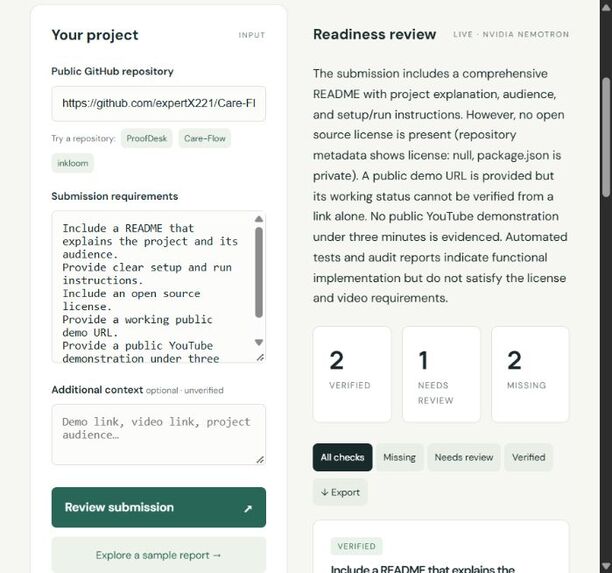
Home Page
-
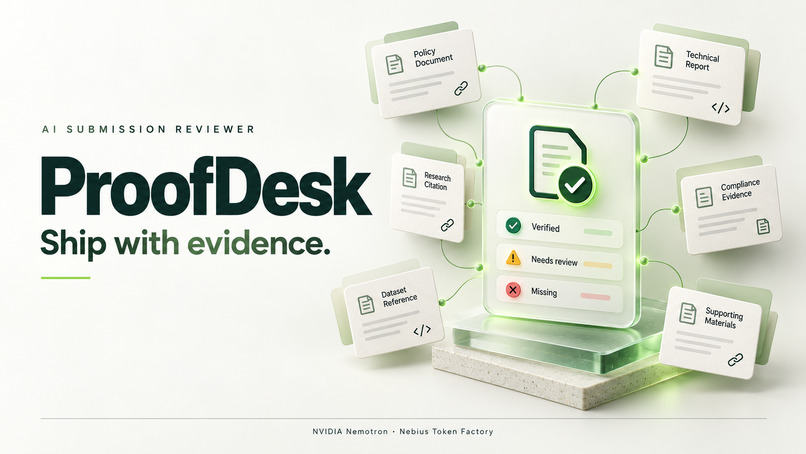
Cover Image
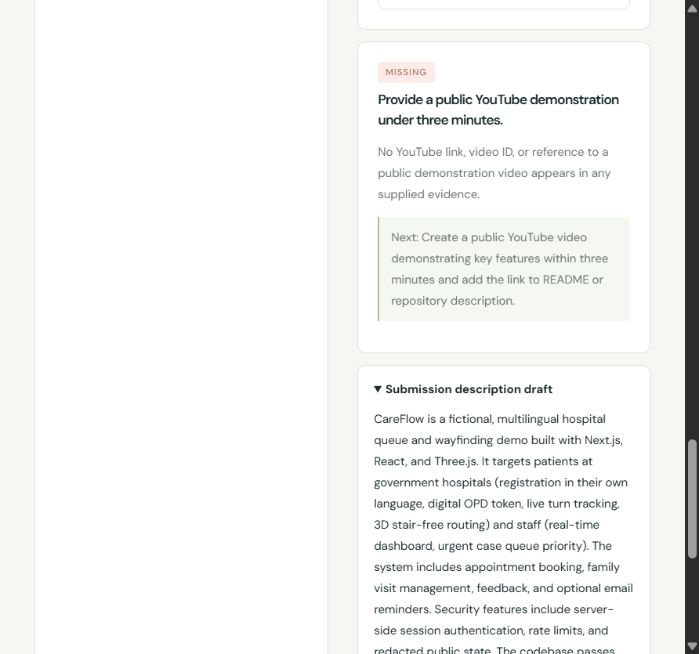
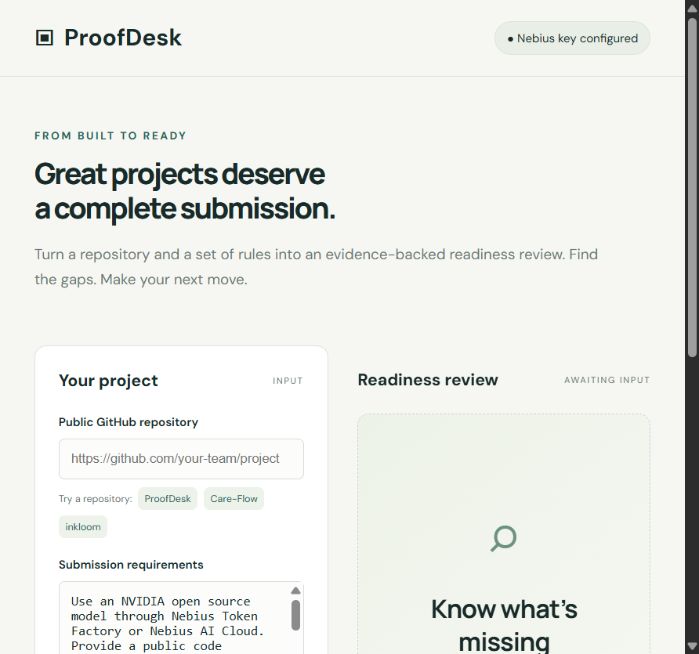
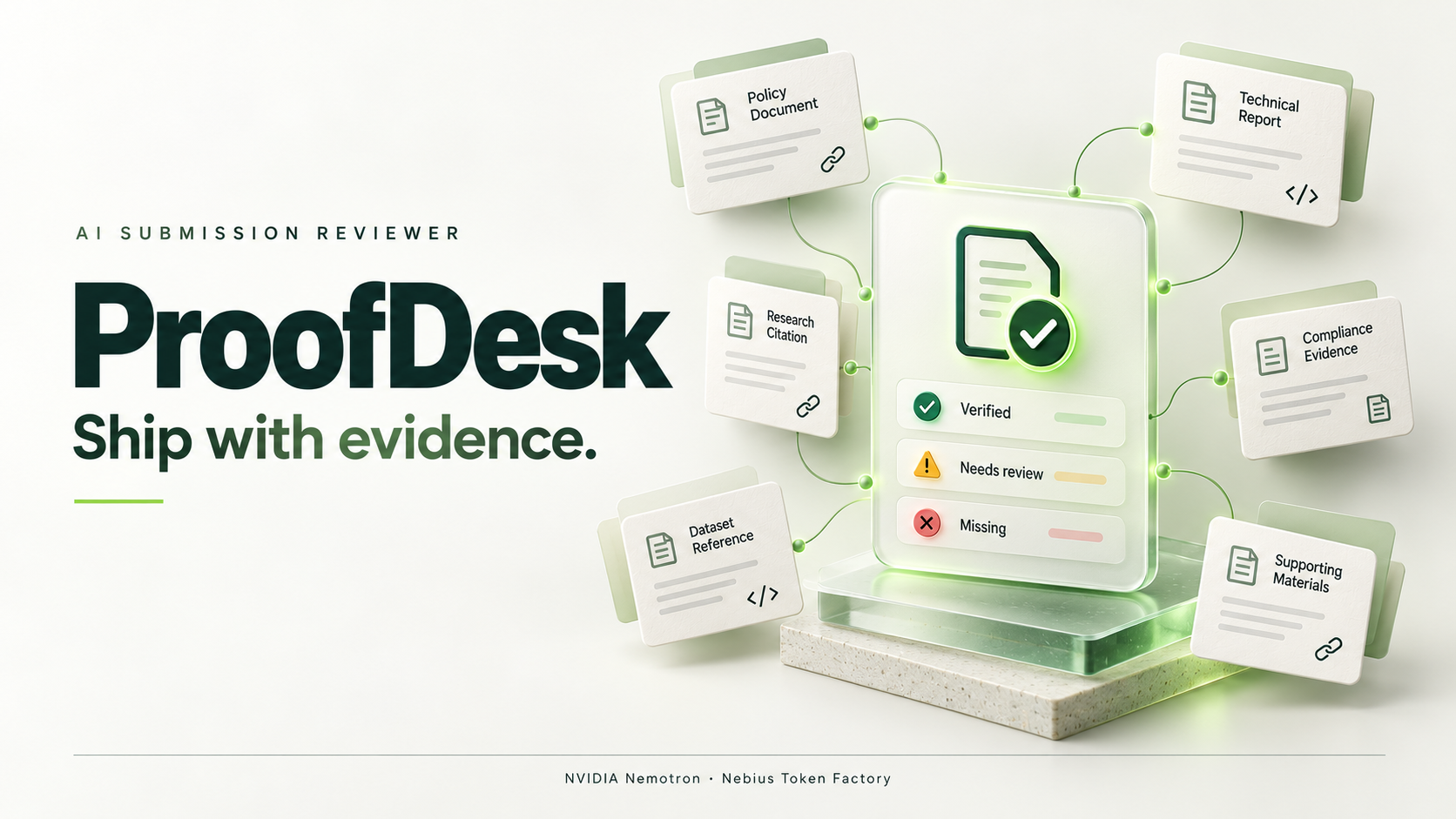
Inspiration: Building a working project is only part of a hackathon. Teams also need to follow detailed rules, document their work, publish a demo, and prepare a complete submission. We built ProofDesk to help builders catch missing requirements before the deadline and connect their claims to evidence.
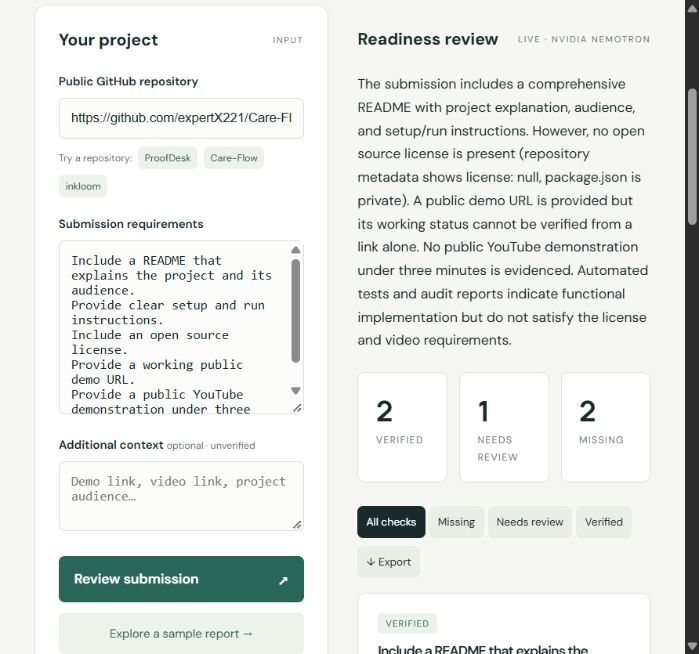
What it does: ProofDesk compares submission requirements with evidence from a public GitHub repository. It organizes findings into Verified, Needs review, and Missing, with source references and specific next steps.
It also generates submission-description and demo-outline drafts, and exports reports as PDF or JSON. “Verified” means supported by inspected text—it does not mean the reviewed software has been executed.
How we built it: We built a Python backend with a responsive HTML, CSS, and JavaScript interface. The backend retrieves selected files through GitHub’s REST API and sends them to NVIDIA Nemotron 3 Ultra through Nebius Token Factory.
The model returns a structured report. Our backend validates its statuses and evidence references before displaying it. ReportLab generates PDF downloads in memory. We deployed the application on Vercel and published the source under the MIT license.
Challenges we ran into: The central challenge was separating documented claims from proven functionality. Code referencing an API cannot establish that a runtime call succeeded, and a demo URL cannot establish that an application works.
We also handled malformed model citations, bounded repository scanning, Python deployment on Vercel, and browser compatibility for PDF downloads. We switched PDF export to a direct download after encountering problems with the browser’s fetch-based flow.
Accomplishments that we're proud of: We shipped a publicly accessible application with real Nemotron inference, inspectable source evidence, actionable findings, and PDF and JSON exports.
One verified request completed inference in 5.9 seconds, with 8.2 seconds total request time. We also demonstrated a live review of our Care-Flow repository, recorded the workflow, documented actual platform feedback, and passed nine automated tests.
What we learned: Useful AI reviews need traceable evidence and clearly stated limits. Structured output helps, but application-level validation is still necessary.
Nebius Token Factory let us integrate managed NVIDIA inference without provisioning GPUs or building a model-serving stack. We also learned that repository retrieval, model inference, deployment, and downloads each contribute to the overall user experience.
What's next for ProofDesk: We plan to improve file selection for larger repositories, add saved review history and requirement templates, and compare faster NVIDIA models for simpler checks.
We also want to add explicit, opt-in demo-link checks and show how submission readiness changes between repository revisions. Better access controls and usage limits will help support broader public use.
