Inspiration
Every first-year student we know gets the same resume advice: "add keywords", "quantify everything", "beat the ATS". In practice that becomes copying skills from the job posting and inventing numbers like "improved performance by 40%". The tools around us gave a mysterious "ATS score" and pushed the same idea: claim more.
We wanted the opposite: a tool that makes your resume sharper without making it less true. That became our rule and our name: Sharper resume. Zero fiction.
What it does
Paste your resume and a job posting (or pick one of 30 role presets, tech and non-tech, based on India's top early-career roles). ProofCV then:
- Sorts every skill in the posting into three buckets: Already in resume, Worded differently (e.g. you wrote "Express endpoints", the posting says "REST APIs") and Not found.
- Shows two honest numbers: coverage now, and coverage after rewording skills you genuinely have.
- Inspects each bullet: flags weak openers ("Worked on", "Responsible for") and missing results, then rewrites with a stronger verb. Where a number belongs, it inserts a
[N]placeholder for you to fill. It never makes one up. - Never suggests a fake skill. For a gap it asks: "Don't claim this unless it's true. Have you used it? Where?"
- Re-creates your resume in 6 LaTeX templates. Copy the code, download the
.tex, or open it straight in Overleaf. Placeholders print in red so you can't miss them. - Saves your audit history so you can compare versions and watch coverage climb.
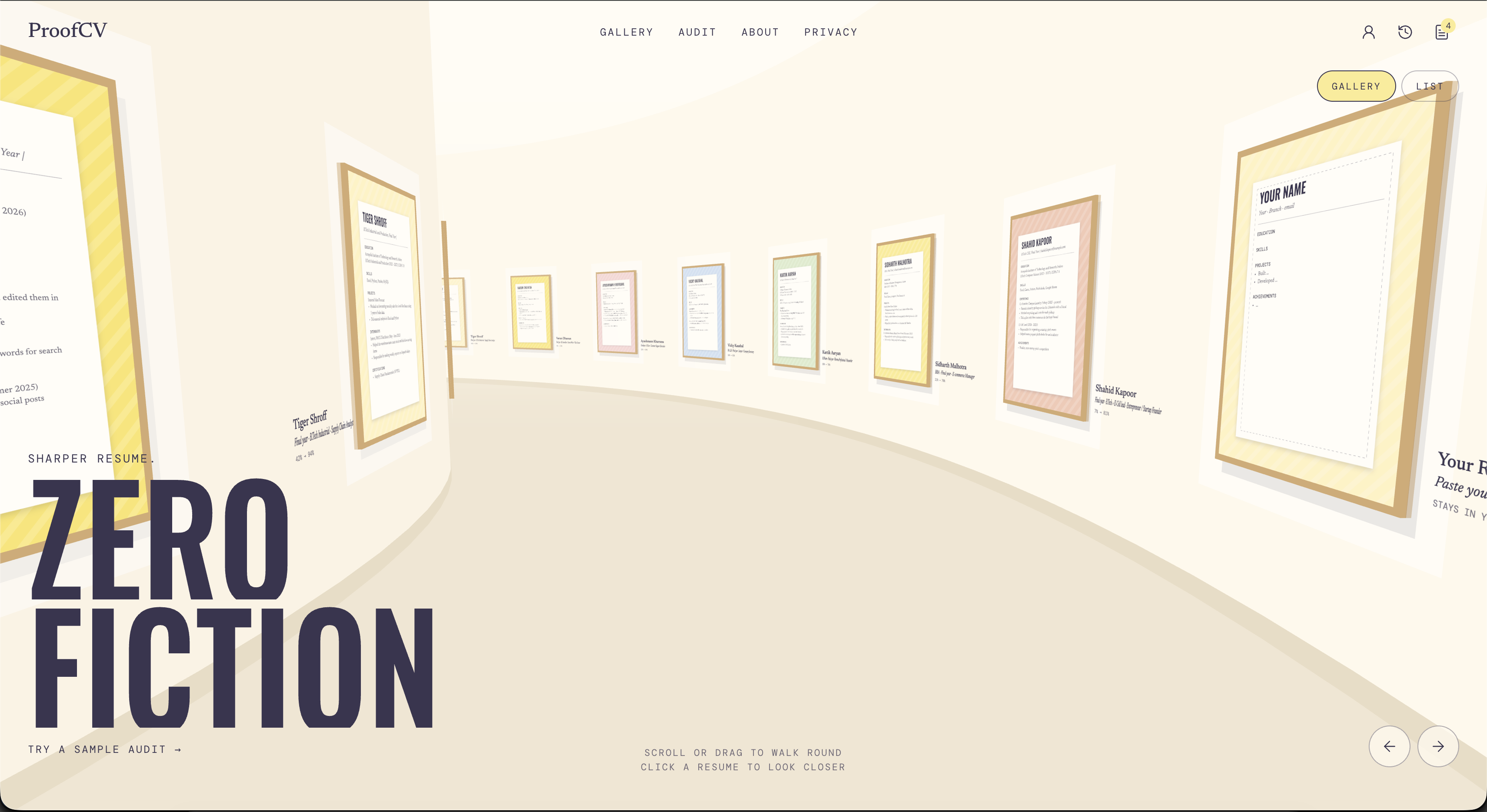
- 3D gallery of 30 parody sample resumes to explore and try instantly.
- Optional AI Resume Builder: a short interview with Claude that drafts a resume only from your answers. Anything it can't back up becomes
[N].
How we built it
- Frontend: React 19 + Vite, Tailwind CSS v4, React Router, Zustand (persisted to
localStorage), three.js for the gallery. - Shared engine (
@proofcv/shared): a rule-based matcher with ~285 skills and aliases, a bullet analyser and rewriter, a resume parser, and the LaTeX generator. The same code runs in the browser and on the server, and it's covered by unit tests. - Backend: a small Express server and one Vercel serverless function for the optional Claude builder.
- Deploy: Vercel.
The coverage score is weighted, so required skills count more than nice-to-haves. Required skills have weight $w = 2$, preferred skills $w = 0.5$:
$$ \text{Coverage}{\text{now}} = \frac{\sum{s \in \text{found}} w_s}{\sum_{s \in \text{JD}} w_s} \qquad \text{Coverage}{\text{potential}} = \frac{\sum{s \in \text{found} \,\cup\, \text{reworded}} w_s}{\sum_{s \in \text{JD}} w_s} $$
For our Software Developer sample, 4 skills found and 6 worded differently out of 17 give $\frac{6.5}{23.5} \approx 28\%$ now and $\frac{15.5}{23.5} \approx 66\%$ after honest rewording. Nothing in that jump requires claiming anything new.
Challenges we ran into
- Keeping the rewriter honest. It's tempting to "improve" a bullet by adding a metric. We restricted rewrites to verbs and filler and added a test that fails if any rewrite contains a digit that wasn't in the original.
- Parsing messy resumes. "B.Com" was detected as a website, "Summer 2024" broke date parsing, and skills like "AWS (EC2, S3)" were split in the wrong place. Each needed its own fix and test.
- LaTeX that actually compiles. Every template had to work with standard packages on both pdfLaTeX and XeLaTeX. For example, microtype letter-spacing fails under XeTeX, so we replaced it.
- Deploy-day bugs. After a deploy, browsers sometimes requested old code files that no longer existed, and Vercel cached those 404s for a year. We fixed the caching and added automatic recovery. We also found that slow page loads left the old page on screen under a new URL, so we added proper route-level loading with a progress bar.
Accomplishments that we're proud of
- An audit that runs entirely in the browser: your resume never touches a server.
- Honesty enforced in code and tests, not just in copy.
- A one-click path from audit to a polished LaTeX resume in Overleaf.
What we learned
- Being honest with users is a design constraint, not a disclaimer: every feature had to answer "could this make someone claim something untrue?"
- Simple, explainable rules beat a black-box score when the user needs to trust and act on the result.
- Shipping is its own skill: caching, code-splitting and deploy behaviour mattered as much as the features.
What's next
- PDF and DOCX import with better section detection.
- More role presets and regional job postings.
- Shareable audit links that stay private by default.
Built With
- anthropic
- claude
- express.js
- firebase
- javascript
- latex
- node.js
- overleaf
- react
- react-router
- tailwindcss
- three.js
- vercel
- vite
- zustand
