-
-
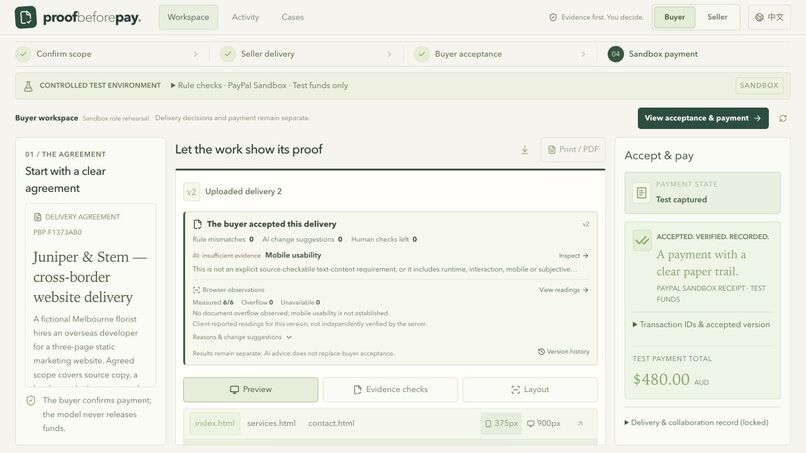
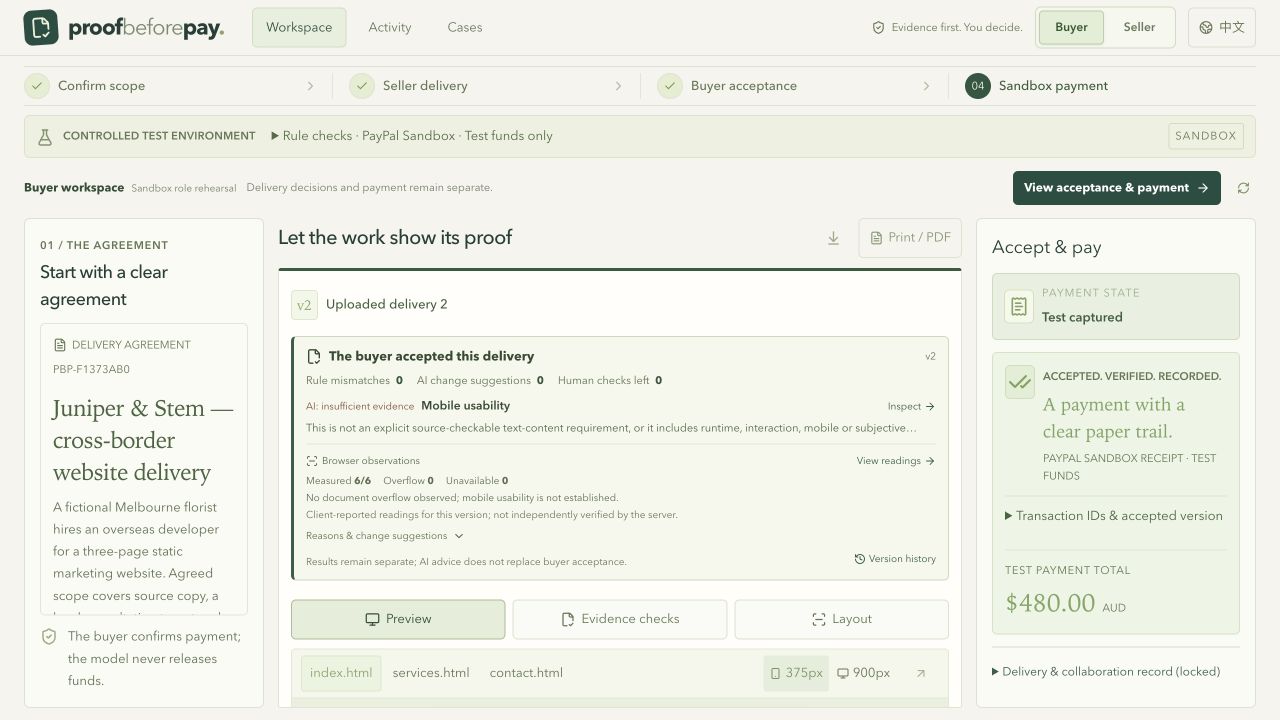
Earlier, separate Sandbox exercise: accepted v2 and a saved test-fund receipt. Not a payment made in this demo.
ProofBeforePay
Evidence before acceptance. Payment stays a separate human decision.
Inspiration
Imagine a small noodle shop commissioning a website. The agreed menu price is AUD 18, but the delivered page displays AUD 28. The correct price is still present in hidden source text, so simply searching the file is not enough.
This fictional example captures the problem we wanted to explore: a small merchant may know what they asked for without knowing how to inspect the delivered code. We built a workflow that makes the agreement, evidence, revisions and buyer's decision easier to compare before payment.
What it does
A buyer starts with a plain-language brief and confirms a checklist. The seller supplies a version of the static website. The workbench keeps rule checks, optional AI source assessments, separately recorded browser evidence and manual judgments distinguishable.
DeepSeek provides advisory findings with source references. Buyers can inspect the cited material, request changes, and compare evidence for two deliveries. An AI opinion does not approve the work.
The buyer accepts one exact version. Evidence available at acceptance is preserved in that record; a later report does not replace it. Payment is a separate, deliberate action. Our PayPal integration uses Sandbox test funds.
The account-free interactive demo runs bounded browser checks on a fixed fictional example. It also explains acceptance and links to separate historical AI and Sandbox evidence. Those historical records have their own files and test context; they are not new results for this three-page example. Viewing the replay makes no new model call, acceptance or payment. The workbench is the place for authorized project actions.
How we built it
We used TypeScript and React with Vite, Cloudflare Workers and D1. Server-side checks protect project access and bind evidence and acceptance to delivery versions.
DeepSeek assessments are checked against the submitted source and expected report structure before publication. These controls help detect unsupported references; they are not a guarantee that every model judgment is correct. The buyer can examine the underlying evidence and make an independent decision.
The PayPal flow creates an Orders v2 authorization, followed by a separate Payments v2 capture tied to the accepted delivery. The demonstration evidence uses Sandbox accounts and test funds, not a live commercial transaction or escrow.
Challenges we ran into
The first challenge was separating what a file contains from what a visitor sees. Our fixed example includes a hidden correct price and a conflicting visible price. The interactive demo inspects rendered elements for its specified checks rather than treating a source-text match as sufficient.
The second was preserving the meaning of evidence over time. A revised delivery, a later AI report and the buyer's earlier acceptance must remain distinguishable. We worked on exact-version records, cited evidence, revision comparisons and editable feedback that is never sent automatically.
The third was presenting these boundaries clearly: advice is not acceptance, and acceptance is not payment.
Accomplishments that we're proud of
- A concrete, interactive example that exposes a visible-price mismatch despite a correct value hidden in the source.
- A path from a specific failed requirement to its evidence, an editable feedback draft and a comparison with a revised version.
- Acceptance records tied to an exact delivery, with later reports kept separate.
- A PayPal Sandbox authorization/capture integration, with historical test evidence presented separately from the read-only demo.
What we learned
Useful evidence needs context: the requirement, the exact delivery, the cited source and the person making the decision. A simple pass/fail summary is insufficient when those refer to different versions.
We also learned to state what a demonstration actually establishes. The browser demo checks a bounded static example. AI reads source text, not image pixels. Neither is a security audit or a guarantee that arbitrary code or backends work correctly.
What's next
Test the workflow with unfamiliar buyers and sellers on real commissioned deliveries. Measure whether they can locate a defect, request a useful revision and accept the correct version without guidance. Evaluate AI's additional value over rules on previously unseen cases, and extend mobile and accessibility testing on physical devices.
Try it and inspect the evidence
Start the account-free interactive demo. Run the checks: version 1 has two mismatches; version 2 corrects them. The mobile usability criterion remains a human decision.
Judge guide links to separate historical model evidence and the workbench. The earlier AUD 1 Sandbox exercise used two authenticated accounts operated by one developer; it is not independent user research or a payment made in the current video.
MIT source and setup includes the full application and a provider-free local helper, node scripts/judge-demo.mjs (macOS/Linux, or WSL2 on Windows). Live DeepSeek assessments and genuine PayPal Sandbox use require the tester’s own provider credentials. Hosted project actions require an authorized account; the public demo itself needs no account.
The full workbench also supports explicitly configured, disposable booking endpoints under a separately confirmed bounded HTTP protocol. This is separate from the static demo and does not certify arbitrary backends. Protocol and limitations.
