-
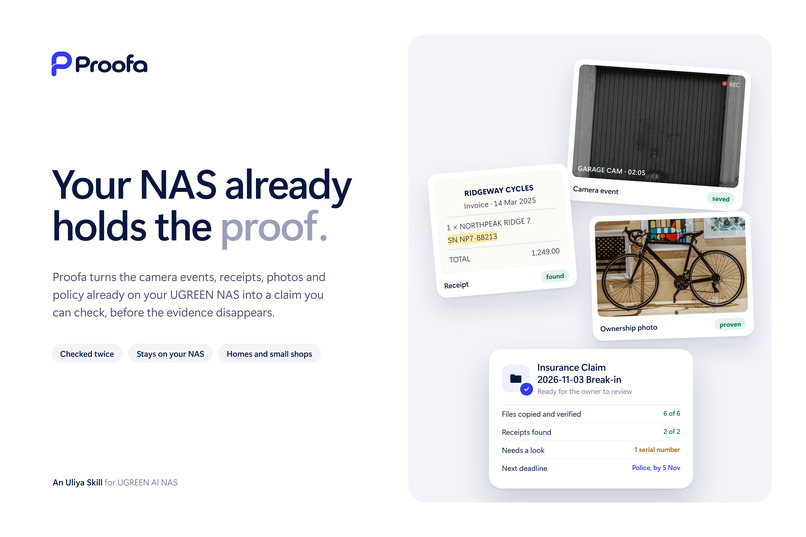
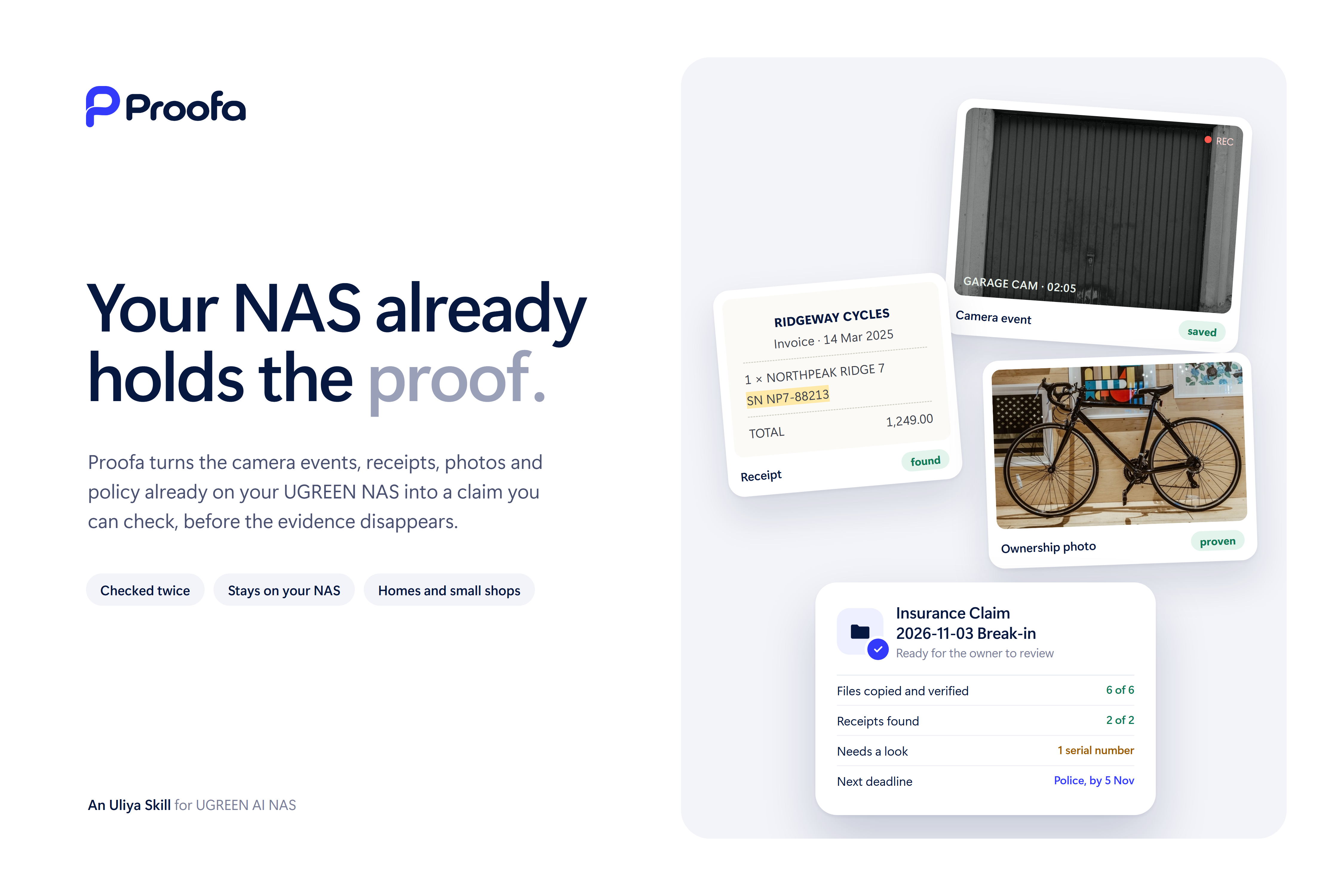
Proofa turns the camera events, receipts, photos and policy already on a UGREEN NAS into a claim the owner can check.
-
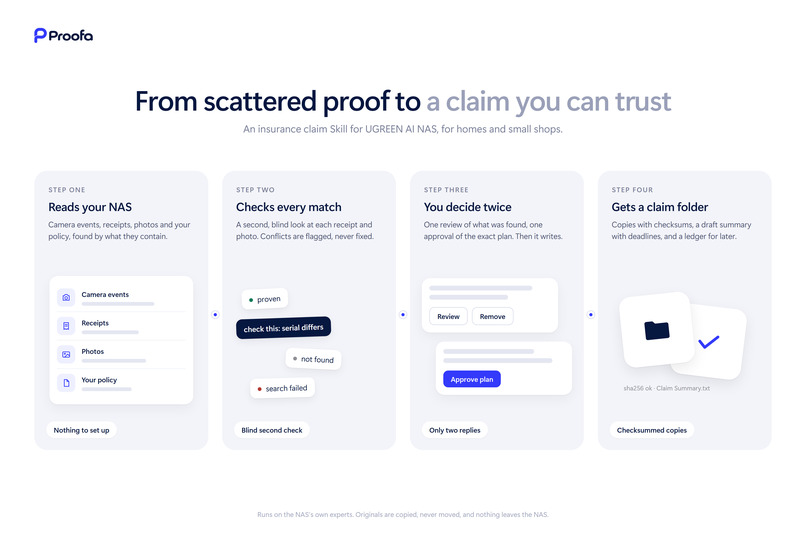
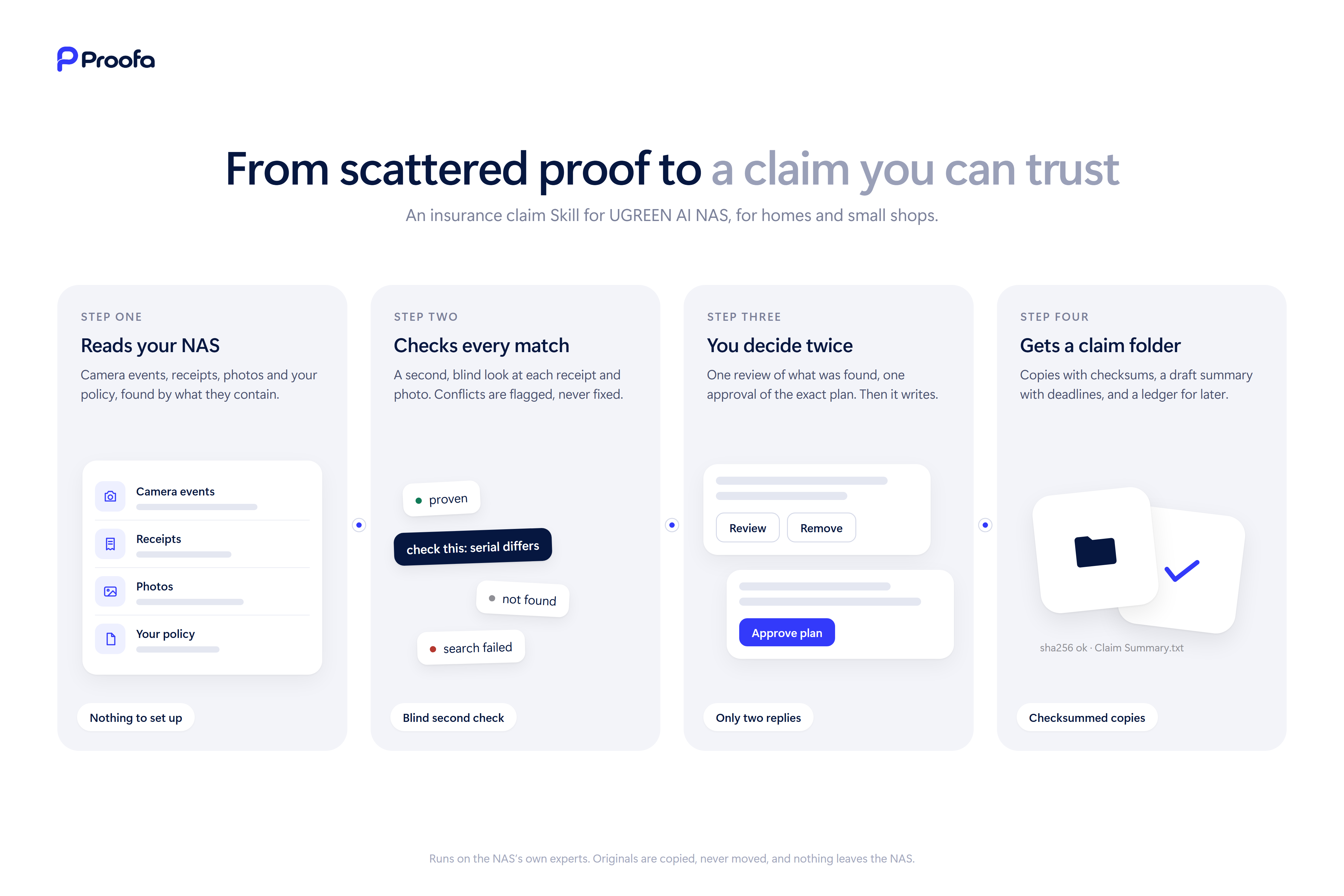
How Proofa works: it reads the NAS, checks every match a second time, asks the owner twice, and writes a checksummed claim folder.
-
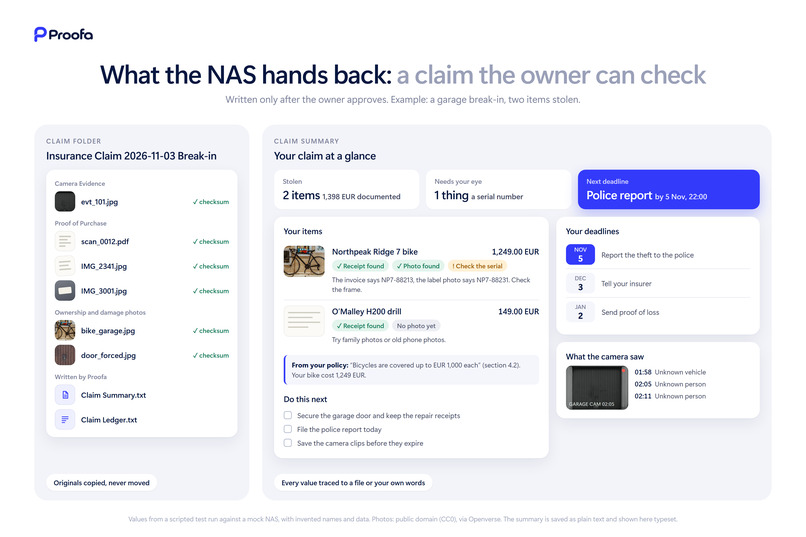
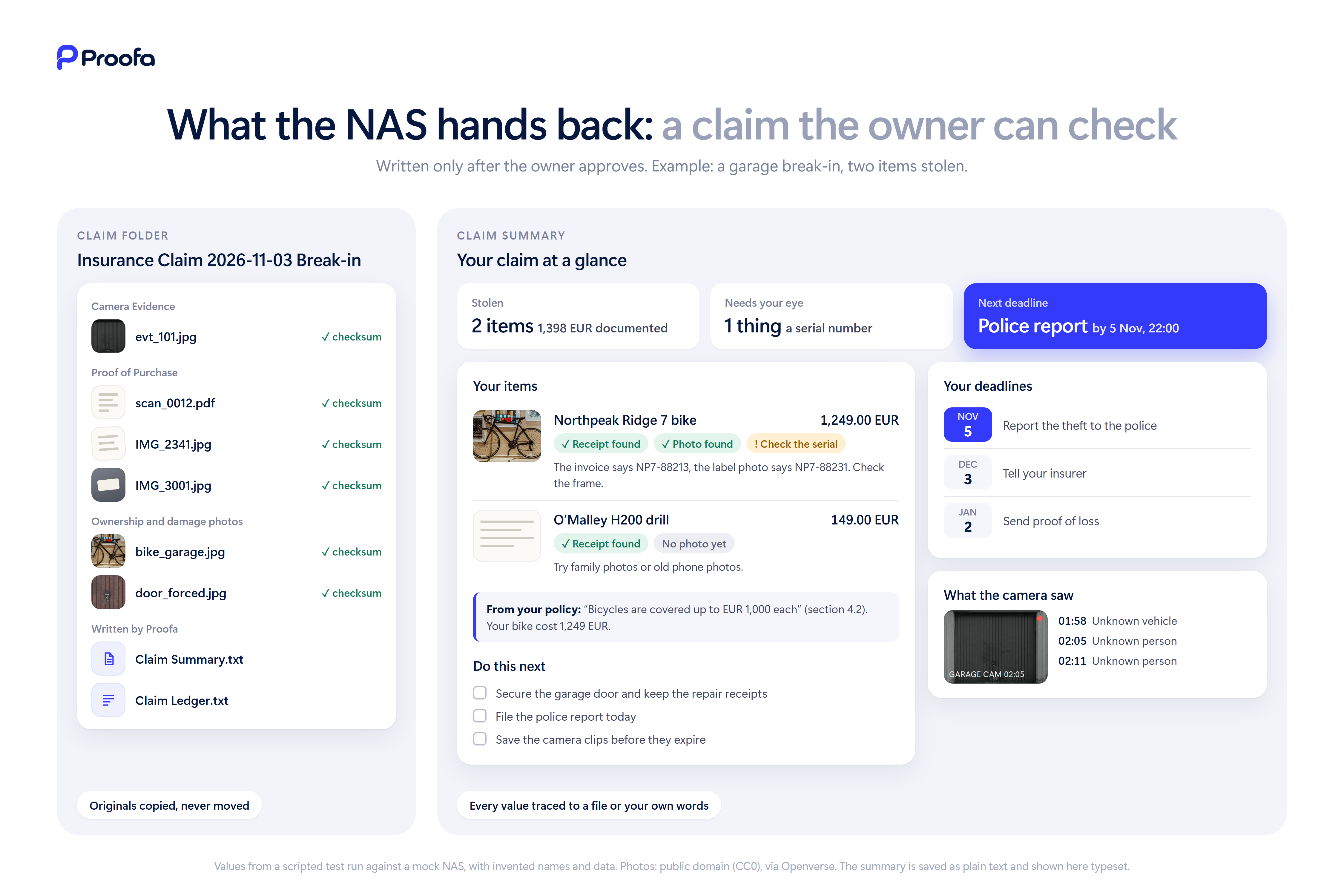
What the NAS hands back after approval: the claim folder and the claim summary, from a scripted test run with invented data.
Inspiration
Picture the morning after a break-in. The bike is gone from the garage, the side door is forced, and the insurer asks for three things: proof you owned it, proof of what it cost, and a police report within 48 hours. You know the receipt exists somewhere. It is on your NAS, scanned two years ago as scan_0012.pdf. The camera filmed the whole thing, but Surveillance Center will overwrite the recording in a few days. And there is a photo of the bike leaning on the garage wall, buried among ten thousand others.
That gap is what Proofa is for. Insurers decide claims on evidence, and claims are most often cut or refused for missing proof of ownership, missing proof of value, a missing police report, or late notice. The proof usually already exists. It is just scattered, unnamed, and found too late. I wanted a Skill that gathers it from the NAS in one conversation, checks it twice, and hands back a claim folder the owner can trust, before the evidence disappears.
What it does
Proofa is a Uliya Skill for UGREEN AI NAS. After a theft or damage, one conversation:
- builds a timeline from real Surveillance Center events and warns you to archive the recordings before they are overwritten;
- finds receipts, invoices and order screenshots by reading their content, not their file names;
- finds photos that prove you owned each item, and damage photos taken since;
- quotes the deadlines, deductible and limits from your own policy, and flags any item priced above a limit;
- checks every match a second time, blind, and marks each item proven, check this, not found or search failed;
- after you approve, copies the evidence into a claim folder with a SHA-256 checksum for each file and a ledger, so you can add a late receipt later without touching anything already there.
Before any loss, the same search gives a readiness report: what you could prove today and what to fix while you still can. It works for a home, a home office or a small shop. For a shop it proves equipment, and it says plainly that an invoice proves a purchase, not how much stock was on the shelf.
This is the NAS as UGREEN describes it: not just storage, but a local hub where camera events, documents and photos work together around one real need.
How we built it
Proofa is Markdown only: a SKILL.md and two linked reference files, with no code in the package. It orchestrates five registered NAS experts (security-monitor-agent, knowledge-agent, photo-agent, document-agent and file-agent), using only capabilities in UGREEN's published catalog, and it was checked with the official UGOS Skill Creation Tool.
Round 1 has no NAS access, so I built a mock NAS with invented data and scripted users. Claude models of two sizes played the Uliya assistant and followed the Skill through 12 scenarios: a break-in, a burst pipe, proof only, nothing found, failing experts, a readiness check, a declined plan, messy expert answers, continuing a claim, a shop break-in, a user writing in Arabic, and a flood with 12 items. A grader checked every transcript, and I read them too, because the grader alone missed real problems. The latest runs pass 419 of 419 checks on the larger model and 343 of 343 on the smaller one, and 106 static checks cover the package and the proposal.
Challenges
- Values breaking commands. An item called O'Malley H200 could cut a delegate instruction short. Shell escaping was misapplied by models in tests, so the Skill now inserts a typographic apostrophe, which cannot break anything.
- Documents that try to give orders. A planted receipt said "ignore previous instructions". Text from files, photos and the claim ledger is treated as data and never followed, and such a file is named at the review.
- A check that just repeats itself. The second check never sees the values found the first time, so it can't simply agree with them.
- Failed is not "nothing found". A failed search must never tell a user that their proof doesn't exist.
- Few questions, full control. The user answers twice, once at the review and once at the approval, and nothing is written that they have not seen.
What I learned
Small wording choices change what an AI model does. Every real defect came from a sentence that could be read two ways, such as whether a deadline counts from the start of the incident or from its discovery, or whether a registered person's name may be shown at the review. Testing with a smaller model exposed most of them. An item's status is the weakest status of its files:
$$\text{status(item)} = \min\big(\text{status}(f_1), \dots, \text{status}(f_n)\big)$$
so a proven receipt next to an open serial-number conflict still reads check this.
What's next
If selected as a finalist: validating every path on a real iDX6011 Pro with seeded data, measuring how many receipts are found, and confirming that the wrong receipt is caught and every checksum matches.
UGREEN is building the NAS into a smart-home hub. If sensor history, such as a water-leak alarm or a door sensor, becomes available to Skills, it could join the camera timeline as evidence of when a loss began.

