Inspiration
Every household has the same moment: the dishwasher dies a few weeks after you think the warranty ended, or the bike is gone from the garage. The receipt exists, somewhere among thousands of phone photos. The invoice is a PDF named after an order number. The manual is in Downloads. On a NAS all of it is in one place, and still nobody can find it when it matters.
What it does
Ask in plain words: "My dishwasher broke, am I still under warranty?" or "Build a claim file for my bike, it was taken last night between 23:00 and 06:00."
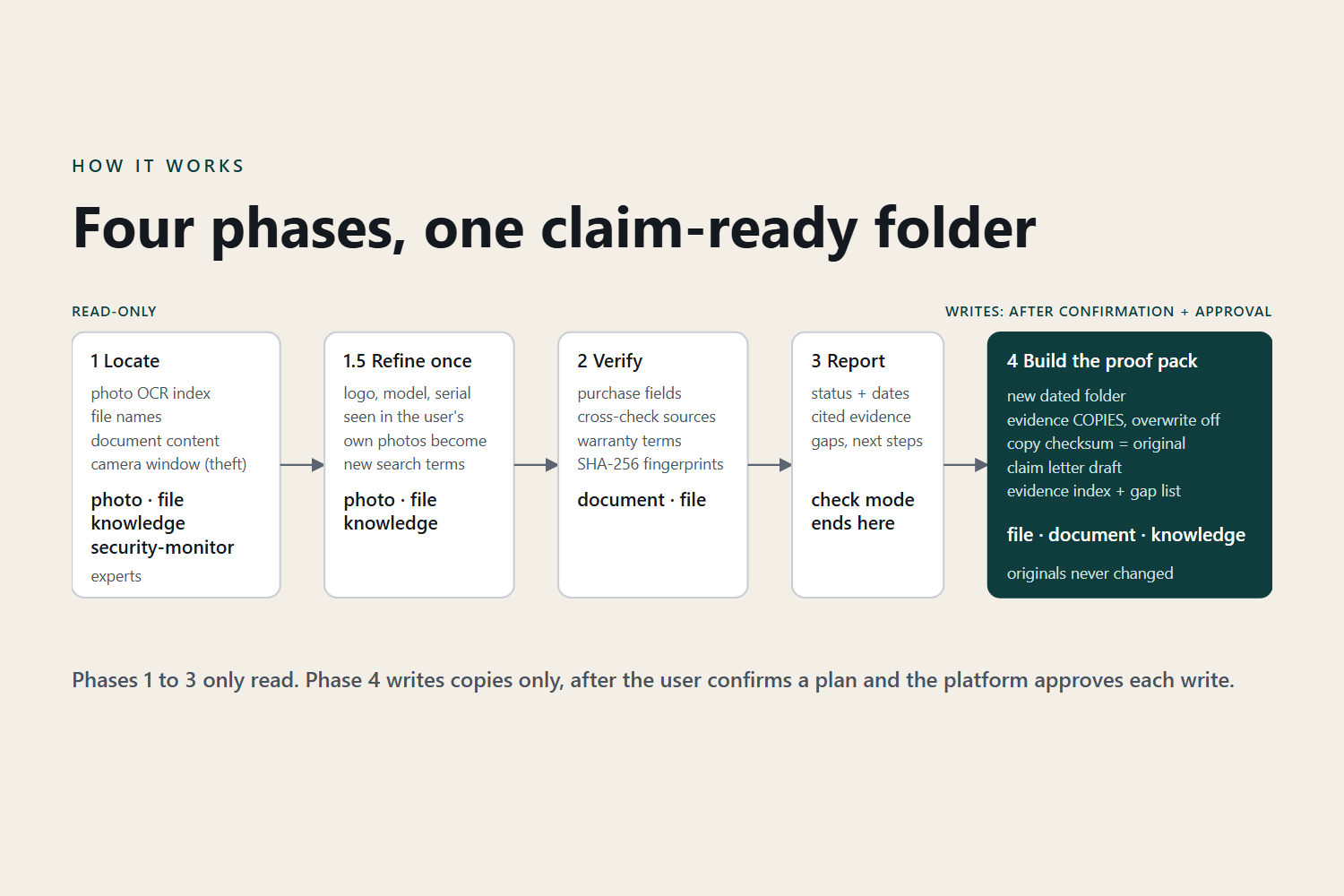
- Readiness check (read-only): finds the receipt through the photo text index, the invoice and manual in your files, and photos of the item from before the problem; extracts seller, date and amount; reads the warranty period with a page citation; computes the end date; lists what is missing.
- Proof pack (after you say yes): a new dated folder with numbered copies of the evidence, an evidence index with a SHA-256 fingerprint per file (each copy checked against its original), a claim letter draft and a gap list. For a theft, camera events from the window you name are included; people are never identified.
How it is built
A Markdown orchestration Skill following the Uliya Skill Development Standard. It delegates to five registered NAS experts (photo, file, document, knowledge, security-monitor) across six CLIs. Every step gets only the real results of the step before it. Searching and verifying only read. Writes happen after the user confirms an explicit plan, and every write still passes the platform's own approval: copies only, overwrite off, nothing deleted or moved.
One step is the heart of it: refine once. If the purchase proof is not found, the brand, model or serial that the vision model reads in the user's own photos becomes the next search term. In testing, a TV receipt saved as a scanned PDF named only by a number was found only after a photo of the back label gave the model and serial, and that serial then matched the receipt.
Challenges
Making it honest. A claim tool that guesses is worse than none, so a missing date or warranty period is reported as not found, a similar item is never offered as a substitute, and an evidence copy is called verified only when its checksum matches the original.
Accomplishments
The package passes UGREEN's official checker with 0 errors and 0 warnings. A local dry run with mocked experts over synthetic data passed five scenarios (warranty check, theft pack, no-proof edge case, refused approval, photo-led refinement) with checks on writes, checksums, unresolved values and invented amounts.
What we learned
The best search term is often one the user never typed. File names lie; photos and document contents do not.
What's next
If selected as a finalist: run the same test plan on a real iDX6011 Pro, tune the instructions to the real expert outputs, and record the demo.
Disclosures
- AI tools: Claude (Anthropic), via Claude Code, for drafting and revising the Skill Markdown and for a local dry-run simulation against synthetic data; Google Flow (Nano Banana Pro) for the cover photograph, retouched, with all text set in real type.
- Third-party components: none bundled or called. The Skill uses only capabilities from the UGOS Skill Creation Tool catalog (uliya-skill-kit 0.7.3).
Built With
- markdown
- ocr
- sha-256
- ugos
- uliya-skill
- vision-language-model
