-
-
The Idea
-
Roadmap
-
Website

Inspiration
With the advent of our online presence, such as what kind of events we attend and what we are interested in. Increasingly getting linked to our wallet address, there is a need for a protocol that enables individuals to show the story of their career using their wallet address.
What it does
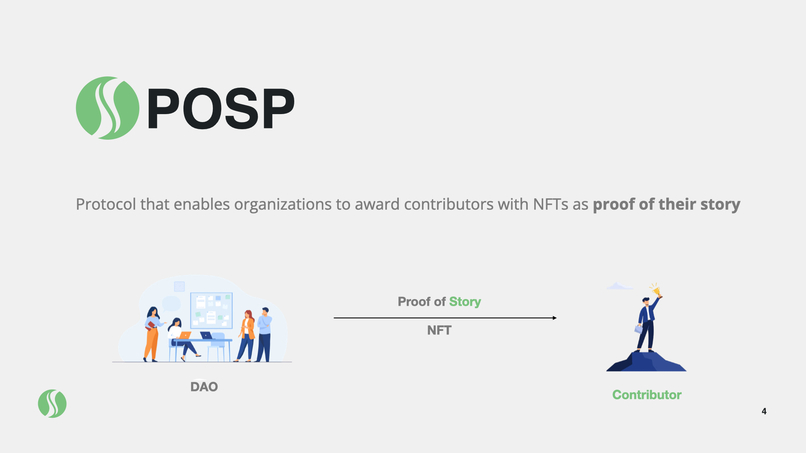
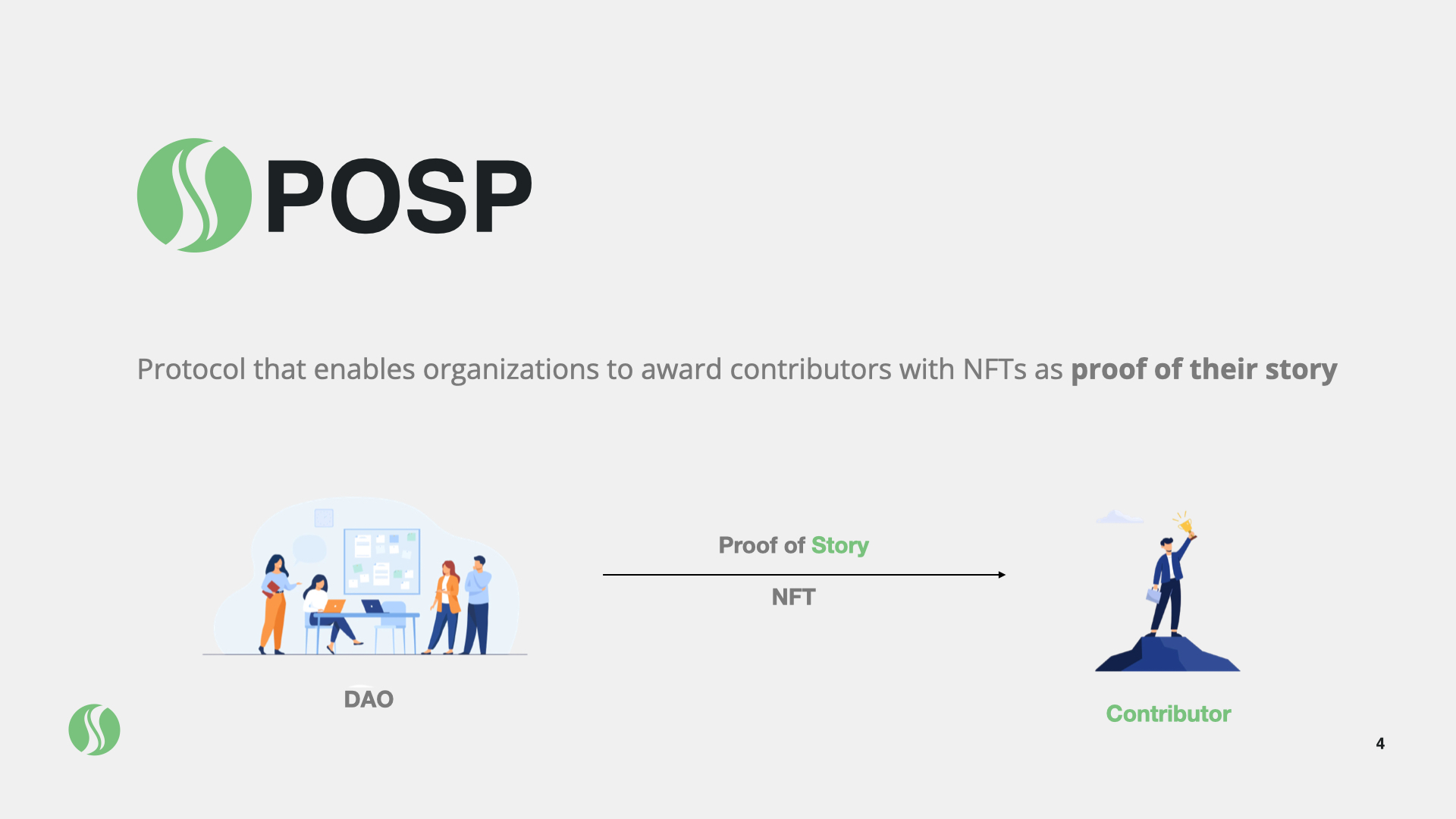
We at POSP are building a protocol that enables organizations to award their contributors with NFTs as proof of their contributions.
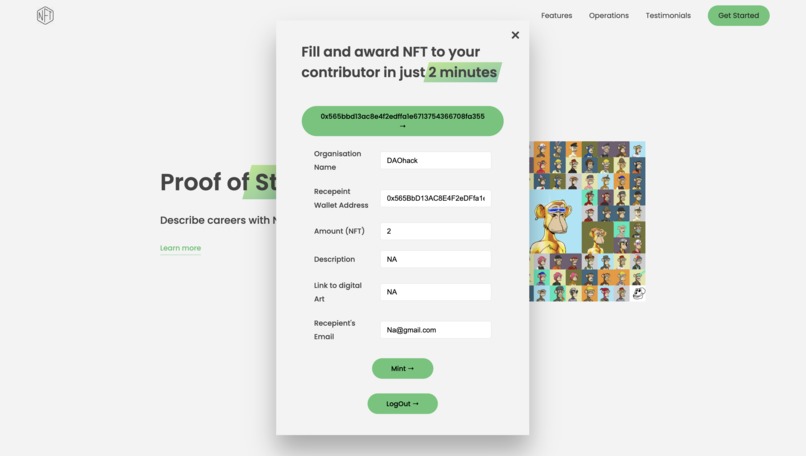
Organizations have to fill a small form with the details that they want in the NFT, this process takes only 2-5mins, and an NFT is sent to the recipient.
Now let's look at how POSP is going to benefit the DAO ecosystem. With folks working in multiple DAOs for short-term gigs, it's increasingly difficult for DAOs to find the right person, and DAOs have to do this at a higher cadence. Using POSP, the DAOs can quickly understand the work done by a person by glancing through the NFT collection that the candidate holds. They can also believe in this collection more than Resumes or Websites since other organizations award these NFTs while most of the things on websites are self-claimed. These NFTs can also increase the satisfaction level of contributors towards the DAO as it will provide a sense of accomplishment.
There are benefits for contributors as well, While it's relatively easy for developers and designers to prove their work using GitHub and Behance, proving your experience becomes complicated for Product Managers, Community Managers, Ecosystem Evangelists, etc. POSP will enable them to prove their contributions to different projects using their wallet ID.
How we built it
In this project, we used javascript with React framework, and we used firebase to deploy the front end.
We developed the smart contract in solidity using open zeppelin libraries. We tested it on a remix and then deployed it on Ropsten using hardhat for further testing. We eventually deployed it on Polygon.
To store the metadata and Image files, we used IPFS and used NFT.storage libraries to implement this functionality.
To design the mockups, we used Figma.
More specifically, IPFS helped us store the Image files and Metadata files. It provided us with a secure way to store our data. We used NFT. storage APIs to implement this.
Challenges we ran into
We wanted to save the metadata as we minted the NFTs, and we had to save this metadata and NFT in IPFS. Hence To store the data on IPFS, The NFT storage API store function fetches the image from the URL and then takes the image as a blob into the metadata, which was an issue for us as the store function gives the file name the same as metadata.json, with different Cid for multiple tokens.
This was solved by using the store directory function, which gives the option to have custom metadata and the custom file name, and it even resolves the issue of image loading over the opensea.
The second problem was image loading over opensea , we solved by uploading the image on the IPFS and then passing the Cid URL as the parameter in the digital link art.
What's next for Proof of story protocol
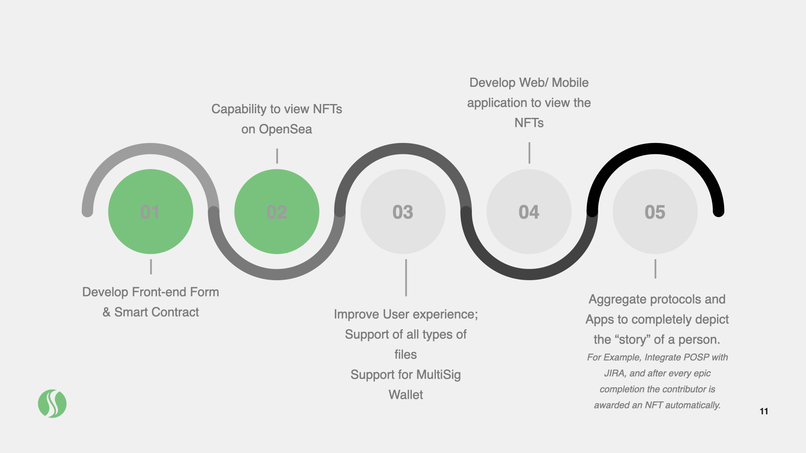
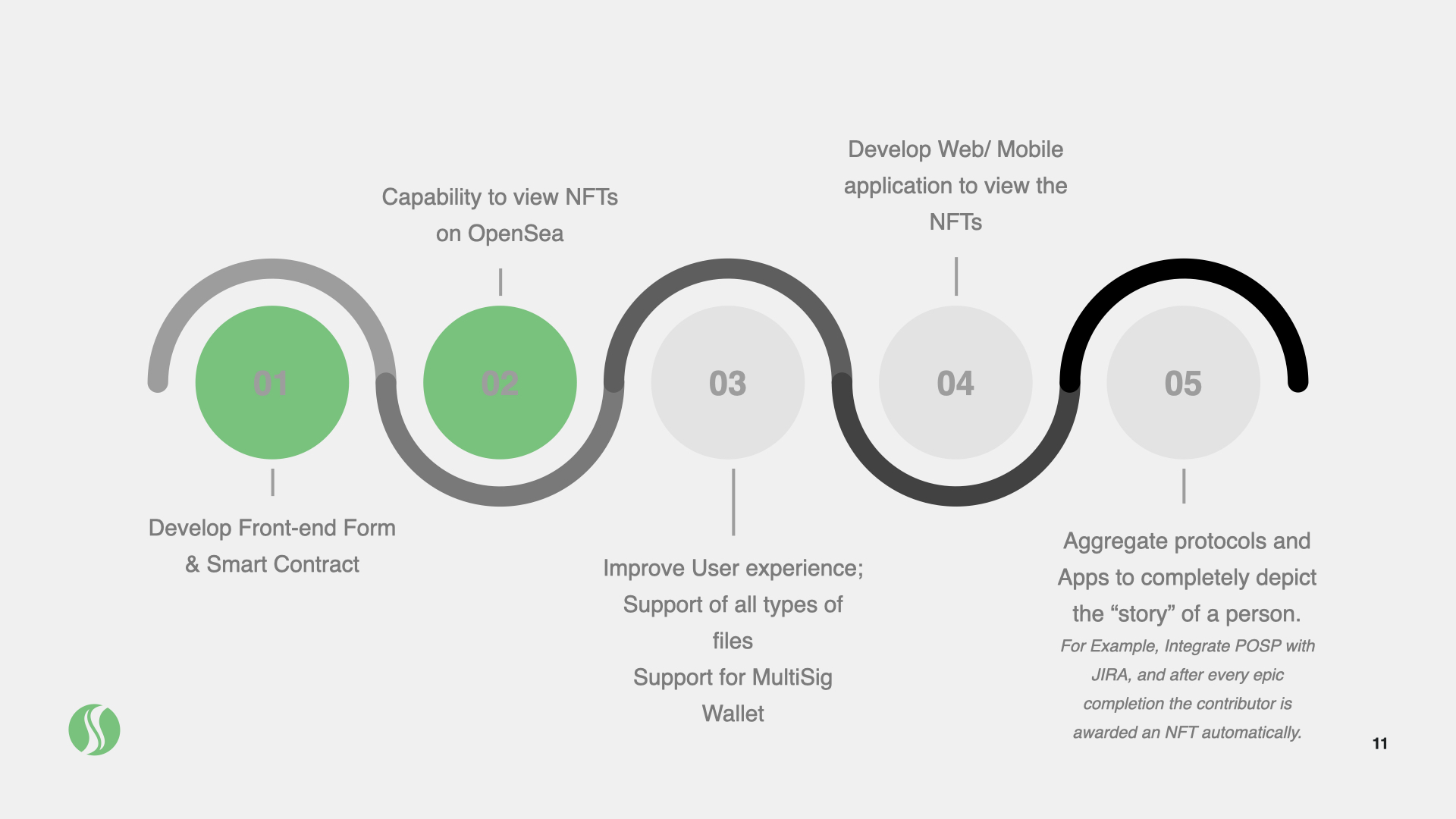
In terms of the feature roadmap We have developed a front-end form and ERC 1155 standard smart contract. For this project. We have also been able to show it on the opensea.
As the next step, we want to improve the user experience by creating a full-fledged website; that support all types of art and support multi-sig wallets.
After that, we can focus on developing an application that makes it easy for users to view their profiles.
And after that, we will focus on Aggregating protocols and Apps to completely depict the "story" of a person. For Example, Integrate POSP with JIRA; after every epic completion, the contributor is automatically awarded an NFT. Or with any other web2 application that is linked to career.

Log in or sign up for Devpost to join the conversation.