Inspiration
Health insurance usually moves in one direction: premiums rise, but users rarely have a trustworthy way to prove they are becoming healthier and deserve better rates. At the same time, fitness challenges and wellness reward programs still rely on screenshots, manual review, or blind trust, which makes fraud easy and payouts slow.
We wanted to build a system where healthy behavior could be proven in a privacy-preserving way and turned into real financial benefit. That idea became Proof of Pulse: a platform where users can prove real workouts using wearable heart rate data, receive wellness-based rewards, and do it all without exposing raw biometric data on-chain.
What it does
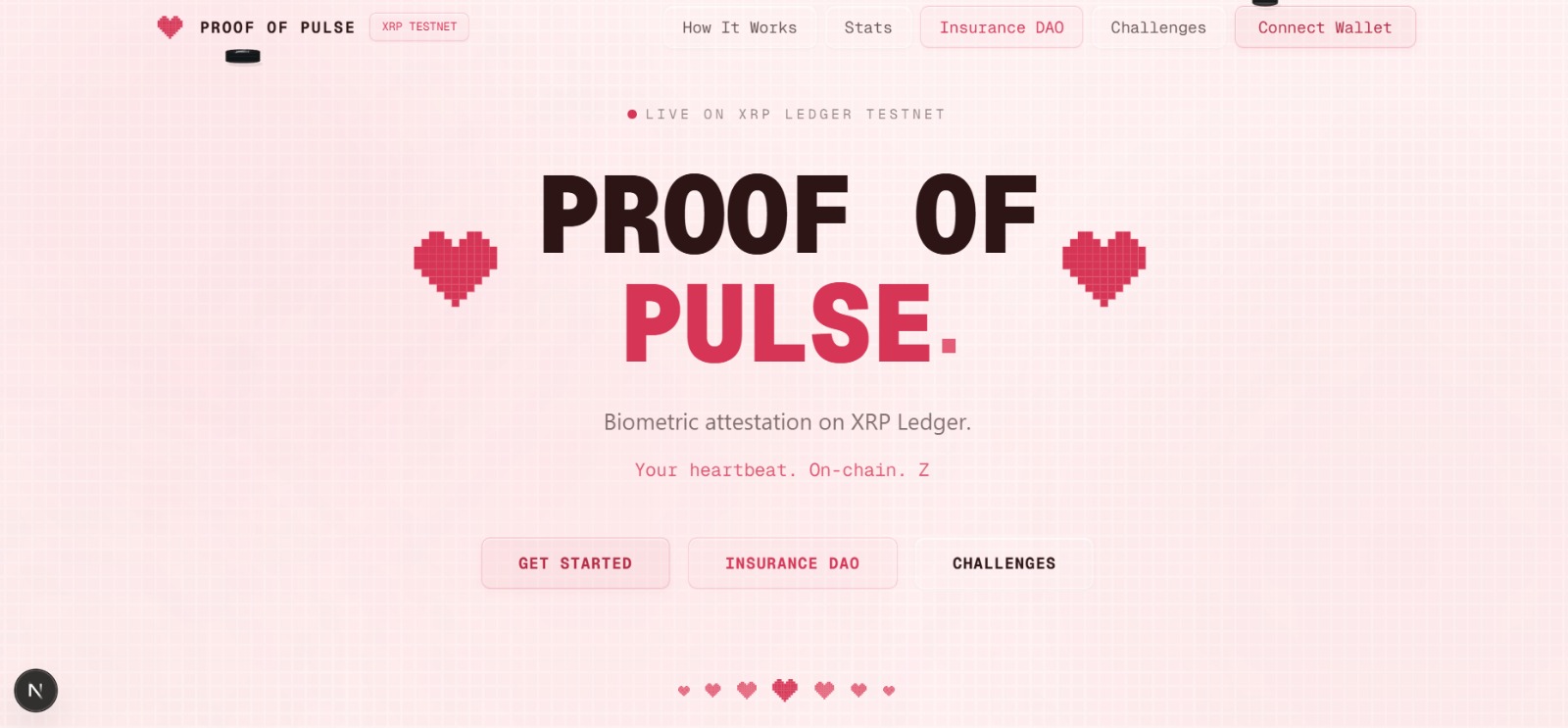
Proof of Pulse is a cross-chain platform for privacy-preserving biometric attestation.
It supports two main use cases:
- Insurance Wellness DAO: users submit proof of exercise, the system analyzes the workout for authenticity, and the DAO can approve a wellness rebate or improved premium tier.
- Challenge Reward DAO: sponsors create fitness challenges, participants submit biometric proof, and the DAO votes to approve XRP payouts.
The core idea is simple: users prove they exercised, the system verifies the evidence without exposing sensitive raw data publicly, and approved outcomes trigger rewards through blockchain-based governance and escrow.
How we built it
We built Proof of Pulse using:
- Next.js 16 + TypeScript for the frontend
- Solidity smart contracts on the XRP EVM Sidechain
- XRPL Devnet for native XRP escrow and payout settlement
- Pinata IPFS for storing proof data off-chain
- Hono for backend API routes
- Telegram Bot for mobile-first DAO voting and case management
- MetaMask for wallet connection and on-chain interaction
The system uses a biometric attestation engine that analyzes heart rate samples for realistic workout patterns such as warmup, cooldown, natural variability, and heart rate zones. It generates a confidence score and proof hash, while raw biometric data remains off-chain.
Governance happens on the XRP EVM Sidechain through Solidity DAOs, while XRP rewards are locked and released through XRPL escrow. This gives us flexible smart contract logic for voting and reliable native settlement for payouts.
Challenges we ran into
One of the biggest challenges was designing a proof system that felt meaningful. We did not want to simply accept uploaded heart rate data at face value, so we had to build a fraud-detection approach that could distinguish realistic workout behavior from suspicious or fabricated patterns.
Another major challenge was cross-chain coordination. Our governance logic lives on the XRP EVM Sidechain, but the actual payout flow happens on XRPL through escrow. Connecting these two layers cleanly while keeping the demo understandable took a lot of design and debugging.
Privacy was also a constant balancing act. We wanted the application to be useful and verifiable, but without exposing raw biometric information publicly on-chain.
Accomplishments that we're proud of
We are proud that Proof of Pulse is more than a concept. We built a working end-to-end prototype with:
- deployed smart contracts on XRP EVM Testnet
- an Insurance Wellness DAO
- a Challenge Reward DAO
- a biometric attestation and fraud-detection engine
- IPFS-based proof storage
- XRPL escrow-based reward settlement
- a Telegram bot for mobile governance
- a demo flow showing proof generation, DAO voting, and XRP payout release
We are also proud of the product vision: turning biometric data into something users control, instead of something platforms exploit.
What we learned
We learned that building trust into health-related systems is much harder than just deploying a contract or building a UI. The real challenge is creating a model that balances privacy, verification, usability, and incentives all at once.
We also learned a lot about integrating multiple layers of Web3 infrastructure, especially using Solidity on the XRP EVM Sidechain while coordinating real XRP escrow flows on XRPL. On the product side, we learned that privacy-preserving design is not just a technical choice, it is central to user trust.
What's next for Proof Of Pulse
Our next step is to make the platform even more production-ready.
We want to integrate with real wearable data sources such as Apple Watch, Fitbit, or Garmin instead of only simulated sessions. We also want to improve privacy further through encrypted evidence access or zero-knowledge style proof systems.
Long term, we see Proof of Pulse evolving into infrastructure for wellness programs, employer fitness incentives, sponsor-backed challenges, and insurance rebate systems, where users can prove healthy behavior and unlock benefits without giving up control of their biometric data.
Built With
- biometric-attestation
- cross-chain
- dao
- ether.js
- hono
- ipfs
- metamask
- nextjs
- node.js
- piniataipfs
- smartcontracts
- solidity
- tailwind
- telegrambotapi
- typescript
- xrlp.js
- xrpevmsidechain
- xrpldevnet


Log in or sign up for Devpost to join the conversation.