-
-
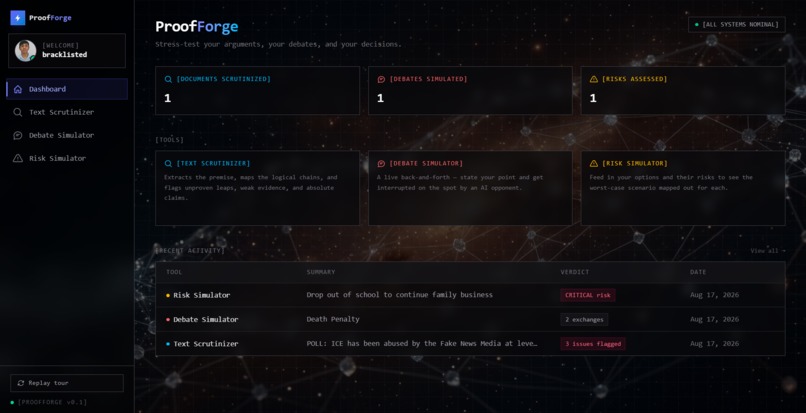
Dashboard
-
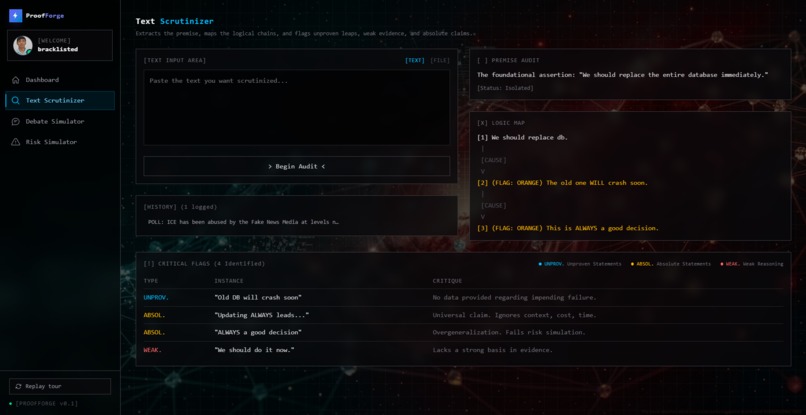
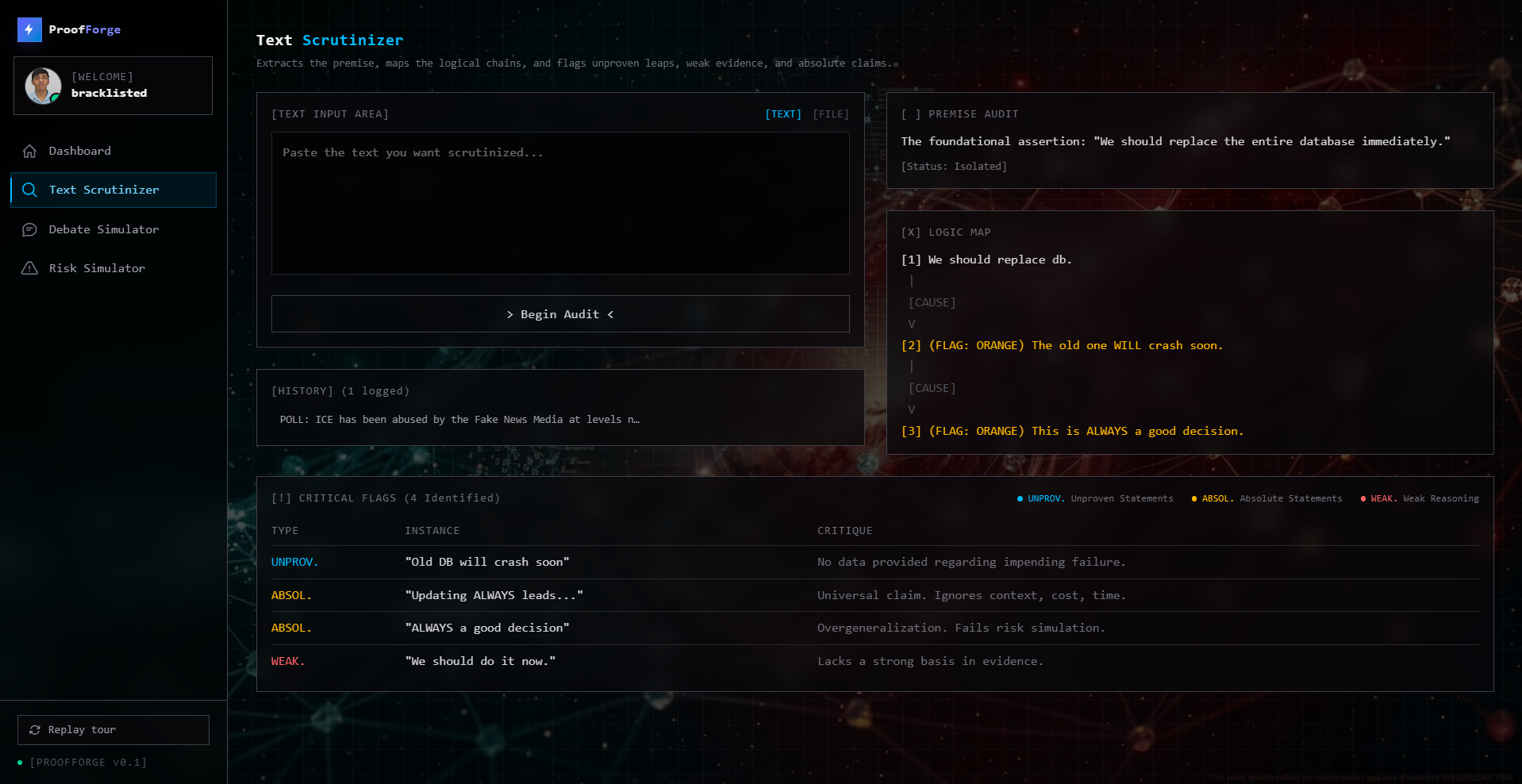
Main Scrutinizer
-

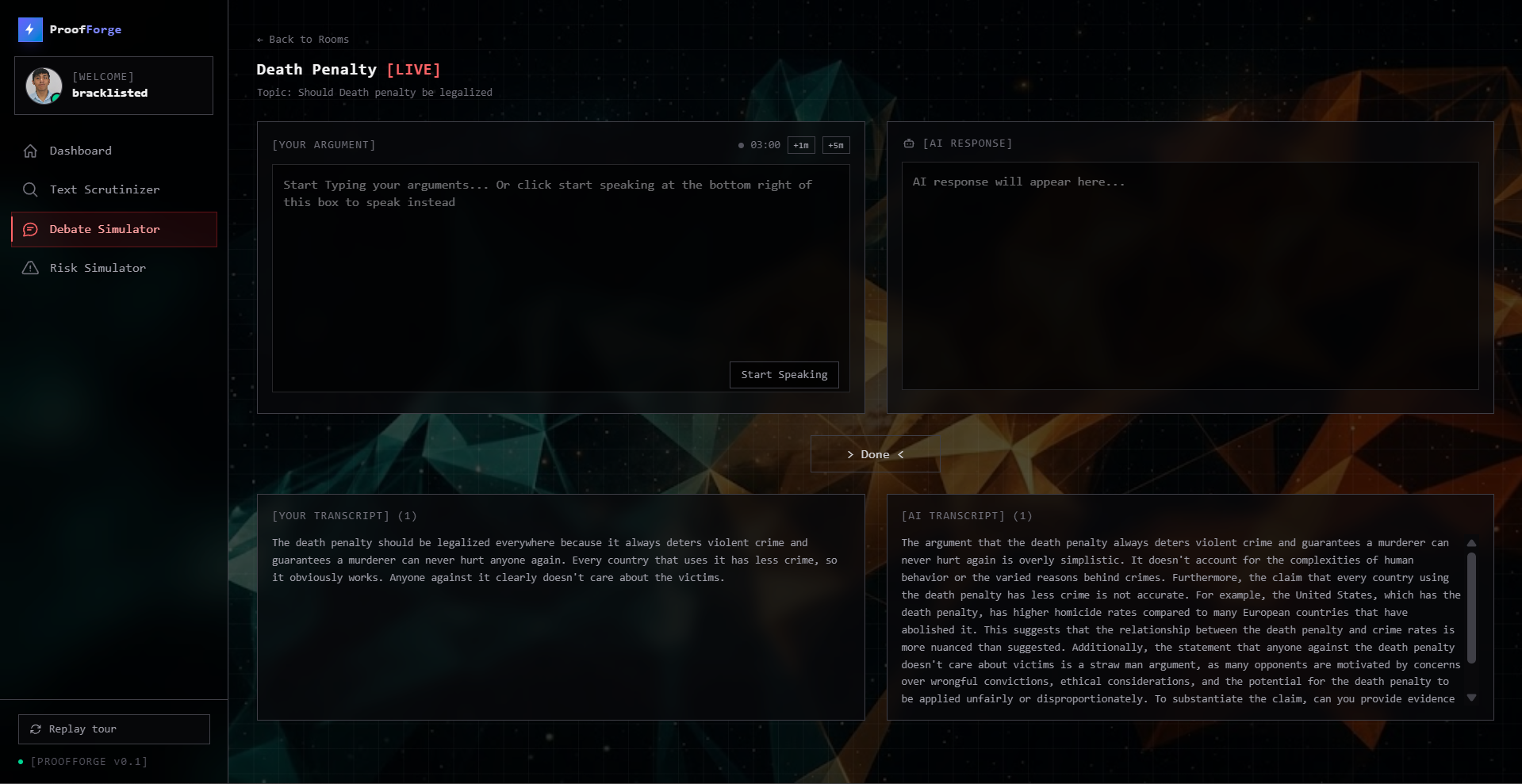
Main Debate Simulator
-
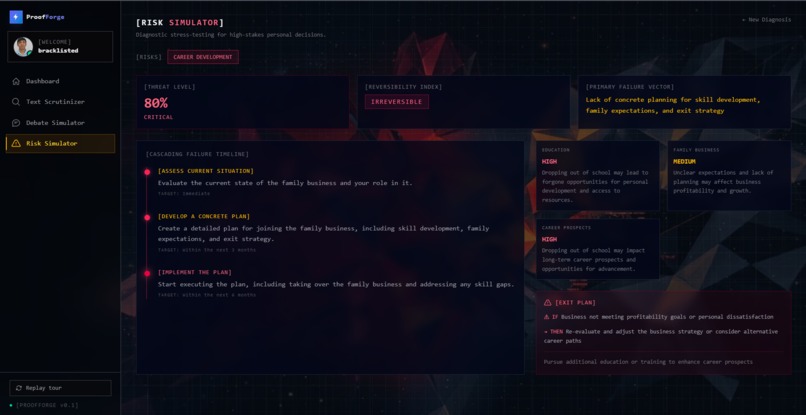
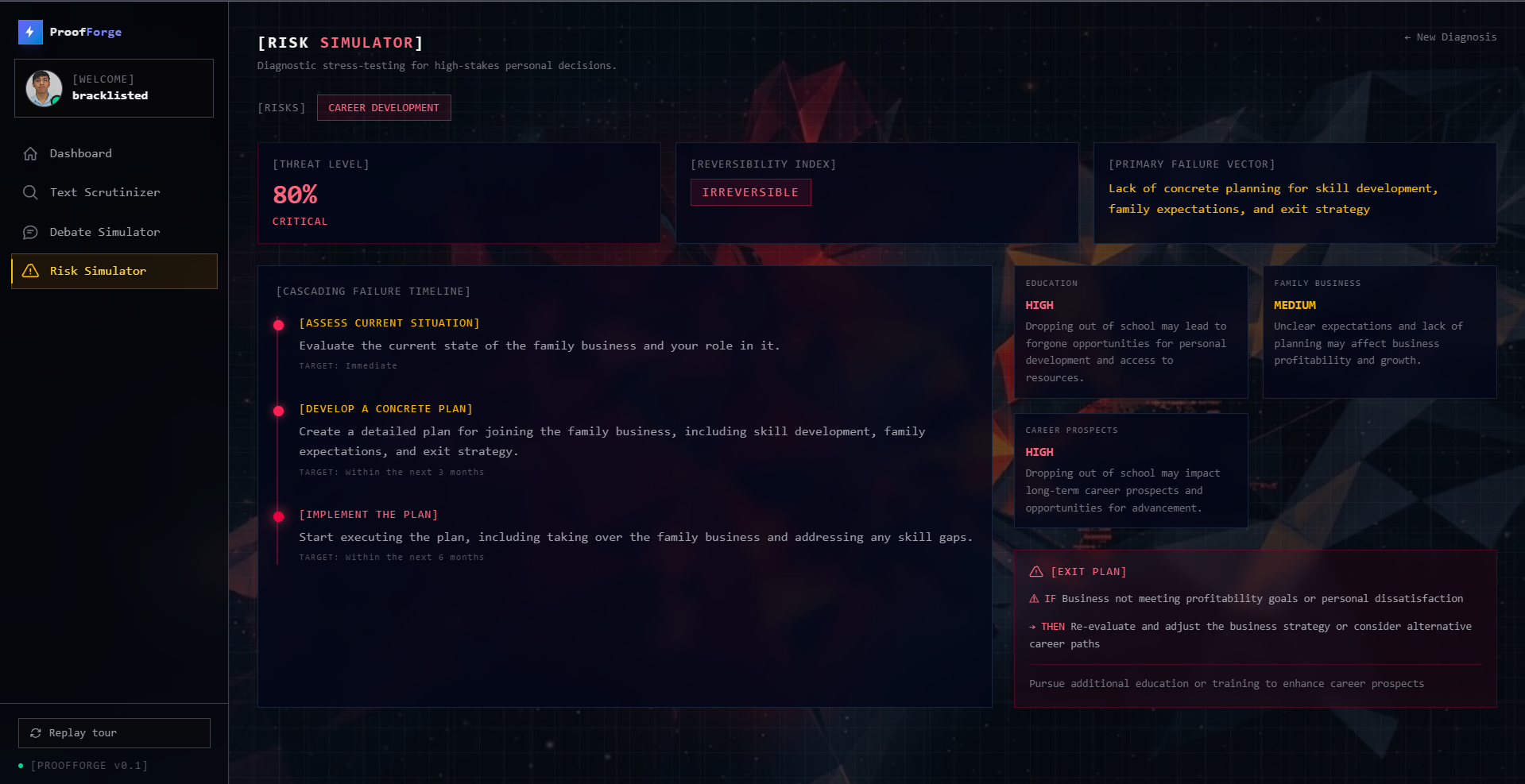
Main Risk Simulator
-

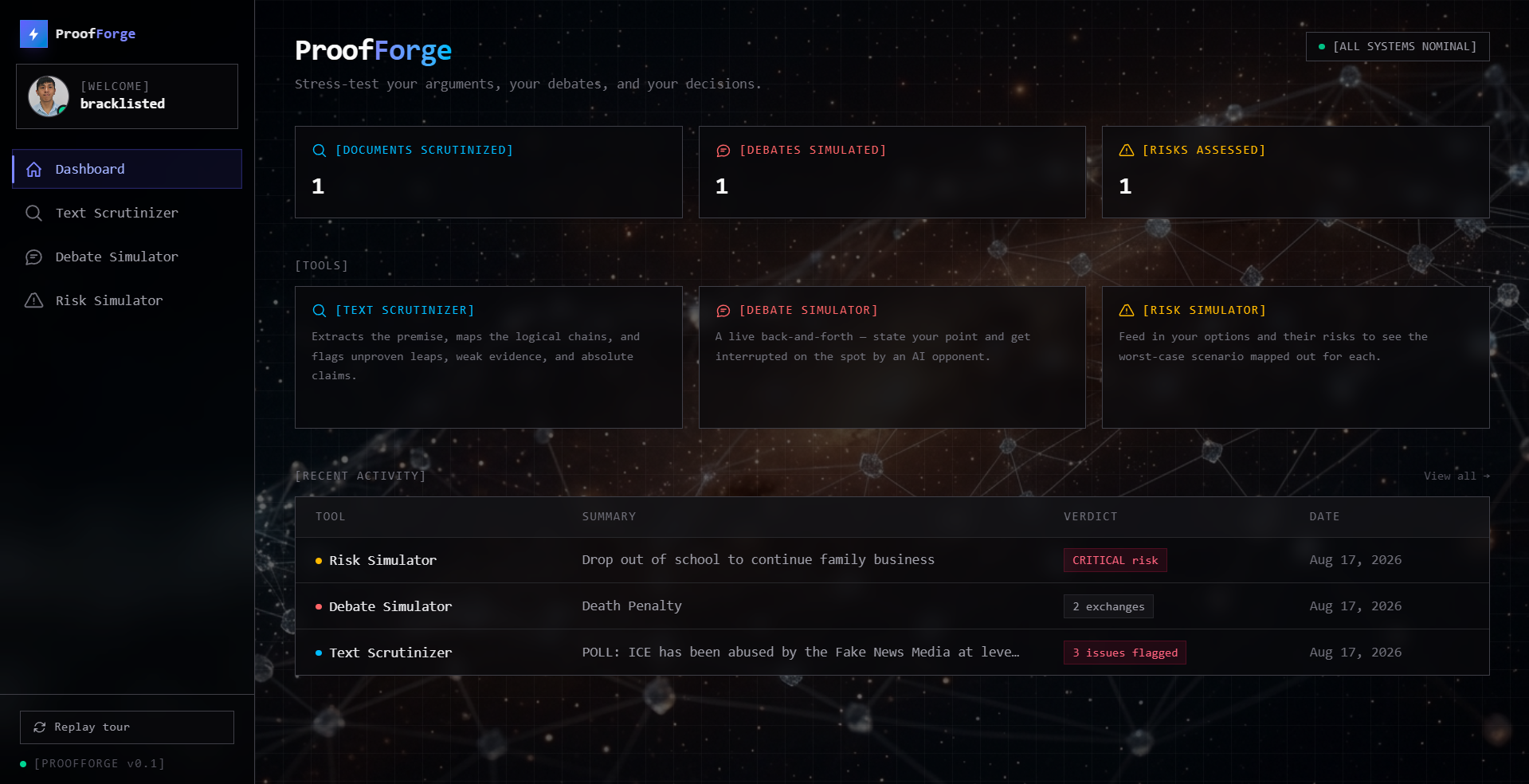
Probing Questions Risk Simulator

Video Link
https://youtu.be/5f6Qc48h34M?si=6HSOovYT2um0V04r
Inspiration
Most “AI strategy” and verification tools end in a bland bulleted list, a polite warning, or a generic summary. We wanted something you could actually run through.
What if pasting a political speech or high-stakes business roadmap didn’t just produce a text summary—it summoned an active cross-examination engine? What if AI agents didn’t just agree with your assumptions, but rather attacked your logic, mapped out multi-stage risk vectors, and calculated your actual blast radius in real time?
Proof Forge started from that itch: To make strategic verification active, zero-latency, and merciless. Great strategy shouldn't seek validation, it should demand it.
What it does
Proof Forge turns high-stakes rhetoric and technical plans into an interactive risk-architecture diagnostic, then subjects it to adversarial cross-examination.
- Text Scrutinizer: Input claims or plans -> Proof Forge deconstructs text to expose fallacies, unverified assertions, and hidden structural liabilities.
- Debate Simulator: Engages you in live, dynamic debate logic to force explicit risk identification rather than passive agreement.
- Risk Simulator: Generates numerical risk scores (0–100), threat levels, reversibility categories, multi-node blast radiuses, and chronological timelines.
- Instant Sub-Second Execution: Runs on high-throughput LLMs via Groq LPUs, delivering sub-second, structured responses without lagging loading screens.
- Guided, Beginner-Friendly Tour: An automated walkthrough guides judges directly through the core analysis flow on first launch.
It’s not a dashboard that summarizes your text. It’s an engine that stress-tests your choices.
How we built it
Proof Forge was built using a high-performance React + TypeScript architecture backed by a Node/Express API with a production PostgreSQL database.
- Groq LPU Acceleration: Integrated
llama-3.3-70b-versatilevia Groq’s inference engine for ultra-fast, structured JSON generation. - Relational Schema Design: Utilized PostgreSQL JSONB columns to store dynamic risk parameters, chronological timelines, and multi-node blast radius arrays atomically.
- Adversarial Engine Core: Designed prompt pipelines that enforce strict schema constraints while adopting an unyielding, analytical persona.
- Tour Architecture: Built an automated, interactive HUD tour that highlights key UI nodes, drives the narrative, and demonstrates immediate value without manual setup.
- Decoupled Deployment: Hosted the frontend on Vercel and the Express/Node backend on Render.
The secret wasn't "add more LLM features." It was making everything legible, critical, and instant.
Challenges we ran into
- Sub-Second Schema Enforcement: Enforcing complex, multi-field nested JSON outputs without missing keys or incurring parsing errors under high speed.
- Latency Bottlenecks: Rebuilding our backend inference pipeline away from Featherless and migrating to Groq LPUs to eliminate 10+ second loading spinners right before submission.
- Tour UX Balance: Teaching users how the cross-examination step works without cluttering the UI or blocking manual interaction during live demos.
- SQL Injection & JSONB Sync: Ensuring dynamic user debate inputs were safely mapped into PostgreSQL JSONB columns without breaking real-time client state updates.
Accomplishments that we're proud of
- Zero-Latency Real-Time Feedback: Achieving near-instant structured analysis outputs that make the app feel like a polished production SaaS.
- An Adversarial Engine that Works: Moving beyond passive "AI chatbots" to create a system that actively challenges assumptions and identifies real-world liabilities.
- Frictionless Demo Experience: A guided tour setup where judges can open the application and immediately understand the value proposition without reading a manual.
- From Repo to Production in 48 Hours: Building a robust frontend, full REST backend, relational database schema, and complete video pitch inside a single sprint.
What we learned
- Speed IS the Feature: Sub-second latency completely changes how an interactive AI tool feels. Sluggish models kill engagement regardless of output quality.
- Guided Demos are Better: Lock down the story, drive the focus, and show the core user value within the first 30 seconds.
- Structure Beats Prose: Strategy tools become actionable only when soft text is converted into concrete, structured metrics like risk scores and blast radiuses.
What's next for Proof Forge
- Multi-Agent Red Teaming: Introducing specialized personas (e.g., Financial Critic, Technical Auditor, Legal Adversary) to attack the same proposal simultaneously.
- Historical Decision Tracking: Logging risk metrics over time so teams can track how their risk exposure evolves across iterations.
- Exportable Risk Audits: One-click generation of PDF/Markdown risk receipts complete with decision timelines, vulnerability scores, and exit strategies.
- Collaborative Debriefs: Multiplayer mode where team members cross-examine the same strategy together in real time.

Log in or sign up for Devpost to join the conversation.