-
-
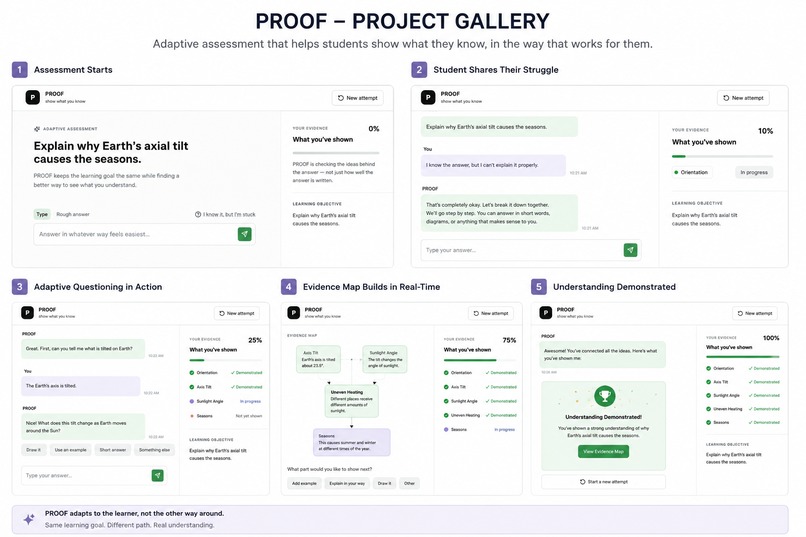
these are the previews from the project.
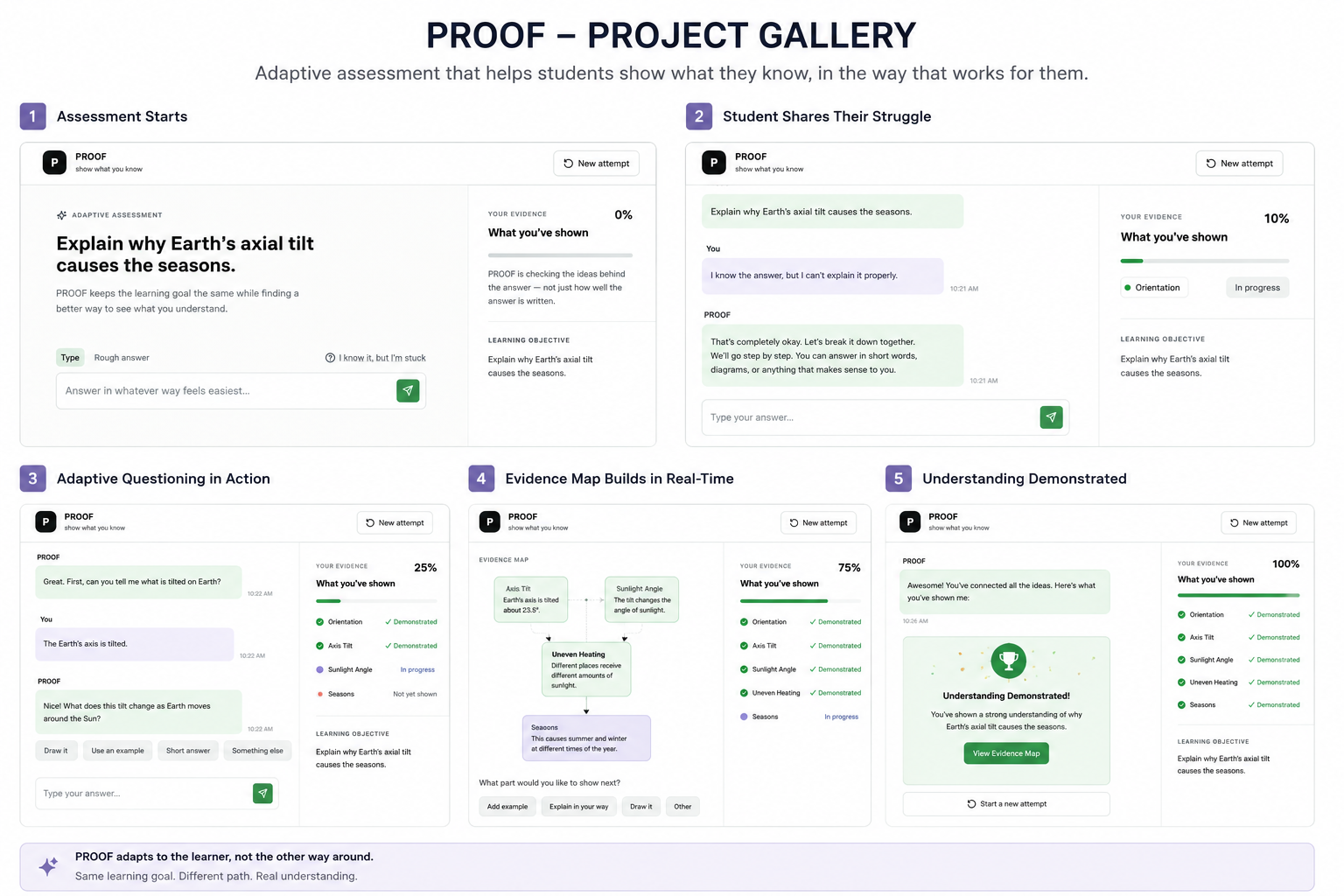
Inspiration
We kept coming back to a simple problem: sometimes a student knows the answer, but the way they are expected to give that answer gets in the way.
A written question can test much more than the subject itself. It can also test writing, organization, processing speed, working memory, or the ability to get started under pressure. For a neurodivergent student, those extra demands can sometimes hide what they actually understand.
We wanted to build something that asks a different question:
What if we could separate "I don't know this" from "I know this, but I can't show it this way"?
That became PROOF.
What it does
PROOF is an AI-powered conversational assessment tool for neurodivergent learners.
Instead of immediately grading a difficult response, PROOF can break the learning objective into smaller questions and change how it asks them. A student can respond through text, choices, voice, or other supported formats.
The important part is that PROOF does not simply make a question easier or give the answer away. It keeps looking for evidence of the same underlying understanding.
For example, if a student cannot write a paragraph explaining why seasons occur, PROOF can ask targeted questions about Earth's tilt, sunlight, and the relationship between the two. If the student demonstrates those concepts, PROOF can distinguish that understanding from difficulty producing the original written response.
How we built it
We built PROOF around a simple adaptive loop: start with a learning objective, break it into the ideas that need to be demonstrated, look at the student's response, and decide what evidence is still missing.
Instead of repeatedly asking the student to answer the same kind of question, PROOF can break the task into smaller steps and change the way it asks for evidence.
AI is used to interpret the learning objective, evaluate responses against the underlying concepts, generate targeted follow-up questions, and decide what should be asked next. The assessment logic remains separate from the language model so that PROOF is not simply a chatbot generating encouraging answers.
We wanted to keep one thing fixed: the learning objective. The path to demonstrating it can change, but the standard does not.
Challenges we ran into
The hardest part was finding the line between supporting a student and lowering the standard.
We did not want PROOF to become a system that tells a student they understand something just because the original question was difficult. At the same time, we did not want difficulty with a particular format to automatically become a knowledge gap.
We also had to avoid assuming that every neurodivergent learner needs the same type of support. PROOF is therefore designed around the student's interaction with the task rather than a fixed "neurodivergent learning style."
Accomplishments that we're proud of
We are proud that PROOF does not simply give the student an answer.
The student still has to demonstrate the underlying concepts. What changes is the route used to gather that evidence.
We are especially proud of the evidence map, which makes the reasoning behind the result visible instead of reducing the interaction to a single score.
What we learned
Building PROOF made us question something that is easy to take for granted: when a student gives a poor answer, we often assume that they do not understand the material.
But the answer we see is not always the same thing as the understanding in the student's head.
We also learned that accessibility is not about adding as many options as possible. Too many choices can become another barrier. The useful question is what helps this particular learner move forward at that moment.
What's next for PROOF
We want to test PROOF with more neurodivergent learners and across different subjects and types of assessment.
We want to learn when the system correctly identifies an expression barrier, when it identifies a genuine knowledge gap, and how learners feel about being assessed through an adaptive conversation.
Longer term, we want PROOF to work alongside the assignments students already have rather than becoming another separate learning environment.
Built With
- api
- css
- fastapi
- javascript
- llm
- python
- react
- tailwind
- vite


Log in or sign up for Devpost to join the conversation.