-
-
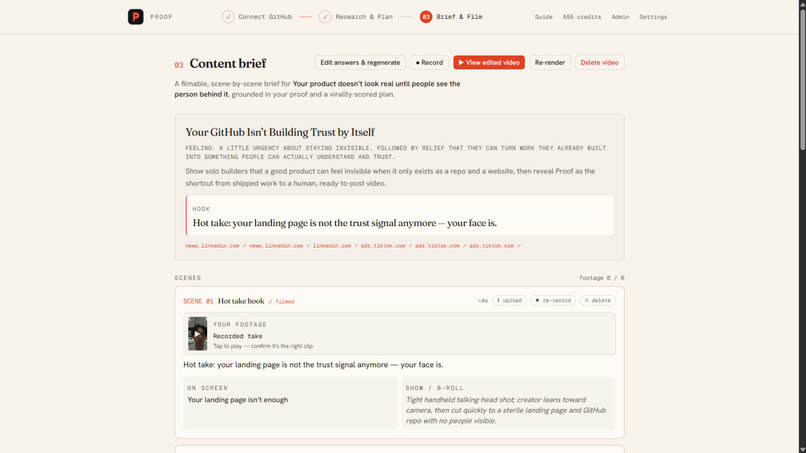
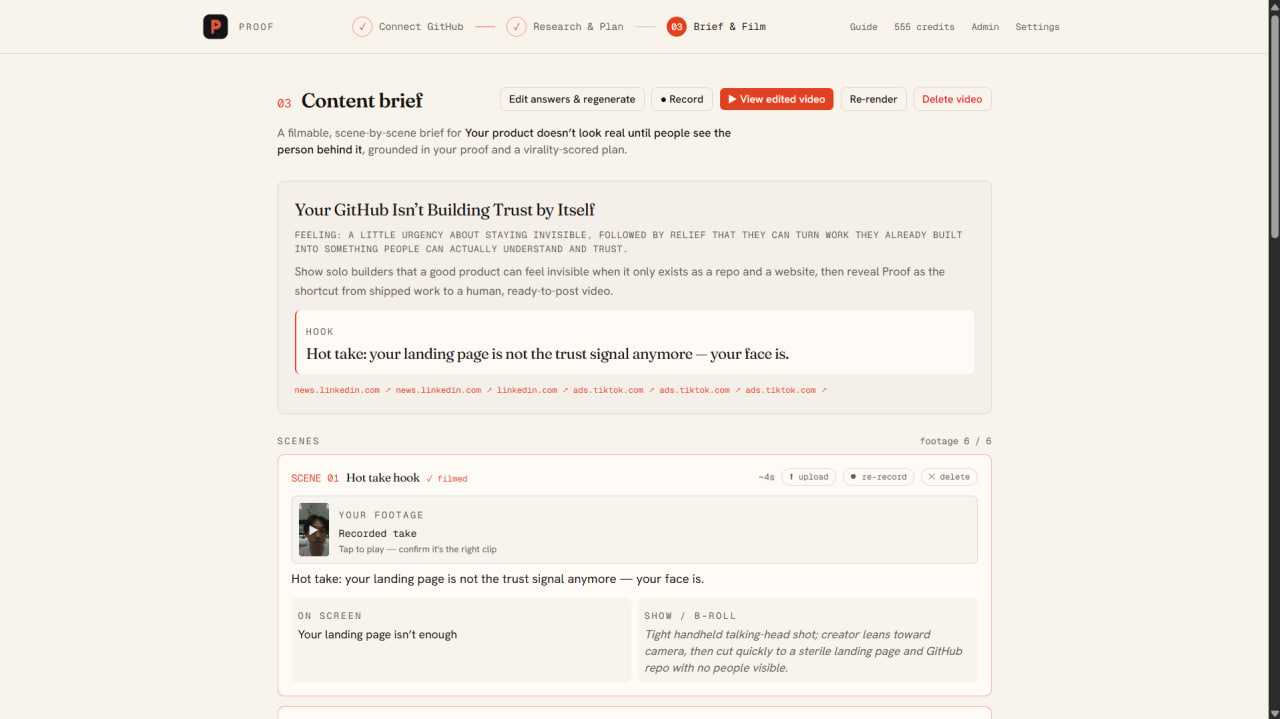
Step 3: Proof drafts all scenes for you
-
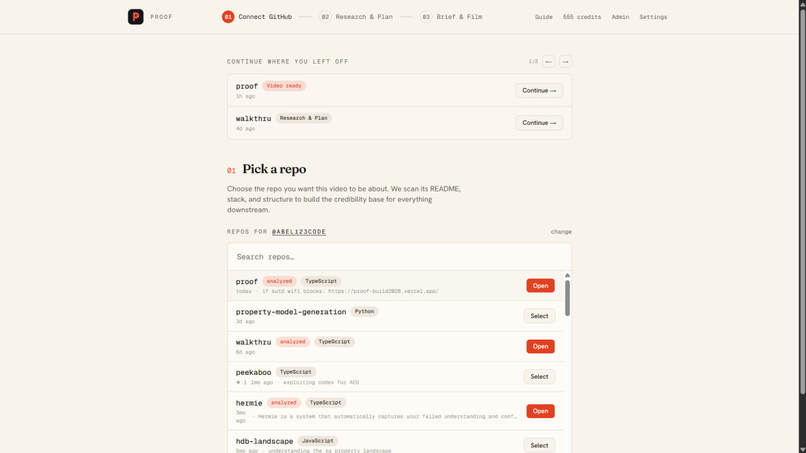
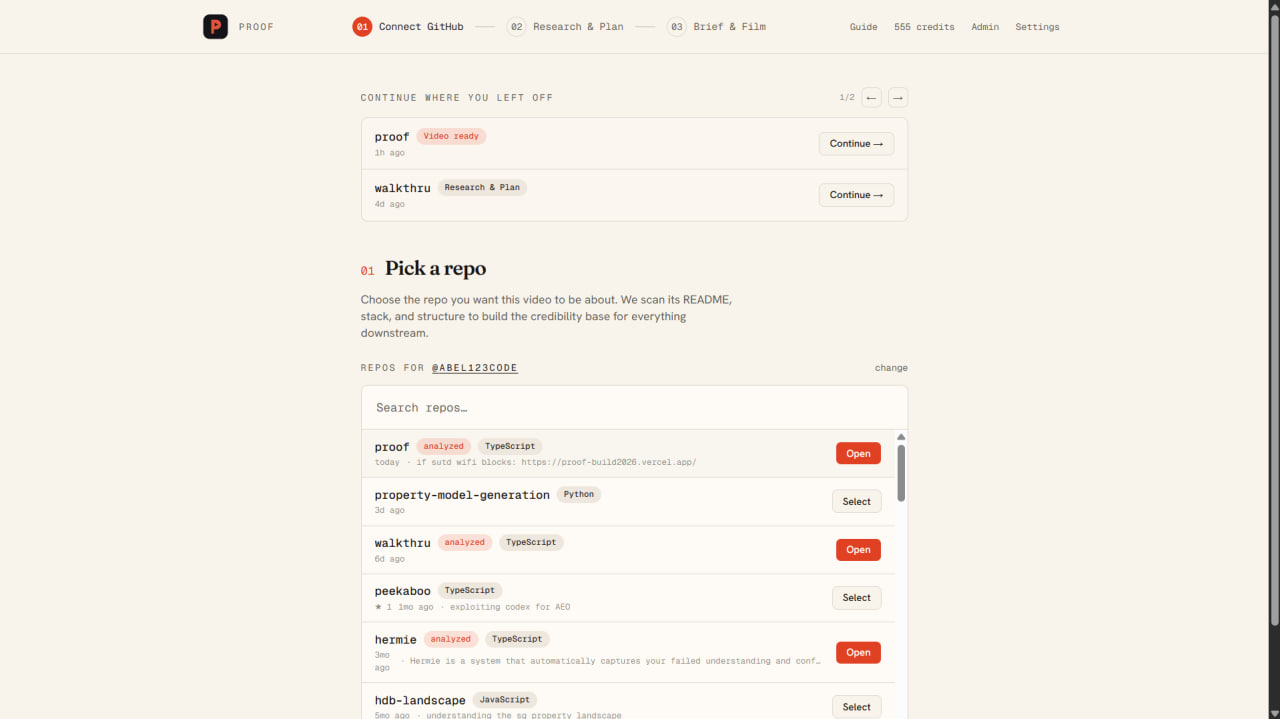
Step 1 : Choose your Software's Github Repo
-
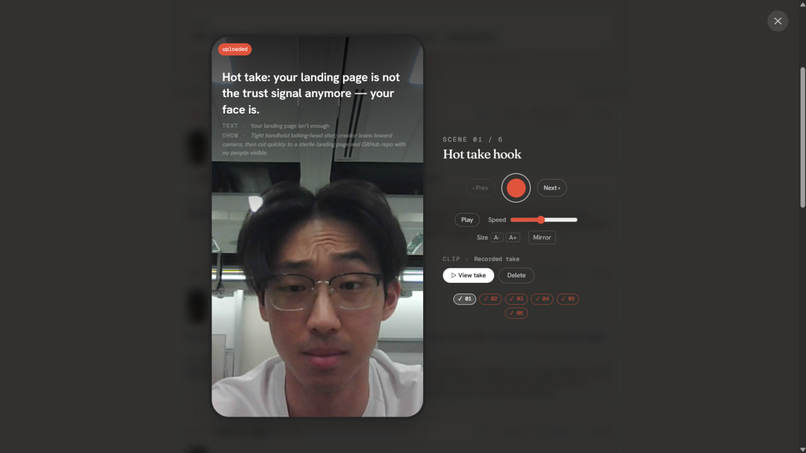
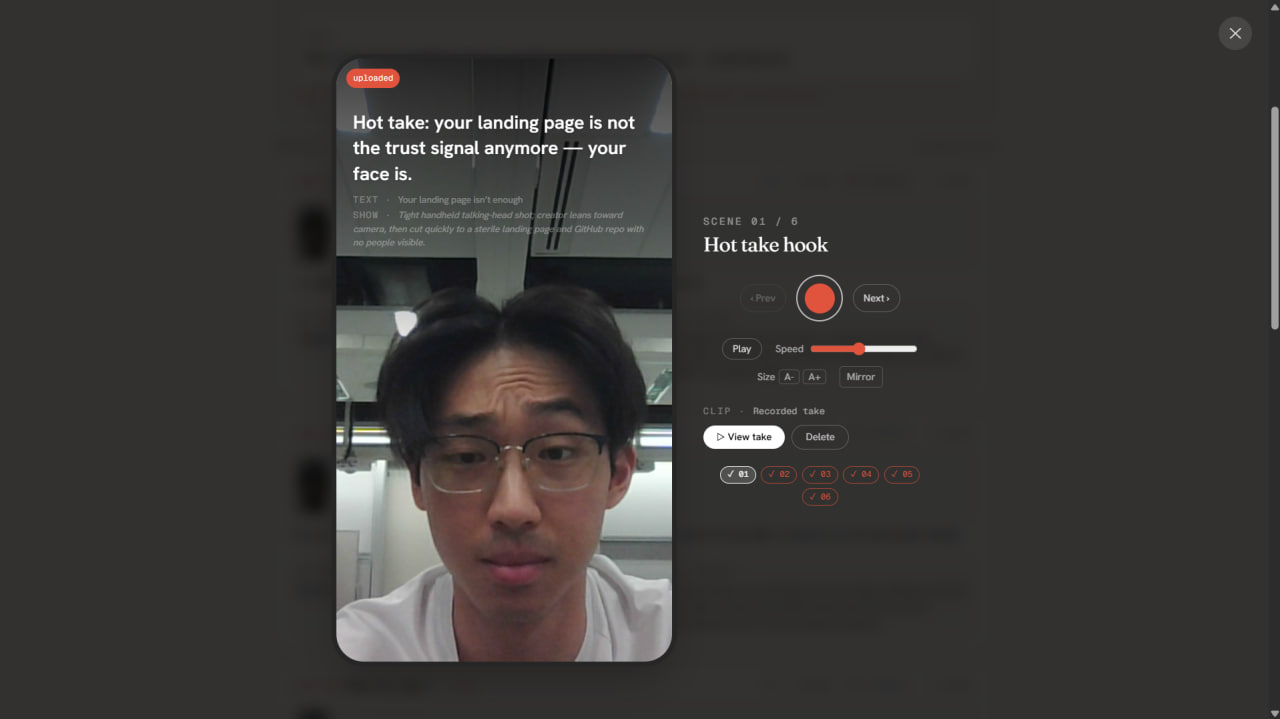
Step 4: You film and upload the scenes to Proof for editing
-
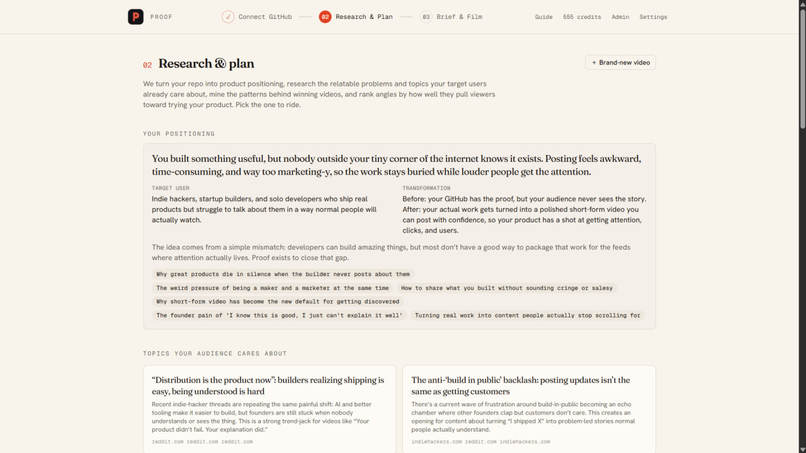
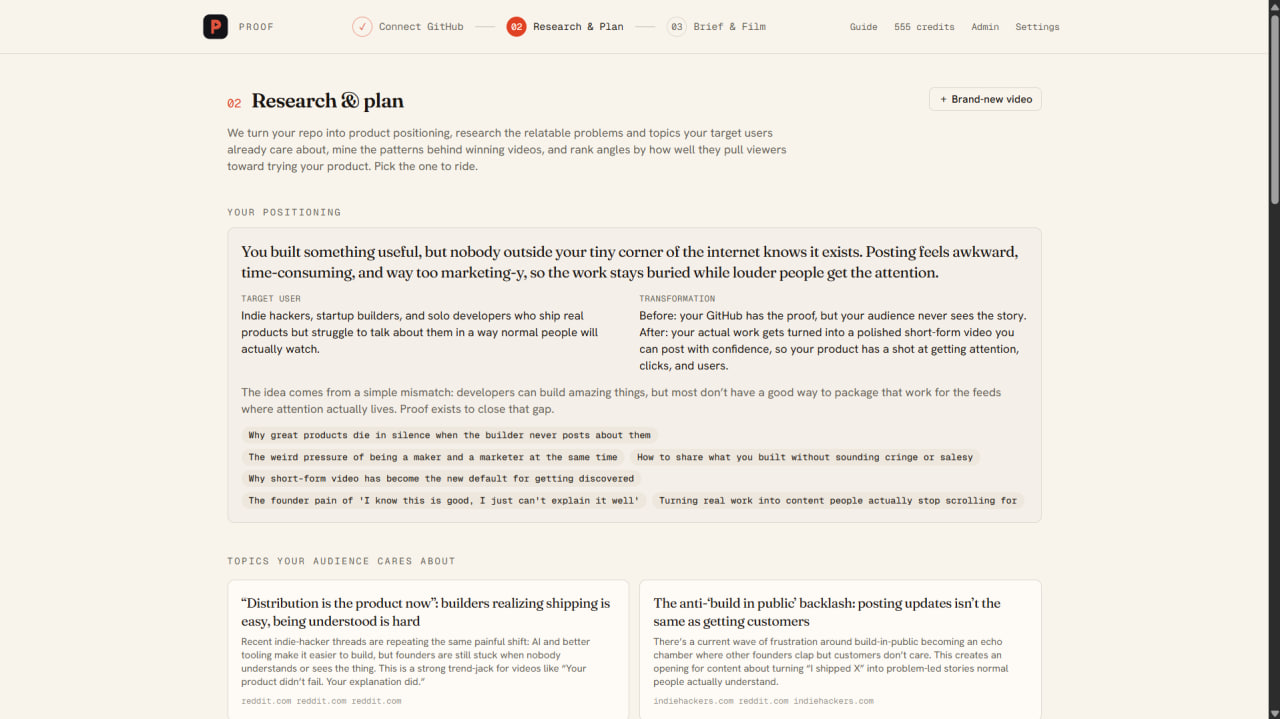
Step 2: Proof researches and plan scenes
Inspiration
Technical founders can ship software faster than they can explain it. We watched projects we were proud of disappear with a README and one launch post. A good video required research, scripting, recording, editing, and review. That became a second job.
Proof keeps the part that should stay human, the founder's face and take, then handles the rest.
What it does
Choose a GitHub project. Proof extracts its strongest proof points, researches current audience demand, and ranks several video angles. The chosen angle becomes a scene-by-scene brief and browser teleprompter.
After recording, Whisper supplies word timestamps. FFmpeg removes fillers and dead space. Remotion renders captions. GPT-5.6 Sol authors HyperFrames scenes and reviews five frames over the real footage. Approved scenes reach the final 1080x1920 MP4. Rejected scenes are repaired or omitted.
Judges can try the recording flow without an account. The public Short is a real pipeline output.
How we built it
The Next.js app handles GitHub analysis, research, briefs, recording, authentication, and credits. A Railway worker handles transcription, cutting, generated scenes, visual review, and final composition. Supabase stores durable jobs and finished videos.
OpenAI is the creative decision layer. GPT-5.6 Luna handles structured work such as repository understanding and brief drafting. GPT-5.6 Sol handles web research, angle scoring, scene design, and rendered-frame QA. We use low reasoning for bounded render calls and the model default for angle scoring.
The model cannot award itself the winning angle. Sol proposes rubric scores, then Proof clamps each value from 0 to 100 and recomputes the weighted total in TypeScript.
The render loop judges pixels rather than generated code. Sol writes scene HTML. Proof validates
it, renders a transparent layer, masks the speaker and captions, composites it over the footage,
and sends five PNGs back to Sol. Approval requires { "ok": true, "issues": [] }. Named defects
become repair instructions. If no version passes, Proof returns the valid captioned video.
Model-authored HTML is untrusted. Proof rejects external references and known network or evaluation APIs. Remote images pass HTTPS allowlisting, public-DNS checks, redirect blocking, and a byte cap.
Codex was the main engineering environment. We used worktrees, the OpenAI Docs MCP, GitHub CLI, parallel review agents, and Playwright. Codex traced a client request that bypassed the premium renderer, migrated Sol and Luna by workload, added regression coverage, and verified the real FFmpeg and visual-QA path.
Proof existed before Build Week and placed 1st Runner-Up at 'Sup Build2026. The repository has a dated commit boundary showing the work added during this event.
Challenges we ran into
Scene HTML can look plausible and still clip text or cover the speaker. We made rendered-frame review mandatory and kept the captioned video as a safe fallback.
A stale client value silently selected the fixed-template path. We moved render-mode ownership to both service boundaries so callers cannot choose a weaker path.
Prompting alone did not protect the speaker. An FFmpeg alpha mask now clears generated pixels from the face and caption zones before vision QA reviews the scene.
Accomplishments that we're proud of
Our eight-second production fixture needed two repairs. Sol caught duplicated values, weak entrance contrast, and malformed copy before approving the scene. The review loop found real defects instead of rubber-stamping its own output.
The repository has 54 web tests and 62 renderer tests. Type checks, lint, clean installs, the production build, and GitHub Actions pass. The product also has a public narrated demo, a no-signup recording flow, and a real edited output.
What we learned
Rendered pixels are the ground truth. Models should make creative judgments while code owns the invariants. Sol decides what to show. TypeScript owns ranking and control flow. FFmpeg owns timing and safe zones.
Keeping the founder in the recording stops the output from becoming generic. Proof removes the editing work without removing the person.
What's next for Proof
Next, the pending assets workflow will carry real screenshots, logos, colours, and interface patterns into every scene. Shot-aware subject tracking will replace the fixed safe zone. The QA loop will compare rejected and repaired frames, verify each fix, and track recurring defects.
Built With
- codex
- gpt5.6-luna
- gpt5.6-sol
- next.js
- openai
- typescript


Log in or sign up for Devpost to join the conversation.