PromptScope , DevTools for Prompts
Prompt engineering is becoming production engineering, but the workflow is still surprisingly opaque: write an instruction, run it, inspect an answer, and repeatedly guess what went wrong.
We built PromptScope to make that workflow visible, testable, and easier to improve.
PromptScope gives AI builders one practical loop:
Write → Analyze → Optimize → Validate → Ship
It helps developers inspect prompt quality, understand instruction and constraint coverage, compare prompt revisions, test expected behavior, and make a more confident decision before a prompt reaches users.
Inspiration
Software engineers do not ship code without tools such as linters, debuggers, diffs, tests, and CI checks. But prompts often the core logic behind an AI product are still commonly edited in a text box and validated by intuition.
We were especially interested in a simple but high-impact failure mode: a prompt may say “do not invent facts,” but fail to say what the model should do when information is missing. That missing fallback can create unreliable behavior even when the prompt sounds safe.
PromptScope was inspired by the question:
What if prompt engineering had the same developer experience as software engineering?
What it does
PromptScope provides a focused prompt-development workspace:
Prompt analysis evaluates prompt quality, complexity, token footprint, estimated cost, and latency.
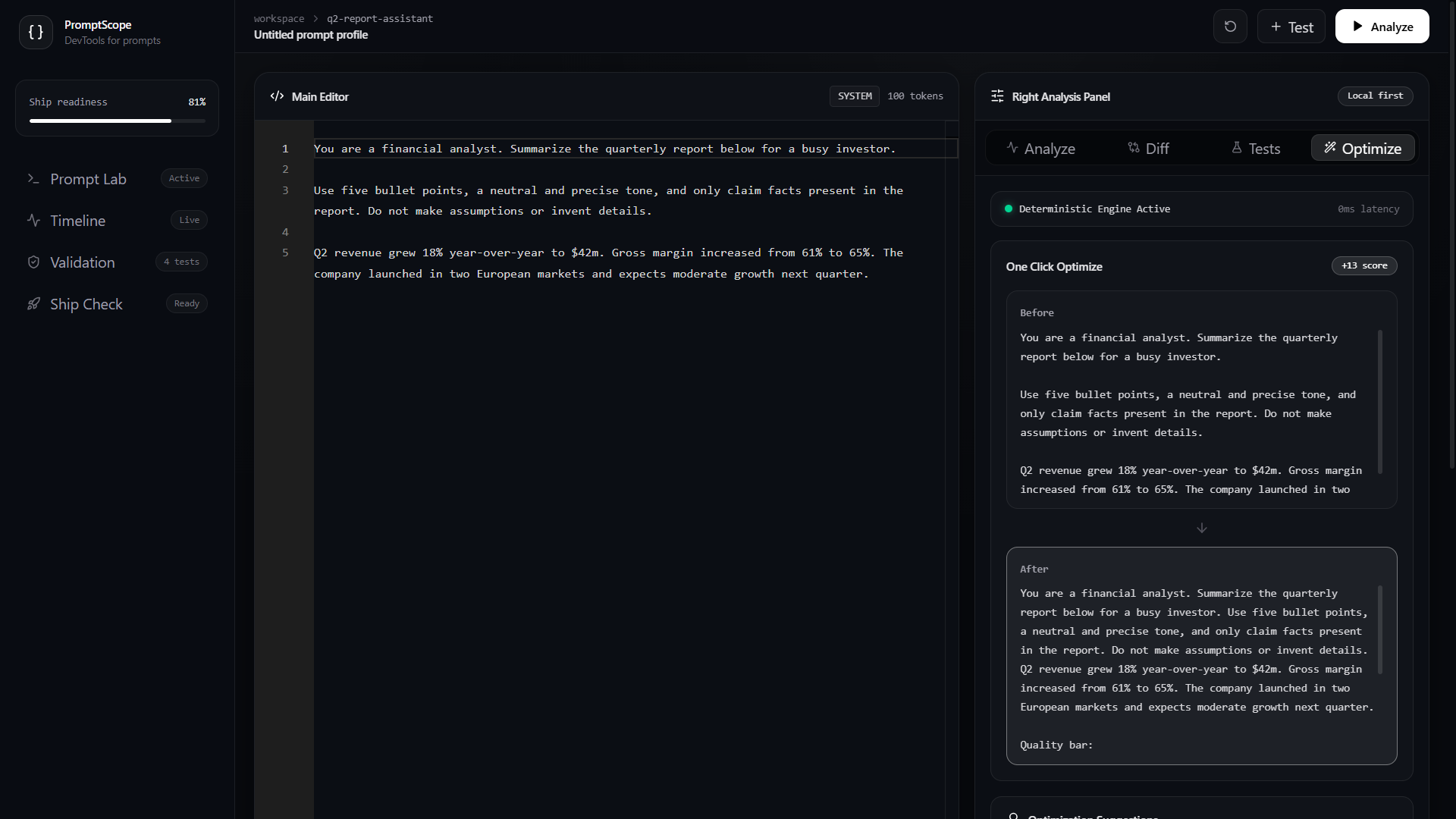
Optimization suggestions identifies missing controls, redundant instructions, and reliability improvements.
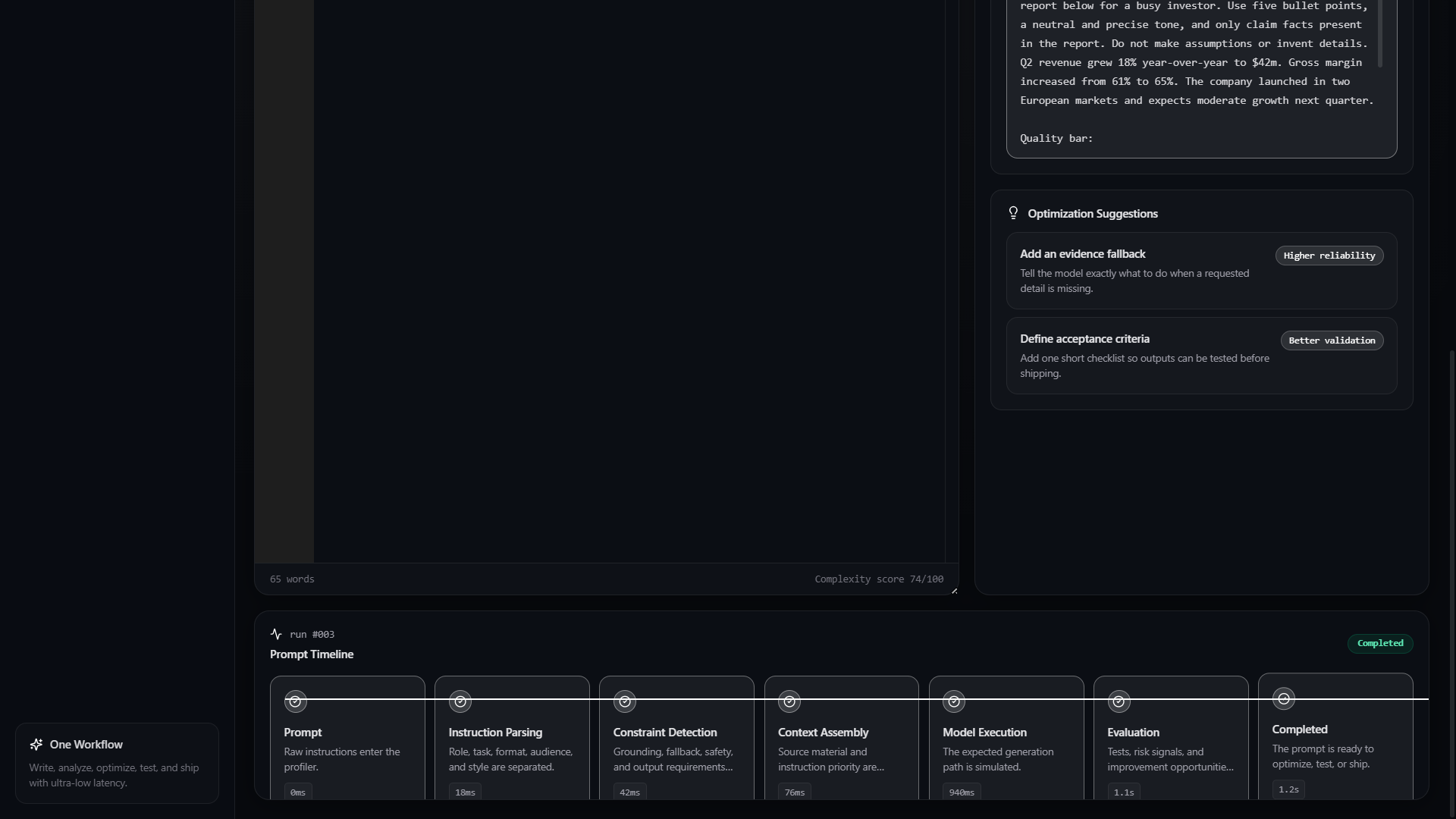
Prompt Timeline shows an operational trace of the workflow around a prompt: instruction parsing, constraint detection, context assembly, evaluation, and readiness.
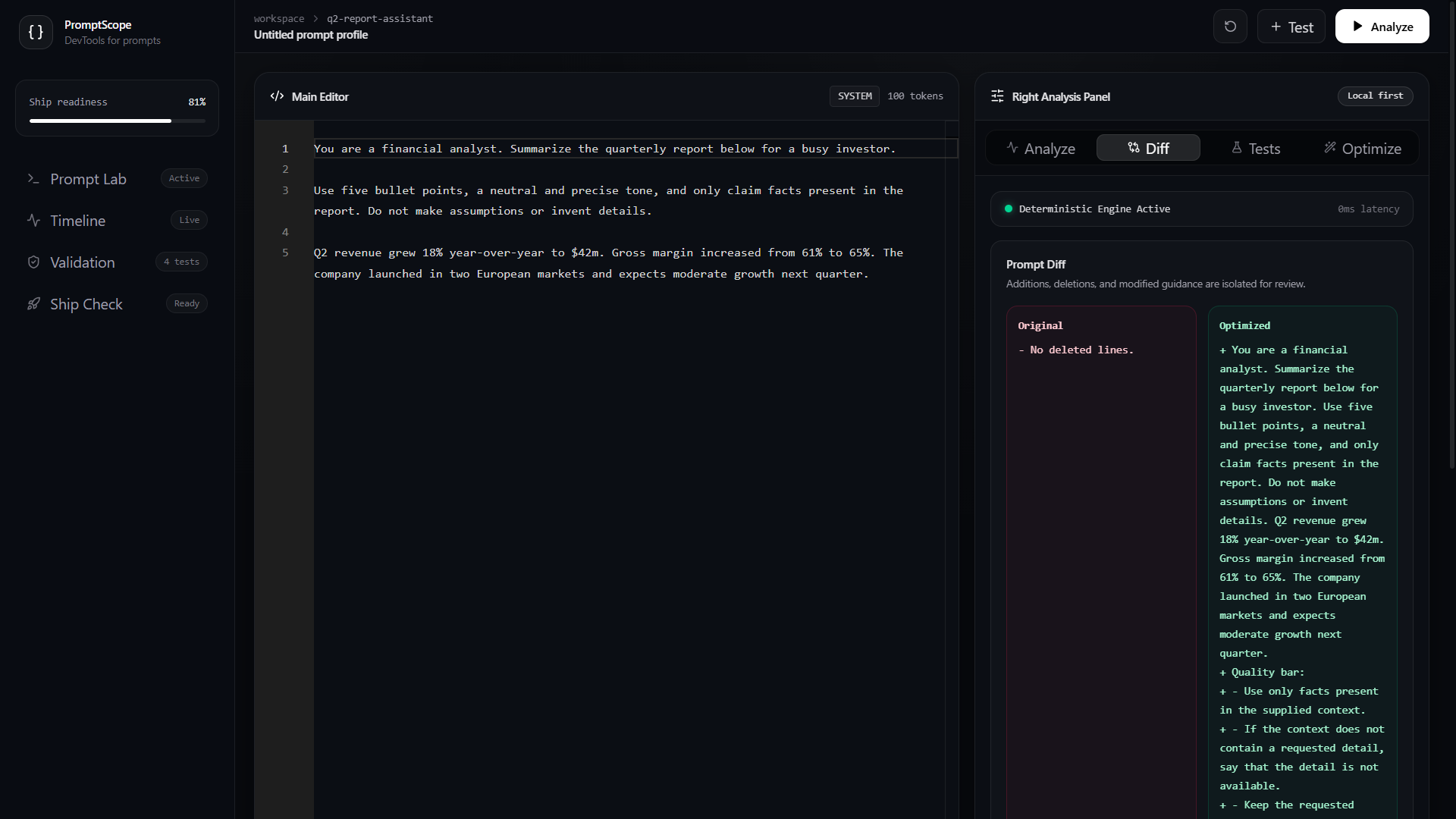
Prompt Diff : compares an original prompt with an optimized revision so every change is reviewable.
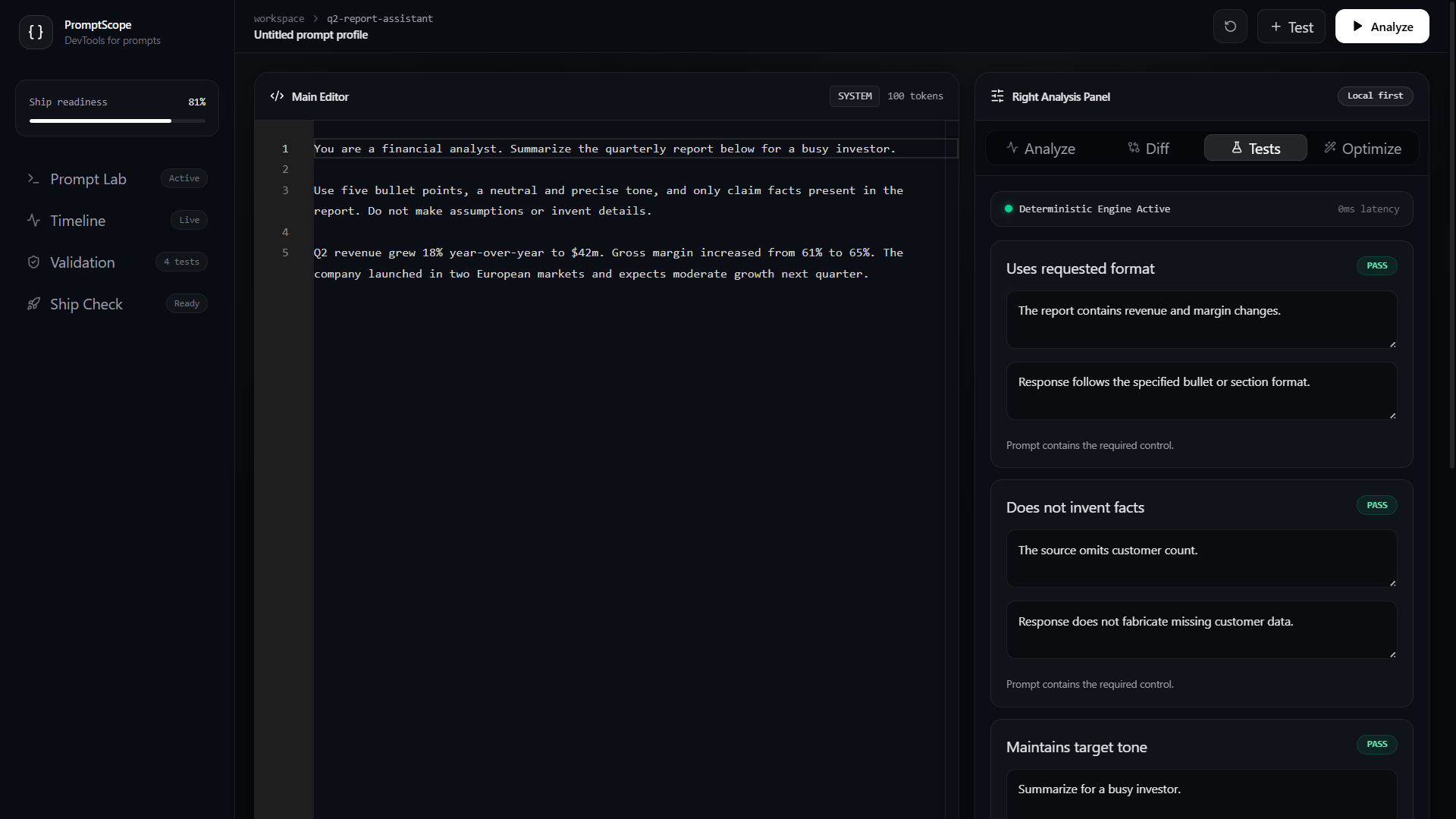
Prompt Tests : validates expected behavior such as output format, factual grounding, and target tone.
Ship readiness : turns the result into a clear signal for whether a prompt is ready for deployment.
A key principle of the project: the timeline does not claim to expose hidden model reasoning. It visualizes the observable engineering workflow around the prompt, giving developers a practical way to inspect and improve it.
How we built it
We built PromptScope as a modern web application with a developer-tool interface:
Next.js and TypeScript for the application framework
React for the interactive UI
Tailwind CSS and shadcn-style components for the visual system
Monaco Editor for the prompt-editing experience
OpenAI Responses API for live prompt analysis when an API key is available
A local, demo-ready fallback experience so the workflow remains usable and explainable without external dependencies
The product is intentionally designed around one cohesive workflow rather than a collection of disconnected AI utilities.
Challenges we faced
The biggest challenge was designing a product that feels technically meaningful without making misleading claims about how foundation models work internally.
We solved this by separating:
what PromptScope can observe and evaluate,
what it can recommend through prompt analysis,
and what should remain clearly labeled as an operational or simulated workflow trace.
Another challenge was fitting a complete developer workflow into a hackathon-sized MVP. We focused on the highest-value sequence: analyze a prompt, identify a reliability gap, apply an improvement, compare the revision, and validate the behavior with tests.
Finally, API quota and reliability constraints reinforced an important product lesson: a good developer tool should make failure states understandable. PromptScope provides a local-first experience and clear fallback behavior rather than leaving users with an unexplained broken screen.
What we learned
We learned that prompt quality is not only about writing clearer instructions. It is about making behavior explicit, reviewable, and testable.
We also learned that the best AI developer tools do not need to promise access to model internals. They need to help builders ask better questions:
What behavior does this prompt require?
What happens when context is incomplete?
What changed between versions?
Which assumptions can be tested before deployment?
What’s next
Next, we want to add prompt version history, reusable test suites, team collaboration, CI integration, multi-model comparisons, and richer evaluation datasets.
Our goal is simple:
Prompts are production logic. They deserve DevTools.
Built With
- monaco-editor
- next.js
- node.js
- openai-api
- openai-responses-api
- react
- tailwind-css
- typescript
- vercel

Log in or sign up for Devpost to join the conversation.