-
-
-
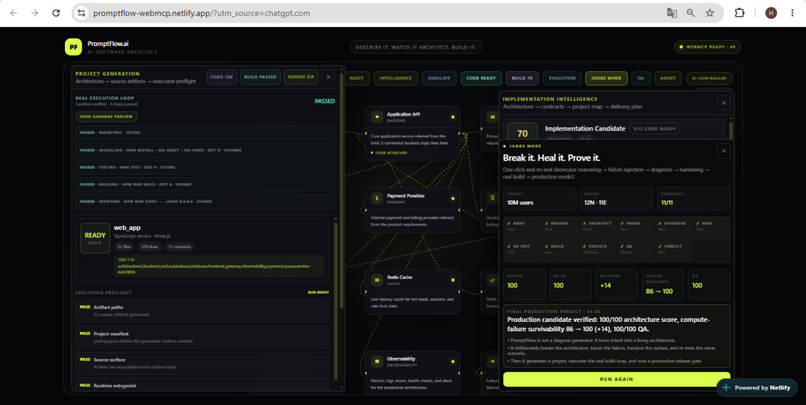
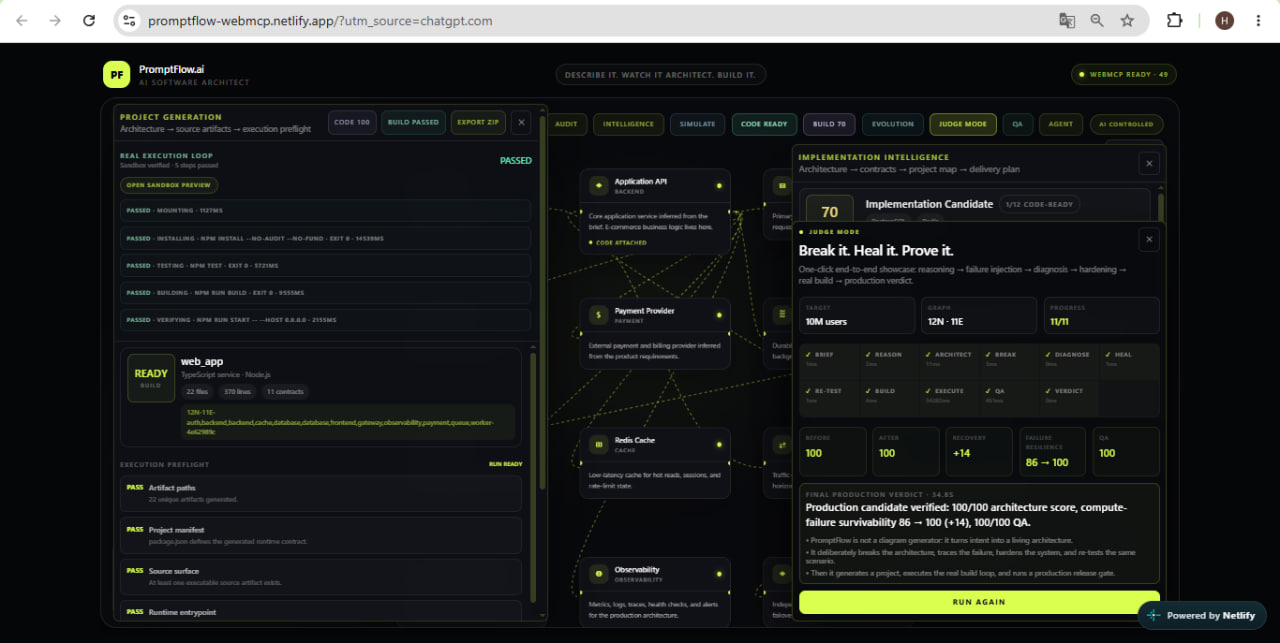
Judge Mode deliberately breaks, diagnoses, heals and re-tests the architecture before producing a production verdict.
-
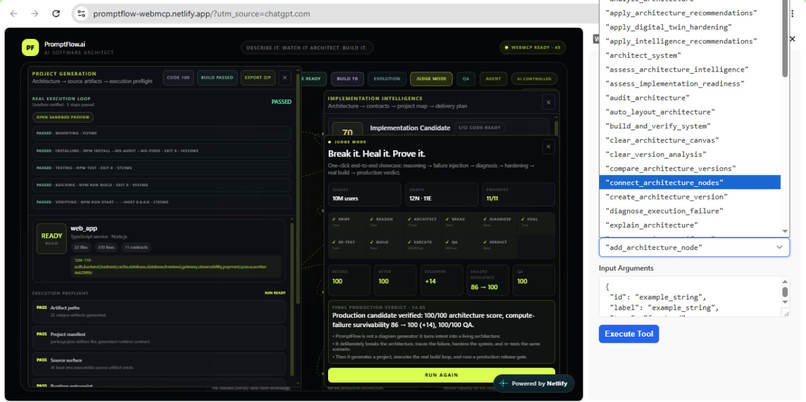
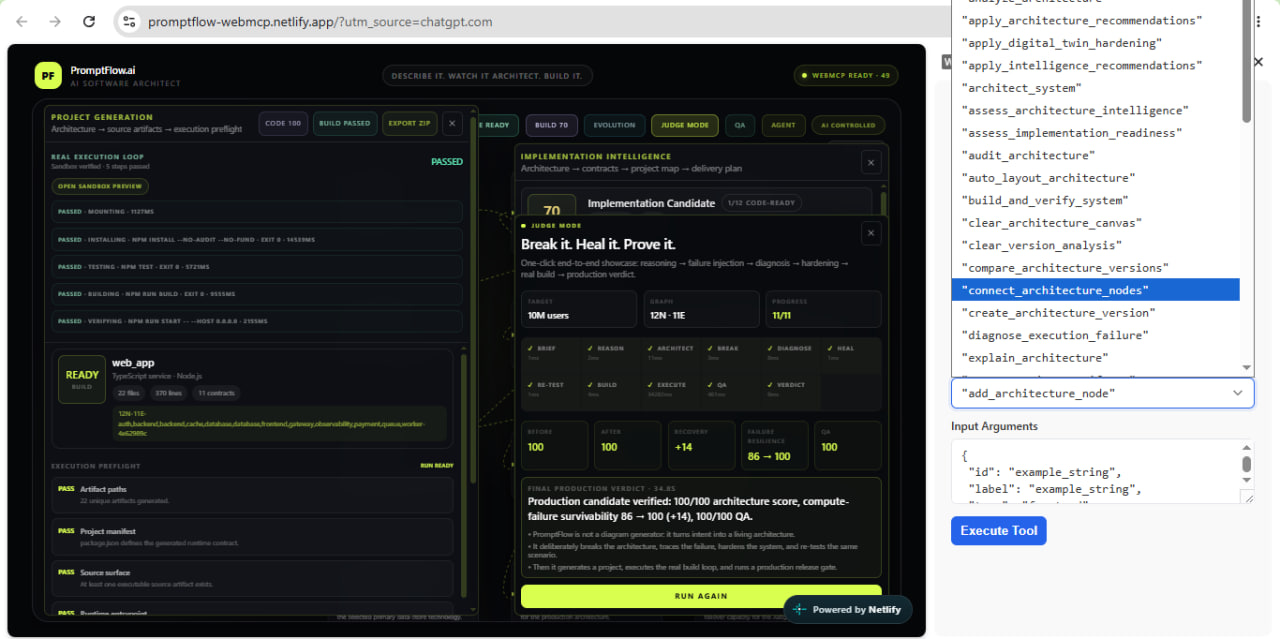
49 WebMCP tools let an AI agent discover and operate PromptFlow directly.
PromptFlow.ai — AI Software Architect
Describe it. Watch it architect. Build it.
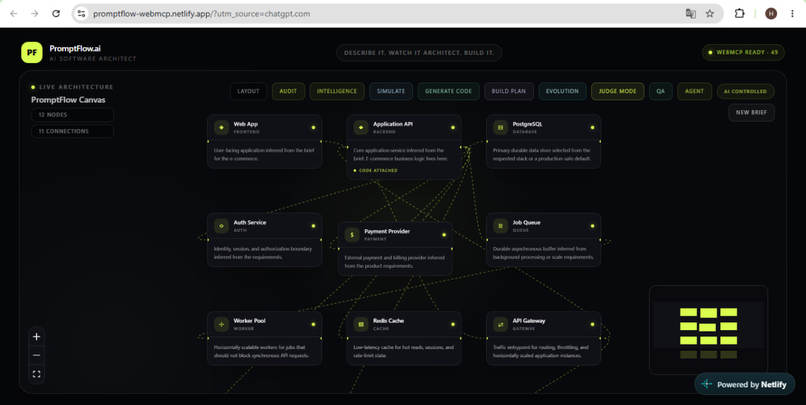
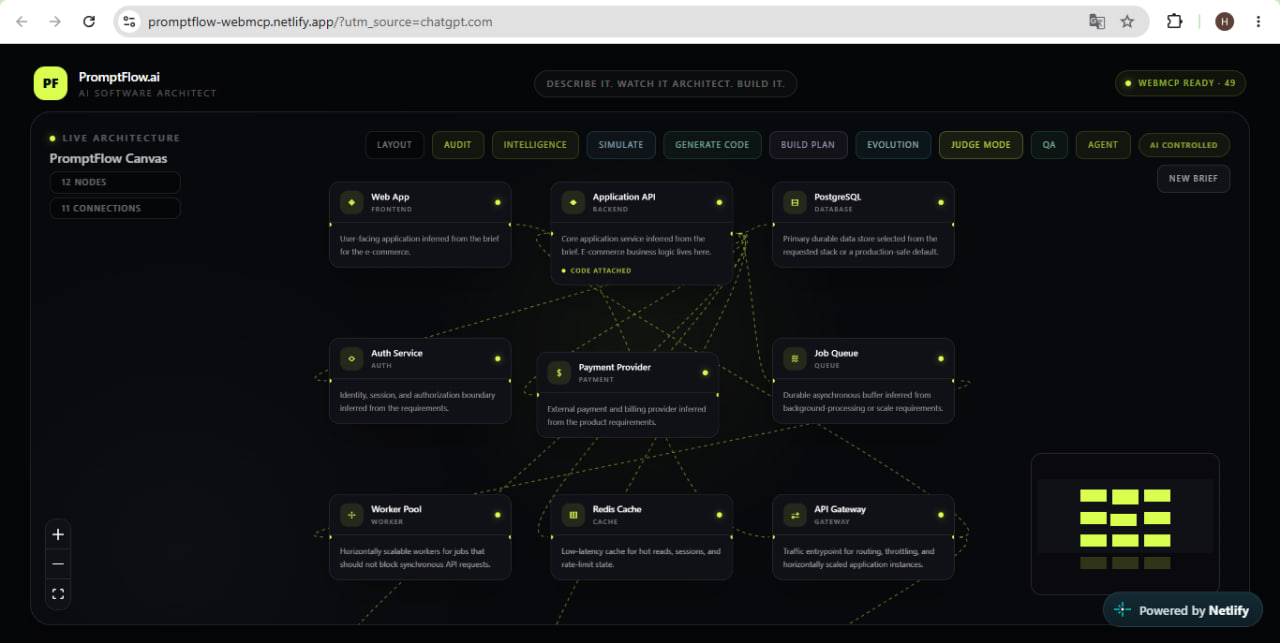
PromptFlow.ai is an AI-native software architecture workspace where humans describe systems in natural language and AI agents operate the live architecture through WebMCP.
Instead of treating architecture as a static diagram, PromptFlow treats it as a living system that can be designed, analyzed, deliberately broken, diagnosed, hardened, re-tested, built, executed, and verified.
Why WebMCP?
WebMCP is the core interaction layer between the AI agent and PromptFlow.
A normal visual architecture tool requires an agent to understand the application's UI and manually figure out how to manipulate it. PromptFlow exposes structured, typed WebMCP tools so an agent can discover capabilities, reason about the user's intent, construct an architecture plan, and invoke deterministic operations directly.
PromptFlow currently exposes 49 WebMCP tools:
- 37 Agent OS tools
- 12 atomic architecture tools
For a complete product brief, the primary agent workflow is build_and_verify_system.
The calling AI agent owns open-ended semantic reasoning. PromptFlow owns validation, state mutation, deterministic architecture intelligence, project generation, browser-native execution, and verification.
Humans + Agents
The human provides the product idea and constraints.
The AI agent interprets the intent and decides which PromptFlow capabilities to use.
WebMCP carries the structured tool calls into the live application.
PromptFlow validates the agent-authored architecture plan, updates the live graph, analyzes the system, simulates failure, applies hardening, generates the project, executes it in a browser-native WebContainer, and produces a final production verdict.
This collaboration makes it possible to move from:
Natural-language intent → architecture → failure analysis → implementation → executable proof
without requiring the human to manually construct every node and connection.
The Core Verification Loop
PromptFlow's Judge Mode orchestrates:
Brief → Reason → Architect → Break → Diagnose → Heal → Re-test → Build → Execute → QA → Verdict
The system intentionally injects failure scenarios into the architecture instead of only demonstrating a successful happy path.
It then:
- identifies bottlenecks and failure propagation,
- diagnoses the affected architecture,
- applies bounded hardening,
- re-runs the same failure scenario,
- generates the implementation workspace,
- executes the generated project inside WebContainer,
- runs Production QA,
- produces a final release verdict.
The result is an architecture workflow that demonstrates not only what the system looks like, but how it behaves under failure and whether the generated project can actually execute.
Real WebContainer Execution
PromptFlow uses WebContainer as a browser-native Node.js runtime.
The generated project goes through:
Generate → Mount → Install → Test → Build → Diagnose → Heal → Re-run → Verify
The generated source is not executed directly by the host page.
The production demo successfully verifies the real execution loop, including:
- mounting,
- dependency installation,
- testing,
- building,
- runtime verification.
Architecture Intelligence
PromptFlow evaluates architecture across:
- Reliability
- Scalability
- Performance
- Security
- Resilience
- Observability
It also provides:
- deterministic architecture audits,
- heuristic stress testing,
- Architecture DNA,
- failure simulation,
- digital-twin analysis,
- implementation readiness,
- implementation contracts,
- project blueprints,
- migration planning,
- architecture versioning.
These are explicitly planning and review signals, not security certifications, production load-test guarantees, or infrastructure capacity guarantees.
Production QA
The final Production QA gate checks the actual application state, including:
- architecture integrity,
- generated artifact safety,
- WebMCP registry coverage,
- browser isolation requirements,
- generated project readiness,
- real WebContainer execution state,
- architecture checkpoint integrity.
The final demo produced:
- 100/100 architecture score
- 86 → 100 compute-failure survivability
- +14 recovery
- 100/100 Production QA
- 11/11 Judge Mode stages completed
- 5/5 real execution steps passed
What Makes PromptFlow Different
Most architecture tools stop at visualization.
PromptFlow connects the full lifecycle:
Describe → Architect → Break → Diagnose → Heal → Re-test → Build → Execute → Verify
The architecture itself becomes an active system that can be reasoned about, challenged, repaired, and proven.
PromptFlow's central idea is:
Architecture should be a living system, not a static diagram.
Implementation
PromptFlow is built with:
- React
- TypeScript
- React Flow
- Zustand
- Vite
- WebMCP
- WebContainer
- Netlify
WebMCP tools are registered directly in the browser using the WebMCP model context API.
The application does not require a PromptFlow backend for the core architecture execution flow.
The architecture graph remains in browser state, while the WebMCP layer provides the agent-facing execution contract.
Demo
Live application:
https://promptflow-webmcp.netlify.app/
The demo video shows:
- AI agent discovery of PromptFlow WebMCP tools
- Agent-authored architecture planning
- Live architecture generation
- Judge Mode failure injection
- Diagnosis and hardening
- Re-test and recovery
- Real WebContainer execution
- Production QA
- Final production verdict
WebMCP Challenge Work
PromptFlow was meaningfully extended for the WebMCP Challenge submission period.
The WebMCP-specific work includes:
- WebMCP tool registration and discovery
- Agent OS architecture tools
- 49 agent-facing WebMCP tools
- structured agent-authored architecture plans
build_and_verify_systemorchestration- deterministic architecture execution
- WebMCP execution telemetry
- Judge Mode integration
- failure injection and diagnosis
- architecture hardening and re-testing
- project generation
- browser-native WebContainer execution
- Production QA
- final production verdict
- production WebMCP deployment configuration
The repository history documents the WebMCP implementation work added during the challenge period.
Safety & Boundaries
PromptFlow intentionally keeps semantic reasoning and deterministic execution separate.
The AI agent can reason about arbitrary product requirements, but PromptFlow validates all structured operations before applying them.
Simulation tools are non-destructive.
Generated code is executed only inside the isolated WebContainer runtime.
Architecture Intelligence, Digital Twin, and Production QA metrics are clearly presented as deterministic or heuristic planning signals rather than guarantees of real-world production performance, security, or availability.
Built With
- flow
- netlify
- react
- typescript
- vite
- webcontainer
- webmcp
- zustand


Log in or sign up for Devpost to join the conversation.