-
-
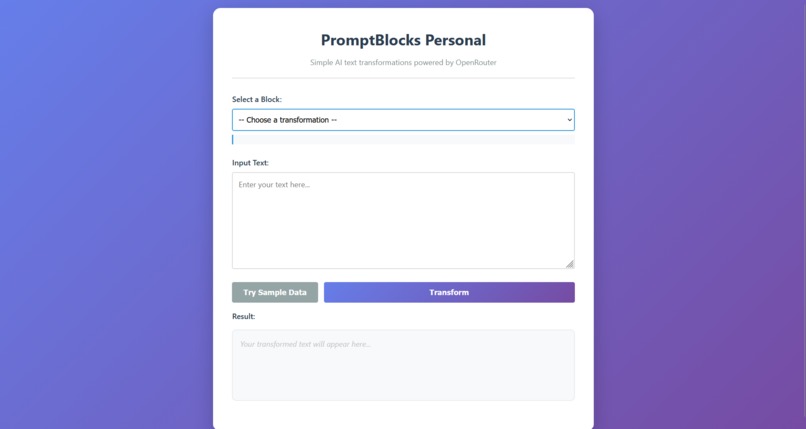
First-App
-
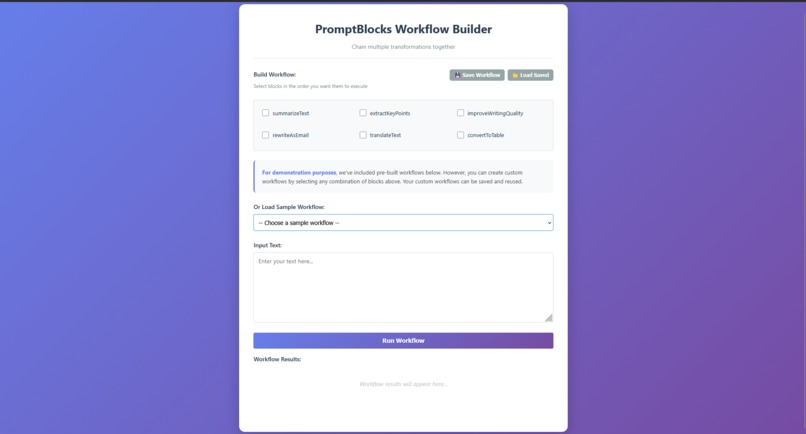
Second-App
💡 Inspiration
Building AI apps kept forcing me to rewrite the same foundations: API calls, retries, workflows, formatting.
Which usually cost 20+ hours from the development time. So, I realized this was a perfect use case for the Skeleton Crew pattern, build a production-ready foundation once, then reuse it for unlimited applications. That’s why I built PromptBlocks, a reusable AI skeleton framework powered by OpenRouter, designed to help developers ship applications faster with zero repeated effort.
🔍 What It Does
PromptBlocks provides a production-ready skeleton for any AI text-processing app. To prove the architecture works, I built two completely different apps using the same core:
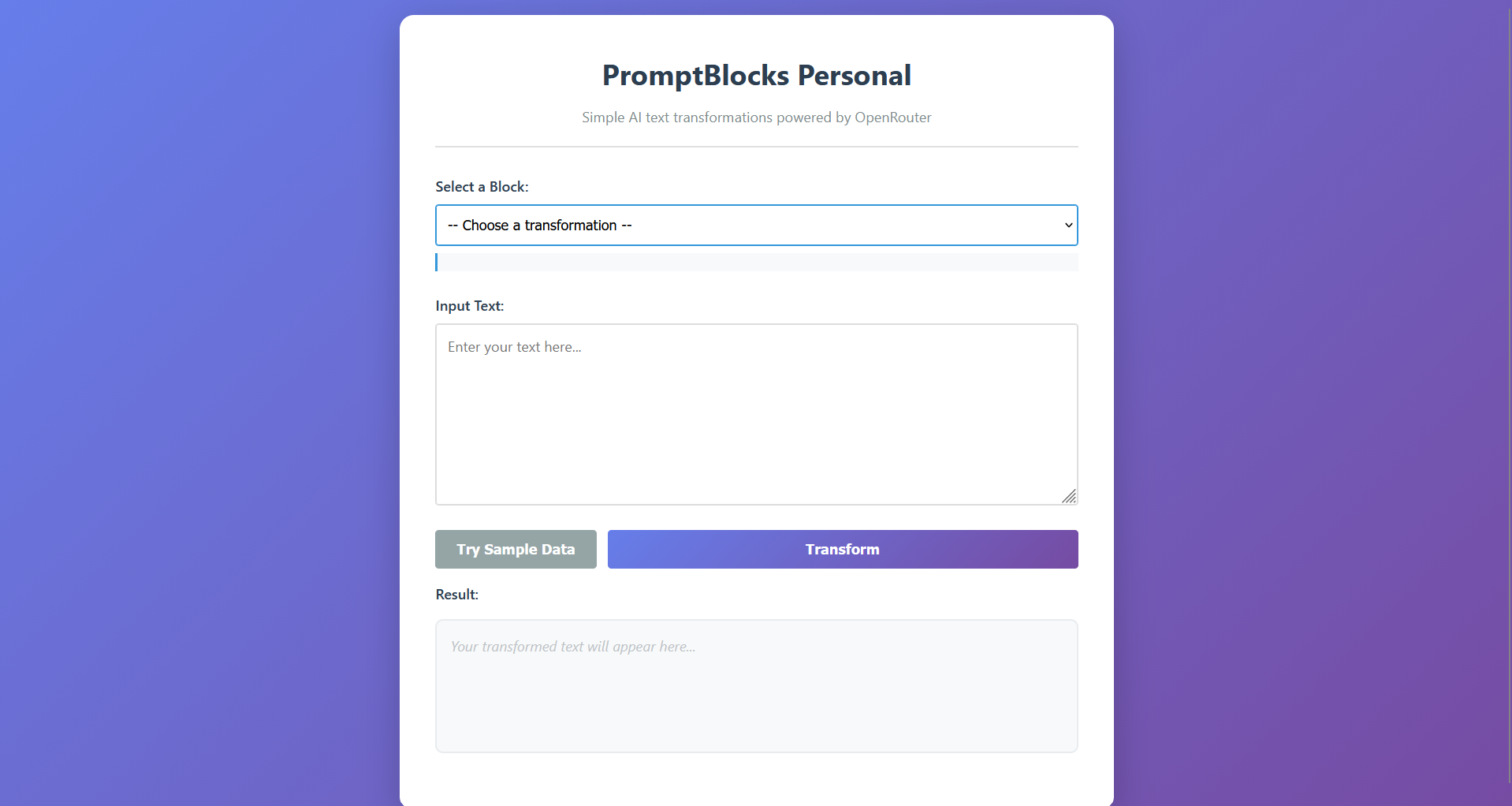
- Single-Block App: Run one transformation (summarize, rewrite, extract, translate, etc.) with clean, human-readable output.
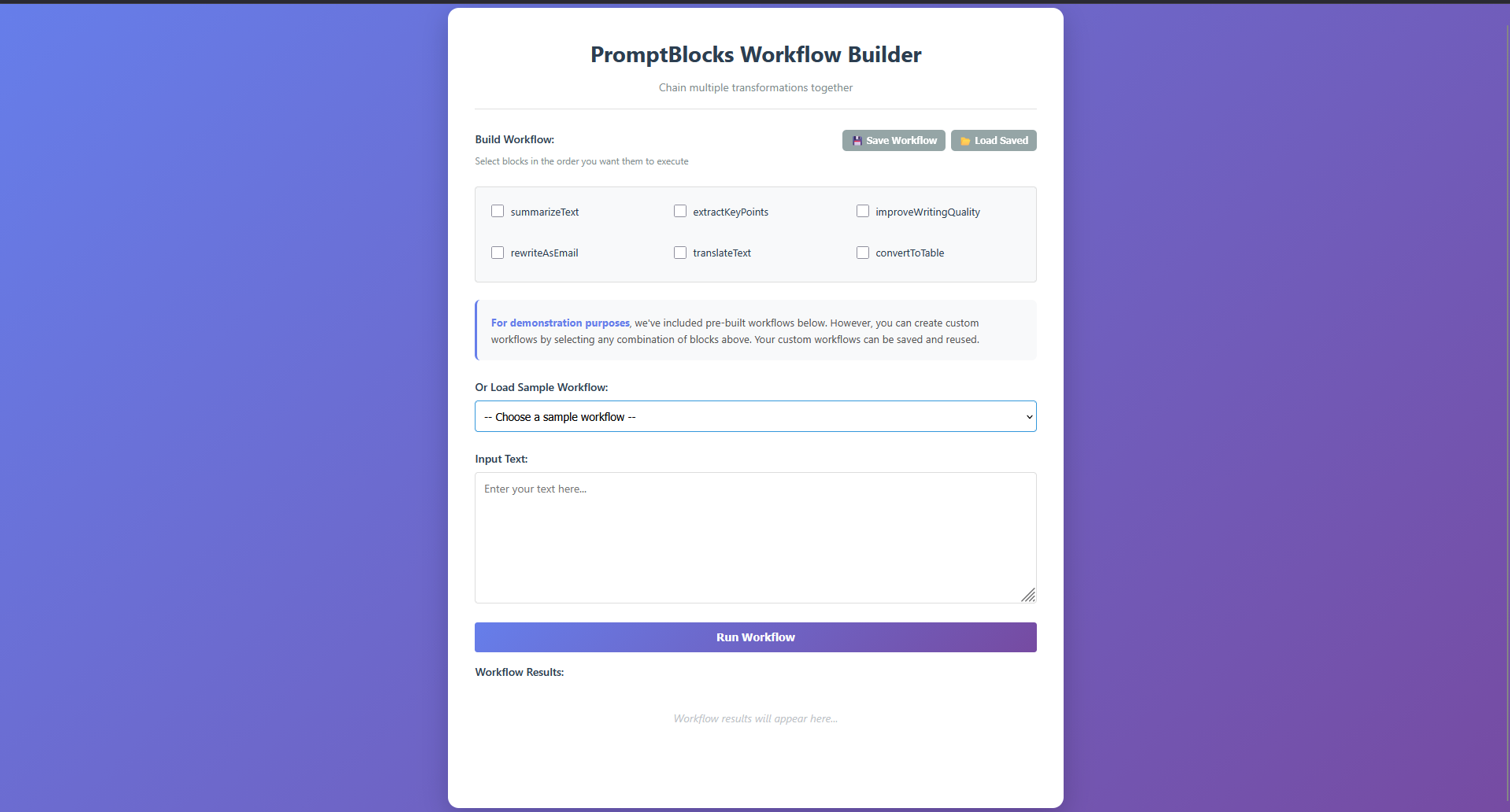
- Workflow Builder: Chain multiple transformations into pipelines, run them step-by-step, and visualize each stage.
Both apps share 100% of the logic through the skeleton engine: block registry, executor, workflow engine, formatting, and error handling.
🛠️ How We Built It
I followed a full spec-driven development process using Kiro:
- Wrote detailed EARS-style requirements and steering docs
- Built the reusable skeleton engine first (blocks, executor, workflows)
- Then created two separate apps using only the skeleton zero duplication
- Added agent hooks for automated checks and vibe coding for fast iteration
- Integrated OpenRouter with nousresearch/hermes-3-llama-3.1-70b for all AI transformations
The result is a clean, disciplined architecture where UI is thin and the skeleton does the heavy lifting.
⚙️ Challenges We Ran Into
- Rate limits on free AI models required smart exponential backoff and retry logic
- Enforcing zero duplication across two apps required automated hooks and steering docs
- Ensuring outputs were always human-readable meant building a sanitization layer
- Managing state across workflows needed a robust workflow engine
🏆 Accomplishments We’re Proud Of
- Built two fully functional apps with 100% shared logic
- Production-quality error handling, retries, validation, and workflow stability
- Super easy extensibility, adding a new block takes minutes
- Strong use of Kiro: specs, vibe coding, hooks, and steering all integrated cleanly
📚 What We Learned
- Spec-first design leads to cleaner code and fewer surprises
- Constraints (like “no duplication”) force better architecture
- Automation through hooks saves hours of debugging
- Skeleton Crew is a powerful pattern when executed with discipline
🚀 What’s Next for PromptBlocks
- Expanding the core framework with more transformation blocks and domain-specific modules
- Shipping a standalone batch-processing engine so teams can run large workflows directly from the library
- Adding multi-model adapters (OpenAI, Anthropic, local models) as pluggable backends
- Publishing developer guides, templates, and a community-driven block marketplace to help teams extend the framework effortlessly.
The goal: make PromptBlocks a fully installable framework you can drop into any project and build production-ready AI workflows with almost zero boilerplate.

Log in or sign up for Devpost to join the conversation.