The vision
Anyone should be able to take a URL — an article, a blog post, a story — and turn it into a place. Not a summary card or a thumbnail: a world you can walk through, with a goal, glowing objects to inspect, and characters to talk to. And for this competition: a world you can reach into with your hands on Meta Quest.
Honest scope: URL ingestion is live today for Paragraph.xyz posts (and Paragraph publications on their custom domains). The plain-language path — describe a place, walk into it — works with any sentence, right now, no account. Arbitrary URL → world is the next step on the same pipeline.
Try it (no headset needed)
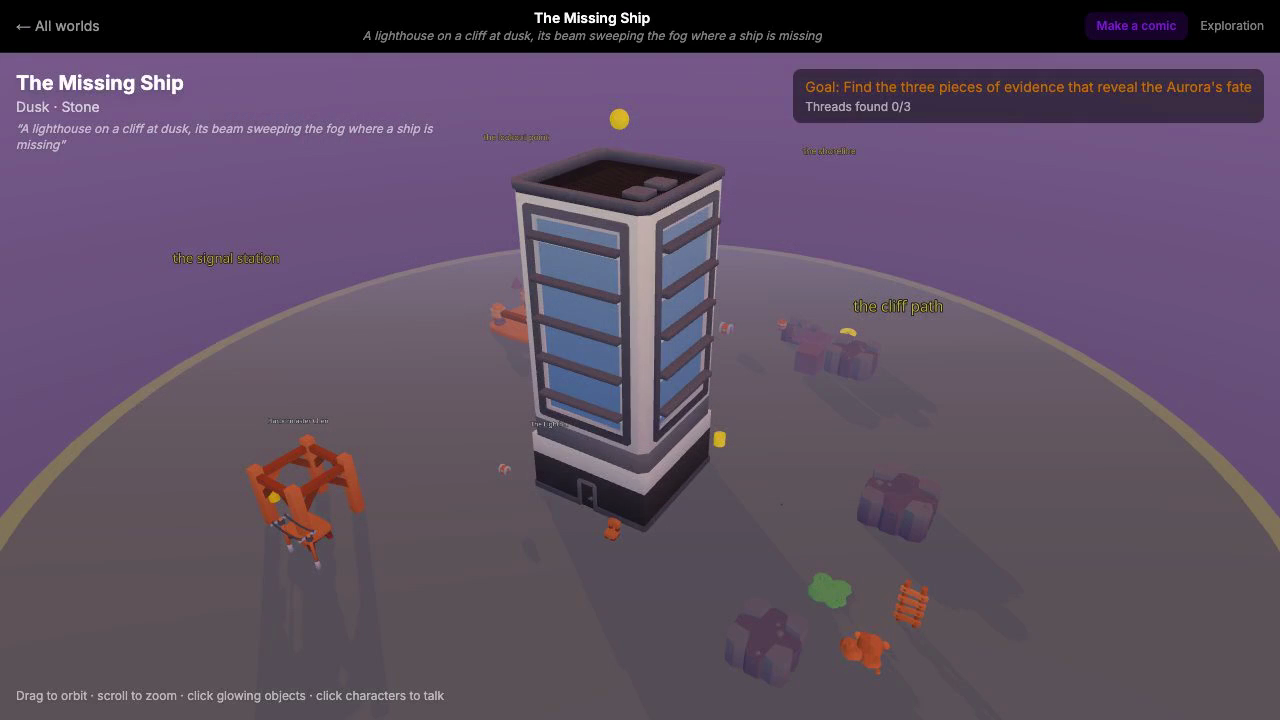
- Open the demo world — "a lighthouse on a cliff at dusk, its beam sweeping the fog where a ship is missing."
- Press Step in — WASD to walk, Q/E to turn if the browser won't lock the pointer. Click a glowing object to check off a quest thread; click a character to talk.
- On a headset: Enter VR in the Quest browser puts the same world on your table — pinch objects and characters, hands-first end to end.
What it does
Paste a Paragraph link or describe a place in plain language. WritersArcade's pipeline turns it into a walkable 3D world. Type a second sentence — "make it night and add the missing ship" — and it reshapes. One scene plan renders three ways: Walk (3D diorama), Read (comic strip), Watch (title-card cut).
On a headset it's a hands-first tabletop experience: the world becomes a ~1.1 m model village floating at chest height, every prop in arm's reach. A pinch lands on the same pointer events a mouse click uses — pinch a glowing object to inspect it, pinch a character to hear their dilemma. No parallel input layer, no port: the same scene graph serves desktop and VR.
How we built it
- Content → world. The platform already turns article URLs into playable story games (
ContentProcessorService.processUrl→ story generation). Prompt → World is the same contract pointed at raw descriptions and reshapes: any text becomes aScenePlan, and aScenePlanbecomes a place. - A contract, not a prompt.
ScenePlannerServicemakes one structured-output call → a validatedScenePlan(Zod schema: mood, ground type, palette, object categories, primitives). The LLM never emits geometry; it composes inside the schema and a React Three Fiber renderer assembles deterministically from a 303-model CC0 Kenney library. - Repair drift, don't reject it. Structured output does not honour numeric bounds — we saw
y: -3for a field capped atmin(0). A repair pass clamps numbers, truncates arrays, coerces enums, and recovers missing asset keys before validation. - VR via
@react-three/xr. One shared XR store (kept onglobalThis— dev bundlers can instantiate the module twice). ATabletopgroup recentres and shrinks the world; aVRPlacardmirrors the goal card, NPC dialogue, and a "Leave VR" pinch target in-headset. - Model layer: fal
any-llmas the primary route, borrowing the AI SDK's OpenAI provider with wire-format translation (messages → flat prompt, cumulative SSE → delta chunks,$refinlining for Anthropic).
Challenges
- Asset packs alone did not raise coverage (55% → 51%); a measurement-driven label-matching recovery pass moved it to 61%.
- Desktop Chrome ships a deviceless
navigator.xrthat makes the IWER emulator refuse to install — we force-install the emulated runtime. The IWER DevUI also starts paused, which presents as a black headset view until play mode is on. - ~39% of objects still render as category-shaped primitives — there is no CC0 model for every subject. Procedurally forged models are next.
What's next
Arbitrary URL → world beyond Paragraph.xyz, procedural model generation for subjects with no CC0 equivalent, and per-object voice. The same plain-language sentence always re-opens its saved world — no re-generation, no account, no GPU. Every article, blog post and story on the web is a world waiting to be walked into.
Built With
- fal-ai
- large-language-models
- meta-quest
- next-js
- prisma
- react-three-fiber
- three-js
- typescript
- webxr
- zod

