-
-
Banner
-
Post PowerUp Coding
-
Landing Page
-
Prompt Template
-
Final Output
Inspiration
We run Vibe, live classes where teens learn to build apps with AI. In class we can coach them. Between classes they practise alone, and they type lazy prompts like "make a quiz app" into Gemini. They get a bland app back and never find out why.
Our existing prompt coach made it worse: it rewrote the student's prompt for them, so they copied the answer and learned nothing. We wanted a coach that makes the student do the thinking.
What it does
Prompt UpLoudly is a flipped-interaction prompt coach:
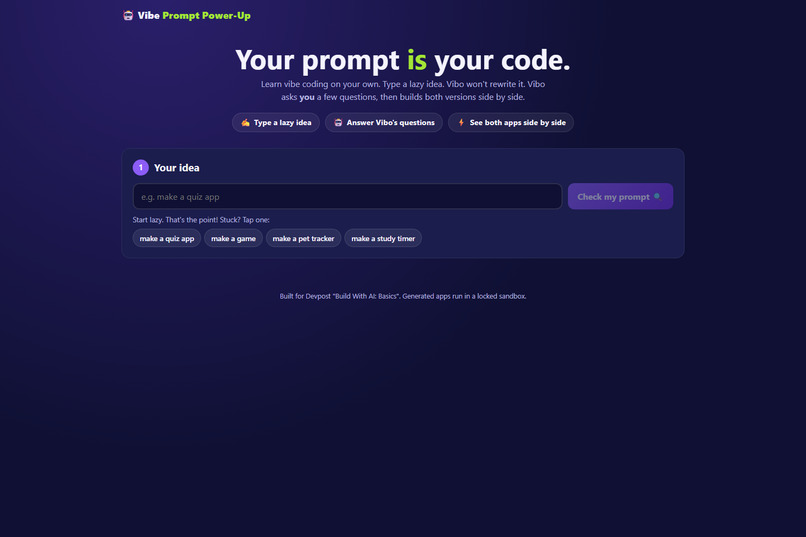
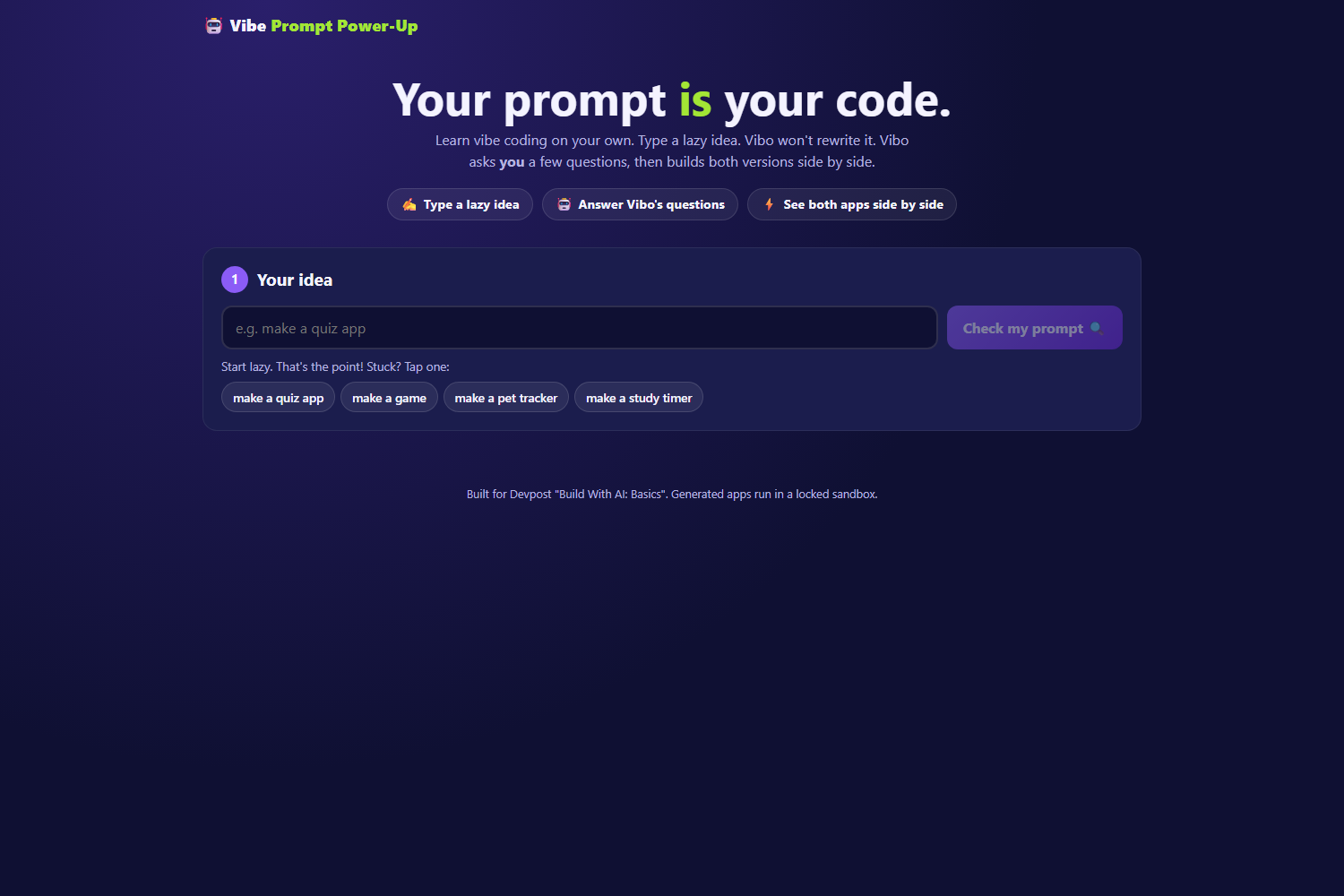
- Type a lazy idea, e.g. "make a quiz app".
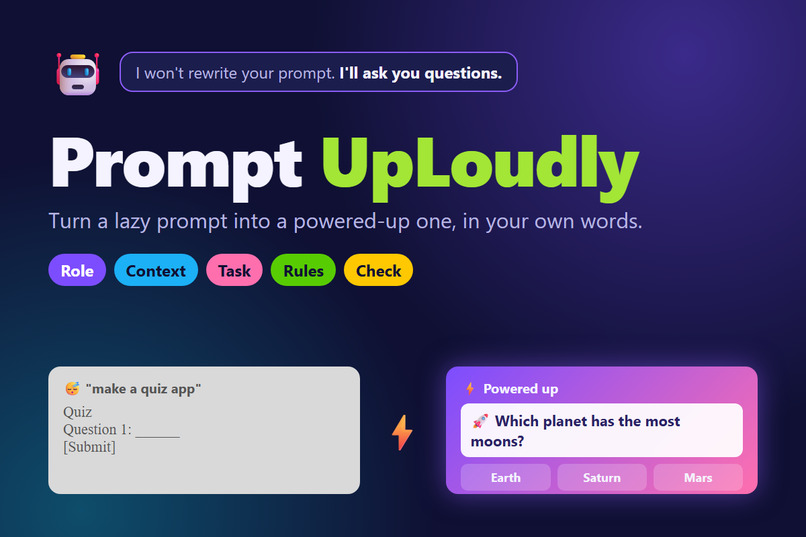
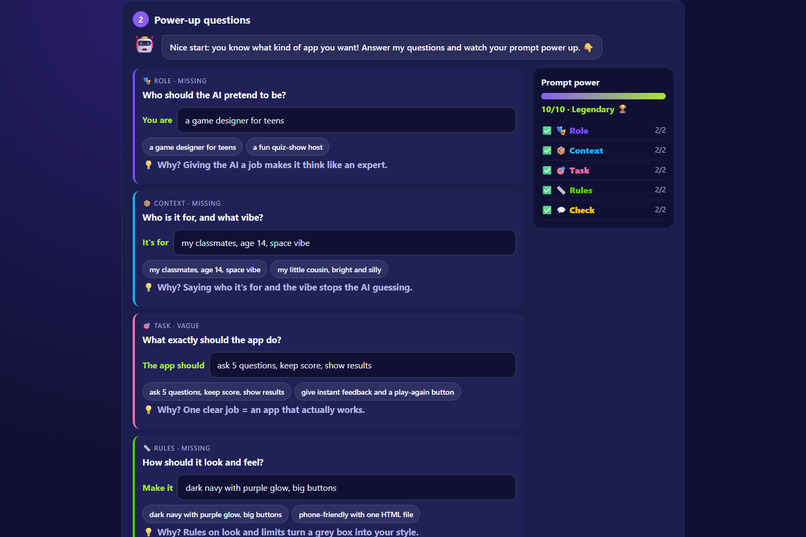
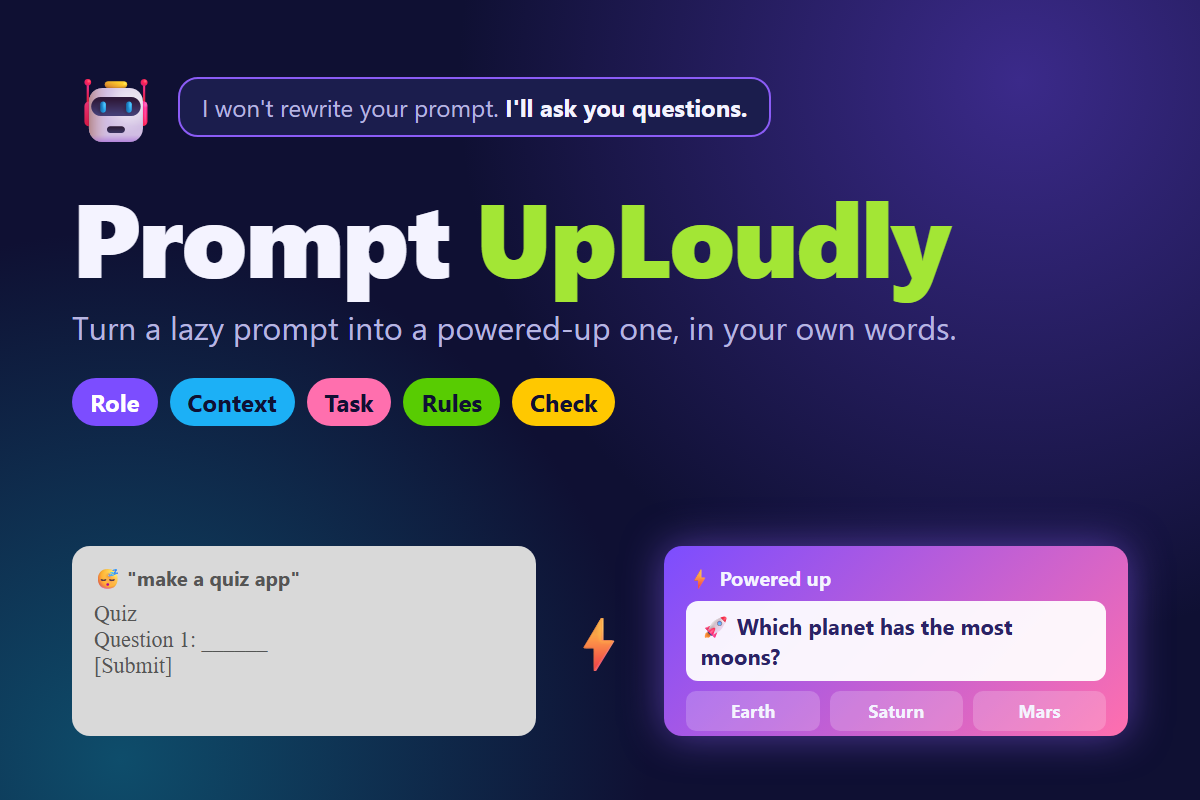
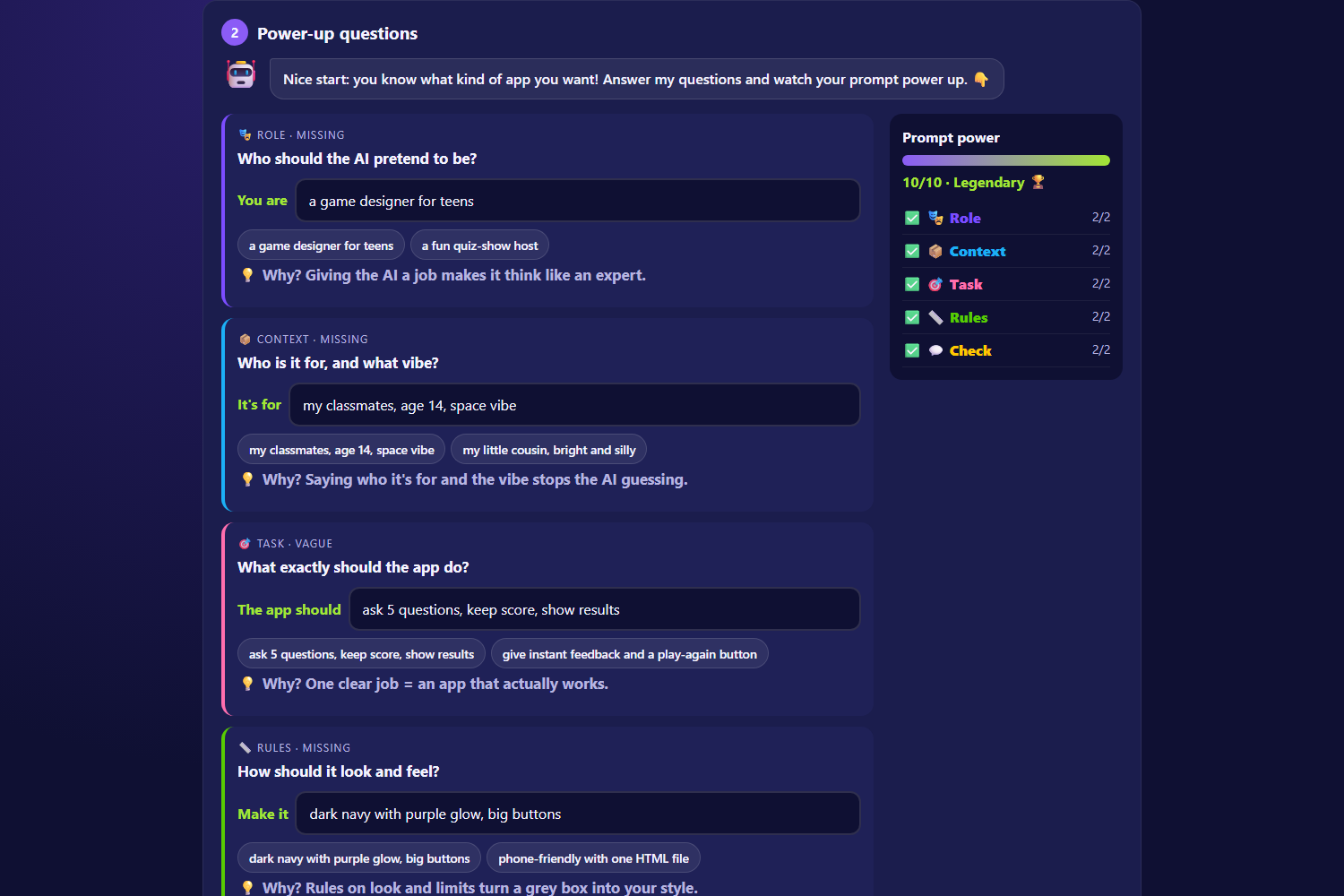
- Vibo, the coach, scores it on five parts: Role, Context, Task, Rules, Check. Instead of rewriting it, Vibo asks 3–5 short questions about the missing parts, with example answers that fit your idea.
- A colour-coded scorecard fills up as you answer, from 0 to 5.
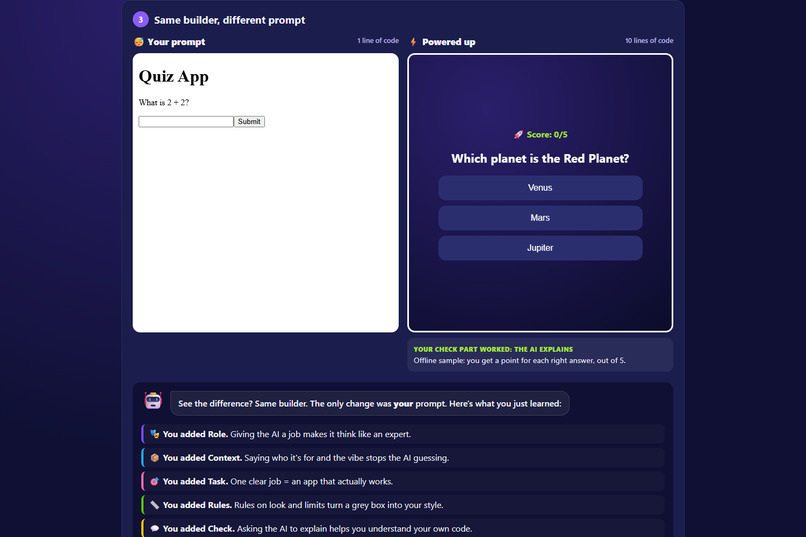
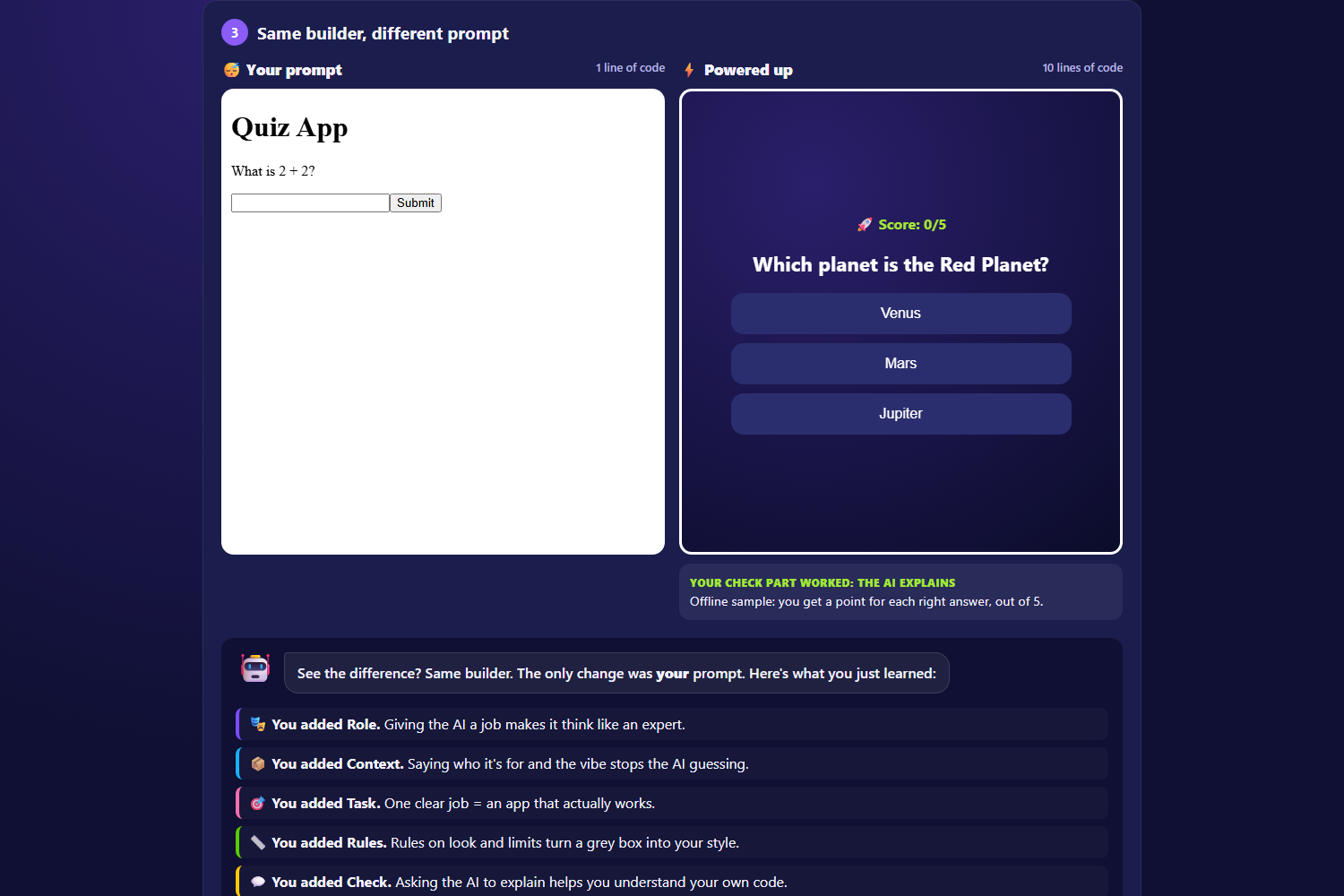
- Press Power up ⚡. The lazy prompt and the powered-up prompt are built by the same AI builder and shown side by side: a plain grey box next to a styled, working app.
- Copy the powered-up prompt into Google AI Studio and keep building.
Idea starters, "why this matters" tips, a recap of what you learned and a next challenge let a teen use it with no teacher beside them.
How we built it
We planned before writing any code, using the Devpost Learn skill pack with Claude Code: scope → PRD → technical spec → build.
- Frontend: plain HTML, CSS and JavaScript, with no framework.
- Backend: a tiny Node.js server with no npm packages. It calls the Gemini API so the API key never reaches the browser.
/api/coachscores the prompt and returns questions and example answers./api/buildturns a prompt into one self-contained HTML app, using identical builder instructions for both prompts.
- Safety: generated apps run in a sandboxed iframe, with no access to the page, no forms and no pop-ups.
- Offline demo mode: with no API key, rule-based questions and sample apps let anyone try the whole flow.
Challenges we ran into
- Stopping the AI from "helping" too much. Left alone, the model rewrites the prompt and that breaks the whole idea. We fixed it in code: the page assembles the powered-up prompt itself, from the student's own words plus a short lead for each part. The AI never writes it.
- Making the comparison fair. Both prompts go through exactly the same builder instructions, or the side-by-side proves nothing.
- Running AI-generated code safely in a page meant for teens.
- Starting from an empty folder. The rules allow old ideas but not old code, so none of our earlier Vibe code could be reused.
- Scope vs. deadline. We cut accounts, dashboards, teacher review and publishing to ship on time.
Accomplishments that we're proud of
- The "oh, that's cool" moment works: the two apps appear next to each other, and the difference a good prompt makes is impossible to miss.
- The coach never writes the prompt for the student. That's built into the code, not just written into the instructions.
- It runs with zero dependencies and works offline in demo mode, so any student or judge can try it in seconds.
- We went from an empty folder to a working proof of concept, with a scope, PRD and spec, inside the hackathon.
What we learned
- Flipped interaction (the AI asks you questions) works for teaching as well as for planning. We used it to plan this project, then built it into the product.
- Writing scope, a PRD and a spec first made the build faster and kept it focused.
- [Add one personal surprise, e.g. how big the gap between the two apps was the first time you saw them.]
What's next for Prompt UpLoudly
- A class dashboard with progress, streaks, quests and a class leaderboard.
- Teacher review and approval.
- Sign-in, daily run limits and server-side safety checks.
- Publishing apps to a shareable
yourname.vibe.uploudly.comURL. - [When you'll put it in front of your students.]
Built With
- cheaperinference
- claude-code
- cloudflare
- css3
- devpost-learn-skill-pack
- gemini-api
- html5
- javascript
- lets-encrypt
- nginx
- node.js
- openai-compatible-api
- oracle-cloud
- pm2
- qwen


Log in or sign up for Devpost to join the conversation.