-
-
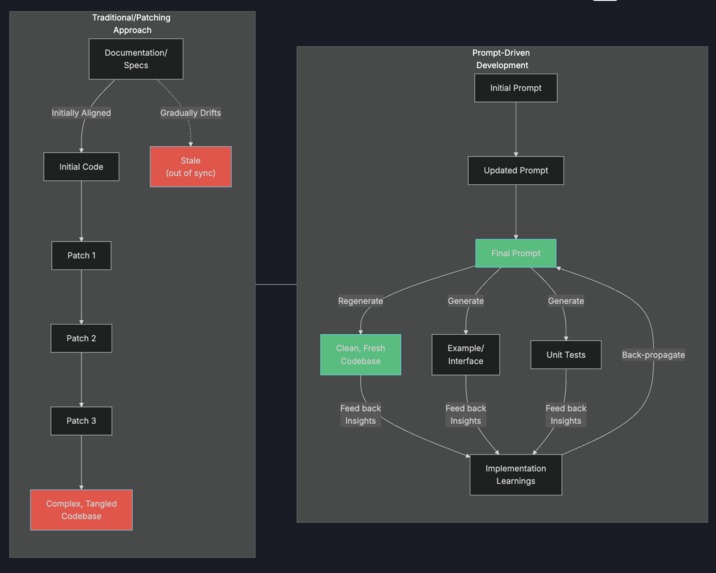
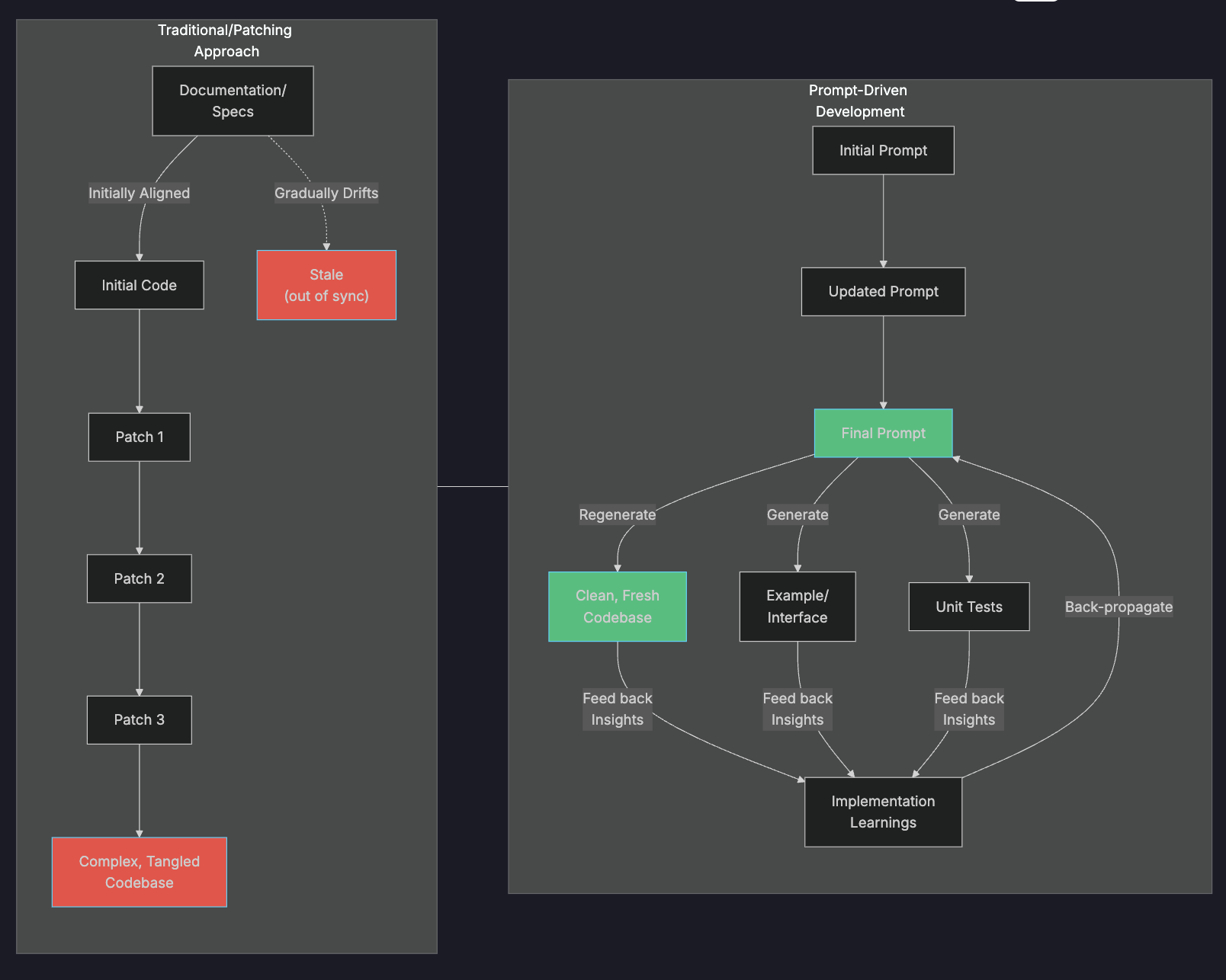
Traditional Code Centric (e.g. Cursor, Claude Code) Approach vs. Prompt-Driven Approach
Inspiration
The critical and ever-growing burden of software maintenance was the primary inspiration for Prompt Driven AI. We observed that as software projects mature, an increasing amount of developer time is spent on understanding, patching, and refactoring existing code rather than building new features. Traditional AI coding assistants, while helpful for generation, often exacerbate this issue by producing code that can be hard to maintain or integrate in the long run. We envisioned a paradigm shift where prompts become the primary source of truth, enabling a more sustainable and efficient way to manage the software lifecycle.
What it does
Prompt Driven (PD) is a platform centered around the concept of Prompt-Driven Development (PDD). It empowers developers to:
- Treat Prompts as the Source of Truth: Instead of directly editing code, developers primarily interact with and version prompts.
- Regenerate Code: The platform uses these prompts to deterministically regenerate code, ensuring it remains clean, consistent, and aligned with the latest requirements. This significantly reduces the cost and effort of software maintenance.
- Leverage Batch Processing: PD offers regenerative batch pipelines that can re-generate code from prompts at a significantly lower LLM cost compared to interactive AI assistants.
- Access a Curated Marketplace: A two-sided marketplace allows creators to share and monetize few-shot examples and test assets, while developers can find high-quality, verified assets to accelerate their work.
- Ensure Enterprise-Grade Governance: For larger organizations, PD provides traceability features, synchronizing prompts, code, and tests, along with audit dashboards and support for compliance standards like SOC-2.
Essentially, Prompt Driven AI aims to slash the lifetime cost of software by making prompt updates and deterministic regeneration the core of the development and maintenance workflow.
How we built it
Prompt Driven AI is built as a comprehensive system with several key layers:
- Open PDD CLI: An open-source command-line interface provides developers with commands like
generate,example,test,fix, andupdateto interact with the PDD workflow. This fosters community adoption and aims to establish a de-facto standard. - Batch Orchestration Engine: A sophisticated cloud-based engine manages LLM interactions. It includes multi-vendor model routing, cost-aware caching, and deterministic regeneration capabilities to optimize for both cost (targeting 40-60% token savings) and consistency.
- Curated Marketplace: The platform features a digital marketplace built with features for search, staking by creators, rating systems, and automated revenue splits. It supports payments via bank card, ACH, or USDC, which are converted to PDD Credits (PDDC).
- Traceability & Compliance Layer: This layer provides robust mapping between prompts, the generated code, and associated tests. It includes diff viewers and an audit API, crucial for enterprise users needing governance and compliance.
- Frontend Cloud Platform: A web interface (PDD Cloud) complements the CLI, allowing users to manage contributions, preferences, view analytics, access support, and interact with the marketplace. It's designed with a user-centered philosophy, emphasizing clarity, consistency, and accessibility (WCAG 2.1 AA).
- Optional Token Rail (Future): Plans include an ERC-20 based "PDD-Credit" token for trust-less moderation and global payouts in the marketplace.
The technology stack involves multi-cloud GPU pools, integration with services like AWS Bedrock, and runners for open models. Marketplace moderation combines automated checks (linting, plagiarism) with community arbitration.
Challenges we ran into
Developing Prompt Driven AI has involved navigating several complex challenges:
- LLM Price Volatility & Supplier Power: The cost of LLM tokens can fluctuate, and there's a high dependency on a few large LLM providers. We've mitigated this by building a multi-model routing system, negotiating volume deals where possible, and exploring the use of open models for a significant portion of the workload.
- Ensuring Marketplace Quality: Maintaining high-quality assets in a two-sided marketplace is crucial for user trust. We're addressing this through creator staking (requiring creators to have skin in the game), a slashing mechanism for low-quality or plagiarized content, and a rating/ranking algorithm that factors in quality.
- Competitive Landscape: The AI developer tool space is rapidly evolving with well-funded rivals. Our strategy is to differentiate through our unique prompt-first, regenerative batch workflow, the network effects of our marketplace, and a focus on enterprise compliance features.
- Balancing Open-Source with Commercialization: We've opted for an open-source CLI to drive adoption, while premium features (marketplace, advanced analytics, enterprise governance) are part of the cloud platform.
- Technical Complexity of Deterministic Regeneration: Ensuring that code regeneration is truly deterministic and handles complex dependencies effectively is a significant ongoing technical challenge.
- Achieving Enterprise-Grade Security & Compliance: Meeting the stringent security and compliance requirements (e.g., SOC-2) of enterprise customers requires significant investment and effort.
Accomplishments that we're proud of
- Developing a Novel Workflow: Pioneering the "prompt-as-source-of-truth" paradigm and its practical application through a regenerative batch model.
- Designing a Robust Marketplace Economic Model: Creating a system with tiered royalties, staking, and buyer incentives (like "Regeneration Insurance") designed to foster a healthy and high-quality ecosystem.
- Significant Cost Reduction Potential: Demonstrating how batch processing and optimized LLM usage can lead to substantial cost savings (aiming for ~50% reduction) compared to traditional interactive AI coding.
- Focus on Maintainability and Compliance: Addressing a critical, often overlooked, aspect of software development – the long-term cost of maintenance and the need for auditable AI-generated code.
- Building a Strong Foundation for Community & Enterprise: Launching an open-source CLI to build a grassroots community while simultaneously developing features tailored for enterprise adoption.
- Early Traction in Defining Differentiated Value: Establishing a distinct value proposition in a crowded market by focusing on the lifecycle and TCO benefits of PDD.
What we learned
- The Importance of a Niche Focus: In a rapidly evolving market like AI developer tools, having a clearly differentiated strategy (like our "Focused Differentiation" on prompt-centric regeneration and marketplace) is key.
- Network Effects are Powerful Moats: A thriving marketplace and a locked-in workflow can create significant switching costs and defensibility against new entrants and competitors.
- Balancing Technical Innovation with Business Viability: Groundbreaking technology needs a solid business model. We've iterated on our marketplace economics and revenue streams to ensure sustainability.
- Enterprise Needs are Distinct: Features like SOC-2 compliance, audit trails, and private marketplace realms are critical for adoption by larger organizations and require dedicated focus.
- Community is Key for Open Source Success: Engaging with developers, gathering feedback, and fostering a community around the open-source CLI is vital for growth and establishing PDD as a standard.
- Iterative Development is Crucial: The AI landscape is constantly changing, so our product roadmap and strategies need to be adaptable and responsive to new developments and user feedback.
What's next for Prompt Driven AI
Prompt Driven AI is on a trajectory to become the de facto prompt-orchestration layer for the software industry. Our future focus revolves around several key pillars:
- Marketplace Evolution: Continuously enhancing the marketplace by refining economic models, introducing new incentive structures for creators, and expanding options for asset discovery and utilization. This includes exploring advanced features like on-chain PDD credits and new ways for creators to monetize their work.
- Core Platform Advancement: Persistently improving the underlying platform by deepening integrations with developer workflows and IDEs, expanding enterprise billing and payout capabilities, and offering more flexible deployment options like on-premise inference gateways.
- Enterprise Offering Expansion: Steadily increasing the value proposition for enterprise clients by achieving higher compliance certifications, building more sophisticated governance and agentic orchestration features, and providing curated, industry-specific content packs.
- Ecosystem Growth: Actively fostering the growth of our community and platform by driving adoption of the open-source CLI, supporting our creator network, and forging strategic partnerships with SIs and other technology providers.
- Long-Term Strategic Development: Positioning Prompt Driven AI for sustained growth and market leadership. This involves ongoing innovation in the prompt-driven paradigm to dramatically reduce software lifecycle costs and exploring strategic opportunities as the platform matures.
The overarching goal is to solidify Prompt Driven's position by tightening the fit between its unique workflow, the two-sided marketplace, and its cost-leverage capabilities, creating a sustainably profitable niche.
Built With
- firebase
- google-cloud
- litellm
- llm
- next.js
- python

Log in or sign up for Devpost to join the conversation.