-
-
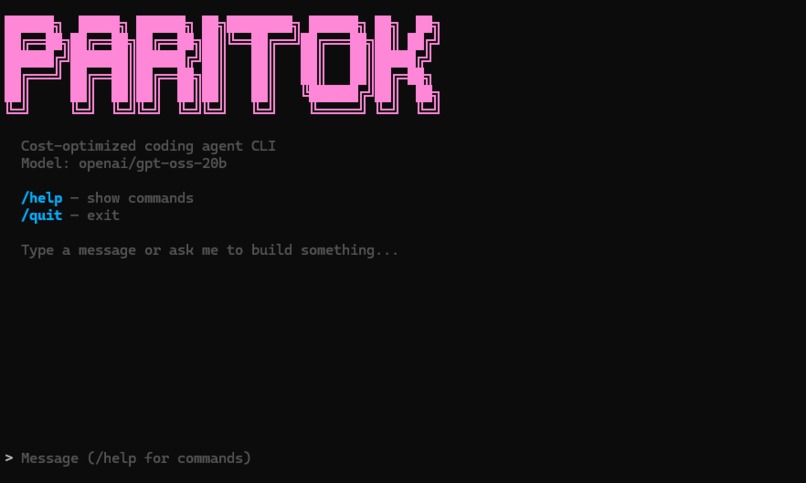
Welcome Banner
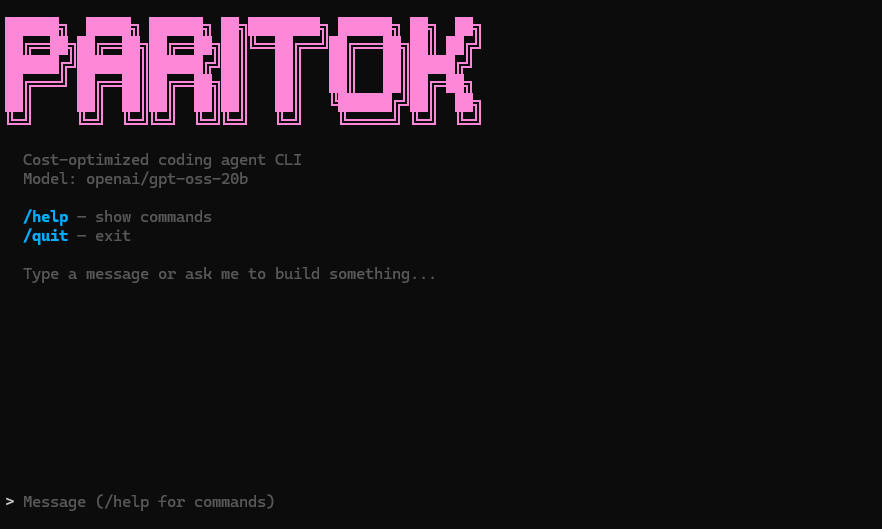
Inspiration
AI coding agents are powerful, but they’re expensive to run. Multi‑turn conversations quickly inflate context windows — generating code, running it, fixing errors, iterating again — and every turn resends the entire history. That drives LLM API costs up fast. To make agentic coding viable, we needed a way to compress conversational context without losing meaning. That’s where Paritok comes in, and paritok‑cli proves the approach works in a real agent loop.
What it does
paritok‑cli is a cost‑optimized interactive coding agent CLI. It gives you a terminal chat interface where you can ask the agent to write code, read files, edit them, run commands, and iterate.
Every message — user or model — is compressed before being sent, typically saving 60–70% tokens per turn.
Flow:
- User enters a prompt
- CLI compresses it via the Paritok cloud API
- Sends compressed context to a local Paritok proxy
- Proxy forwards to NVIDIA’s API
- Model streams back text or tool calls (read, write, edit, grep, bash, etc.)
- CLI executes the tools and returns results to the agent
How we built it
The CLI is written in Go 1.26.5.
The TUI is built using the Charmbracelet ecosystem:
- Bubbletea for the Elm‑style architecture
- Bubbles for text input and viewport components
- Lipgloss for styling and layout
- Glamour for markdown rendering with syntax‑highlighted code blocks
The CLI framework uses Cobra + Pflags.
Tool‑calling is powered by mark3labs/mcp‑go, an implementation of the Model Context Protocol.
Compression pipeline:
Client → Paritok API → compressed JSON → local proxy → NVIDIA API (openai/gpt‑oss‑20b).
The proxy handles authentication and forwards the compressed payload.
Challenges
- Streaming + tool calls: NVIDIA streams tokens, but tool calls arrive as deltas. We had to reconstruct tool call arguments across multiple SSE chunks without breaking the streaming UX.
- Agent loop state management: Coordinating Bubbletea’s message pump with goroutine‑based streaming required careful channel design to avoid deadlocks and stale UI updates.
- Compression fidelity: Early compression dropped important instructions. Tuning Paritok parameters to hit ~70% compression while preserving semantics took extensive testing.
Accomplishments
- ~70% compression in real agent loops, not synthetic benchmarks.
- A fully functional opencode‑class agent in Go: seven tools (read, write, edit, remove, glob, grep, bash), multi‑turn tool‑calling, streaming, markdown rendering — all in a single binary with no runtime dependencies.
- Paritok credit + badge integration: visible in the README and a live token‑savings counter inside the TUI.
What we learned
- Token economics matter: Agentic loops multiply token usage by 5–10× compared to single prompts. Compression isn’t optional — it’s the difference between affordable and unusable.
- Go TUI architecture: Building a responsive terminal app with concurrent streaming taught us how Bubbletea and goroutines interact under load.
What’s next
- Session persistence: SQLite‑backed conversation history.
- Subagents & plugins: Parallel task execution and extensible tool sets.
- LSP integration: Hover, go‑to‑definition, diagnostics via the agent.
- Server mode: Run paritok‑cli as a long‑lived daemon for editors and CI pipelines.
Built With
- bubbles
- bubbletea
- cobra
- glamour
- go
- lipgloss
- pflags


Log in or sign up for Devpost to join the conversation.