-
-
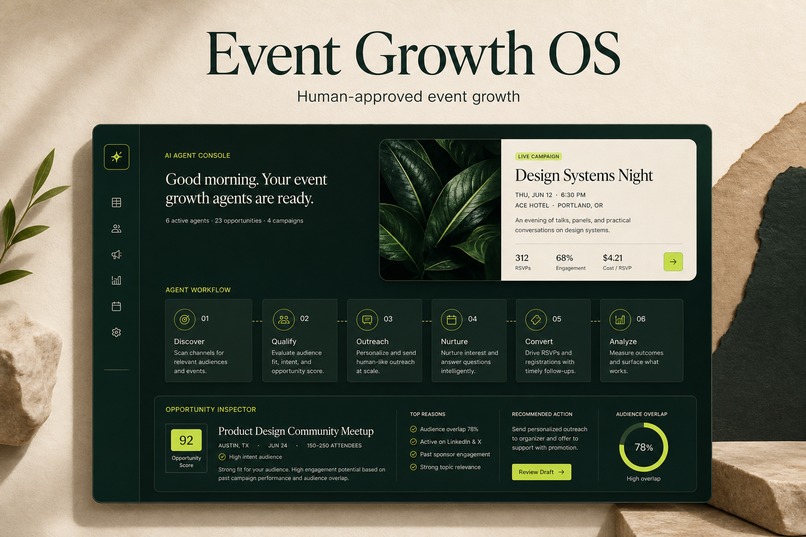
Landing page
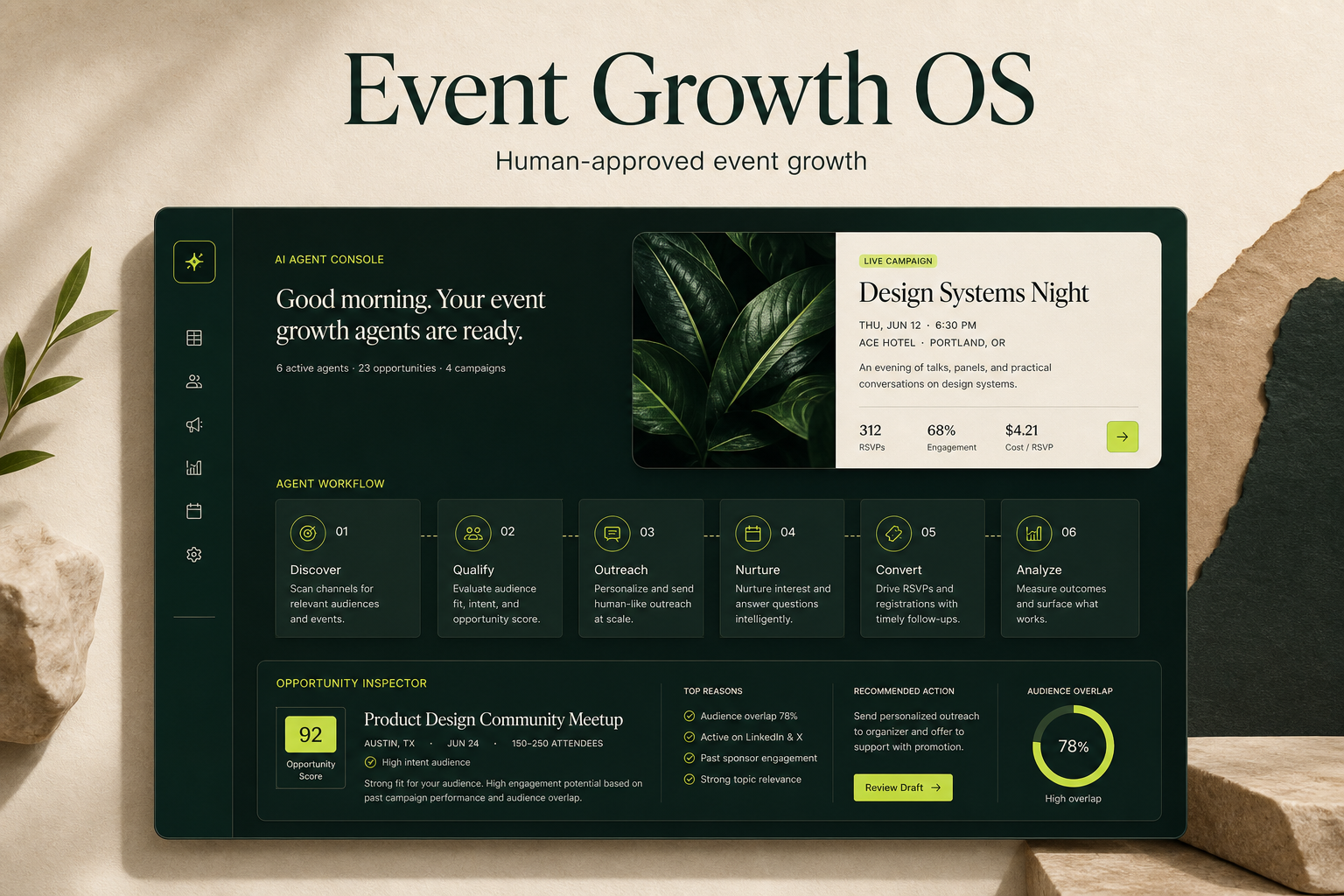
Event Growth OS
Event Growth OS helps event teams find the people who would genuinely benefit from an event—without turning outreach into spam.
Inspiration
Event promotion often rewards volume over relevance: organizers broadcast broadly, while potential attendees get generic messages that do not reflect what they actually need. We wanted to explore a better relationship between people and agents: let an agent do the patient research and first-draft work, while people retain the judgment and responsibility to decide whether to reach out.
That question became Event Growth OS: an agent console for finding genuine audience fit, explaining the evidence, and keeping a human approval checkpoint before any response could be used.
What it does
The centerpiece is an Agent Console that starts with a plain-language goal such as:
Find people who would genuinely benefit from my event.
It then makes a transparent, human-supervised tool sequence:
get_campaignloads the event context.find_relevant_conversationssurfaces discussion signals.analyze_conversationexplains intent, context, and audience fit.draft_responseprepares a useful, transparent reply.request_human_approvalstops for a person before outreach.record_outcomecloses the learning loop.
The interface exposes the reasoning rather than hiding it: opportunity scores, the signal behind each recommendation, the proposed draft, AI-assistance disclosure, and an explicit approval gate. Low-relevance conversations are intentionally rejected.
How we built it
We built Event Growth OS with Next.js, React, and TypeScript as a focused, responsive operator console.
For WebMCP, the app defines six purposeful tools and registers them through navigator.modelContext.registerTool when a compatible browser host exposes the API. Each tool has a name, a clear description, an input schema, and an execution result designed to be discoverable by an agent. The same definitions power the visible console timeline, so a person can understand exactly which capability is being requested at every stage.
The demo data is deliberately realistic but clearly simulated. It lets the product demonstrate the decision flow without pretending that it is scraping conversations or automatically posting to external networks.
Challenges we faced
The main challenge was resisting the temptation to make the experience look autonomous at the expense of trust. A fast draft is useful; an unreviewed message is not always appropriate. We designed the system around a hard human checkpoint and clear disclosure instead of an auto-posting loop.
A second challenge was making WebMCP legible to both audiences. Agents need tools with concrete, discoverable contracts; people need to see why each call matters. The tool timeline and opportunity inspector were designed to bridge that gap.
Finally, native WebMCP support depends on the browser host. We made the integration progressively enhanced: compatible hosts can register the tools natively, while the product still presents an interactive, inspectable demo flow where that API is unavailable.
What we learned
We learned that a strong WebMCP experience is not just a list of functions. The tools need to map to meaningful moments in a real workflow, communicate their purpose clearly, and preserve a person’s ability to intervene.
We also learned that the most compelling agent experiences pair automation with context. In Event Growth OS, the agent does not merely return a score—it shows the source signal, explains the fit, and asks for approval. That makes the system feel less like a black box and more like a thoughtful collaborator.
Built with
Next.js, React, TypeScript, and WebMCP APIs.
Running locally
Install dependencies, then run:
pnpm install
pnpm dev
Open http://localhost:3000. Enter an agent request, run the toolchain, select a conversation, and approve a high-confidence draft to see an outcome recorded.
AI and Codex usage
AI and Codex were used to help implement and refine the product experience. All product claims, simulated conversation signals, and outreach drafts are explicitly presented as demonstration data; the app does not automatically post to external social networks.
Neural deep network ltd neuraldeep.net productions 2026 ai x human power
Built With
- next.js
- react
- typescript
- vercel
- webmcp


Log in or sign up for Devpost to join the conversation.