-
-
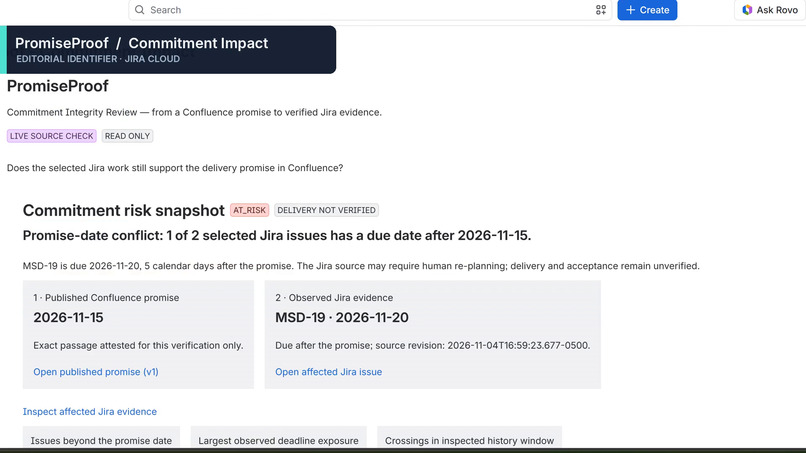
One selected Jira issue is due five days after the published commitment.
-
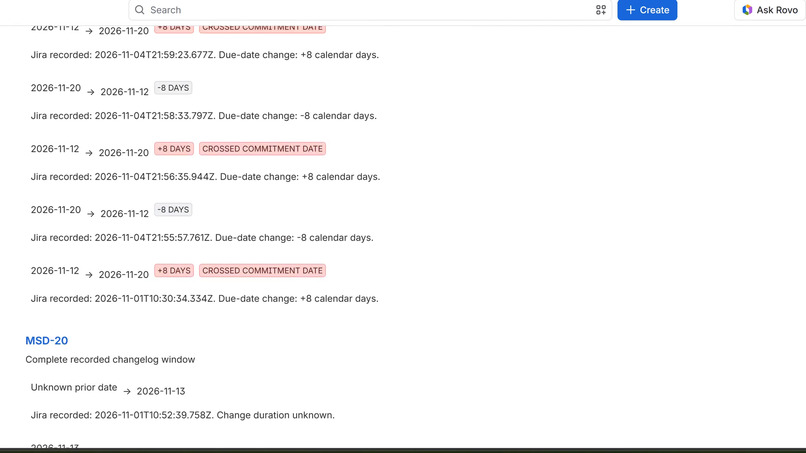
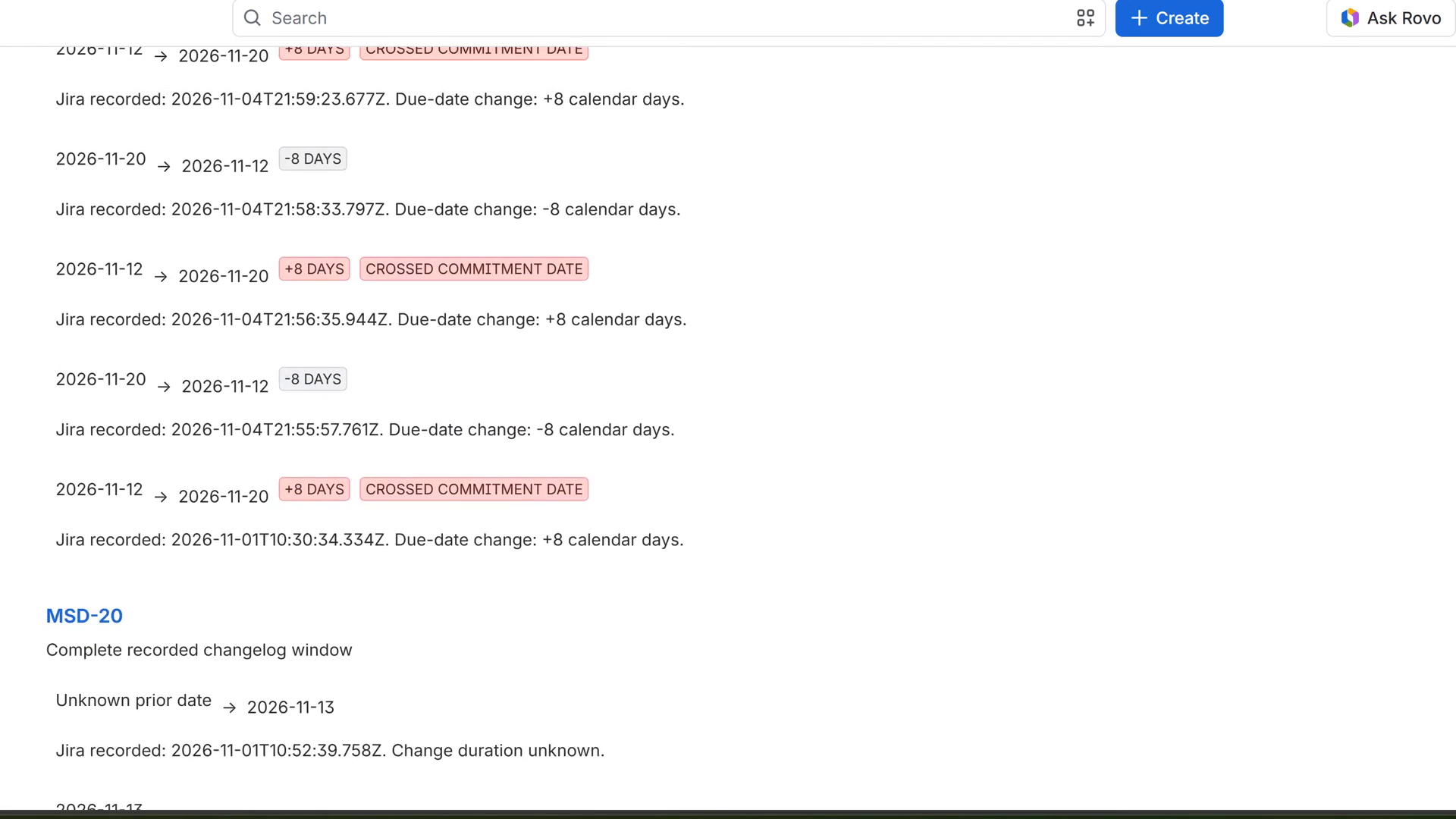
Jira records an eight-day due-date change crossing the commitment date.
-
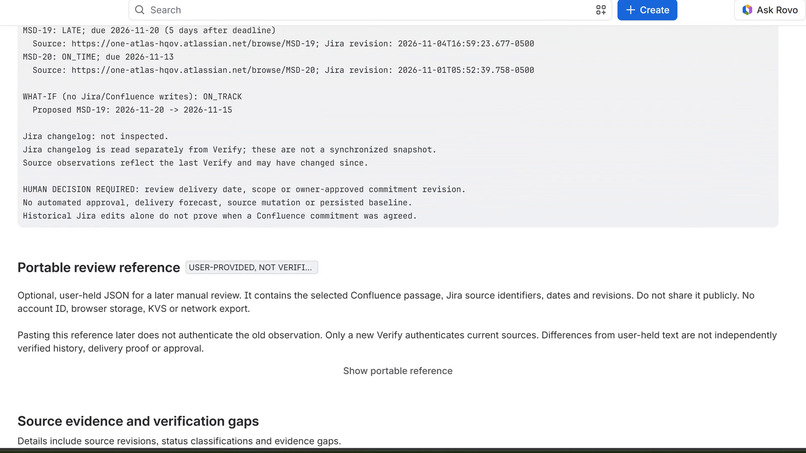
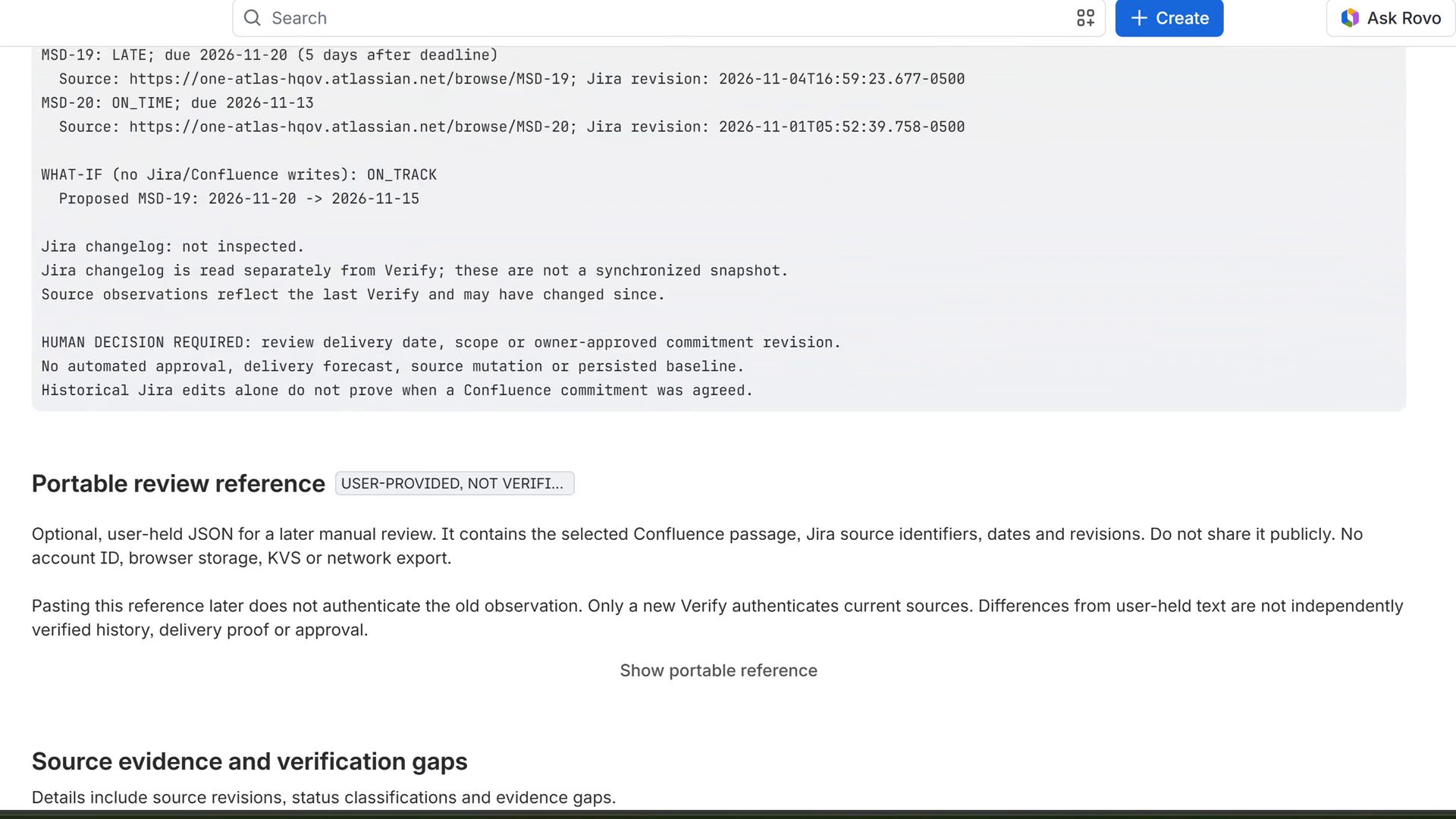
What-if is hypothetical; observed status remains AT_RISK. A human decides.
-
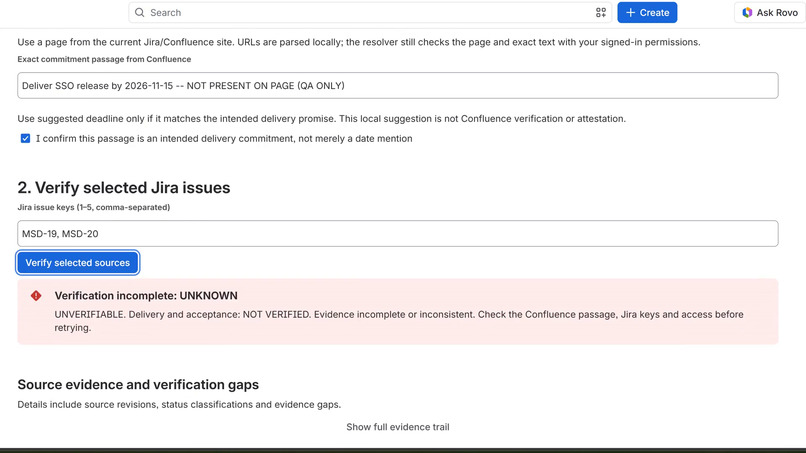
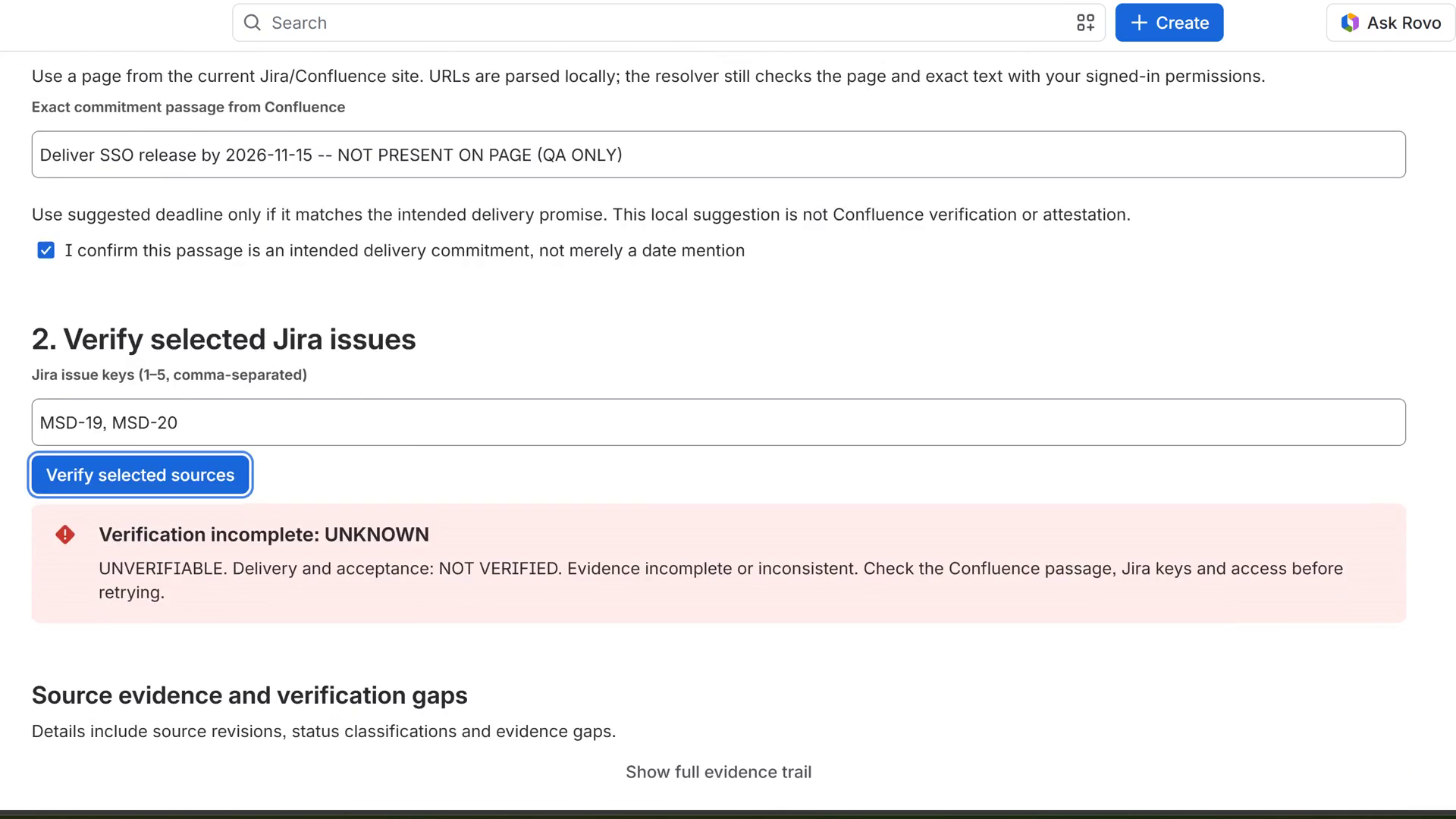
An absent passage returns UNKNOWN instead of stale reassurance.
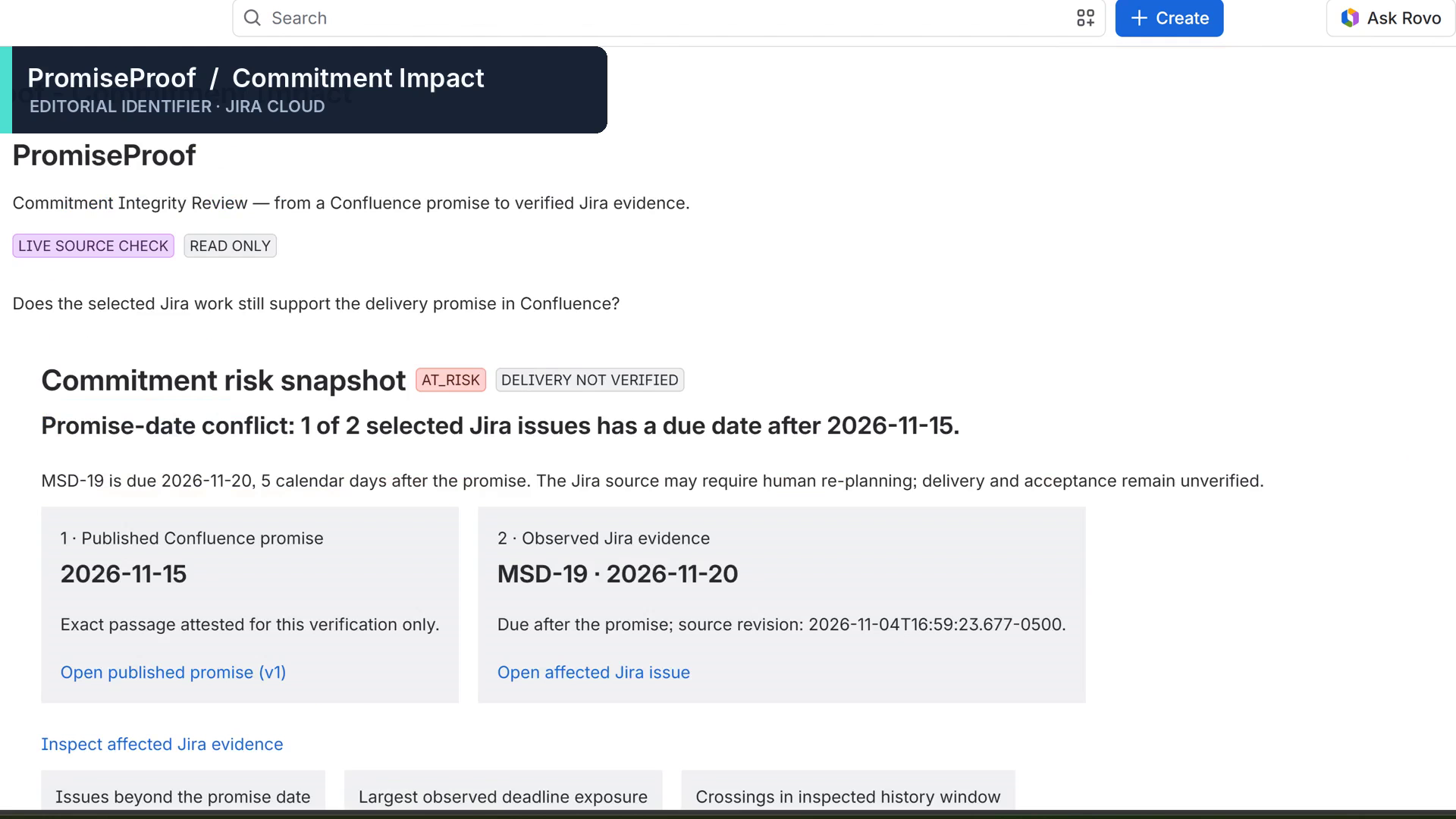
Before a release lead repeats a published deadline, can the evidence still support it? In a synthetic scenario on a real Atlassian test tenant, Confluence promises November 15 while one of two selected Jira issues is due November 20. PromiseProof verifies the exact published passage against live, permission-checked Jira data, cites the five-day date conflict, and separates a read-only What-if from the observed state. If evidence is missing or unverifiable, it reports UNKNOWN—not an assumed success. This is not a delivery forecast or sign-off.
Watch the 2:06 public end-to-end demo. The core decision story concludes at 1:46:
0:00 — Published Confluence promise and the live Jira question. 0:16 — Verify the exact passage against the explicitly selected issues. 0:31 — See the five-day date conflict with source citations. 0:45 — Inspect the Jira due-date history. 0:59 — Compare a read-only What-if with the unchanged observed result. 1:14 — Review the evidence-bounded human decision. 1:29 — See missing passage evidence fail closed as UNKNOWN. 1:46 — Restore the verified promise and return to the observed result.
Decision this supports: a release lead can choose whether to reaffirm the date, investigate the discrepancy, or discuss recovery with stakeholders. PromiseProof supplies source-linked evidence, not approval.
The demo uses synthetic test data. It does not prove delivery or acceptance, discover every dependency, or make Jira or Confluence changes.
Inspiration
A delivery date can stay published in Confluence while the Jira work supporting it changes. For a release lead communicating that date, the question is not whether another dashboard is green. It is: Can we still support the exact promise stakeholders were shown with current source evidence?
Public Atlassian discussions about due-date history and Jira–Confluence reporting illustrate the problem. They do not establish adoption or demand for PromiseProof.
What it does
PromiseProof is a read-only commitment integrity review for software teams. A reviewer chooses a published Confluence page, attests its exact commitment passage and deadline, and selects 1–5 relevant Jira issues. PromiseProof reads only those sources under the signed-in user's permissions and returns:
ON_TRACK: Selected Jira due dates align with the attested commitment date. AT_RISK: At least one selected issue is due later, with the calendar-day gap. UNKNOWN: The passage or required source evidence cannot be verified; missing evidence never means success.
The reviewer can pin an in-session observation and re-Verify to detect source changes, inspect bounded Jira due-date history, run a read-only What-if, and review a decision brief. Observed facts, hypothetical outcomes and human approval remain separate.
This is not automatic dependency discovery, delivery forecasting, Jira editing or sign-off.
Real demonstration
In an authorized, synthetic Jira + Confluence TEST tenant, the published promise reads:
Deliver SSO release by 2026-11-15.
Two selected Jira issues are due November 20 and November 13. PromiseProof reports AT_RISK: one issue extends five calendar days beyond the promise. Jira changelog evidence shows an eight-day due-date extension crossing that boundary.
A What-if proposes an earlier date and yields hypothetical ON_TRACK, but the actual Jira issue stays AT_RISK. Entering a passage absent from the published Confluence page triggers UNKNOWN instead of stale reassurance; restoring the exact passage restores the observed risk.
The judge guide supplies a fresh synthetic fixture so testers need not access the owner's test issues. None of this proves the release was delivered or accepted.
What makes it different
PromiseProof is for one decision point: before a release lead repeats or revises a date already published to stakeholders, can the selected Jira work still support that exact sentence?
The reviewer selects and attests the published Confluence passage, then chooses 1–5 Jira issues. PromiseProof re-reads those sources as the signed-in user and compares their current due dates with the published date. It returns ON_TRACK, AT_RISK, or UNKNOWN with links to the evidence.
The review is deliberately bounded to the sources the person selected. It does not discover every dependency, forecast delivery, or prove delivery or acceptance. Missing or unverifiable evidence returns UNKNOWN; a read-only What-if stays hypothetical and separate from observed facts.
This is a focused cross-source review, not a claim that adjacent products cannot perform similar checks.
Potential impact
The intended user is a release manager, engineering manager, QA lead or technical program manager about to reaffirm a date or negotiate a recovery. The review can expose the mismatch before a status update and clarify what must be checked by a human.
Evidence limit: The five-day case and tests demonstrate functionality, not paid demand, adoption, independently measured savings or ROI.
How we built it
PromiseProof is a native Atlassian Forge UI Kit Jira global page with a Forge resolver using permission-checked api.asUser() reads from Jira Cloud and Confluence Cloud. Production requests only read:jira-work and read:page:confluence, with no Jira/Confluence write scopes, external egress, Forge KVS permissions or persistent app-managed approval records.
The Confluence passage is checked against the published page; Jira native Due dates are compared within the selected scope. Partial history is labeled as such, and What-if never writes to the source.
On November 17, 2026, Forge production version 2.3.0 was deployed from pinned source commit b1a7027b77fabbb5261a30de7f7aae3748a3445a. The exact source passed 347/347 Node tests and 77 syntax checks in hosted GitHub Actions, with Forge lint passing and no high/critical production dependency findings (six moderate advisories remained). The owner's Jira and Confluence production test tenant passed the P735 live browser E2E scenarios A–G. These tests do not establish independent cross-tenant installation success or delivery certification.
Challenges we encountered
The difficulty was preserving evidence authority across two products: exact published text, scoped live records, access failures, partial history and the difference between a proposed recovery and a real observation. We chose explicit UNKNOWN, temporary comparisons and read-only permissions over misleading confidence or premature writes.
Accomplishments
Demonstrated a five-day Jira–Confluence date conflict and eight-day Jira due-date edit on synthetic production test data. Separated observed source changes, hypothetical recovery and the final human decision. Kept production read-only with two OAuth read scopes. Verified the release source with 347/347 Node tests in hosted GitHub Actions and retained authenticated owner-tenant production browser E2E evidence for Forge 2.3.0.
What we learned
A credible delivery decision separates what was promised, what selected live evidence now supports, and what was actually delivered. PromiseProof reviews the first two within a deliberately bounded scope; it does not claim to verify the third.
What's next
Test installation and first use with an independent Jira + Confluence administrator, gather real release-lead feedback, and improve setup clarity and readability. Persistent ledgers, writebacks, Rovo, Teamwork Graph and Atlassian MCP integrations remain unreleased research.
Judge quick smoke (reproducible test)
The signed Forge installation URL is supplied separately in the Codegeist submission field. This tester-owned synthetic fixture does not require access to the developer's Jira/Confluence test records.
QUICK SMOKE (synthetic data; sign in using your own Atlassian site-admin account; no publisher credentials required)
Use the signed Forge installation link in field 29392. As admin, install PromiseProof to BOTH Jira Cloud and Confluence Cloud; confirm only "View Jira issue data" and "View pages" permissions. Use a test account that can read both sources. Publish a Confluence page containing this exact text without a final period: "Deliver demo release by 2027-06-15". Copy its actual URL or numeric page ID. Create two readable Jira TEST issues with native Due dates 2027-06-12 and 2027-06-20. Record their real issue keys (the developer's MSD keys will not work on your tenant). Jira > Apps > PromiseProof - Commitment Impact. Enter the page URL/ID, deadline 2027-06-15, exact paragraph above and both issue keys; attest the intended commitment, then "Verify selected sources". Expect AT_RISK / DATE_CONFLICT: 1 of 2 due five calendar days later, with Jira/Confluence source links. In the app input ONLY, append " - INVALID-EXCERPT" to the passage and Verify again: expect UNKNOWN / PASSAGE_UNVERIFIED. Restore exact text and re-Verify: expect observed AT_RISK. Optional: read-only What-if for the late issue using 2027-06-15. The proposed result can be ON_TRACK, while its actual Jira Due date stays 2027-06-20. No Jira edit occurs.
ADVANCED (different fixture): To witness actual before/after history, start with issues due 2027-06-12 and 2027-06-13, Verify ON_TRACK and Pin current verified snapshot; in Jira itself change the first due date to 2027-06-20 (+8 days); re-Verify in the SAME browser session to inspect CHANGED and the due-date history. Do not mix these initial dates with the quick smoke.
If testing after 2027-06-15, move all fixture dates forward by the same number of calendar days so the original offsets and expected results remain unchanged. All fixture records belong to the judge's disposable test site; PromiseProof does not create, edit, or approve them.
If UNKNOWN appears unexpectedly, check the page is PUBLISHED, real issue keys, native Due date and reader permissions. App checks only 1–5 selected issues and does not verify delivery acceptance, write Jira/Confluence or store approval records.
