Inspiration
Nobody tracks whether politicians keep their promises. People lose trust in democracy not because they don't care — but because they feel lied to with no proof. I wanted to build something that gives citizens one honest answer: did they do what they said?
What it does
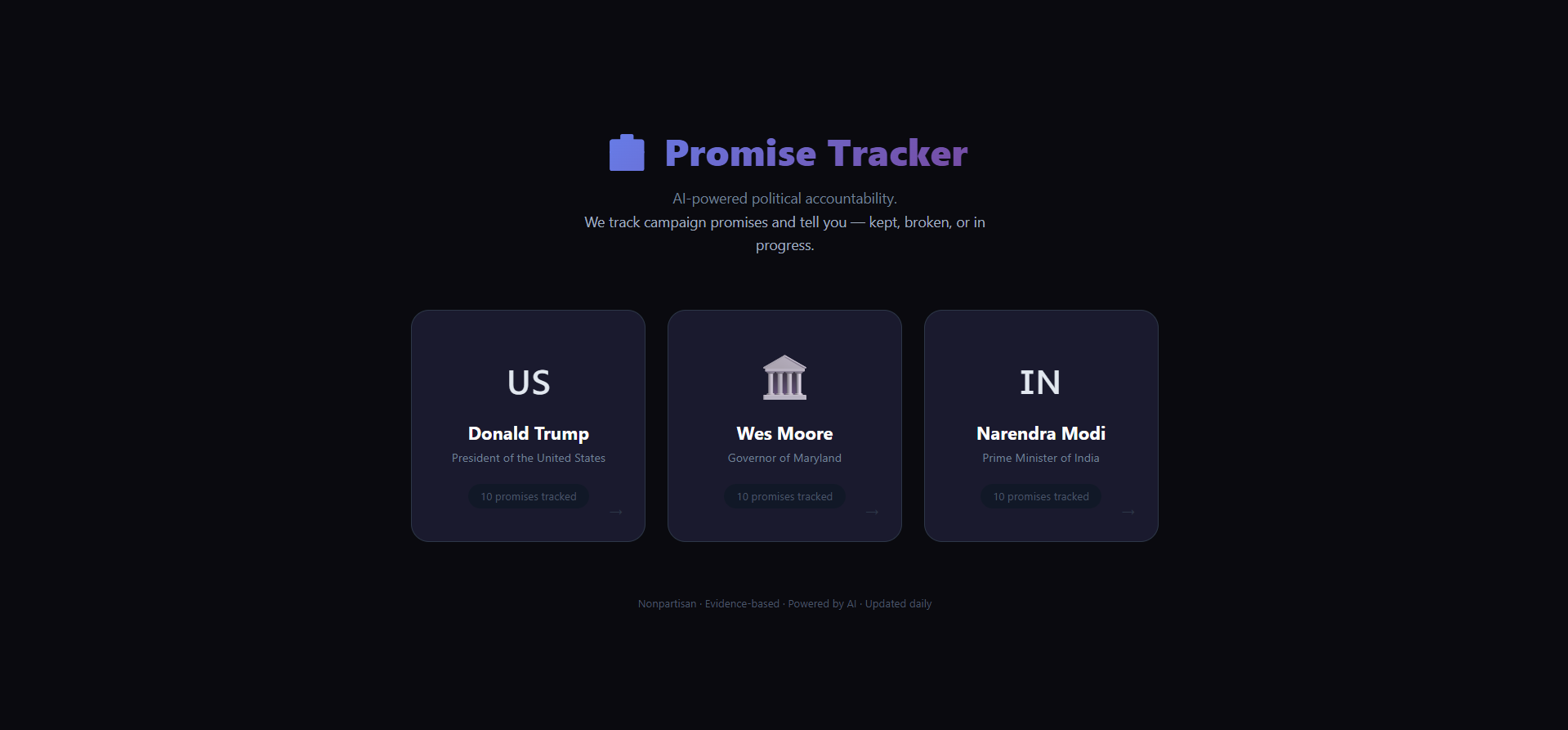
Promise Tracker scrapes real news daily from Google News, NPR, and Washington Post, then uses AI to analyze each campaign promise and return a nonpartisan verdict — kept, broken, in progress, partial, or reversed. Currently tracking Donald Trump, Maryland Governor Wes Moore, and India's PM Modi. Users can subscribe for daily email digests when statuses change.
How we built it
Each politician runs as an isolated AI agent with its own news sources and LLM context — zero cross-contamination between politicians. The pipeline is: scraper pulls news → Groq LLM reads evidence → verdict saved to SQLite → FastAPI serves it → vanilla JS frontend displays it. Built solo in under 1 and half hours.
Challenges we ran into
Getting the LLM to stay genuinely nonpartisan was harder than expected — early prompts would subtly favor one side. Also had to strip the DOM aggressively to keep token costs low, and fought with GitHub blocking my API key in commit history at the last minute.
Accomplishments that we're proud of
Built a full working product solo in one day — scraper, AI pipeline, backend, frontend, and ethical framework. The isolated agent architecture genuinely eliminates hallucination risk across politicians. And the app works — verdicts are accurate and backed by real sources.
What we learned
Prompt engineering for neutrality is a real discipline. Separating agents per context isn't just good architecture — it's an ethical decision. And shipping something real in 1.5 hours forces you to cut ruthlessly and focus on what actually matters for the demo.
What's next for Promise Tracker
Expand to more world leaders. Integrate Congress.gov API for legislative evidence. Build the full email digest with SendGrid. Add a historical timeline showing how verdicts changed over time. And open a public API so journalists and researchers can query promise data programmatically.

Log in or sign up for Devpost to join the conversation.