-
-
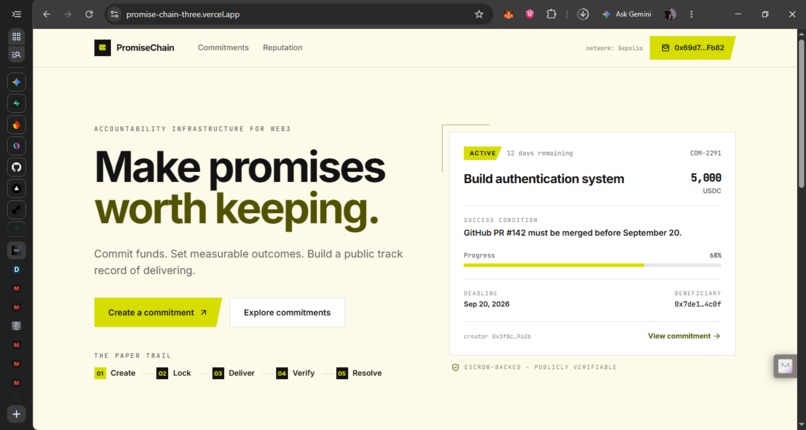
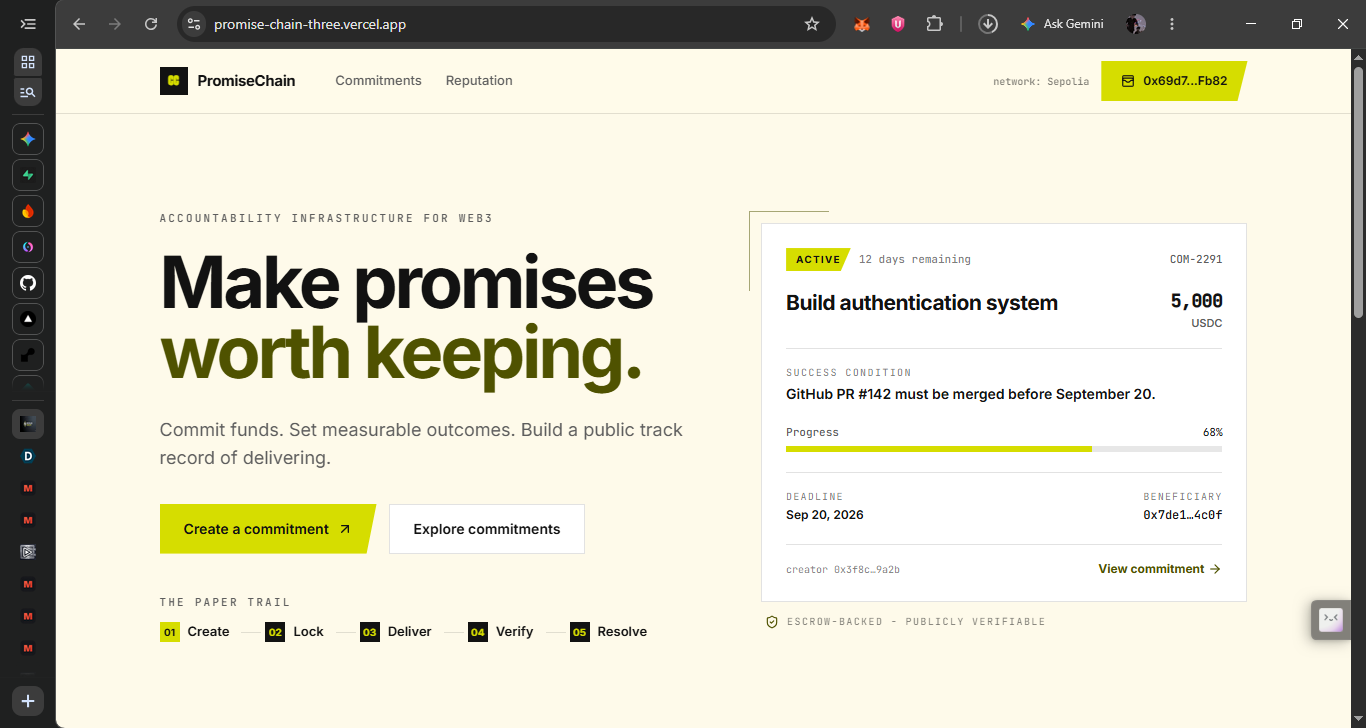
Landing page
-
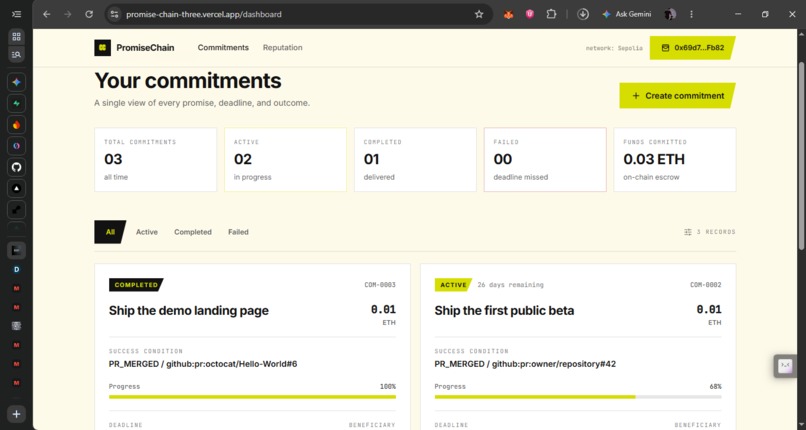
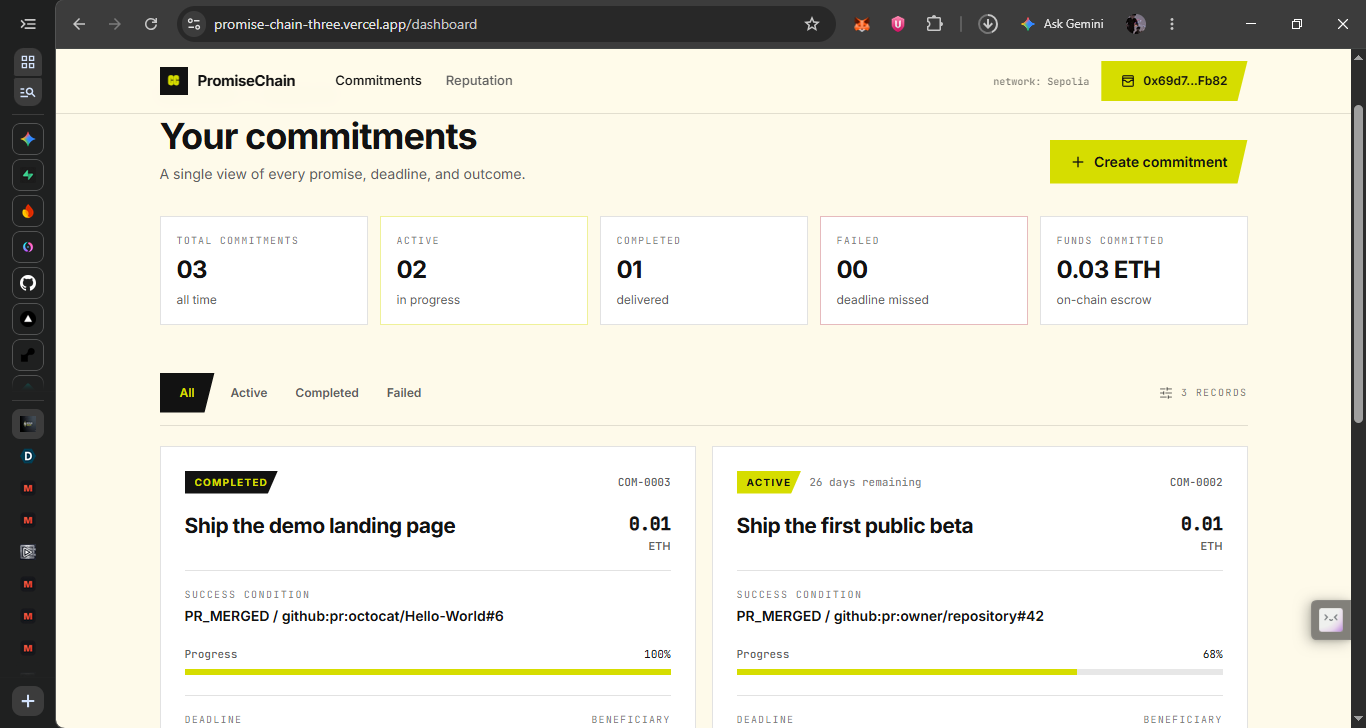
Dashboard with active commitments
-
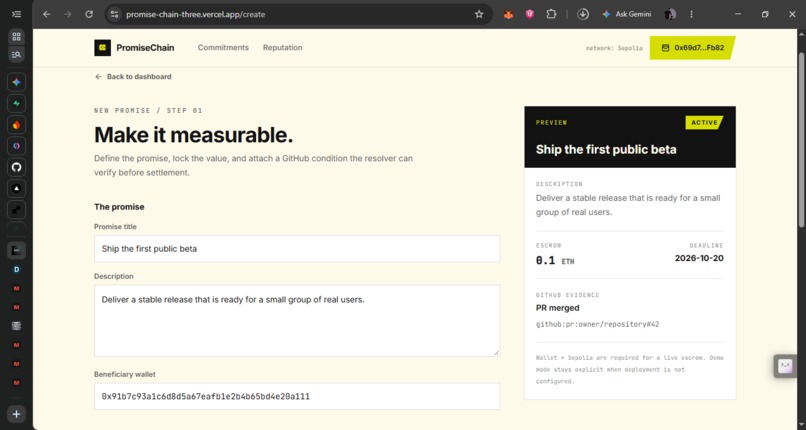
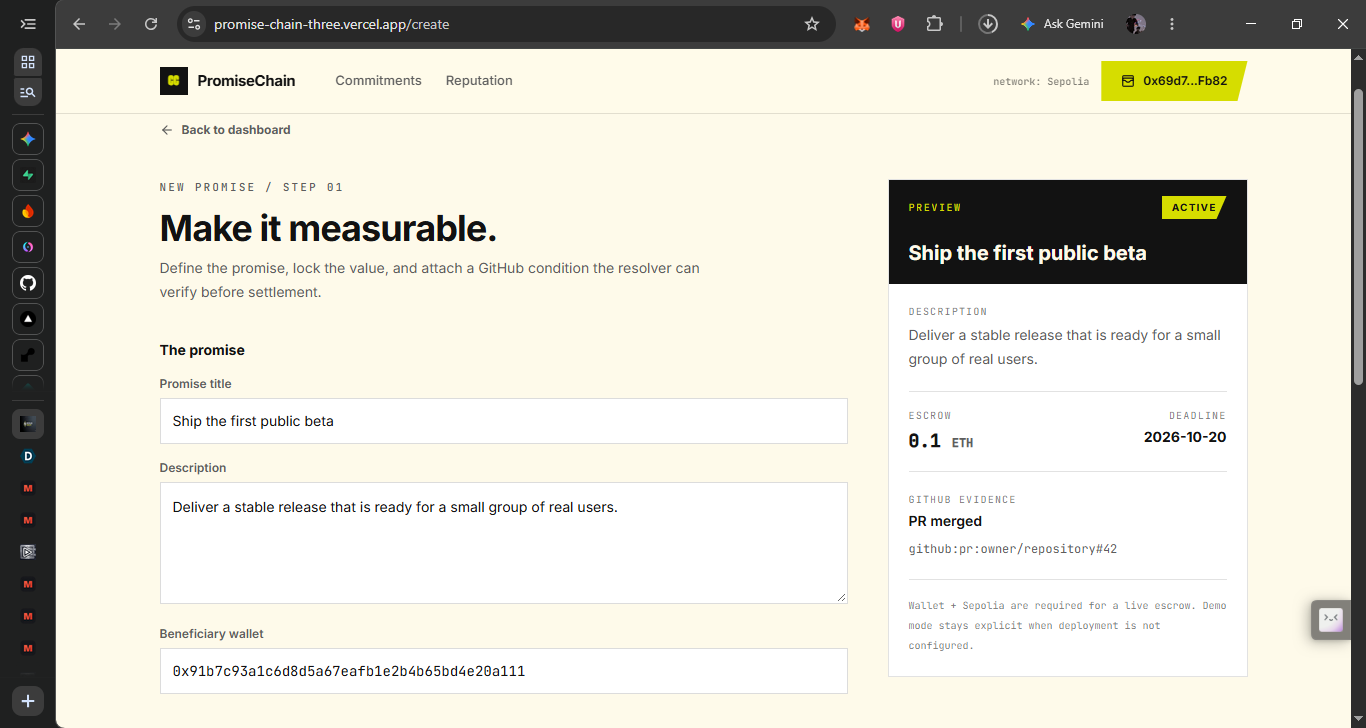
Create Commitment
-
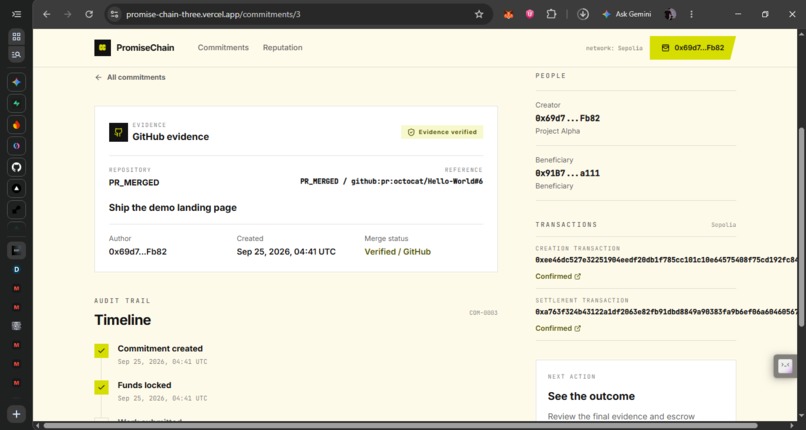
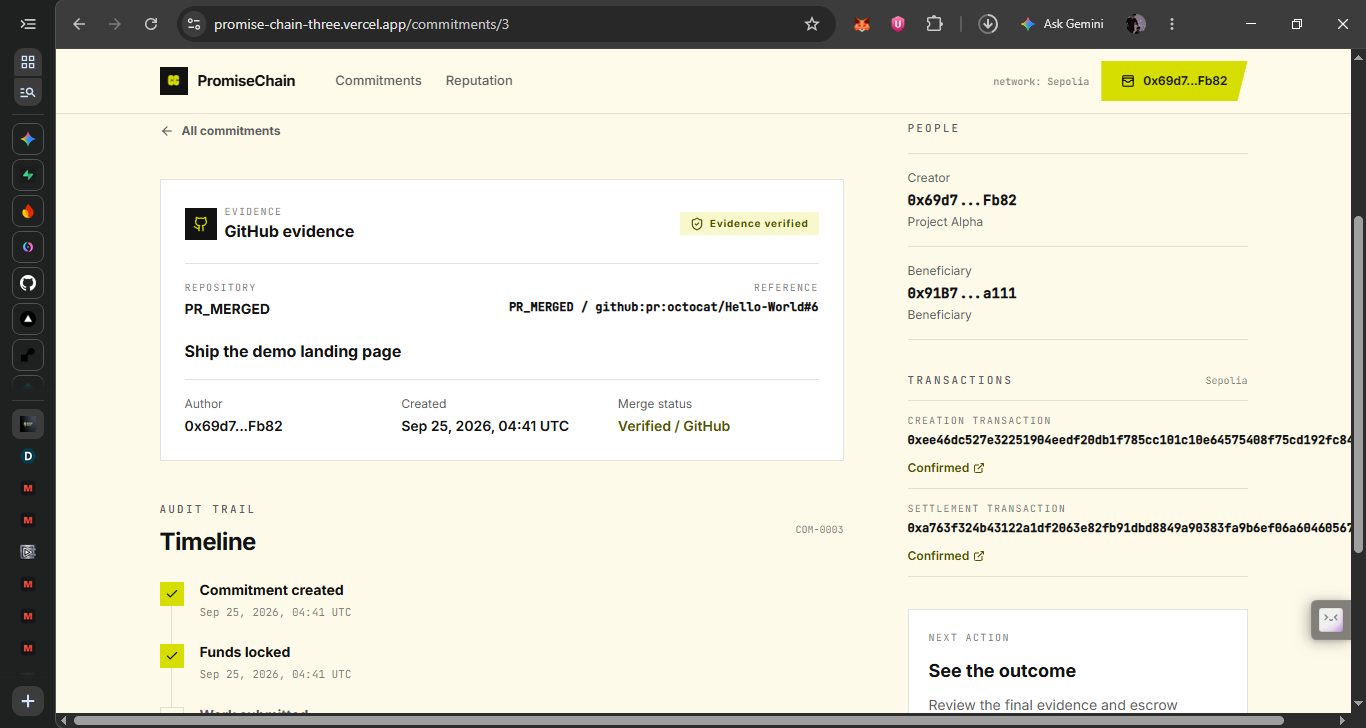
Commitment Detail with escrow information
-
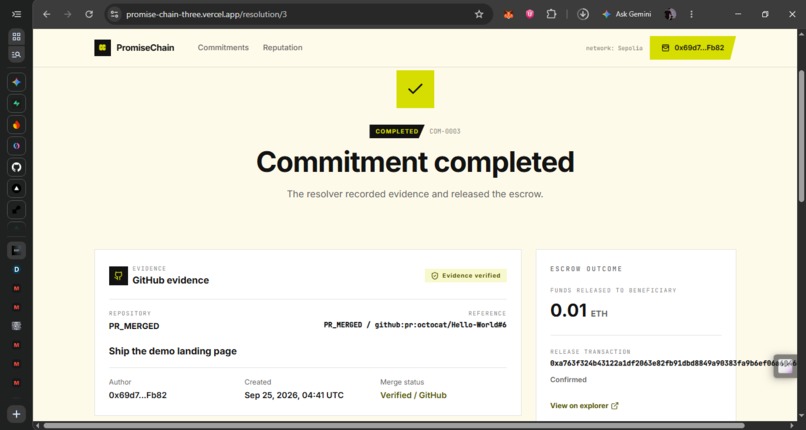
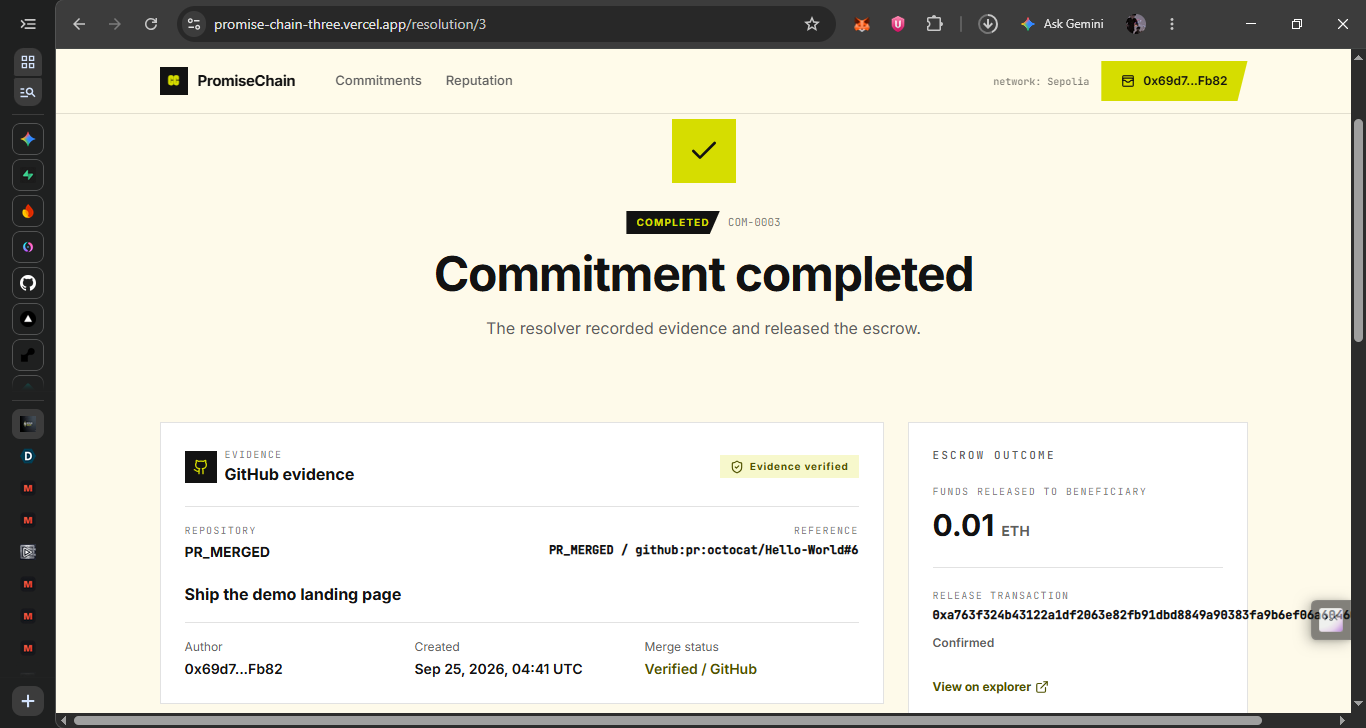
Evidence verification
The Problem
A large part of the digital economy still runs on promises. A freelancer promises to deliver. A grant recipient promises to complete a milestone. A contributor promises to ship a feature. A buyer promises to pay. When the outcome is disputed, the system often falls back to trust, manual verification, screenshots, or centralized intermediaries. The problem is making them objectively accountable. Blockchain gives us programmable escrow and transparent settlement, but simply putting a promise on-chain does not prove that the promised real-world outcome actually happened.
The Solution
PromiseChain connects on-chain financial accountability with verifiable external evidence. A user creates a commitment, specifies the expected outcome and deadline, and locks ETH in smart-contract escrow. When the commitment is completed, the user submits evidence such as a GitHub pull request, closed issue, or commit on a specified branch. PromiseChain verifies the external evidence through a server-side verification boundary. An authorized resolver then submits the evidence and resolution to the smart contract, which releases the escrow to the beneficiary or refunds the creator according to the outcome.
The core flow is:
Commit > Lock ETH > Deliver > Submit Evidence > Verify > Resolve > Release/Refund
This creates a bridge between what someone promised financially on-chain and whether there is evidence that they actually delivered.
Why Blockchain?
Blockchain is not being used simply because the project is Web3. The escrow, deadline, commitment state, and final settlement are handled by a smart contract. This gives the financial agreement a transparent and tamper-resistant source of truth instead of requiring a private database to determine who should receive the funds. External evidence remains external, because not every real-world outcome belongs on a blockchain.
What I Built
The MVP includes:
- ETH escrow on Base Sepolia
- Smart-contract commitment creation and settlement
- Deadline-based resolution
- GitHub evidence verification
- Support for pull requests, issues, and commits
- Commitment history and transaction records
- Promise Passport, a public view of a wallet's commitments and outcomes
- Promise Record, a transparent summary derived from resolved commitments
- A clean dashboard for creating, tracking, and resolving commitments
What Inspired Me
I was interested in a simple question: "What if a promise could have consequences without requiring someone to simply trust the person making it?" That led me beyond the usual Web3 pattern of putting assets on-chain and toward connecting blockchain settlement with evidence from the systems where work actually happens.
What I Learned
Building PromiseChain taught me that the hardest part of a blockchain accountability system is not writing the escrow contract. The difficult part is defining the boundary between on-chain truth and external truth. A blockchain can prove that funds were locked and that a contract reached a particular state. It cannot inherently know whether a GitHub pull request was genuinely merged or whether an external milestone was completed. That distinction shaped the architecture. PromiseChain keeps financial state on-chain while using an explicit verification boundary for external evidence.
Challenges
One of my biggest challenges was avoiding the temptation to make the system appear more decentralized than it currently is. The MVP uses an authorized resolver to bridge verified external evidence into the smart contract. This makes the system practical and demonstrable while leaving a clear path toward a future optimistic verification or oracle/dispute mechanism. I also had to ensure that successful settlement was never incorrectly presented as proof that external evidence had been verified. Keeping those two concepts separate became an important part of the final architecture.
Future Scope
PromiseChain can eventually expand beyond GitHub-based software commitments into grants, freelance work, bounties, procurement, DAO milestones, and other situations where a financial commitment depends on an objectively verifiable outcome. Future versions could introduce decentralized verification, optimistic disputes, multiple evidence providers, richer oracle infrastructure, and additional blockchain networks. For now, the MVP focuses on proving the core idea: financial commitments can be programmable, while real-world evidence can remain verifiable at the boundary.
Built With
- api
- applications
- base
- blockchain
- contracts
- decentralized
- escrow
- ethereum
- github
- hardhat
- openzeppelin
- react
- security
- sepolia
- smart
- solidity
- start
- tanstack
- typescript
- viem
- wagmi
- web3

Log in or sign up for Devpost to join the conversation.