-
-
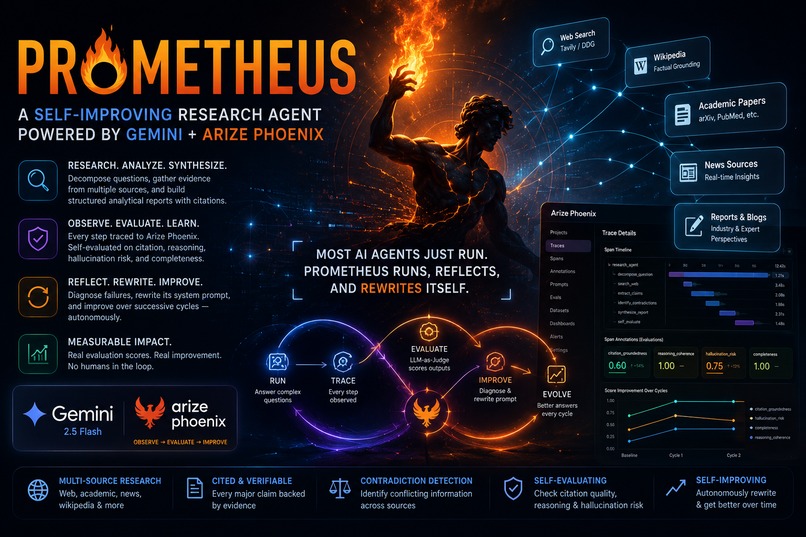
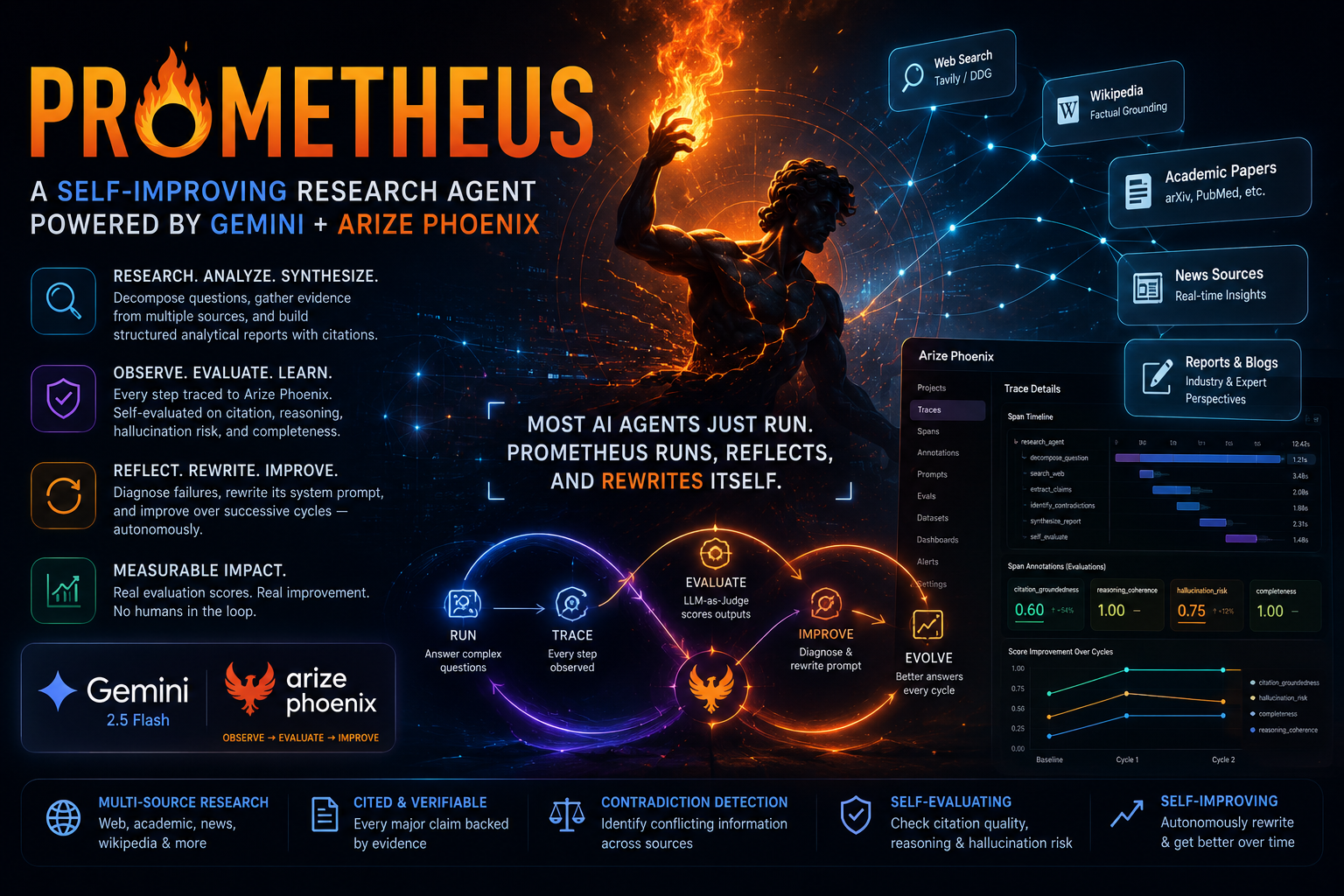
Prometheus: a self-improving AI research agent using Gemini + Phoenix to trace, evaluate, and improve its own reasoning.
Inspiration
Developers and tech leads spend hours making architecture decisions — reading 10 conflicting blog posts, unsure which benchmarks are real and which are sponsored content. The information exists, but synthesizing it into a trustworthy, cited, structured brief takes hours of human work.
We wanted to build an agent that does that synthesis — and then gets measurably better at it over time, autonomously. Not an agent that runs — an agent that learns from running. The name Prometheus came naturally: in Greek mythology, the titan who stole fire from the gods and gave it to humans. We're giving the agent the ability to improve itself — something previously reserved for its human operators.
Most AI agents are black boxes. When they fail — hallucinate a statistic, drop a citation, reason in circles — there's no record of why, and no mechanism to fix it without a human intervening. The feedback loop is broken by design. Prometheus fixes that.
What it does
Prometheus is a multi-step research and synthesis agent powered by Gemini 2.5 Flash and Google ADK. Ask it a hard, multi-part question. It works through six structured stages automatically:
- Decompose — breaks the question into focused sub-problems
- Search — runs independent web searches per sub-problem (Tavily → DuckDuckGo fallback, both free)
- Extract — pulls structured claims from sources, classifies them by type (statistic, assertion, hedged), flags ones needing verification
- Contradict — identifies conflicting information across sources and flags severity
- Synthesize — produces a structured report: Executive Summary, Key Findings, Evidence & Citations, Conflicting Views, Confidence Assessment, Open Questions
- Self-evaluate — assesses citation coverage before finalizing, flags unsupported claims
Every span of every run is traced to Arize Phoenix via OpenInference — zero manual instrumentation code. Every response is scored by an LLM-as-Judge eval pipeline. After each batch, a second improvement agent reads its own traces via the Phoenix MCP server, diagnoses failure patterns, rewrites the system prompt, and saves the new version back to Phoenix — autonomously, without human intervention.
The next run uses the improved prompt. The scores go up. The loop repeats.
How we built it
Agent runtime: Google ADK with InMemoryRunner. The research agent
has five tools, all registered as FunctionTool (not ADK built-ins —
mixing built-in google_search with FunctionTool causes a hard SDK
incompatibility we discovered and worked around):
search_web()— Tavily primary, DuckDuckGo fallback, no paid API requiredsearch_wikipedia()— free factual grounding via Wikipedia REST APIextract_key_claims()— classifies claims by type, flags ones needing verificationidentify_contradictions()— compares claims across sources, flags numeric disagreements >25%assess_citation_quality()— reviews draft report before output, flags unsupported claims
Tracing: openinference-instrumentation-google-adk with
auto_instrument=True via phoenix.otel.register. Every LLM call, tool
call, and agent decision becomes a span in Phoenix Cloud automatically.
Each research query produces 6–8 nested spans.
Evals: Custom LLM-as-Judge pipeline using google-genai directly
(the arize-phoenix-evals high-level API had compatibility gaps with our
version). Four evaluators: citation_groundedness, reasoning_coherence,
hallucination_risk, completeness. Scores logged back to Phoenix as
span annotations via client.spans.add_span_annotation() using
annotation_name= (not name= — a parameter mismatch we debugged from
the Phoenix source).
Self-improvement loop: A second ADK agent uses @arizeai/phoenix-mcp
as its tool layer, calling list-traces, get-spans,
get-prompt-version, and upsert-prompt at runtime. It reads real
operational data from Phoenix, diagnoses failure patterns with specific
examples from actual traces, rewrites the system prompt, and saves a
versioned prompt to the Phoenix Prompts registry. Change logs are saved
per cycle and are auditable.
Deployment: Streamlit web UI deployed on Google Cloud Run via
gcloud run deploy --source. All keys passed as Cloud Run environment
variables — no secrets in the container.
Stack: Google ADK · Gemini 2.5 Flash · Vertex


Log in or sign up for Devpost to join the conversation.