-
-
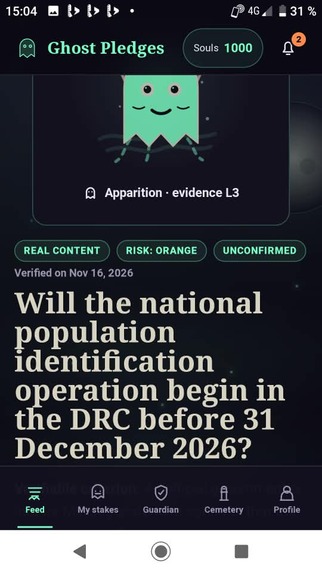
Open pledge
-
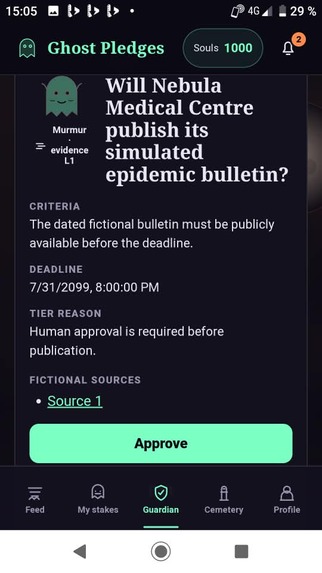
Guardian
-
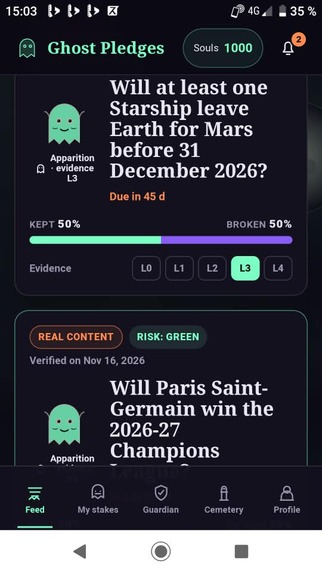
Fil
-
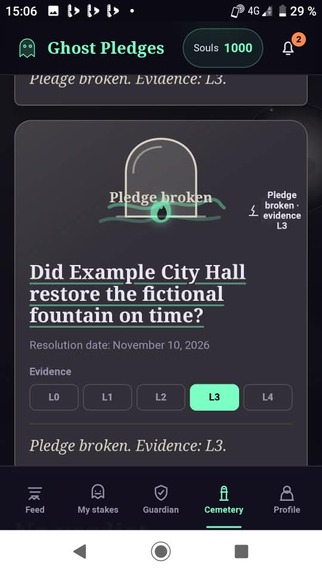
Cemetery
Inspiration
Public promises vanish from the timeline. A minister announces a date, a famous founder announces a launch window, a club is "the favourite", and months later nobody checks. I live in Bunia, in eastern DR Congo, where information is expensive and trust is fragile. I wanted a place that remembers what was promised, shows who said it and where, and lets people say whether they believe it, without any money involved.
What it does
Every verifiable public promise becomes a ghost. The ghost is the state of the promise:
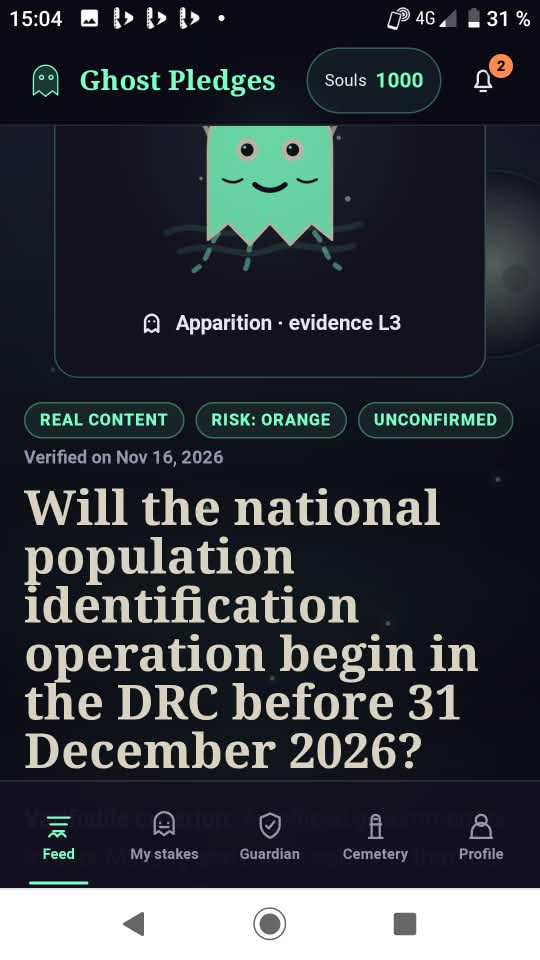
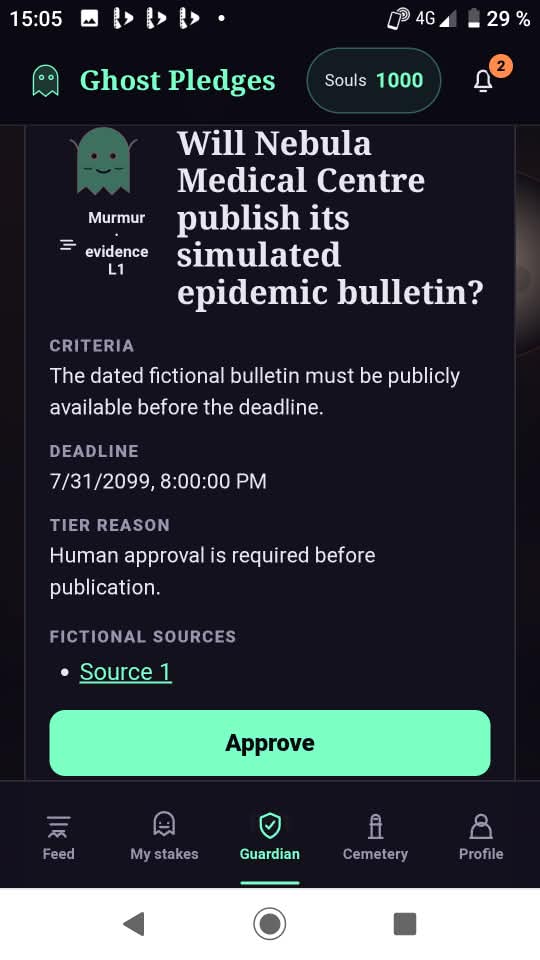
- A faint Murmur waits for approval, an Apparition accepts opinions, a Haunting is close to its deadline.
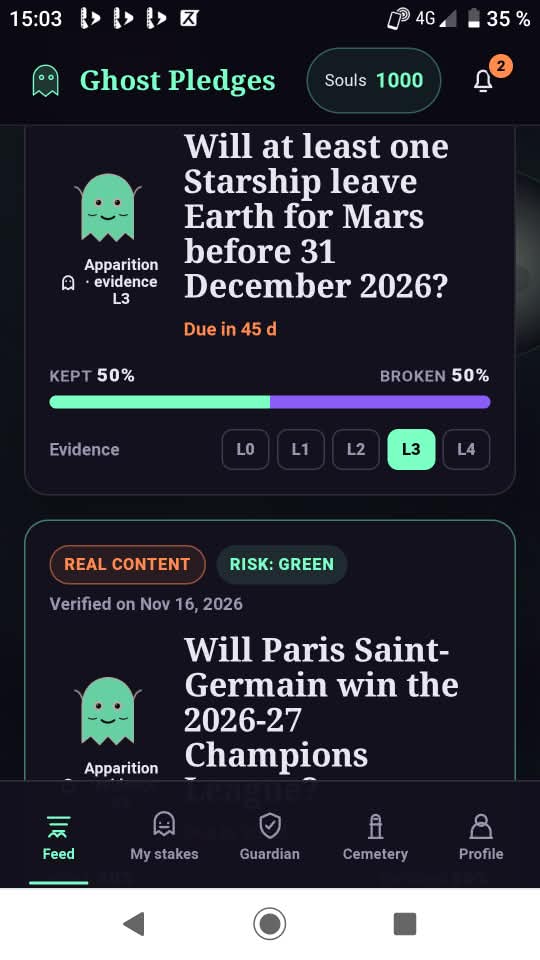
- Ghost opacity shows the evidence level, from L0 (rumour) to L4 (official or primary data). Chains hold the ghost while evidence is missing and break when it grows.
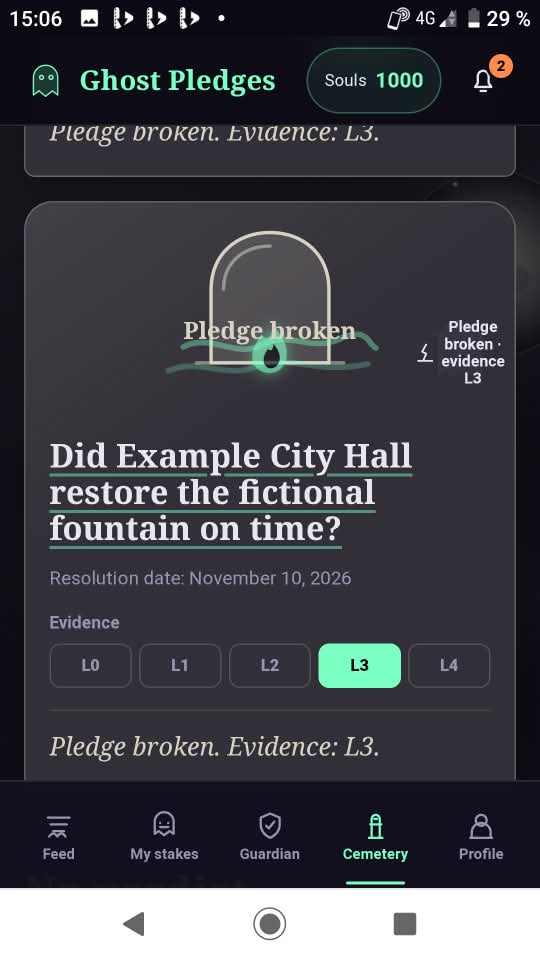
- When a promise is kept, the ghost turns solid in a burst of golden petals. When it is broken, it falls to embers and a gravestone rises from the mist.
- Players stake virtual Souls on KEPT or BROKEN. Souls have no monetary value and cannot be bought or withdrawn. A free one-tap poll lets anyone give an opinion without Souls.
- Each pledge page shows a short summary, a sourced timeline, both sides without taking one, and "what others estimate" (for example market and model forecasts for the Champions League) as read-only references.
- The feed mixes real content verified on 16 Nov 2026 (Champions League contenders, DR Congo public-policy announcements and a current controversy, a celebrity space-launch promise), live football fixtures, and clearly labelled fictional scenarios.
- An AI crew splits the work: Scout finds candidates, Drafter writes the question and criteria, Guardian classifies GREEN / ORANGE / RED / BLOCKED, three Verifiers cross-check outcomes, and a Gravekeeper records corrections.
- Signature feature, the Cemetery of AI Mistakes: when a human corrects an AI resolution, the app keeps the original claim, the correction, the reason and the date on a tombstone.
- Bilingual (French / English), installable as a PWA, built for slow phones (data-saver mode, reduced motion, 79 KB gzipped first load), with optional synthesized sound that is off by default.
How I built it with Kiro
Kiro was the main builder. I wrote the product rules as steering files and a spec (requirements, design, tasks), then Kiro implemented them task by task.
- Specs: requirements R1-R12, a design with seven correctness properties, and 17 tasks.
- Steering: product, tech, design and language files that Kiro followed on every task (the ghost must carry information, Souls are virtual, quotes are never invented, nothing resolves below evidence level 3).
- Property-based tests with fast-check: payout conservation, monotonic payouts, winner protection, no result below L3, terminal lifecycle states, nothing published without criteria, deadline and source, and a model can never lower a rule-based safety tier. In total 118 tests in 24 files.
- Agent hooks: a fictional-data guard, a secrets review before commit, tests on engine save, and a session-notes update when the agent stops.
- Real production fixes: Kiro implemented the fixes for problems found during verification: Node ESM imports in Vercel functions, a wrong season folder in a public dataset, TypeScript narrowing errors, a stale bundle budget, and a changed model name in a text-analysis API.
Transparency. The planning drafts of the spec and steering, and the independent checks I ran on the pushed repository after each step (tests, type-check, production build), were done with Claude. Kiro implemented, tested and corrected the application. Gemini is only a runtime feature inside the deployed app and its output is treated as untrusted.
Challenges I ran into
- Deciding what the system must refuse to claim: no invented quotes, no money, no resolution on a single source.
- Real data is messy: one public football dataset was stale and had placeholder scores, so the app never trusts a single source.
- Building with intermittent electricity and, for much of the time, a phone-only workflow. Kiro's session notes let me resume after every power cut.
Accomplishments that I'm proud of
- A haunted interface where every effect carries information.
- Payouts that never create or lose a single Soul (property-tested).
- An AI that admits its mistakes in public.
- Real, sourced content instead of only demo data.
What I learned
Safety rules written as steering and tested as properties are far stronger than rules written in a prompt. Saying clearly which tool did what makes the work more credible, not less.
What's next
Connect the prepared Supabase schema for accounts and shared polls, add more allowlisted public sources, a human review team for sensitive pledges, and more languages (Lingala, Swahili).
Known limits
- Live political extraction sometimes returns nothing (an empty result is safer than an invented quote).
- State is stored on the device; the Supabase schema is prepared but not connected in this build.
- Fictional demo scenarios are labelled "Fictional scenario" and use example.org sources.
