-
-
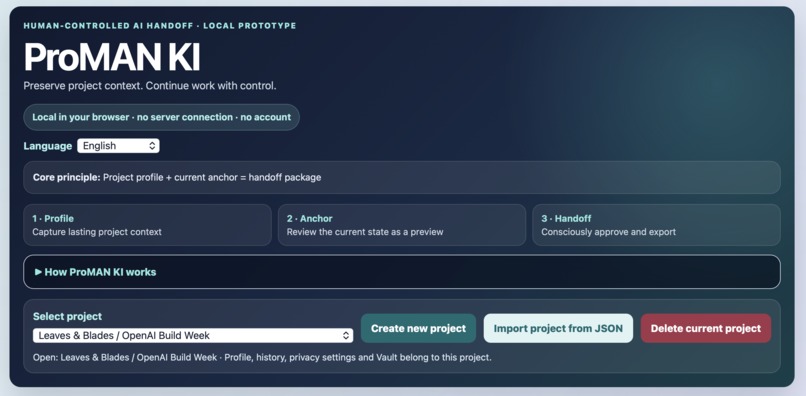
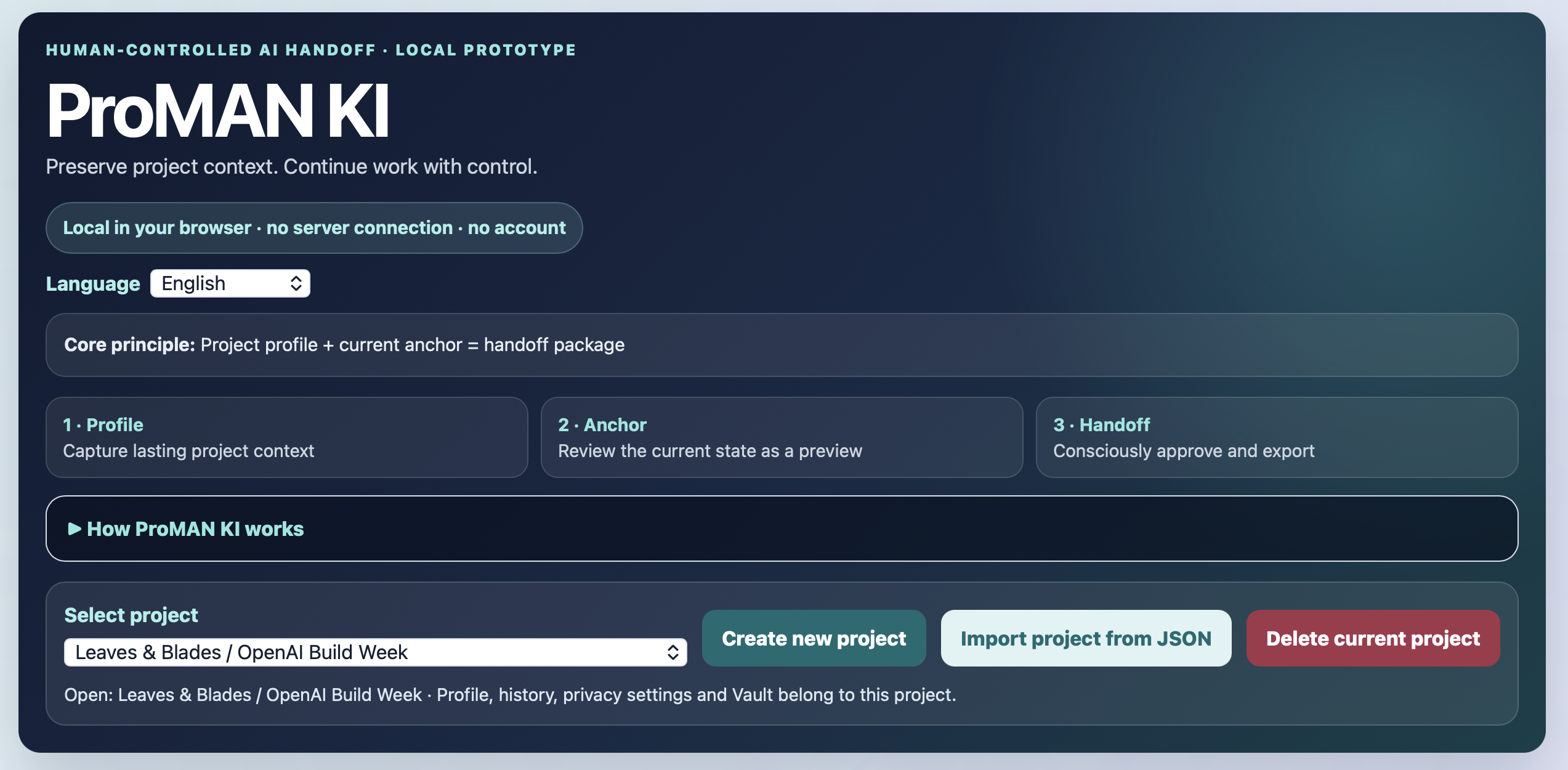
Overview: Local, multilingual workspace for structured, human-controlled AI project handoffs.
-
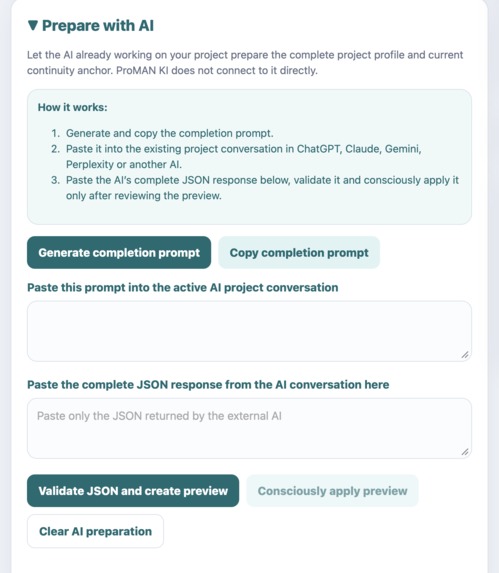
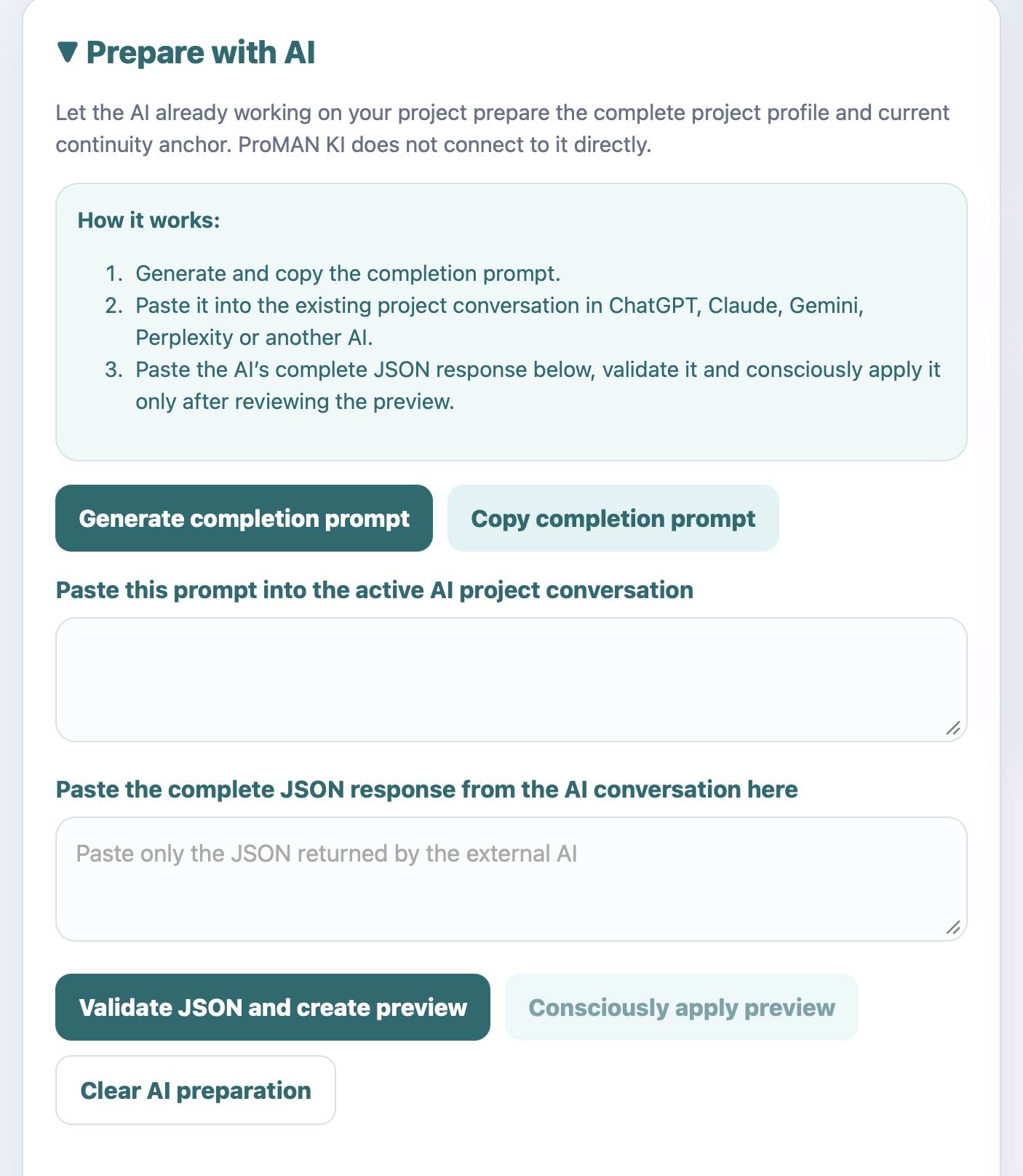
Prepare with AI: Generate a prompt, validate the AI’s JSON response, review it, and apply it consciously.
-
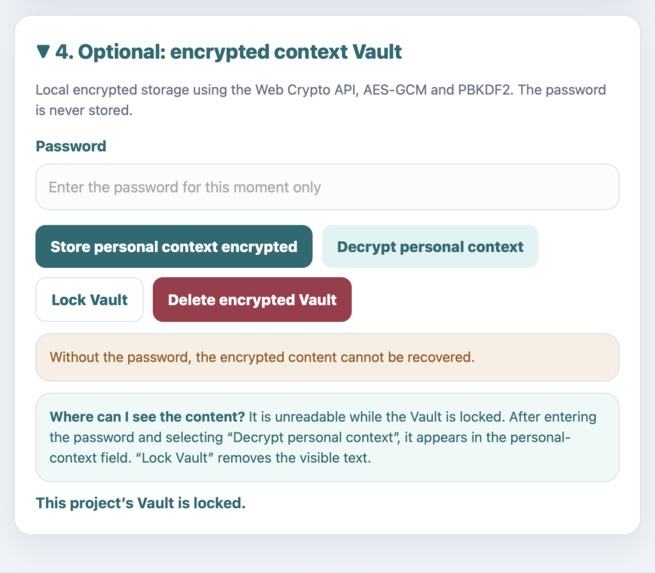
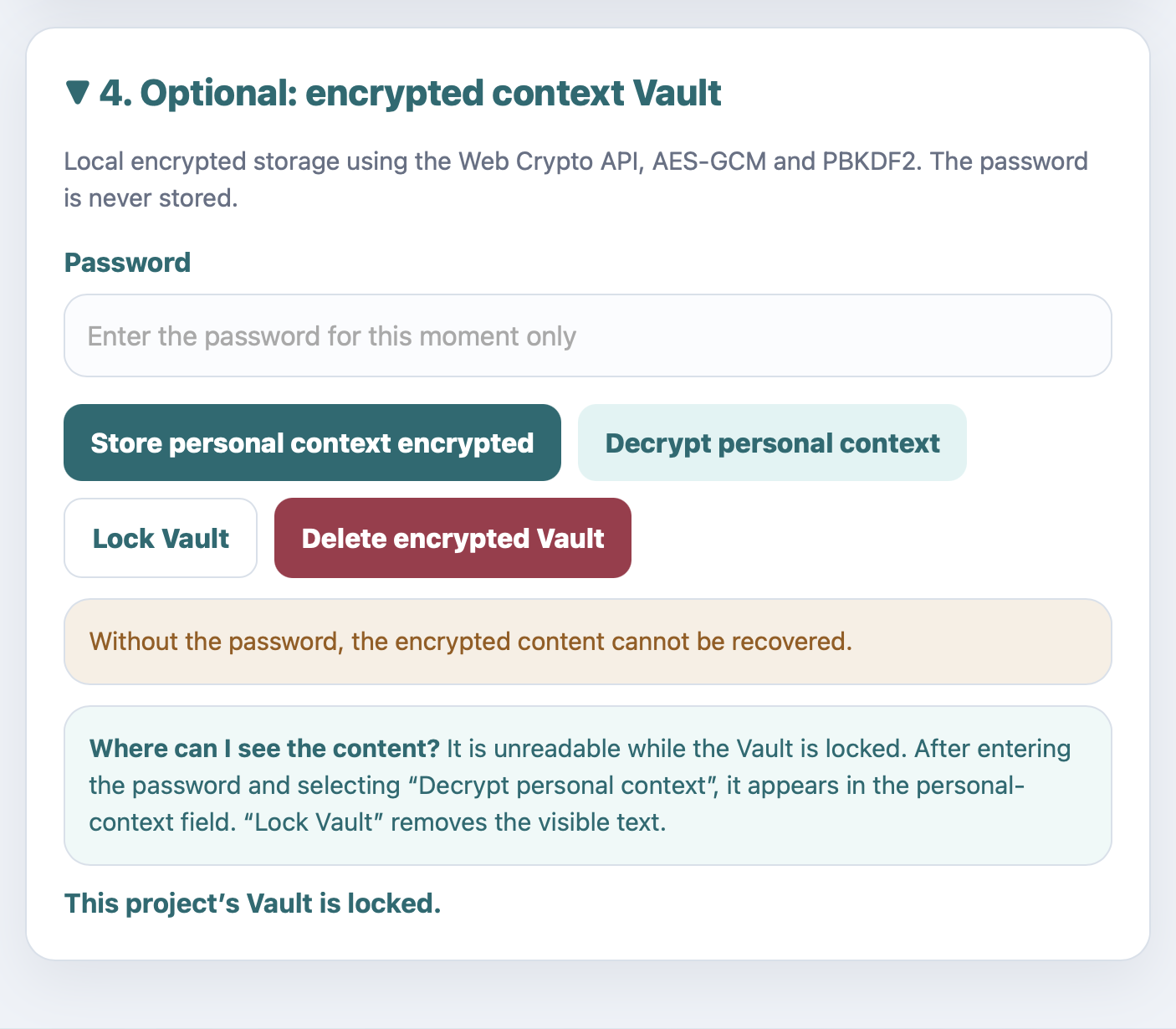
Encrypted Vault: Protect sensitive project context locally with encryption. Passwords are never stored.
-
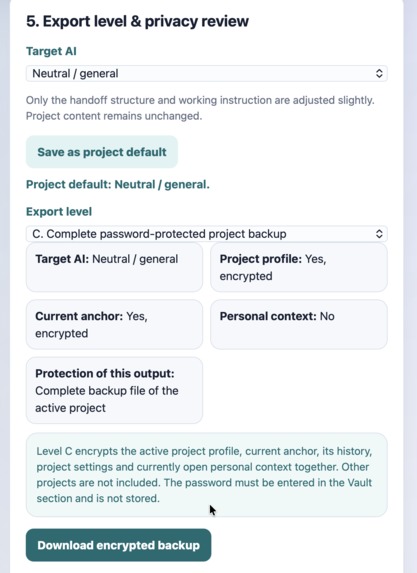
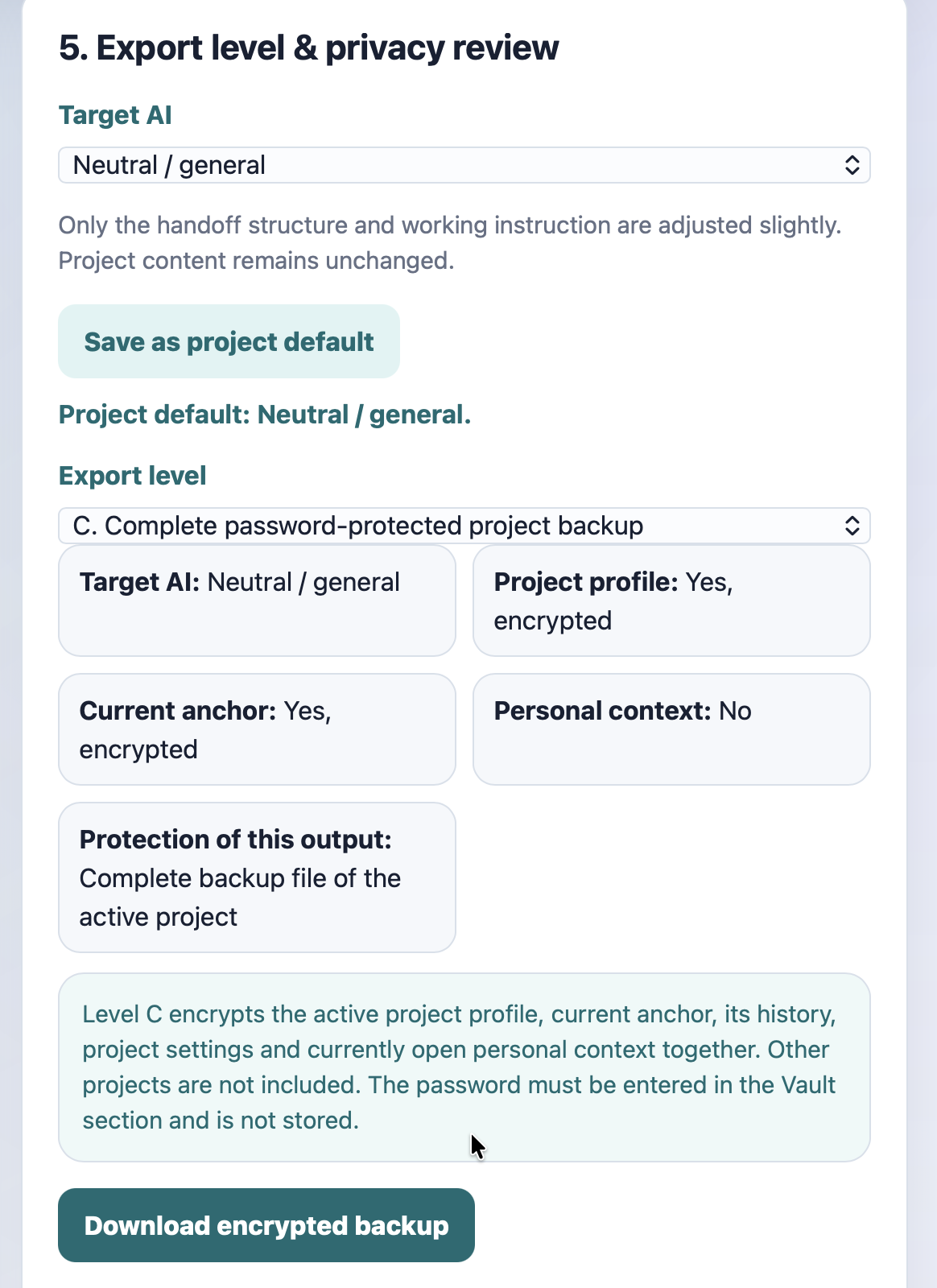
Privacy Review: Review the target AI, export level, included data, and protection status before sharing.
Inspiration
What it does
How we built it
Challenges we ran into
Accomplishments that we're proud of
What we learned
What's next for ProMAN KI – Continuity Anchor
Inspiration Long-running AI-supported projects often lose continuity for reasons that have little to do with model quality. Chats become too long, usage limits interrupt the work, files and decisions get scattered, and switching to another AI system often means explaining everything again from the beginning. I experienced that directly while developing a complex real-world social project with several AI tools. Important decisions, privacy boundaries, unfinished tasks, and instructions about what must not be changed were difficult to preserve reliably. The problem was also personal. In recent years, I have experienced profound loss, had to rebuild important parts of my life, and am currently learning many things again while working my way back into active professional and creative life. I did not begin this project with a traditional software-development background. I came with lived experience, a strong social vision, practical project knowledge, and determination to keep learning. My original social project continues to generate new ideas around education, inclusion, documentation, human dignity, practical support, and responsible technology. ProMAN KI emerged from the need to protect that work and keep it usable across interrupted chats, changing tools, and different AI systems. I also built it because I want meaningful ideas to be seen. I want the chance to prove what I can contribute when product experience, social purpose, technical curiosity, and effective AI collaboration come together. What it does ProMAN KI is not another AI assistant. It is a neutral, human-controlled continuity layer between a person, a project, and different AI systems. Each project has its own stable profile, continuity-anchor history, rules, privacy settings, personal-context Vault, target-AI profile, and import/export flow. A Continuity Anchor records the current work state, completed work, next steps, blockers, decisions, relevant files, and project-related notes. ProMAN KI combines the stable project profile and the current anchor into a portable handoff package available as a human-readable resume prompt, Markdown, structured JSON, a searchable local history entry, or an optional password-encrypted project backup. Users can prepare handoffs for neutral systems, ChatGPT/GPT, Codex, Claude, Gemini, or Perplexity. ProMAN KI does not connect directly to any of them and does not rewrite user content. The target-AI profiles adjust only the structure and working guidance of the handoff; confirmed project content remains unchanged. Human control and privacy Before approval, the app checks whether the handoff contains a clear goal, current state, next step, decisions, risks, and suitable privacy settings. Warnings help the user, but they never replace a conscious decision. Personal project context stays separate from ordinary project data. It is included only after explicit approval. It is removed from unencrypted anchor history and can be stored locally in an AES-GCM encrypted Vault. The complete active-project backup can also be encrypted before download, and passwords are never stored. Project imports are reviewable and do not silently overwrite existing projects. A project import creates a separate project, while anchor imports can be viewed, added to history, or consciously loaded into the current project. The central principle is simple: The AI may assist, but the human decides what becomes confirmed project context. How I built it I began with the product idea, a continuity specification, a resume-prompt template, and an early single-project prototype. During OpenAI Build Week, I used Codex and GPT-5.6 through many iterative cycles to turn that starting point into a working multi-project application. I made the product, privacy, workflow, and scope decisions. Codex accelerated implementation, debugging, refactoring, consistency checks, and browser-based testing. GPT-5.6 supported product reasoning, wording, prioritization, and the definition of the continuity model. The submitted application includes locally separated projects, migration of previous local data, project-specific history with search, filters, tags, and favorites, target-AI profiles, safe project and anchor import, reviewable AI-assisted preparation through prompt and JSON, German and English interfaces, handoff-quality and privacy review, encrypted Vault and project backup, and a neutral one-click example for judges. The application remains a single HTML file using semantic HTML, responsive CSS, Vanilla JavaScript, localStorage , and the Web Crypto API. It has no framework, cloud backend, account system, telemetry, or external runtime dependency. Challenges and learning The hardest challenge was adding substantial functionality without turning the prototype into an unstable or confusing system. Other challenges included migrating previous data without silently deleting it, preventing data from different projects from mixing, separating personal context from ordinary UI state and history, making encrypted backups understandable to non-technical users, supporting imports without silently overwriting existing projects, keeping the interface usable in both German and English, and preserving human approval while still offering useful automation. The project had to remain useful to ordinary people, not only understandable to developers. The main lesson is simple: the important part is not that an AI remembers everything. The important part is that the human controls what becomes the confirmed project state. Continuity should be readable, portable, reviewable, privacy-aware, independent of a specific model, and consciously approved by the user. What is next The next stages could include version comparison between anchors, richer project organization, additional handoff profiles, optional mind-map exports, improved accessibility testing, carefully designed integrations, and structured reference testing across completely context-free AI systems. The long-term vision is to make project continuity portable across AI systems without making users dependent on one specific model, platform, or cloud service. ProMAN KI is intended to remain a neutral mediation layer rather than another closed AI ecosystem. The core principle will remain unchanged: The human remains the owner of the project context and consciously decides what is handed to which AI system.


Log in or sign up for Devpost to join the conversation.