-
-
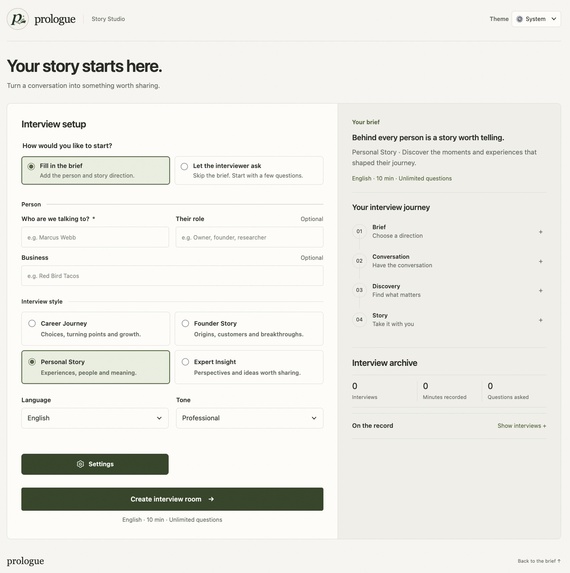
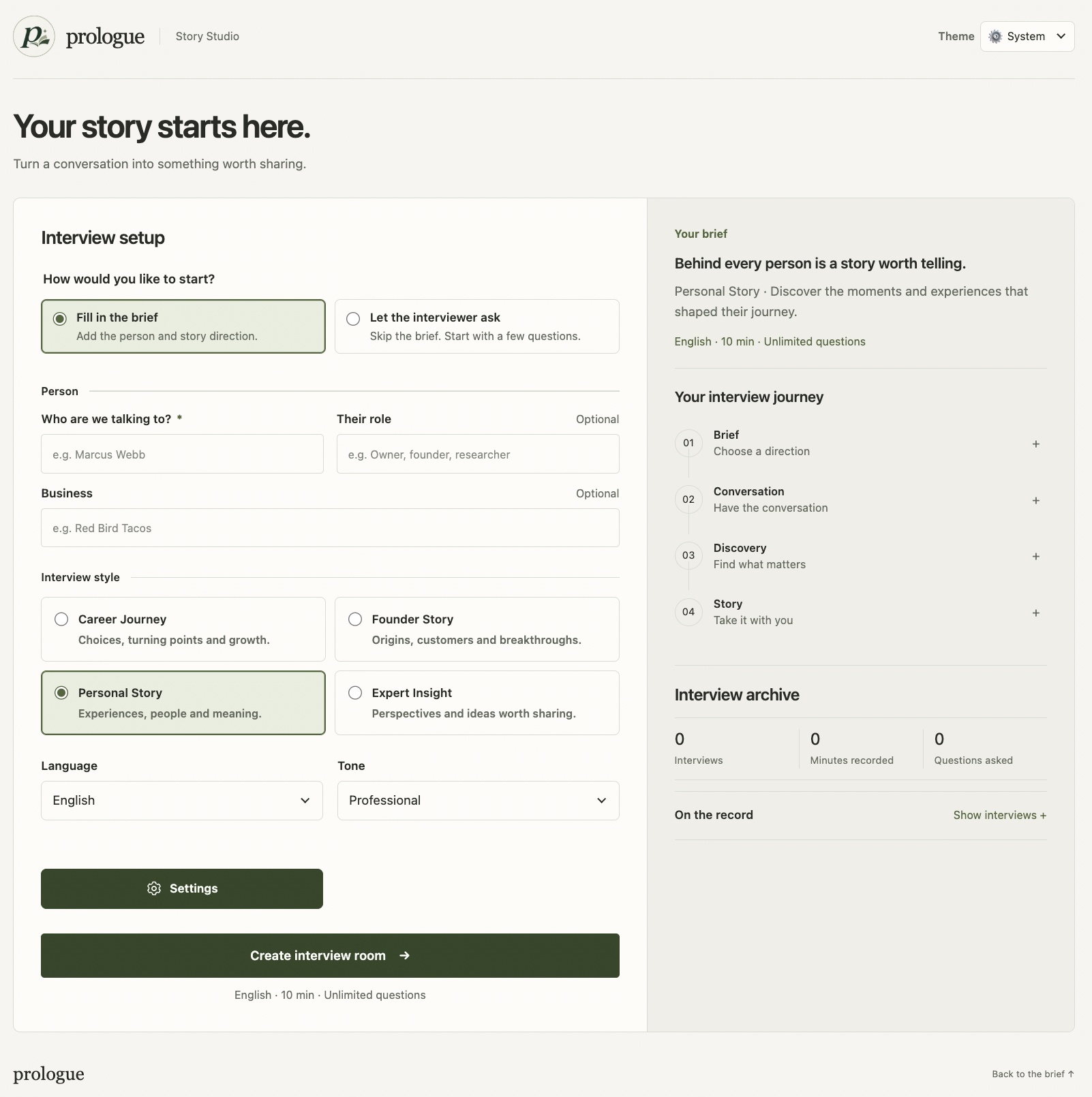
Interview Setup
-
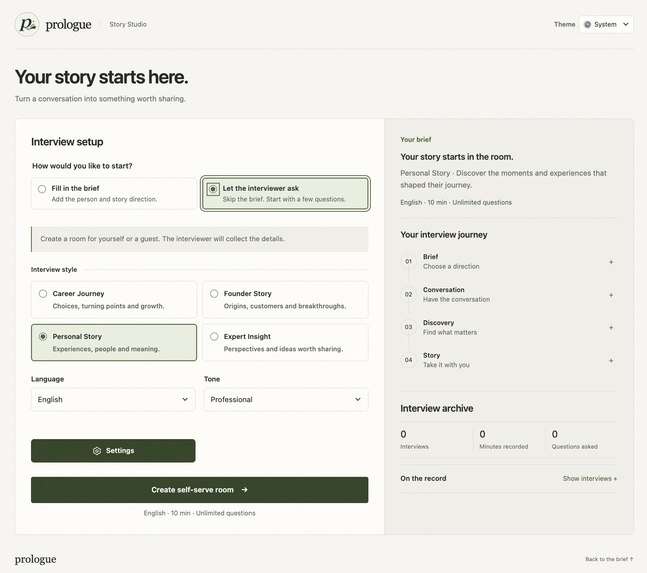
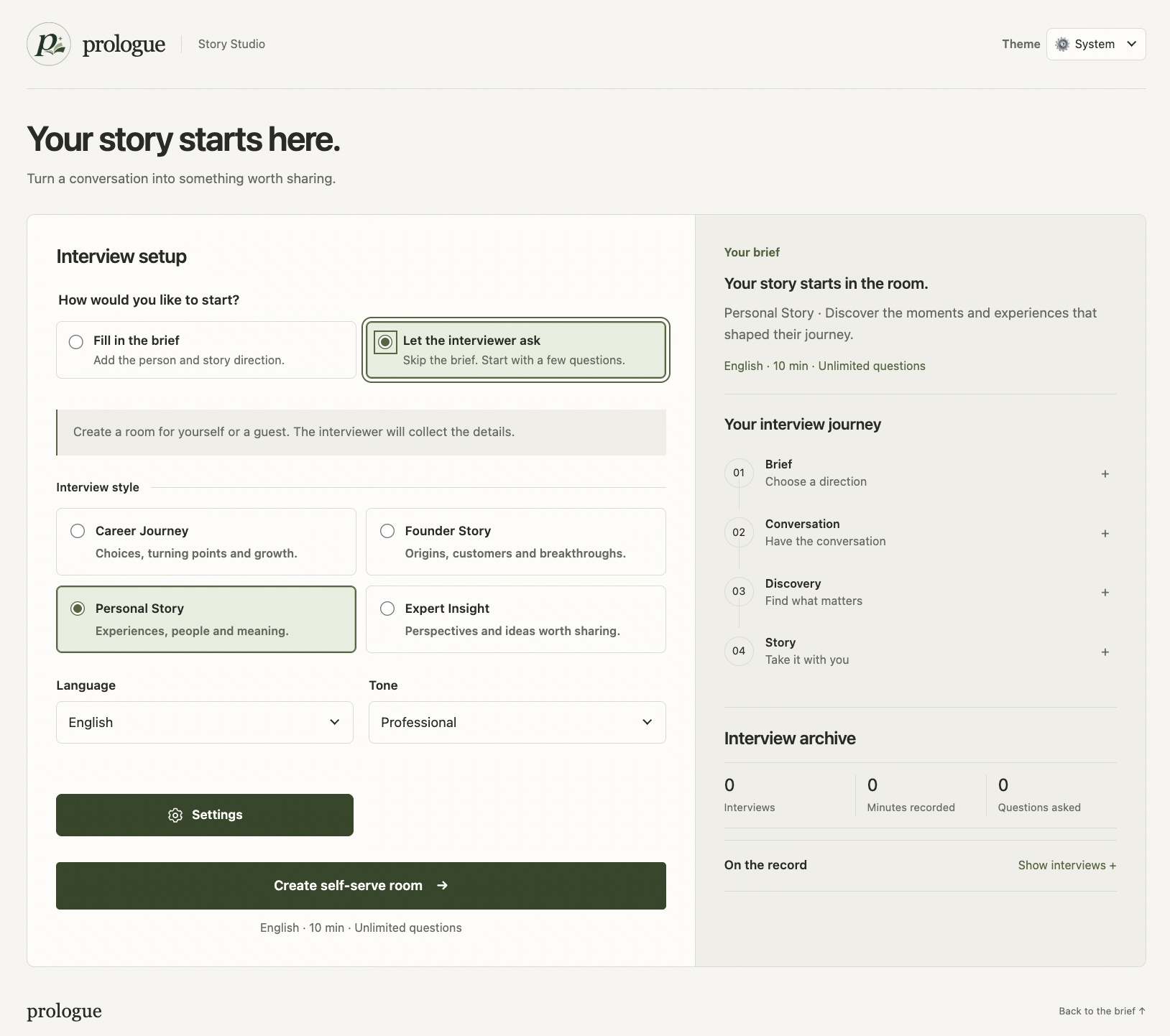
Self- Serve Setup
-
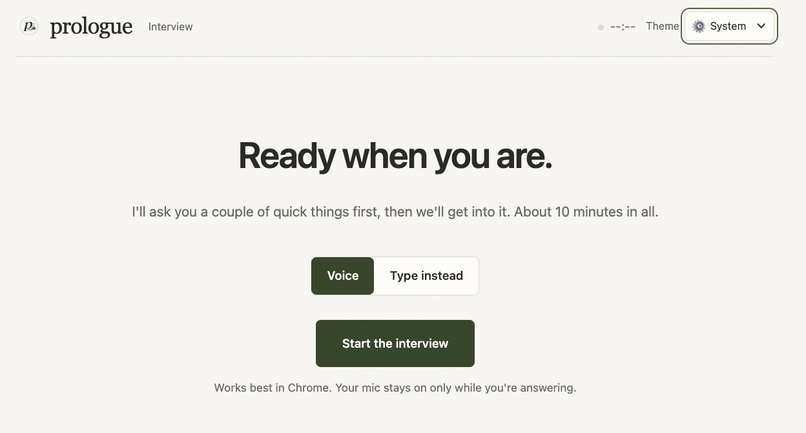
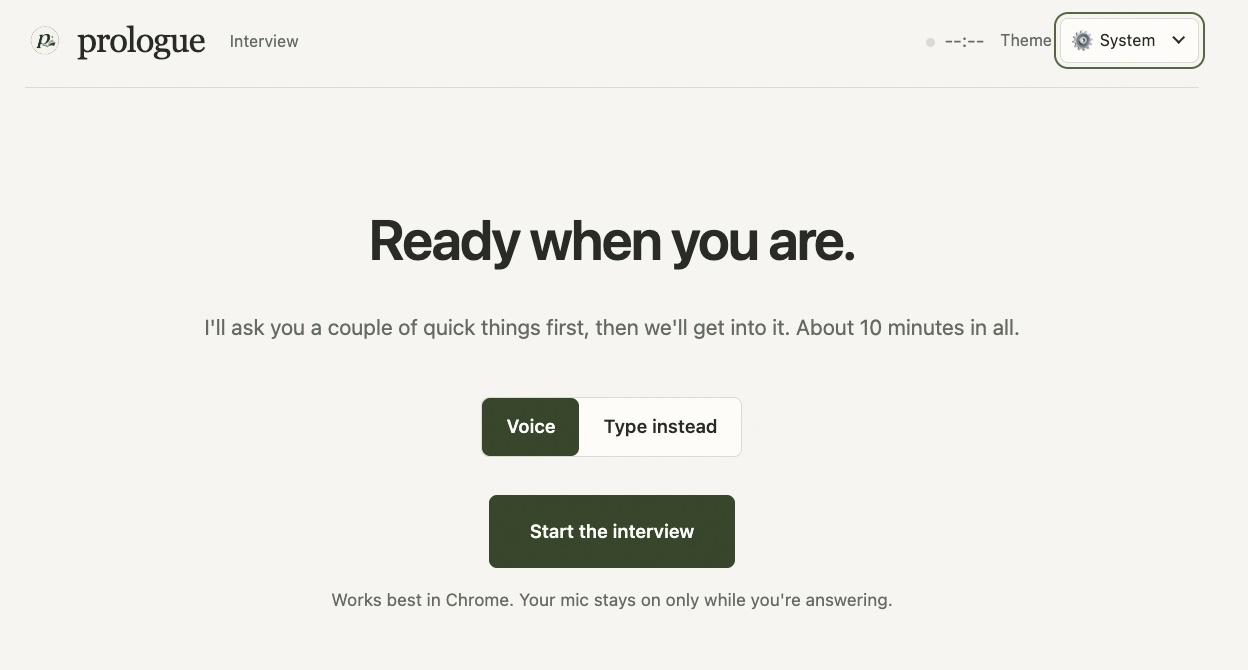
Interview start
-
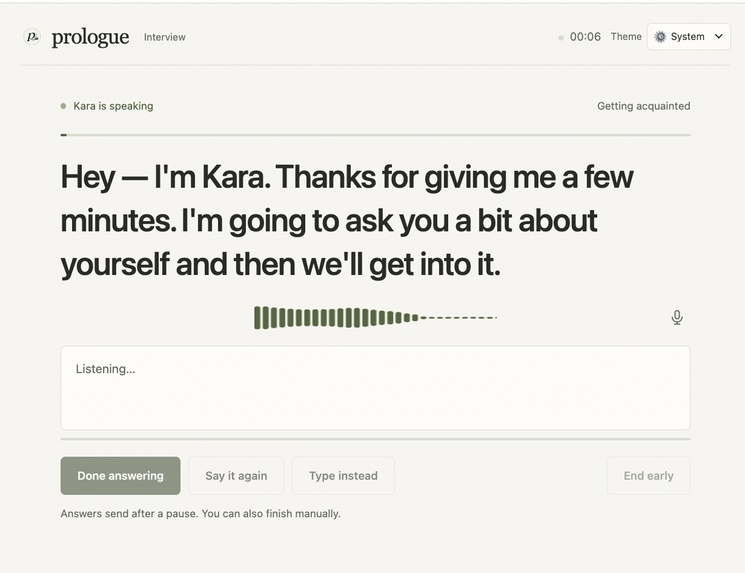
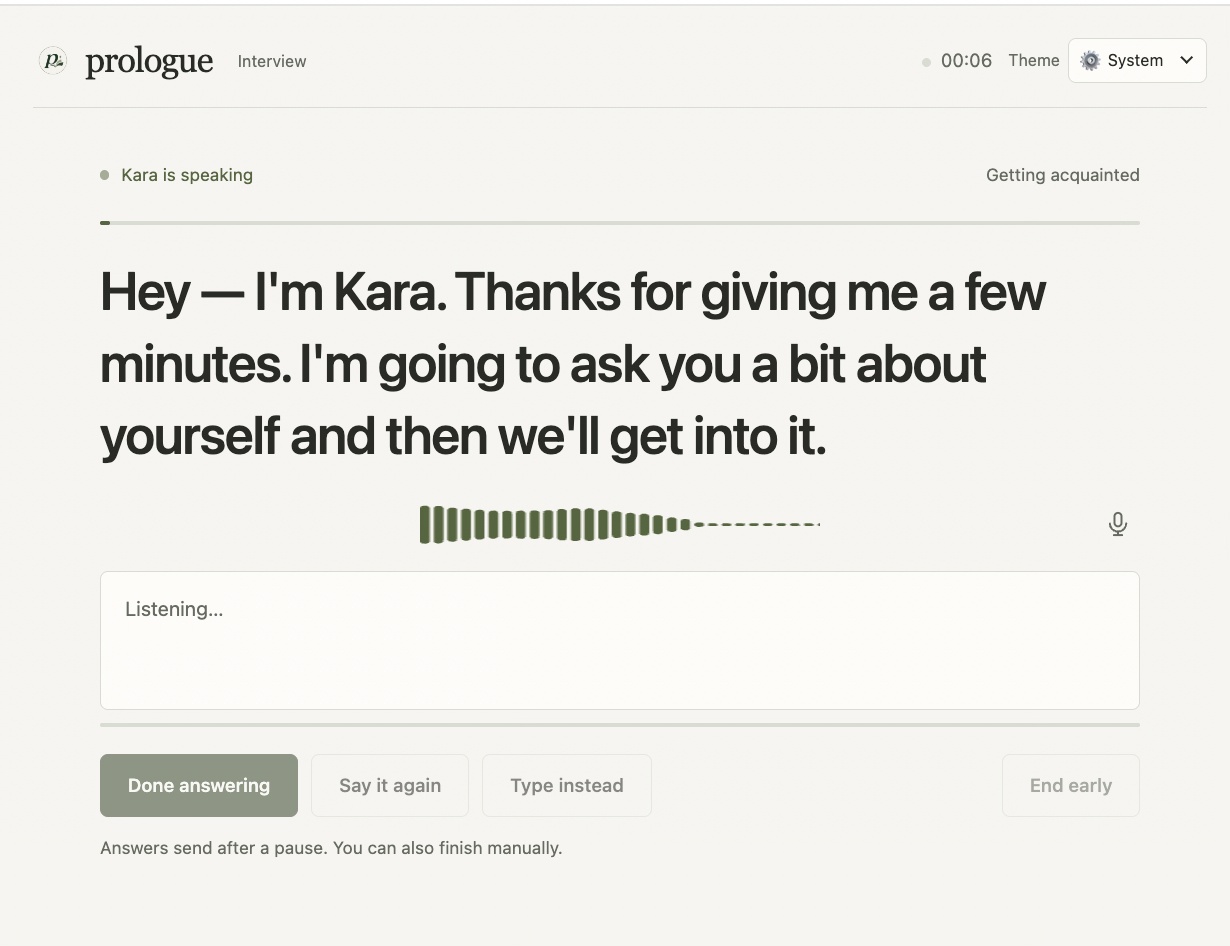
Interview Process
Inspiration
Everybody has a tale worth sharing.
Families, food vendors, small business owners, and entrepreneurs frequently have amazing tales about their beginnings, sacrifices, influential people, and pivotal occasions. The issue is that it takes time to tell those stories well. Asking the correct questions, identifying what is intriguing, following up, and transforming the conversation into something worthwhile are all necessary.
What it does
An AI-powered guided voice interviewer called Prologue – Story Studio transforms important conversations into narratives that are worthwhile to read, share, and preserve.
Users have two options for creating an interview: either give the interviewer a brief or let them figure out the story on their own. They can select their desired language and tone, as well as interview formats including Founder Story, Career Journey, Personal Story, or Expert Insight.
After that, the participant goes into an interview room to have a brief voice chat. The interviewer adjusts to the interviewee's responses rather than adhering to a strict questionnaire. It follows up if a response is ambiguous. A broad assertion necessitates a particular instance or example. It can investigate everything surprising and significant that arises.
How we built it
We designed Prologue around one principle:
Anyone can summarize a transcript. The difficult part is getting a transcript worth summarizing.
Our workflow connects Claude, MCP, an Assignment API, and a browser-based voice interview experience.
Claude creates the interview assignment through MCP. The Assignment API sends the brief to the interview server, where the participant enters the interview room and begins the voice conversation.
During the interview, conversational context helps determine what should be asked next rather than simply progressing through a predefined list of questions.
When the interview finishes, the content returns to Claude through MCP. Claude then acts as the editor, identifying the Nail, developing the final story, and preserving important quotes verbatim.
We also built Story Studio as a responsive web experience with configurable interview settings, multiple interview styles, language and tone controls, light and dark themes, and an interface designed to keep the focus on the conversation.
Challenges we ran into
Our biggest challenge was making the AI feel like an interviewer rather than a chatbot.
Asking questions is easy. Asking the right next question is much harder.
We had to determine how the interviewer should react to vague answers, when it should ask for more detail, when an unexpected response was worth exploring, and how to keep the conversation moving without becoming repetitive.
Another challenge was connecting the entire workflow. Creating the assignment, conducting the voice interview, maintaining conversational context, returning the results through MCP, and transforming everything into editorial content all needed to feel like one seamless experience.
Accomplishments that we're proud of
We're especially proud that Prologue became more than a simple AI transcript summarizer.
We built a complete experience that goes from creating an interview to having a voice conversation to producing a finished story.
We're also proud of the adaptive interviewing behavior. The system can follow up on vague responses, look for concrete moments behind general statements, preserve meaningful quotes exactly as they were spoken, and recognize the central idea of a conversation.
Most importantly, we created an experience where the technology stays in the background and the person's story remains the focus.
What we learned
One of our biggest lessons was that better AI-generated content starts with better conversations.
Even a powerful model cannot create a meaningful personal story if the original conversation never uncovered meaningful details.
That changed the question we were trying to solve from:
"How can AI write a better story?"
to:
"How can AI have a better conversation?"
We learned how important context, adaptive follow-ups, concrete examples, conversational UX, and preserving someone's actual words are when building AI experiences that are meant to feel personal.
We also learned a lot about connecting AI tools through MCP and designing a workflow where multiple components work together while still feeling simple to the end user.
What's next for Prologue - Story Studio
We want Prologue to preserve more than written words.
Our next steps include audio recordings and uploads, allowing someone's actual voice to remain attached to their story; photos, so stories preserve the people and places behind them; and private accounts, where users can interview family members and build a personal collection of memories over time.
We also envision specialized interview question sets for different professions and industries and a story library that grows with every conversation.
A ten-minute conversation with a business owner could become content they share with their customers. A conversation with a parent or grandparent could become something a family keeps for generations.
Conversations today. Legacies tomorrow.
Built With
- ai
- chatgpt
- claude
- claude-design
- codex
- elevenlabs
- vscode

Log in or sign up for Devpost to join the conversation.