-
-
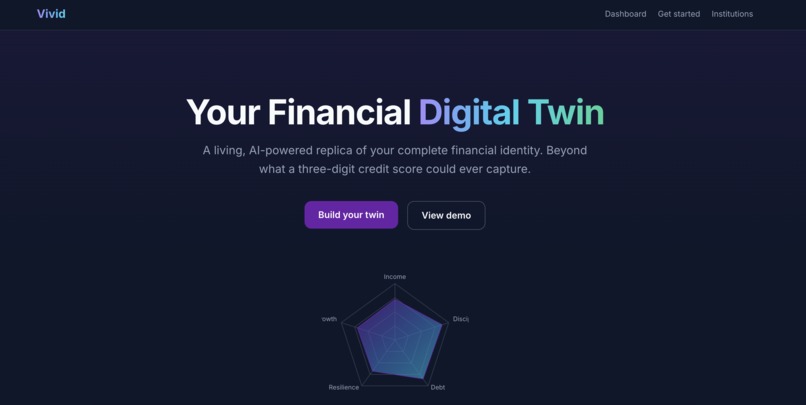
Landing Page
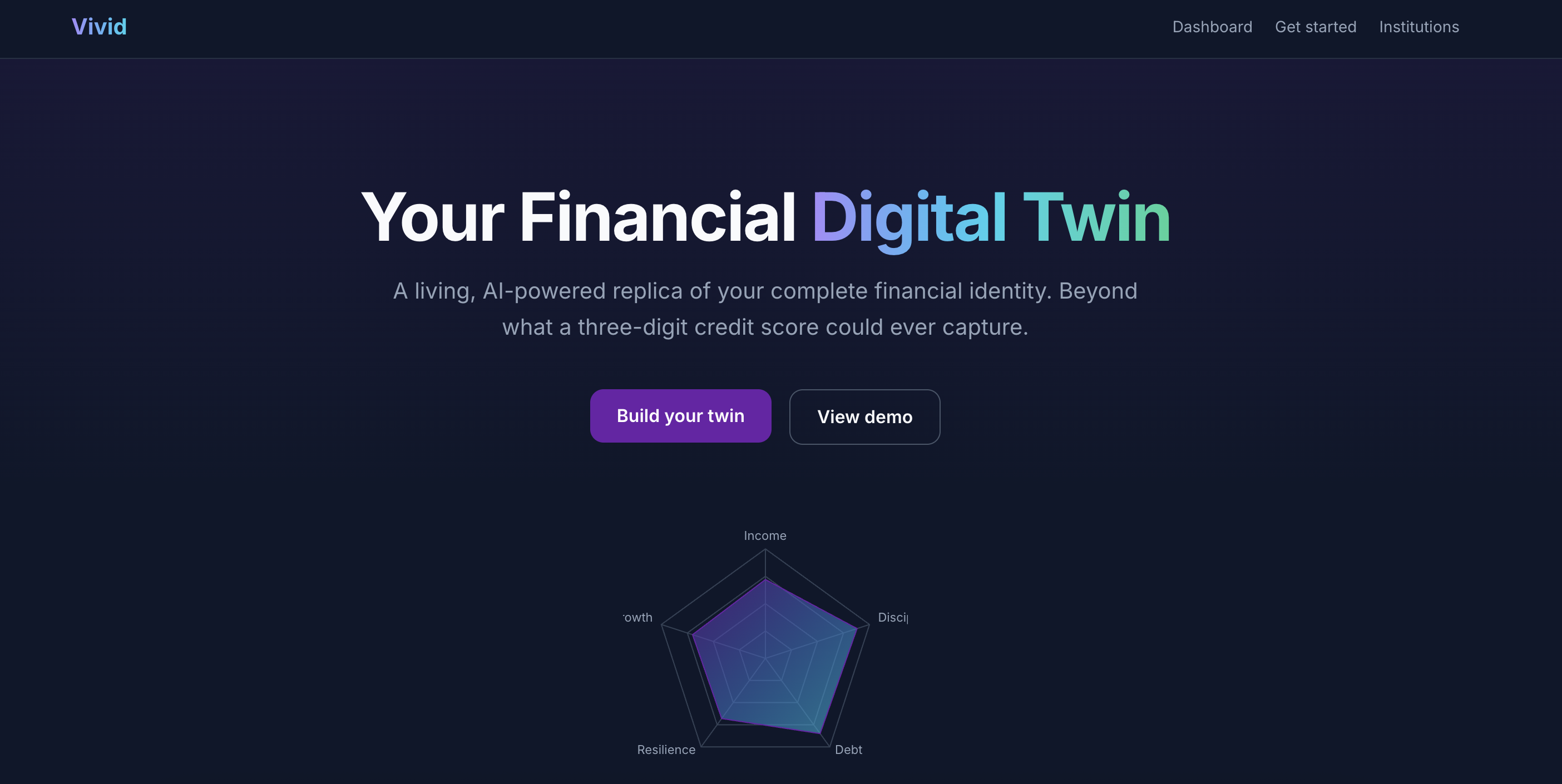
Vivid — Financial Digital Twin
Inspiration
The FICO score is 35 years old. It was designed for a different economy — one with stable employment, traditional credit products, and a narrow definition of financial health. Today, 45 million Americans are "credit invisible," and tens of millions more are gig workers, freelancers, and underbanked individuals who are reduced to a single number that tells almost nothing about how they actually manage their money.
We built Vivid to fix that. Inspired by the concept of a digital twin — a living, dynamic replica of a real-world system — Vivid creates a multi-dimensional, AI-powered model of a person's complete financial identity. One that reflects income stability, spending discipline, debt trajectory, resilience, and growth momentum. One that belongs to the consumer. And one that lenders can trust.
What It Does
Vivid builds your Financial Digital Twin — a verified, shareable, AI-analyzed profile of your financial life.
For consumers: Connect your bank account once via Plaid. Vivid analyzes up to 24 months of transactions using Vertex AI (Gemini 1.5 Pro), scores you across five dimensions, and generates plain-language narratives you can actually understand. Your dashboard includes visualizations, AI-powered insights, spending optimization, stress testing, anomaly detection, and future scenario projections. When you're ready to share with a lender, you generate a permissioned link — you control exactly what they see. A SHA-256 hash of your profile is stamped on Hedera Hashgraph, making it tamper-proof and auditable.
For lenders and institutions: Open a share link to instantly view a verified twin: five-dimension scores, an AI-generated lending narrative, and product-level lending readiness across personal, auto, mortgage, and small business loan categories. No account required. On-chain verification confirms the profile hasn't been altered since it was generated.
One bank connection → one verified, multi-dimensional financial identity you own and control.
Key Features
- 5-Dimension Vivid Score — Income Stability, Spending Discipline, Debt Trajectory, Financial Resilience, Growth Momentum (each 0–100, weighted into an overall score)
- Consumer Dashboard — Radar chart, income vs. spend timeline, spending breakdown, pillar explainability with per-dimension reasons and influential transactions
- AI Financial Chatbot — Powered by Gemini, fully grounded in your live twin data, with dual-voice TTS (Nova / Atlas)
- Spending Optimizer — Flags unnecessary subscriptions and recurring charges with cancel links and estimated annual savings
- Stress Testing — Simulate income loss, job loss, or medical emergencies; see months of runway and adjusted scores
- Anomaly Detection — Identifies lifestyle creep, subscription bloat, income volatility, and spending spikes with severity levels
- Time Machine — Project finances 6, 12, or 24 months forward with preset life scenarios (raise, new job, baby, home purchase)
- Loan Shield — Student and consumer loan risk analysis with ready-to-sign IDR, deferment, and forbearance documents
- Red Flags Detection — Identifies behaviors that hurt loan approval chances with actionable guidance
- Bill Negotiation — AI-generated, ready-to-send negotiation emails for internet, phone, insurance, and utility providers
- Zero-Knowledge Proofs — Create cryptographic claims (e.g., "Score above 70") without revealing raw data, stamped on Hedera
- Permissioned Sharing — UUID share tokens with granular scope controls, view tracking, and instant revocation
- Reputation Network — Attestations from employers, landlords, and lenders woven into a composite trust score
- Peer Benchmarking — Anonymous comparison against similar demographics (age, income, employment type)
- Verified Badges & Widget SDK — Embeddable scoring for partners in lending, rental, gig, and checkout contexts
- Blockchain Verification — Every twin profile hash stamped on Hedera Consensus Service for immutable auditability
How We Built It
Frontend: React 18, TypeScript, Vite, Tailwind CSS, Zustand, TanStack Query, Recharts, Framer Motion, Firebase Auth, and Plaid Link. Covers consumer onboarding, full dashboard, and a lender share view requiring no authentication.
Backend: Node.js 20 with Fastify, Prisma ORM, and Zod validation. Plaid integration with encrypted token storage (AES-256-GCM in dev, Cloud KMS in prod). The twin generation pipeline runs synchronously in dev and via Pub/Sub in production.
AI Pipeline: Plaid transactions → Vivid taxonomy categorization → aggregation → five-dimension scoring → Vertex AI (Gemini 1.5 Pro) for consumer narratives, lender narratives, lending readiness, stress test analysis, anomaly detection, optimizer insights, loan shield, red flags, time machine projections, bill negotiation emails, and year-end wrapped summaries.
Blockchain: A SHA-256 hash of the twin (scores + narratives) is signed and submitted to Hedera Consensus Service. ZKP claims, loan documents, and attestations are also stamped on-chain.
Infrastructure: GCP (Cloud Run, Pub/Sub, Vertex AI, Cloud KMS, Secret Manager, Cloud Storage), PostgreSQL 15, Redis 7, Firestore for real-time status, Firebase Hosting.
Market Opportunity
The problem Vivid addresses is large, structural, and underserved.
- 45 million credit-invisible Americans have no credit score or a file too thin to score — they are locked out of mainstream credit entirely.
- $1.7 trillion in consumer lending is underwritten annually in the US, largely using FICO scores that were never designed for gig work, side income, or modern spending behavior.
- The alternative data market — which Vivid sits at the center of — is projected to reach $68 billion by 2030, growing at over 14% CAGR, driven by demand from fintechs, credit unions, and community banks seeking better underwriting signals.
- 59 million Americans participate in the gig economy. Traditional credit scoring systematically disadvantages this segment despite many having strong, stable cash flows.
- Credit unions and community banks — 10,000+ institutions in the US — are actively seeking compliant, trustworthy alternatives to FICO for applicant evaluation. Vivid's lender view is purpose-built for this market.
Vivid's go-to-market is dual-sided: consumer adoption through financial empowerment, and institutional adoption through a partner API, embeddable widget SDK, and permissioned share links. The blockchain verification layer adds a compliance-friendly audit trail that reduces lender risk when using non-traditional scoring.
Challenges We Ran Into
Monorepo environment loading — The backend was silently failing to load root-level .env variables. We solved this with dotenv-cli and a backend-specific bootstrap loader that runs before any module imports.
Pipeline reliability under synchronous execution — Running Plaid, Gemini, and Hedera sequentially in a single request led to timeout cascades and compounded error states. We hardened error handling at each stage and improved UI feedback so users understand what's happening during twin generation.
Prompt coherence across 10+ AI use cases — Getting consistent, explainable, and grounded outputs across chatbot, narratives, stress tests, anomaly detection, optimizer, and more required careful schema design and tight coupling between scoring logic and prompt templates.
Hedera integration — Correct SDK setup, operator key configuration, and graceful fallback handling for testnet latency without breaking the core flow.
Accomplishments We're Proud Of
- True end-to-end flow — Bank link → AI scoring → narratives → lending readiness → Hedera stamp → shareable twin. It actually works, end to end.
- Real AI, not mock data — Every score, narrative, and insight is generated from actual transaction categorization and Gemini outputs, not hardcoded responses.
- Blockchain with purpose — The on-chain profile hash isn't a gimmick. It enables a lender to verify that what they're looking at hasn't been altered since it was generated.
- Dual-sided product — The same underlying twin serves a consumer empowerment dashboard and a lender-ready institutional view with permissioned access controls.
- 10+ AI-powered features — Chatbot, optimizer, stress test, anomaly detection, red flags, loan shield, time machine, bill negotiation, year-end wrapped, and ZKP claims — all grounded in the same live twin data.
What We Learned
- Monorepos require explicit, deliberate environment-loading strategies — implicit assumptions break silently.
- Synchronous pipelines are viable for demos; production requires async workers, retries, idempotency keys, and real-time status tracking.
- High-quality AI outputs across diverse use cases depend on structured output schemas and tight integration between scoring logic and prompt design — the AI is only as good as the data structure you hand it.
- Hedera's Consensus Service is genuinely well-suited to "stamp once, verify anytime" use cases where immutability matters more than queryability.
What's Next for Vivid
- Production hardening — Fully async twin generation with retries, idempotency, and real-time status updates via Pub/Sub and Firestore.
- Richer data sources — Multi-bank connections, investment accounts, and payroll integrations for a more complete financial picture.
- Lender accounts and CRM integration — Full institution portal with saved applicant history, comparison tools, and exportable reports.
- Compliance and fair lending — Strengthened consent flows, audit trails, and fair-lending documentation to support pilots with credit unions and community banks under ECOA and FCRA frameworks.
- Deeper explainability — Transaction-level attribution for every score dimension, enabling consumers to take targeted action and lenders to justify underwriting decisions.
- Expanded ZKP and credentialing — Portable, privacy-preserving financial credentials that consumers can use across any lender or platform without re-linking their bank.
Built by Manny Serrano and Kevin Benitez — Duke University '27
Built With
- firebase
- google-cloud
- hedera
- hedera-consensus-service
- kms
- node.js-(fastify)
- plaidapi
- postgresql-15
- prisma/postgresql
- react
- redis-7
- tailwindcss
- typescript
- vertex-ai-(gemini)


Log in or sign up for Devpost to join the conversation.