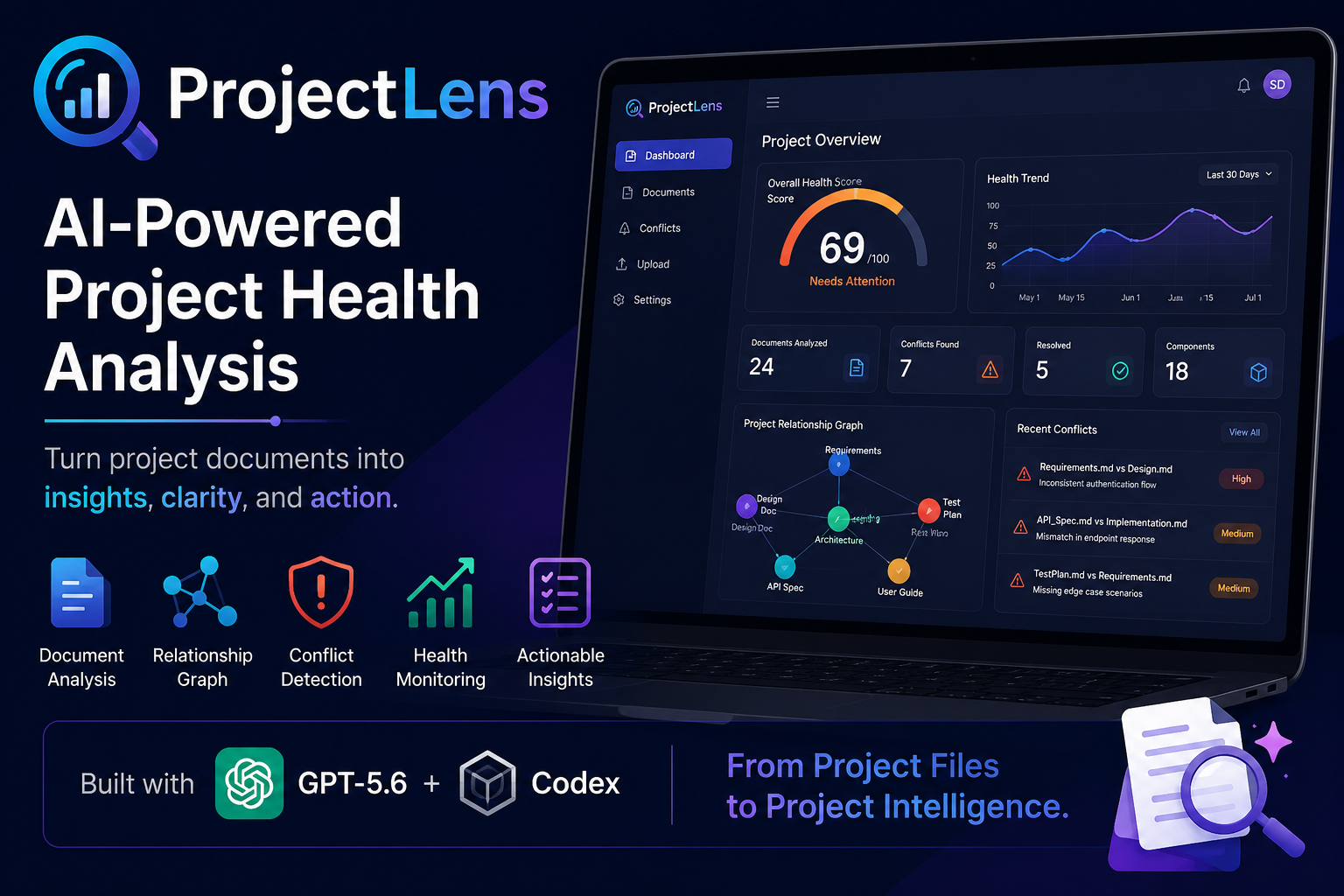
🚀 ProjectLens
From Project Files to Project Intelligence.
💡 Inspiration
The idea for ProjectLens came from a challenge I experienced while working on software projects. Project information was often scattered across requirement documents, reports, presentations, and other artifacts, making it difficult to understand the overall health of a project or identify inconsistencies without manually reviewing everything.
While learning workflow automation, I previously built a similar concept using Make.com. Although it automated parts of the workflow, it lacked a dedicated user interface and advanced project analysis. That experience inspired me to transform the idea into a complete AI-powered platform with project health monitoring, document intelligence, conflict detection, and relationship visualization.
Problem: Project information is fragmented.
Solution: A single AI-powered workspace that understands the health of your project.
✨ What it does
ProjectLens provides a unified view of software project health by analyzing project documents and presenting meaningful insights through an interactive dashboard.
Key Features
- 📄 Upload and organize project documents.
- 📊 Monitor overall project health through key metrics and trends.
- ⚠️ Detect inconsistencies across project artifacts.
- 🕸️ Visualize relationships between project components.
- 🤖 Review and manage detected conflicts from one interface.
- 🔄 Reanalyze projects as documentation evolves.
🛠️ How we built it
ProjectLens was built using GPT-5.6 and Codex throughout development.
To maximize the available Codex credits, I divided the project into development milestones and prioritized the most technically challenging tasks for Codex. GPT-5.6 and Codex accelerated:
- Feature implementation
- Software architecture
- Debugging
- UI refinement
- Rapid iteration
After reaching my Codex usage limit, I completed the remaining implementation independently by integrating components, refining the interface, fixing bugs, and polishing the overall user experience.
Built With
- GPT-5.6
- Codex
- Next.js
- React
- TypeScript
- Tailwind CSS
- Node.js
⚡ Challenges we ran into
The biggest challenge was building the project within the limitations of the free usage tier.
Instead of relying entirely on AI, I strategically planned which tasks would benefit the most from Codex and completed the remaining implementation myself.
Another challenge was transforming the original Make.com automation concept into a complete software application with meaningful visualizations, intelligent analysis, and an intuitive user experience.
🏆 Accomplishments that we're proud of
- ✅ Transformed an automation concept into a full-stack AI application.
- ✅ Built an interactive project health dashboard.
- ✅ Implemented document management and conflict detection.
- ✅ Added relationship visualization between project artifacts.
- ✅ Successfully combined GPT-5.6, Codex, and independent development.
- ✅ Delivered a polished demo and open-source repository within the OpenAI Build Week timeline.
📚 What we learned
This project reinforced that AI is most powerful as a development partner rather than a replacement for engineering decisions.
While GPT-5.6 and Codex significantly accelerated development, building a polished product still required careful planning, debugging, testing, and iterative refinement.
Most importantly, I learned how to:
- Use AI strategically instead of depending on it.
- Structure an AI-assisted development workflow.
- Build efficiently while working within limited resources.
- Transform an idea into a functional product.
🚀 What's next for ProjectLens
The current version demonstrates the core vision of ProjectLens, but this is only the beginning.
Planned Improvements
- ✨ Live GPT-powered conflict explanations.
- 💡 AI-generated resolution suggestions.
- 🔗 GitHub repository synchronization.
- 📈 Advanced project health analytics.
- 👥 Collaborative team workspaces.
- ⚡ Continuous project monitoring.
- 🧠 Smarter AI recommendations.
Long-term Vision
ProjectLens aims to evolve into an intelligent Project Intelligence Platform that helps software teams understand project health, detect issues earlier, and make better-informed decisions throughout the entire software development lifecycle.
Built With
- analysis
- artificial
- codex
- conflict
- css
- dashboard
- data
- detection
- developer
- document
- gpt-5.6
- graph
- health
- intelligence
- knowledge
- management
- next.js
- node.js
- productivity
- project
- react
- tailwind
- tools
- typescript
- visualization

Log in or sign up for Devpost to join the conversation.