-
-
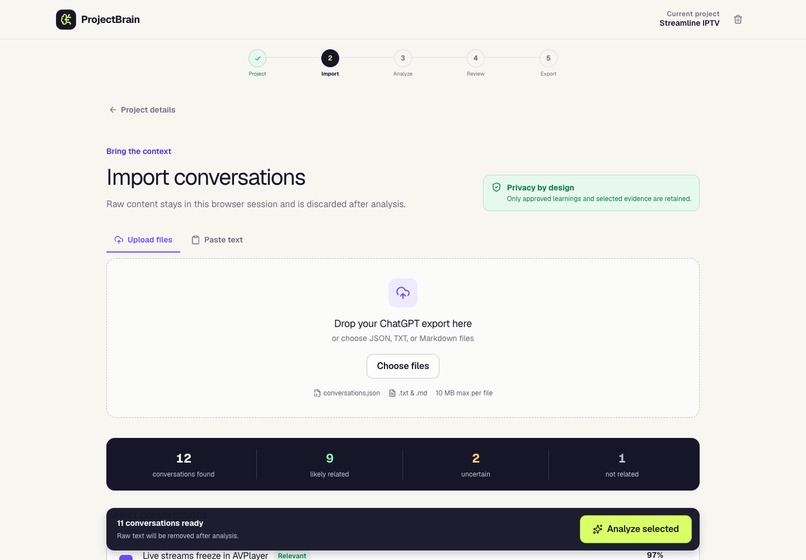
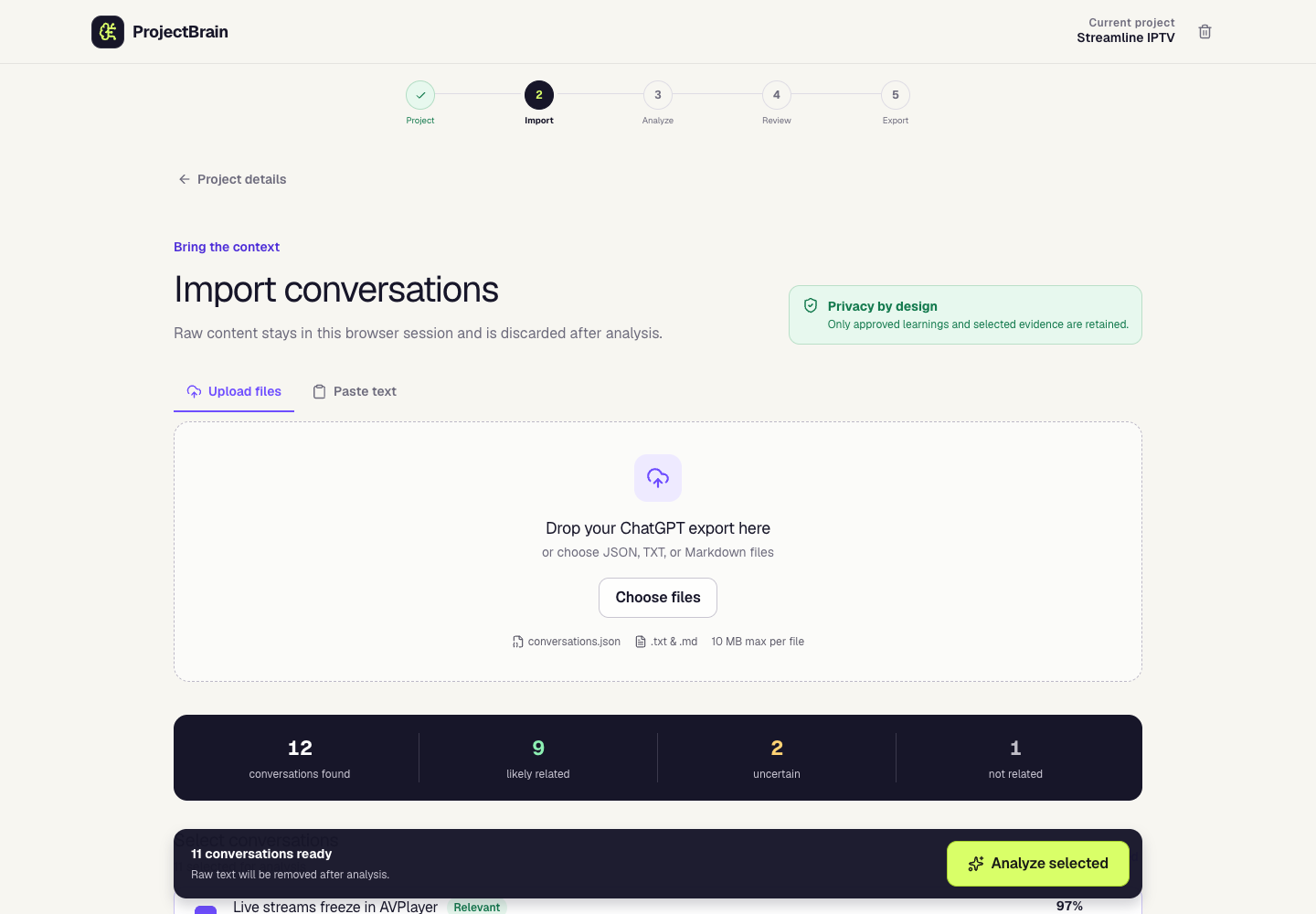
Local import and relevance selection
-
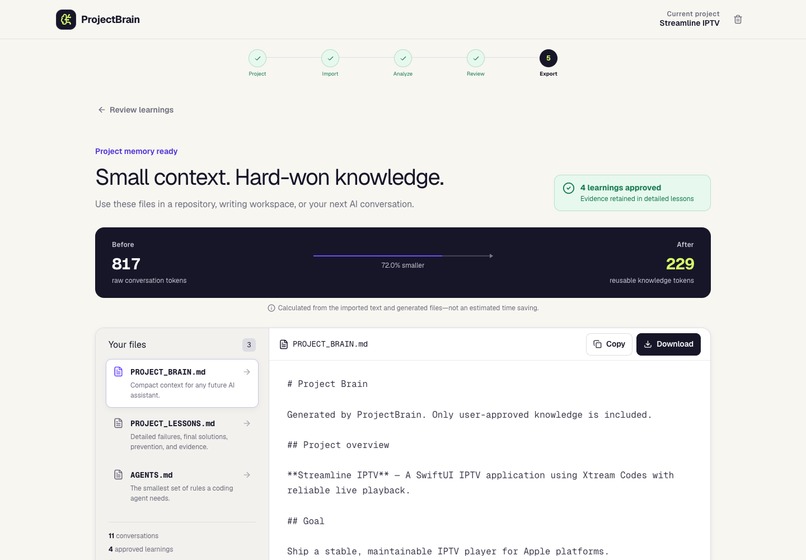
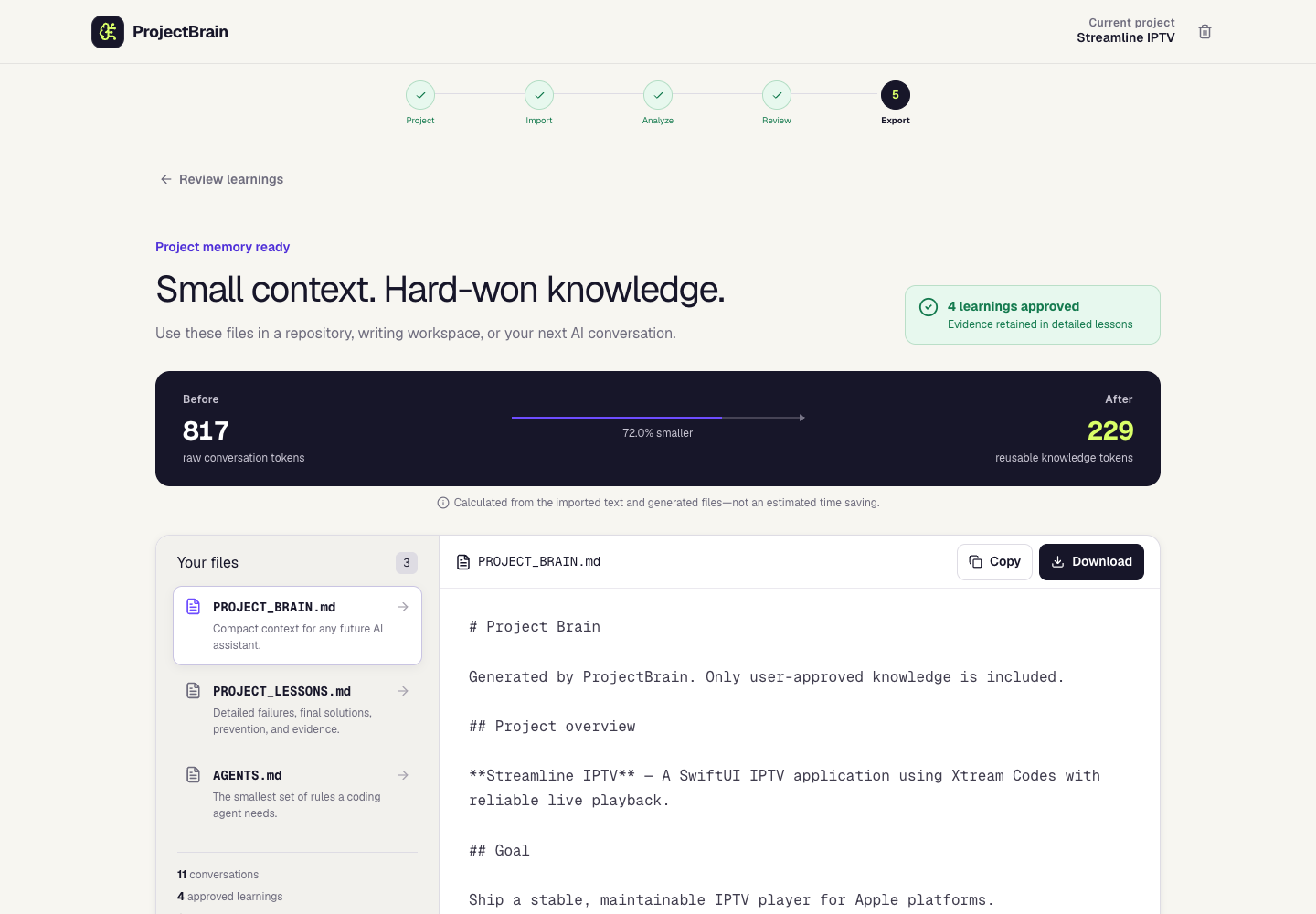
Measured context compression and Markdown export
-
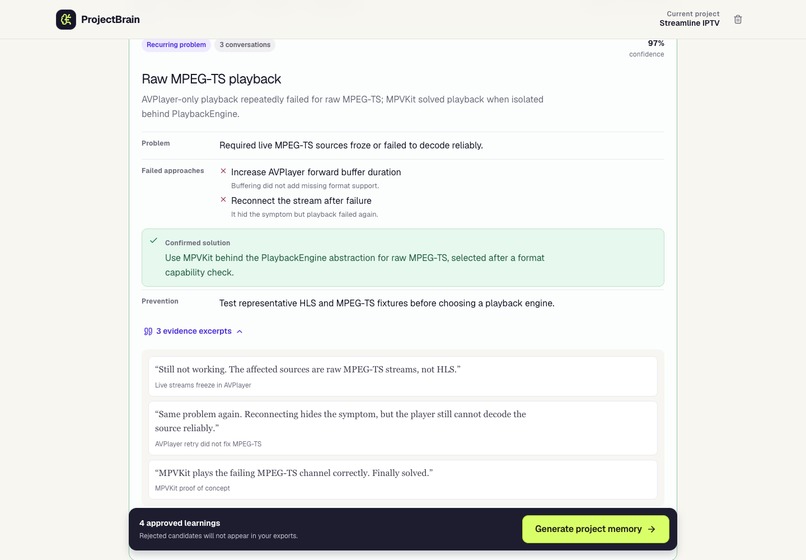
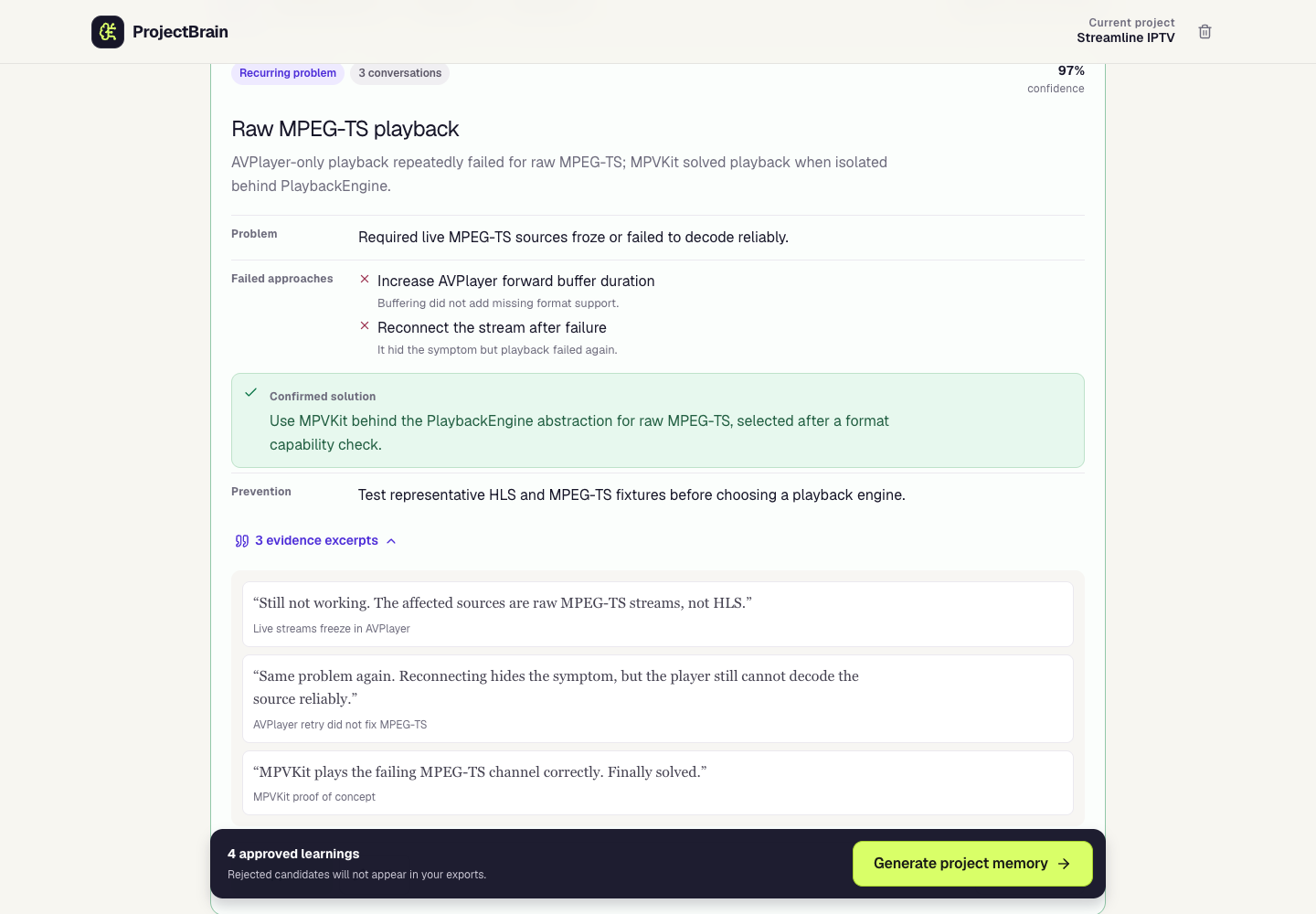
Human review with failed attempts, solution, and source evidence
-
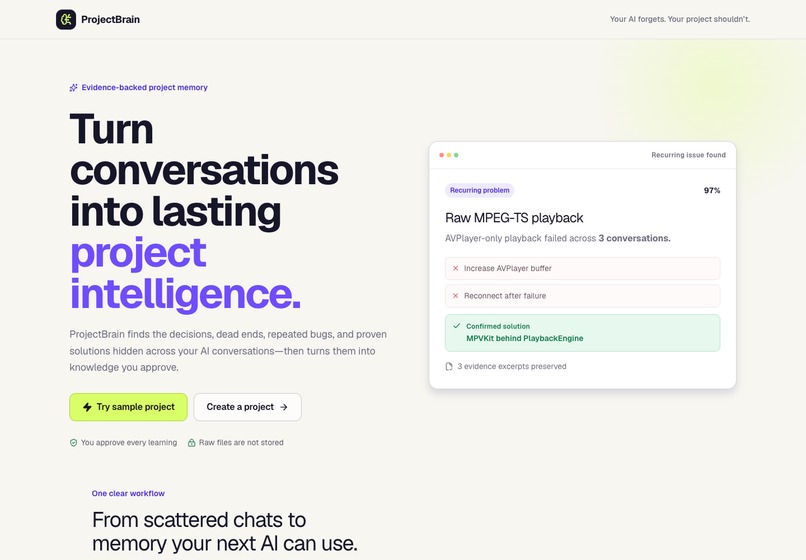
ProjectBrain: evidence-backed project memory
-
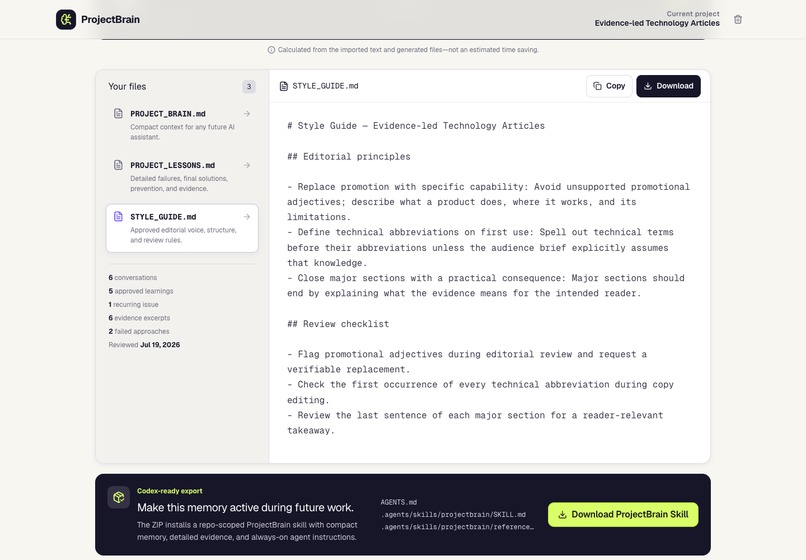
Writing style guide and repo-scoped Codex skill export
Inspiration
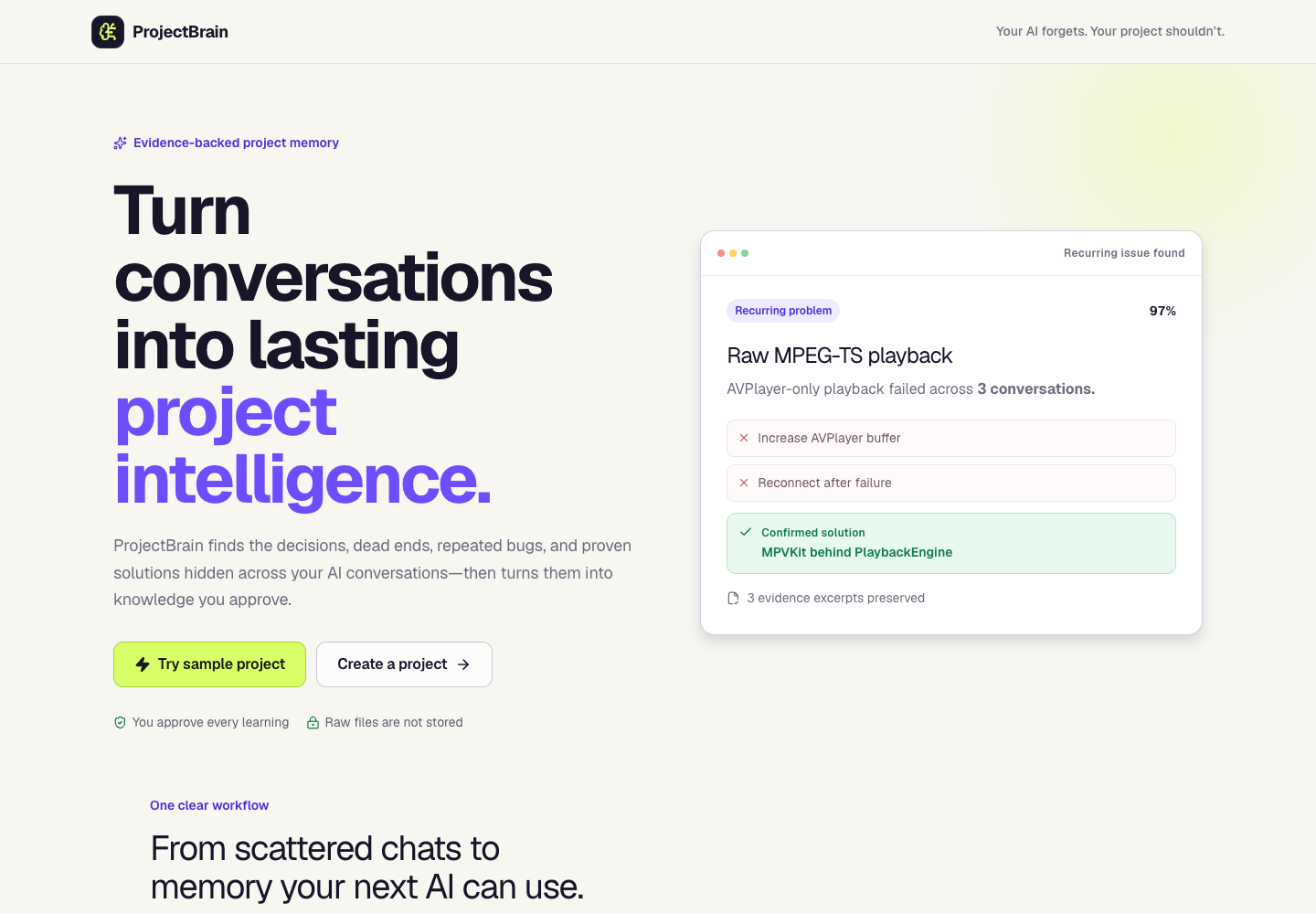
Important project knowledge is buried in AI conversations: decisions, failed approaches, corrections, and fixes that finally worked. A new AI session rarely inherits that context, so teams repeat mistakes and spend tokens replaying history. ProjectBrain turns that forgotten history into reviewed, reusable project intelligence.
What it does
ProjectBrain imports ChatGPT exports, Claude Code session ZIP/JSONL files, generic JSON, Markdown, plain text, or pasted conversations. It classifies relevance locally, extracts reusable observations in bounded batches, consolidates recurring issues across conversations, and attaches source evidence to every finding.
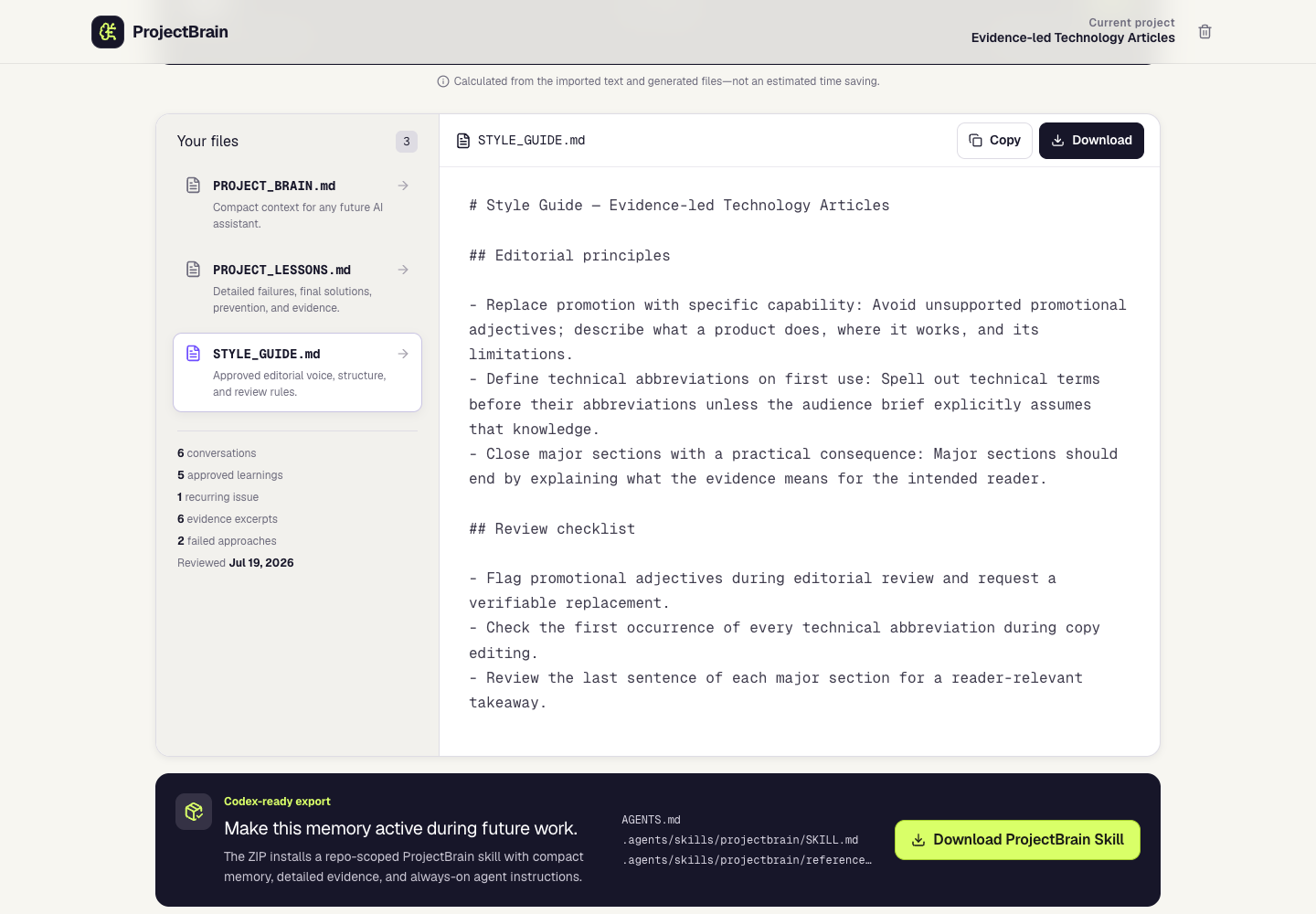
Nothing becomes durable memory automatically. The owner can inspect evidence, edit, accept, reject, deprecate, or resolve conflicts before exporting approved knowledge as PROJECT_BRAIN.md, PROJECT_LESSONS.md, AGENTS.md, STYLE_GUIDE.md, or a repo-scoped Codex skill ZIP.
The synthetic demo connects the same MPEG-TS playback failure across multiple conversations, preserves failed buffer and reconnect attempts, identifies the compatibility root cause, and retains the confirmed MPVKit solution. A second writing demo converts repeated editorial feedback into an evidence-backed style guide.
How we built it
The app uses Next.js, React, TypeScript, Tailwind CSS, Zod Structured Outputs, Vercel, Sentry, Better Stack, and privacy-minimized PostHog EU analytics. Local relevance classification avoids unnecessary LLM calls. Server-only provider adapters support OpenAI, direct Google Gemini, OpenRouter, and NVIDIA NIM with bounded inputs, output limits, timeouts, and controlled fallback.
Codex on GPT-5.6 was the primary engineering partner. I used it to shape the data model and review workflow, build ChatGPT and Claude Code import parsers, define structured extraction schemas, iterate on the evidence-first interface, create privacy-safe synthetic datasets, harden provider fallbacks and quota guards, write automated tests, and run production QA. GPT-5.6 is also available through the optional OpenAI extraction adapter; the public demo currently uses Gemini as its free-tier runtime provider.
Challenges
The hardest part was preserving provenance while merging repeated observations. A normal summary is smaller, but it can erase which attempt failed, which solution was confirmed, and where the evidence came from. We designed extraction and consolidation schemas that keep those relationships explicit, then added human review so model output never silently becomes project truth.
Another challenge was supporting several real export shapes without sending irrelevant conversations to an AI provider. Import parsing and relevance grouping happen locally, raw content is discarded after analysis, and only approved compact memory persists on the device.
Accomplishments
- Evidence on every learning
- Cross-conversation recurring-issue consolidation
- Human Accept, Edit, Reject, Deprecate, and conflict review
- Measured context compression
- Six import paths, including Claude Code session ZIPs
- Software and writing demos using only synthetic data
- Repo-scoped Codex skill export
- Multi-provider resilience with privacy and quota guards
- Automated tests, monitoring, uptime checks, and production QA
What we learned
Durable AI memory needs more than summarization. It needs provenance, explicit human approval, a record of failed approaches, and an export format future tools can actually consume.
What's next
Next steps are authenticated team projects, optional Supabase sync, GitHub review automation, more IDE-agent importers, export versioning, and a ProjectBrain CLI/MCP workflow.
Built With
- google-gemini
- gpt-5.6
- next.js
- openai
- posthog
- react
- sentry
- tailwind-css
- typescript
- vercel
- zod

Log in or sign up for Devpost to join the conversation.