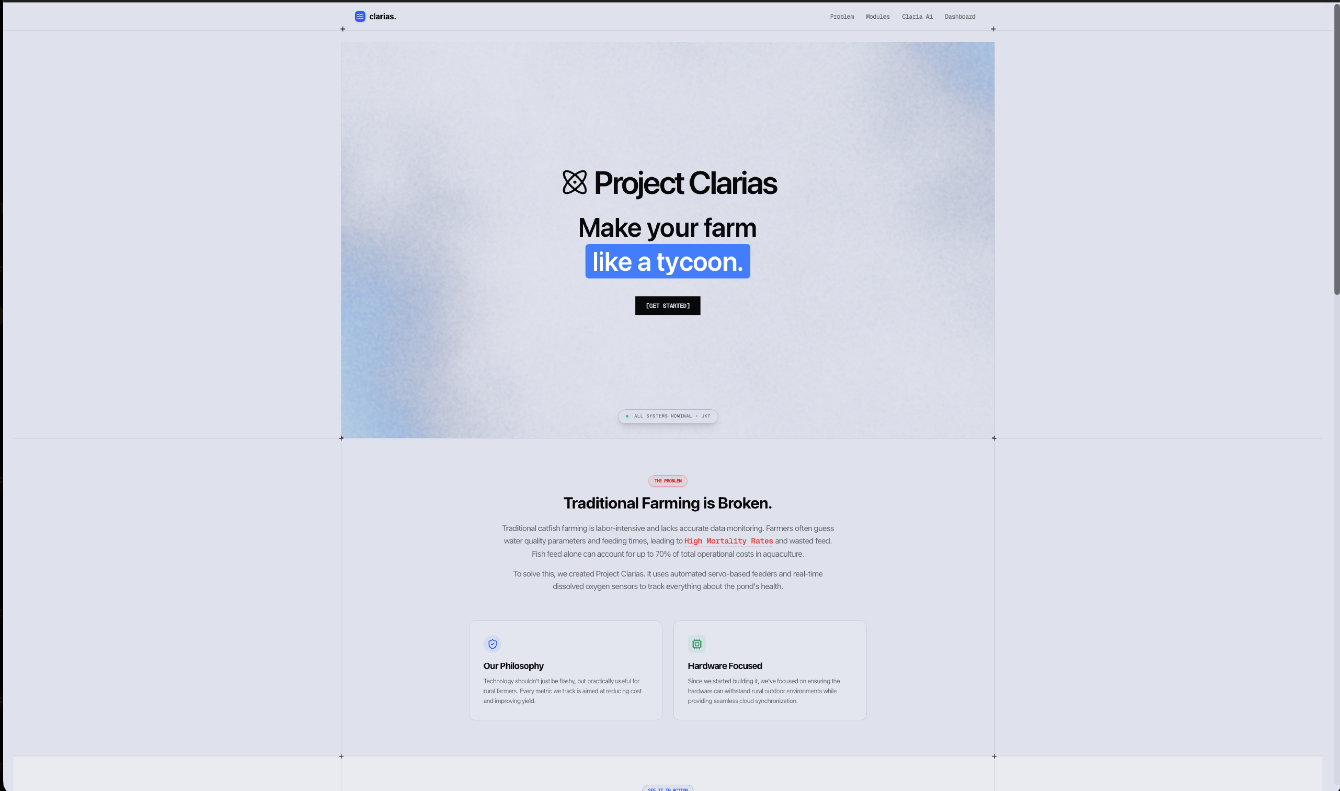
Project Clarias
Inspiration
Aquaculture continues to play an important role in food production, but maintaining healthy pond conditions is still a challenge. Farmers need to monitor factors such as temperature, pH, dissolved oxygen, and water level because even small changes can affect fish growth and survival. Doing this consistently throughout the day is difficult, especially when it relies on manual observation.
Project Clarias began with the idea of creating a complete aquaculture monitoring system. Our long term vision includes a dedicated monitoring device that collects environmental data directly from fish ponds. Before building the hardware, we wanted to establish the software platform that would receive, process, and present that information in a meaningful way. Building this foundation first gave us the opportunity to design the user experience, data flow, and system architecture from the ground up.
Our goal is simple. Help farmers spend less time interpreting raw sensor values and more time making informed decisions.
What it does
Project Clarias is an intelligent aquaculture monitoring platform that helps users understand the condition of their ponds through environmental data and AI assisted analysis.
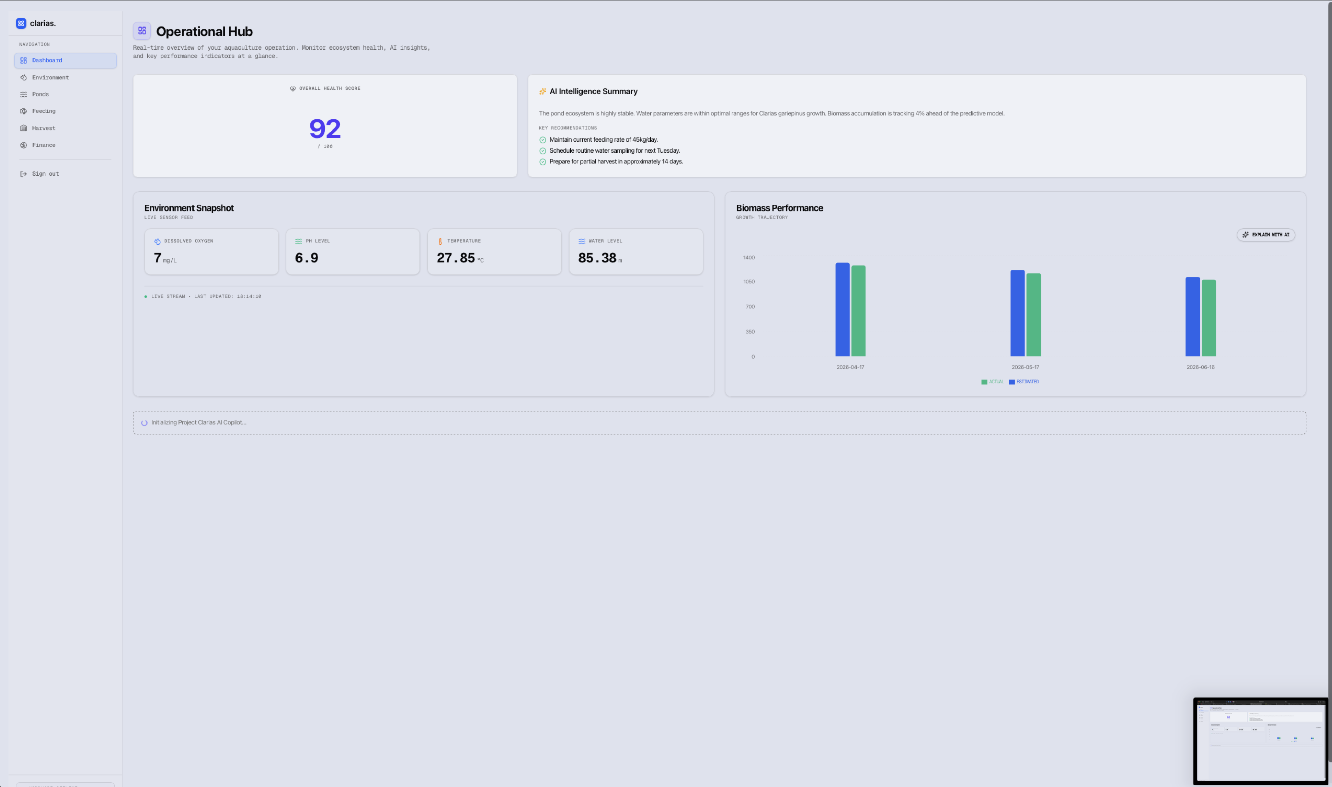
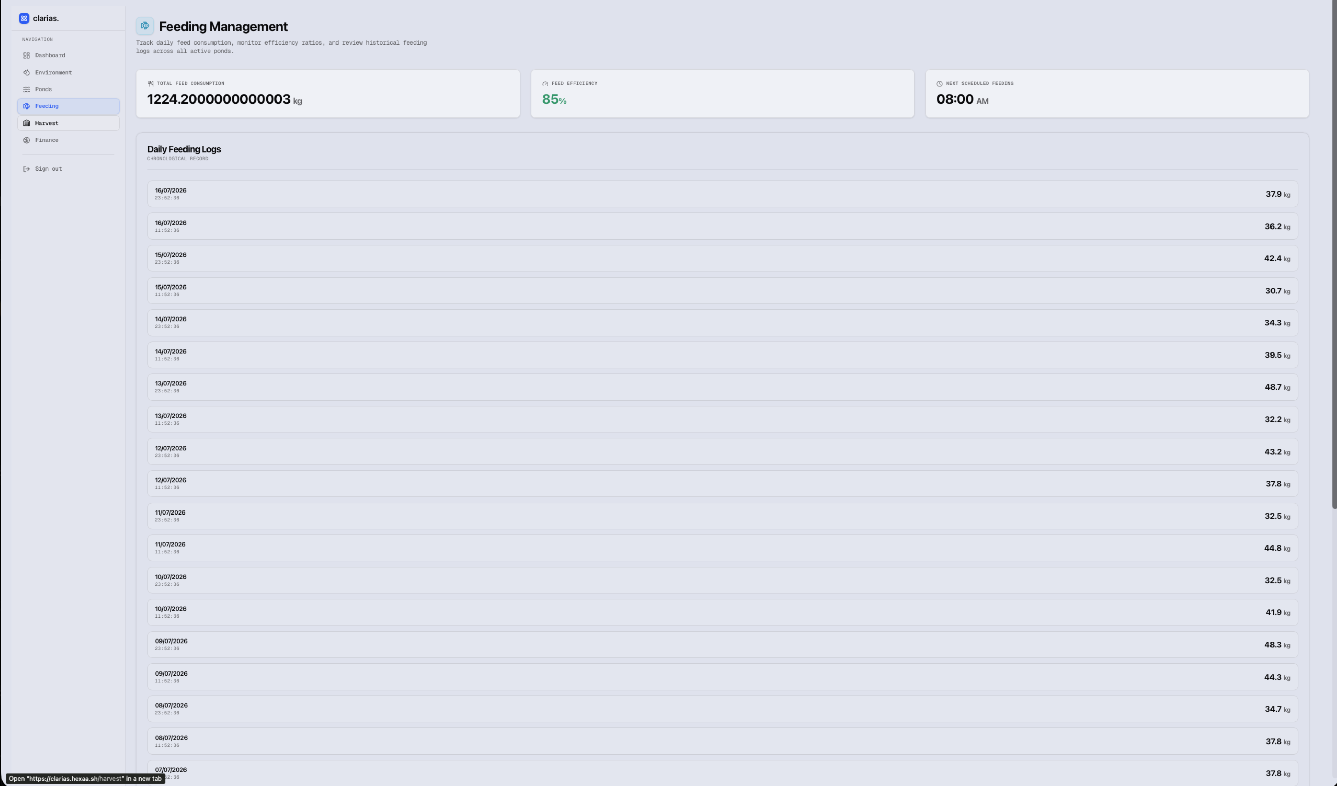
The platform monitors key water quality indicators including temperature, pH, dissolved oxygen, and water level. It also records feeding activities, estimates harvest readiness, and notifies users when environmental conditions require attention.
One of its main features is the AI Copilot. Instead of displaying numbers alone, it explains the current pond condition, identifies possible causes, describes potential impacts on fish health, and recommends practical actions based on the available information.
For this prototype, environmental readings are simulated to represent the data that the future monitoring device will produce. This allowed us to develop the platform while keeping it ready for real world deployment.
How we built it
We built Project Clarias as a full stack application with a modular architecture that can continue evolving as new components are added.
The frontend was developed with Next.js, React, TypeScript, and Tailwind CSS to provide an intuitive dashboard for monitoring pond conditions and interacting with the AI Copilot.
The backend uses Hono, Bun, Drizzle ORM, PostgreSQL, and Supabase. It manages environmental data, feeding records, harvest information, alerts, and analytics while exposing APIs consumed by the frontend.
For AI, we integrated OpenRouter using GPT OSS 120B. Rather than allowing the model to access the database directly, the backend first prepares a structured summary containing environmental conditions, feeding history, harvest estimates, and active alerts. The AI then interprets this information and generates recommendations that are easier for users to understand.
Although the monitoring device is still under development, the platform already expects environmental telemetry in the format that the hardware is planned to produce. This allows future hardware to integrate naturally without requiring major changes to the software architecture.
Challenges we ran into
One of our biggest challenges was deciding how much responsibility should belong to AI.
At first, we considered letting the language model perform most of the analysis. As development progressed, we realized that calculations such as environmental thresholds, biomass estimation, and alert generation should remain deterministic inside the backend. The AI became much more reliable once it focused on interpreting structured information instead of raw data.
Another challenge was designing software that could grow alongside future hardware development. Since the monitoring device is part of our long term vision, we wanted to make sure the platform would not need to be redesigned once live telemetry becomes available.
Balancing development speed with a maintainable architecture was something we continuously worked on throughout the project.
Accomplishments that we're proud of
We are proud that Project Clarias became more than a dashboard.
We built a platform that combines environmental monitoring, analytics, and AI into a single workflow. The AI Copilot provides recommendations that are based on actual pond conditions instead of generic responses, making the information much more useful for users.
We are also proud of the system architecture. Rather than building a prototype around temporary simulated data, we designed the platform around the complete vision of Project Clarias. As the monitoring device is developed, it can become another part of the same ecosystem without requiring significant changes to the platform.
Most importantly, we created a strong foundation that we can continue building after the hackathon.
What we learned
This project taught us that AI is most effective when combined with solid software engineering.
We learned that deterministic calculations and business rules should remain in the backend, while AI is better suited for interpreting information and communicating it in a way that is easier for people to understand.
We also gained valuable experience designing scalable backend services, building modular APIs, integrating AI into existing workflows, and planning software that is ready to support future hardware development.
Perhaps the biggest lesson was realizing that building a complete system starts with building a strong foundation.
What's next for Project Clarias
The next milestone for Project Clarias is developing the dedicated monitoring device that inspired this project from the beginning. Once completed, it will continuously collect environmental conditions from fish ponds and send live telemetry directly to the platform.
Beyond hardware development, we plan to improve harvest prediction, implement anomaly detection, expand support for multiple ponds, provide mobile notifications for important events, and deliver recommendations that adapt to different fish species and farming practices.
We see this hackathon as the first step. The platform we built establishes the foundation for a complete aquaculture monitoring ecosystem, and we are excited to continue turning that vision into reality.
Built With
- hono
- monorepo
- next.js
- supabase
- typescript

Log in or sign up for Devpost to join the conversation.