-
-
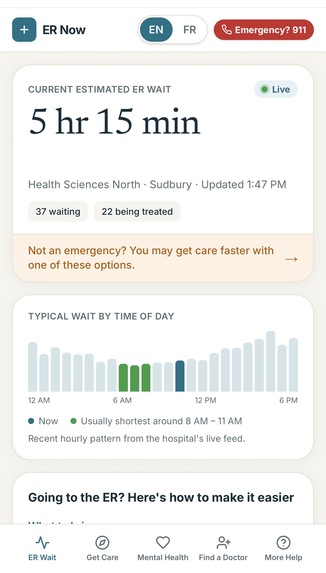
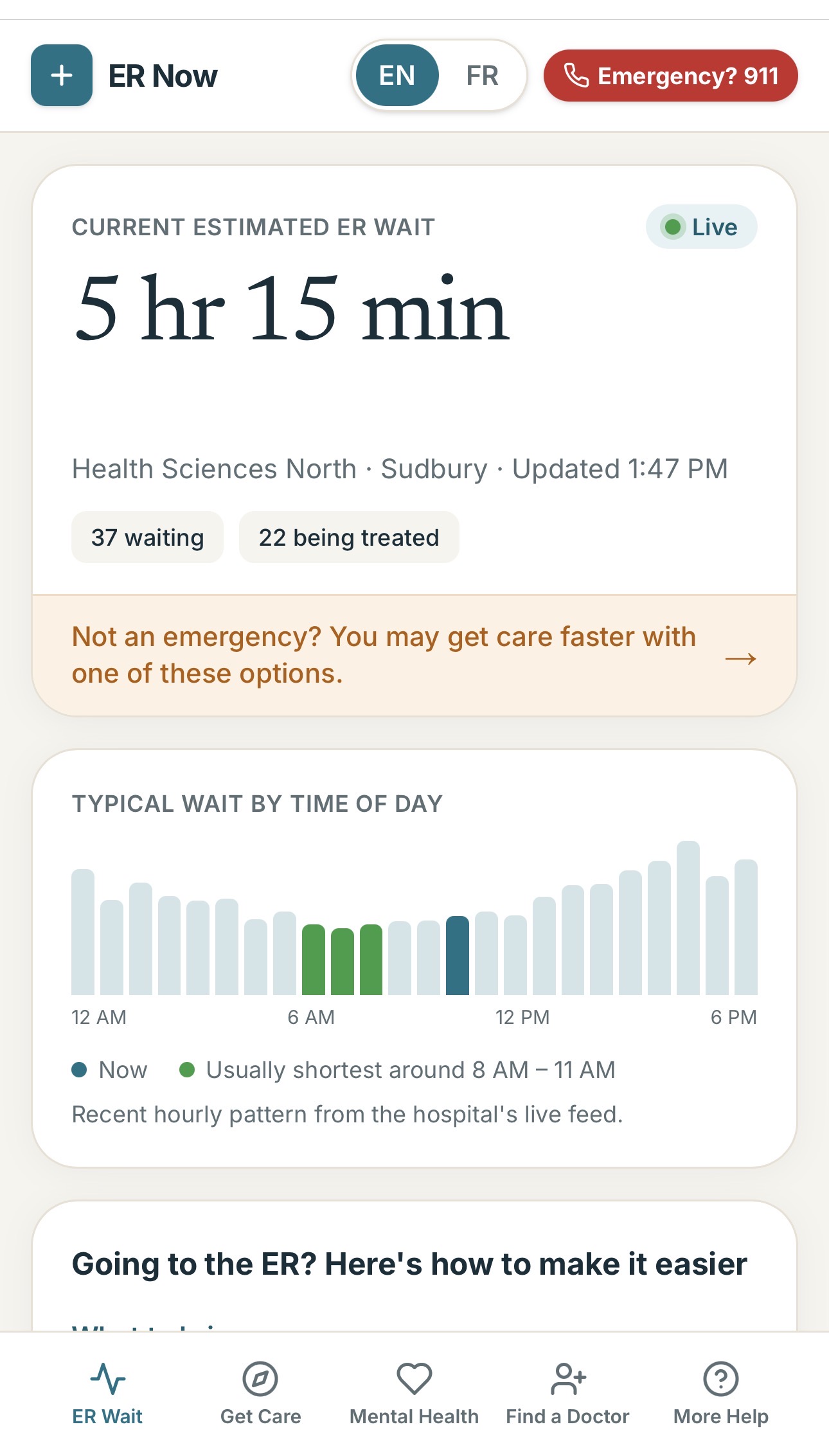
Mobile Version - ER Wait Tab
-
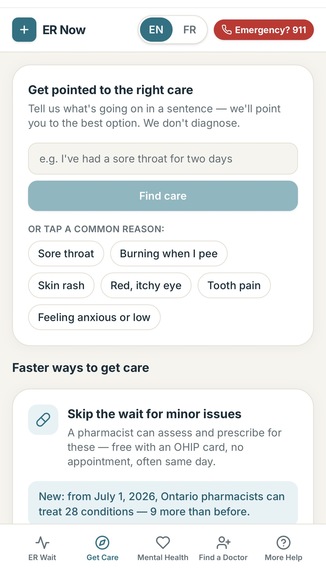
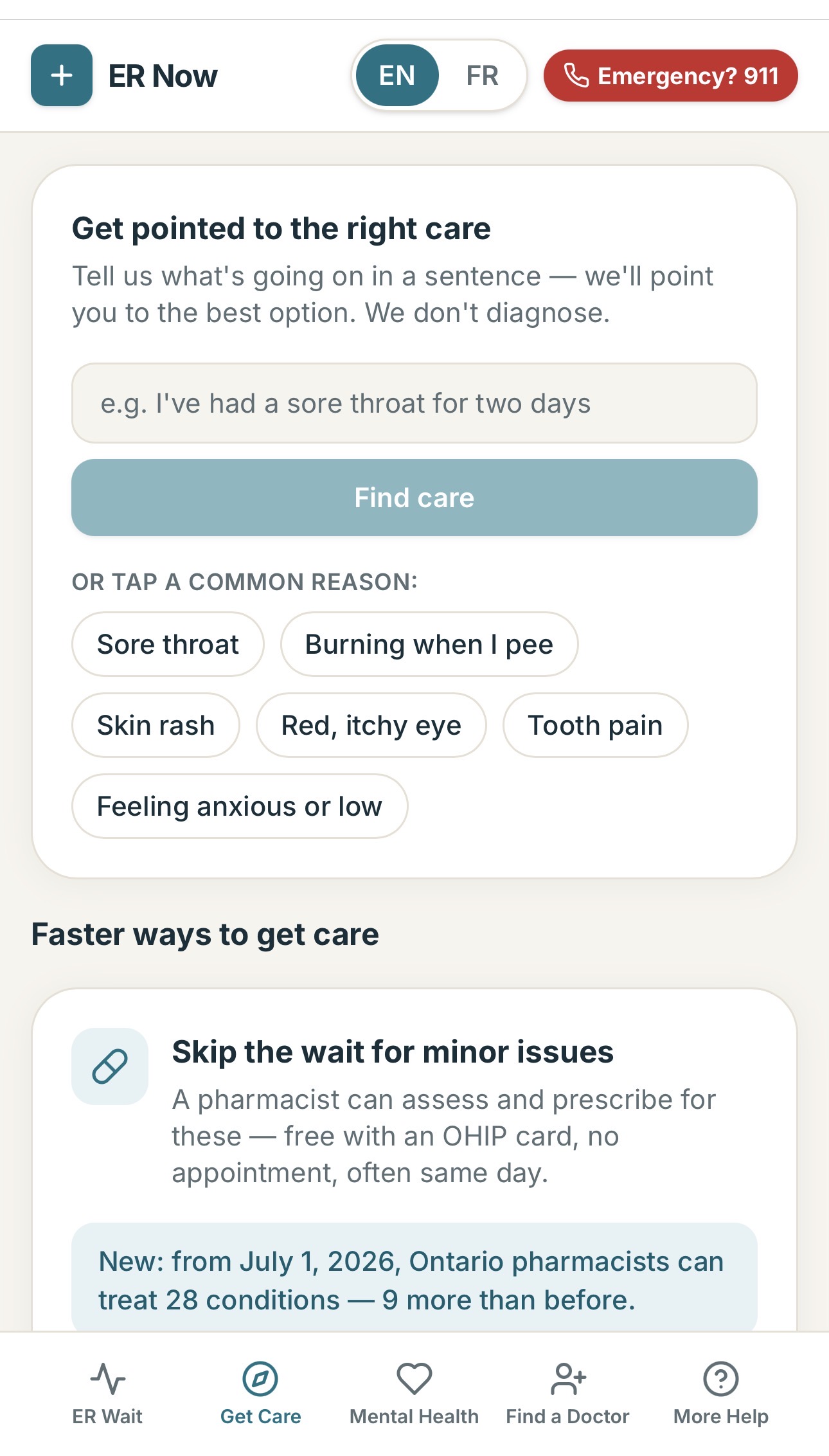
Mobile Version - Get Care Tab
-
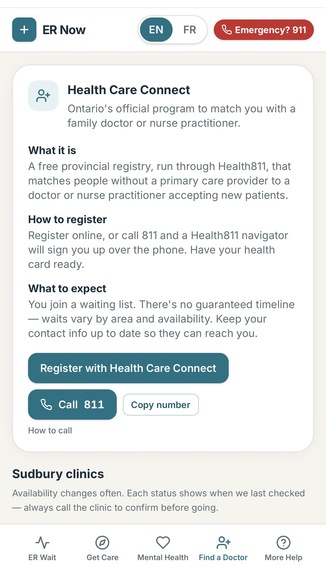
Mobile Version - Find a doctor Tab
-
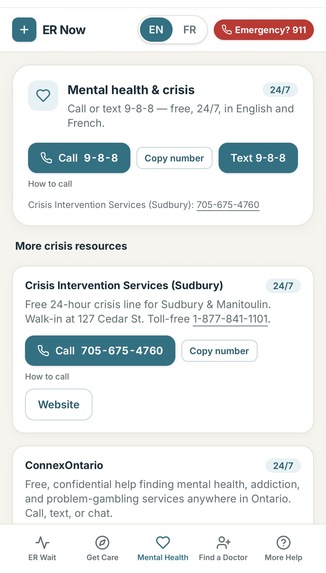
Mobile Version - Mental Health Tab
-
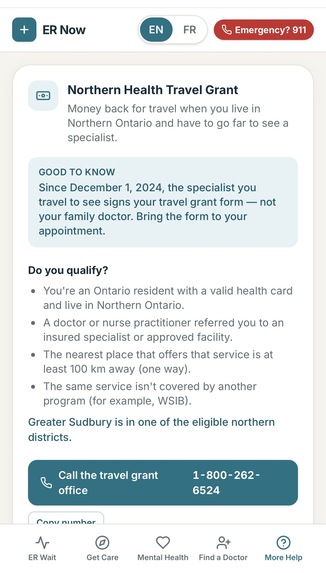
Mobile Version - More Help Tab
-
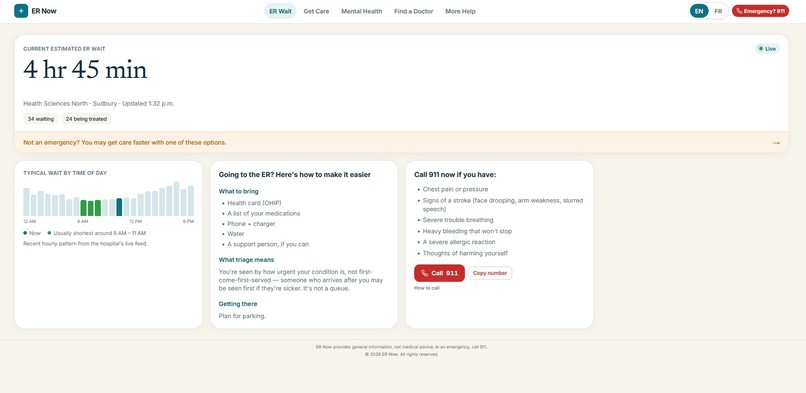
Web Version - ER Now Tab
-
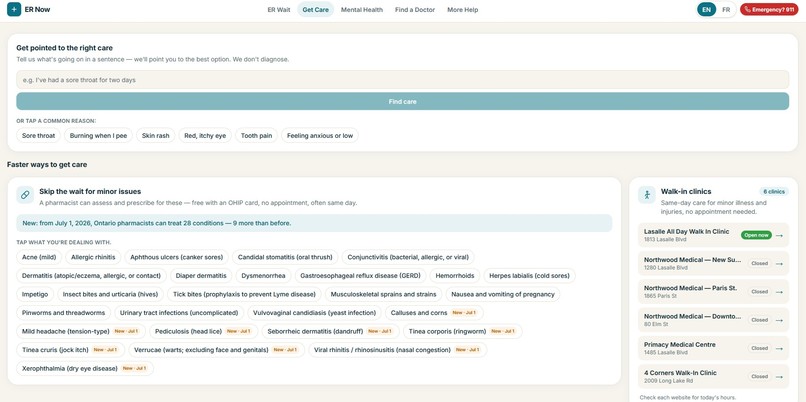
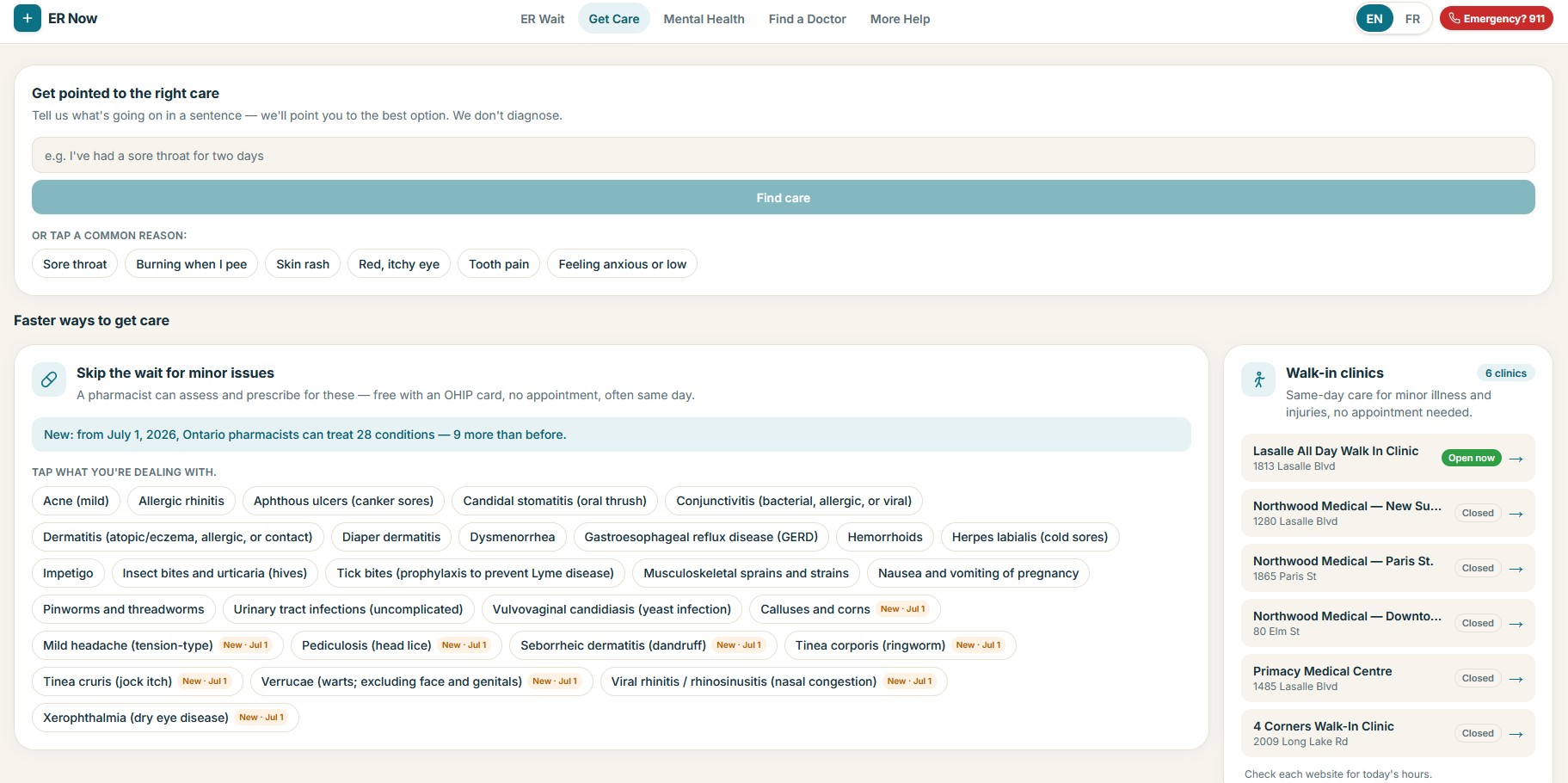
Web Version - Get Care Tab
-
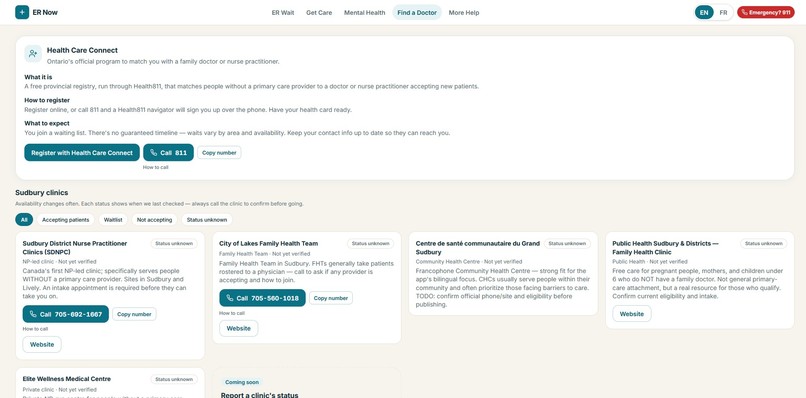
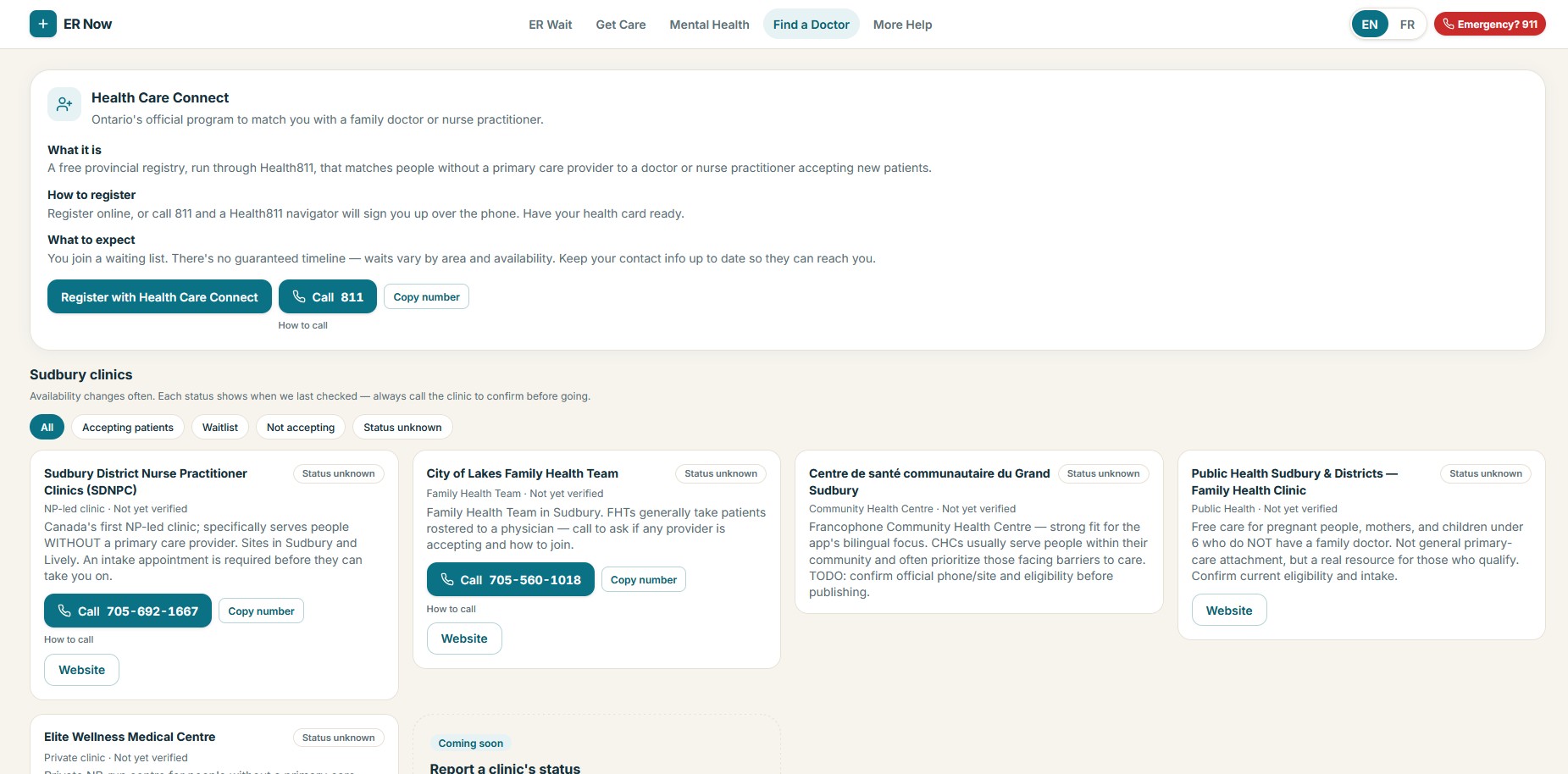
Web Version - Find a Doctor Tab
-
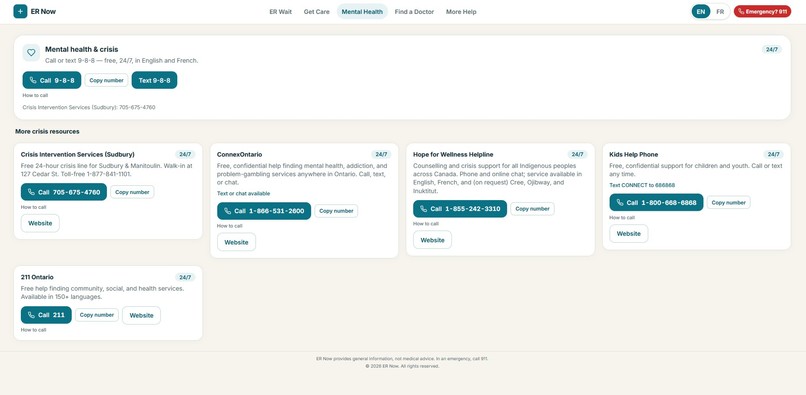
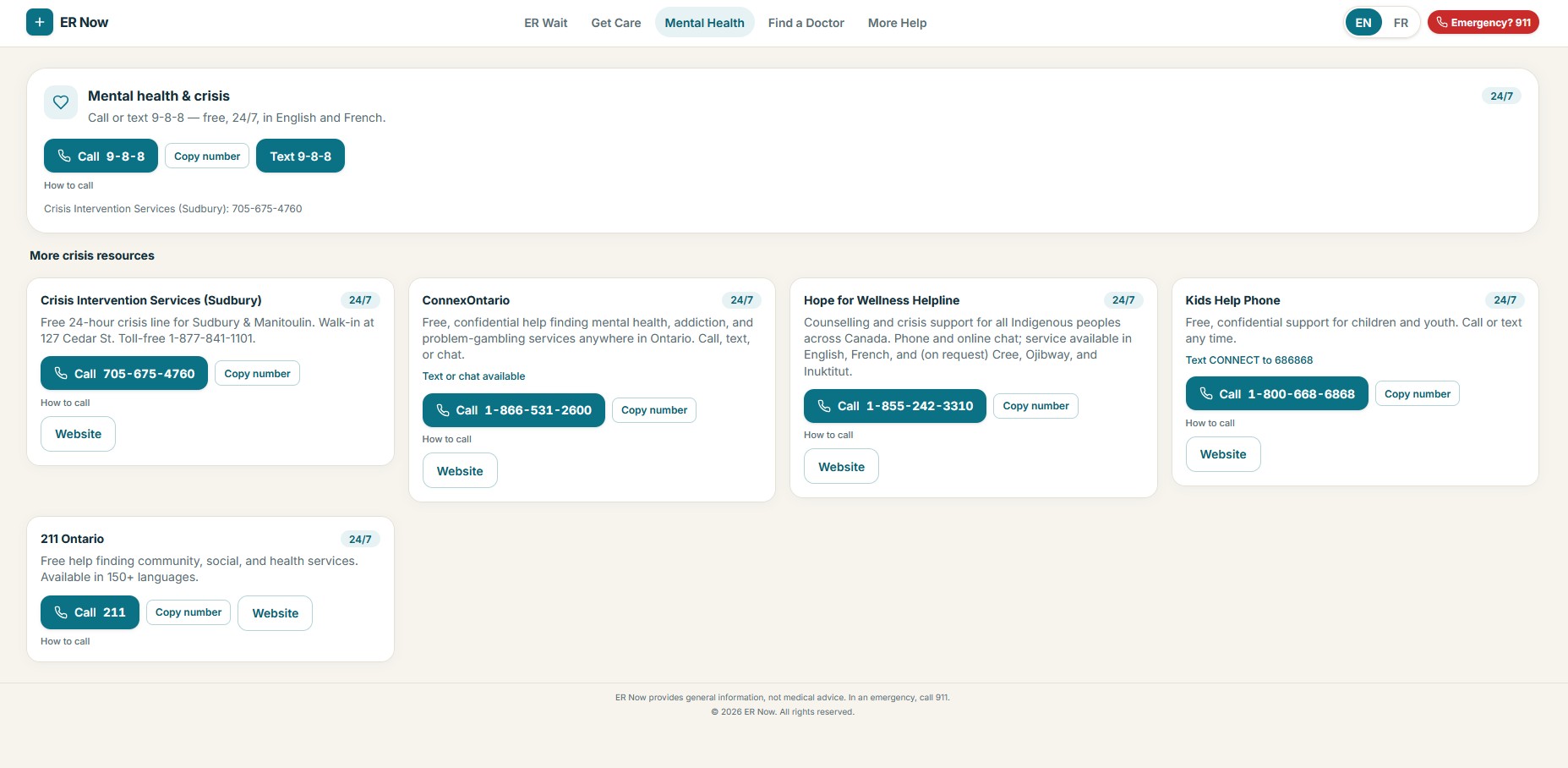
Web Version - Mental Health Tab
-
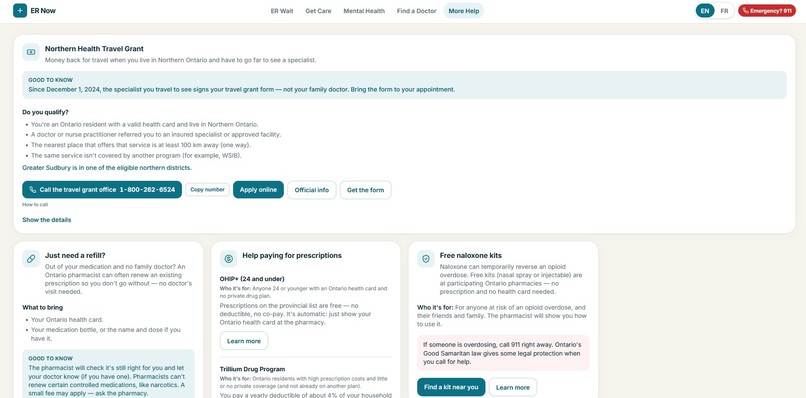
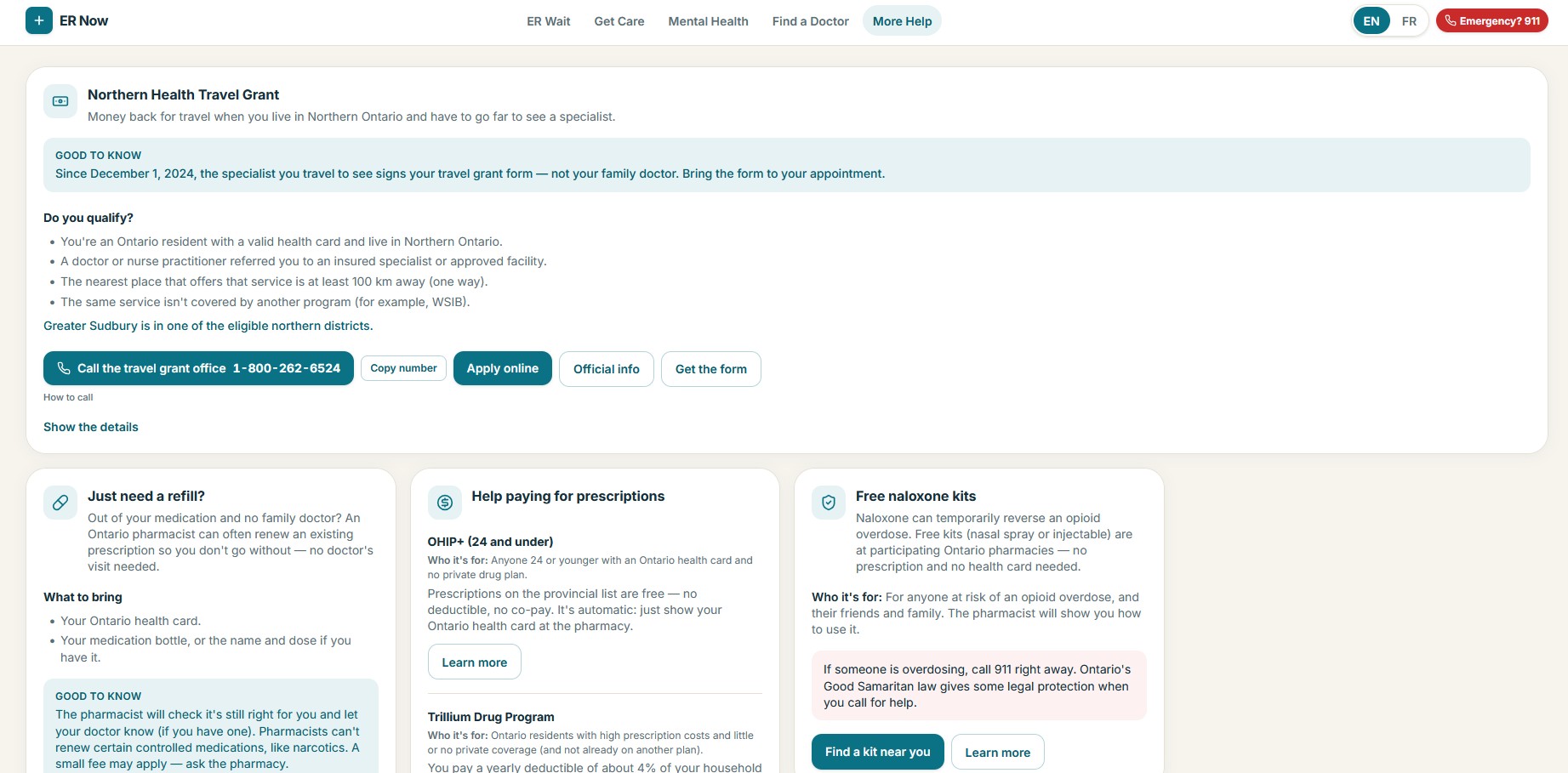
Web Version - More Help Tab
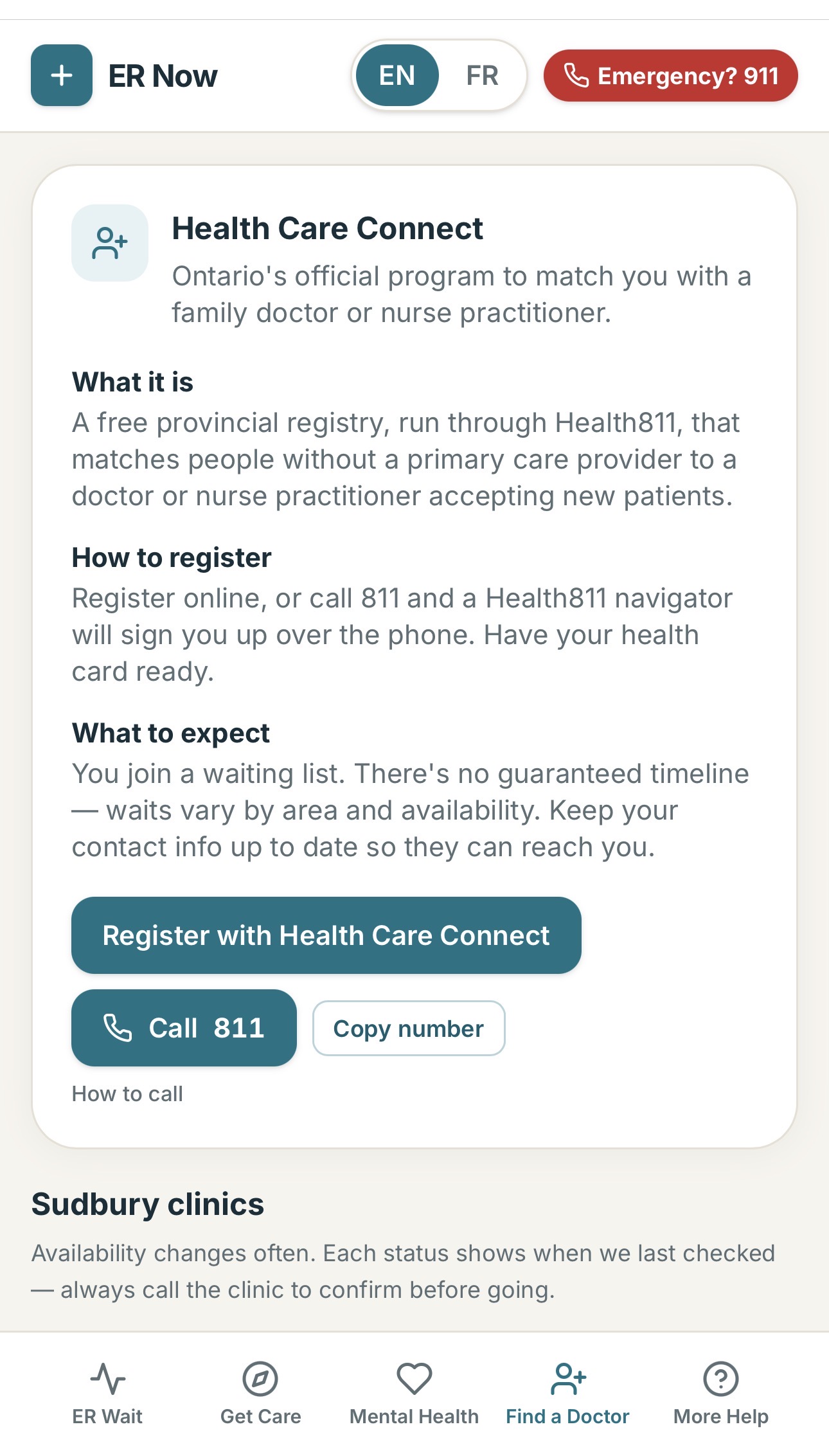
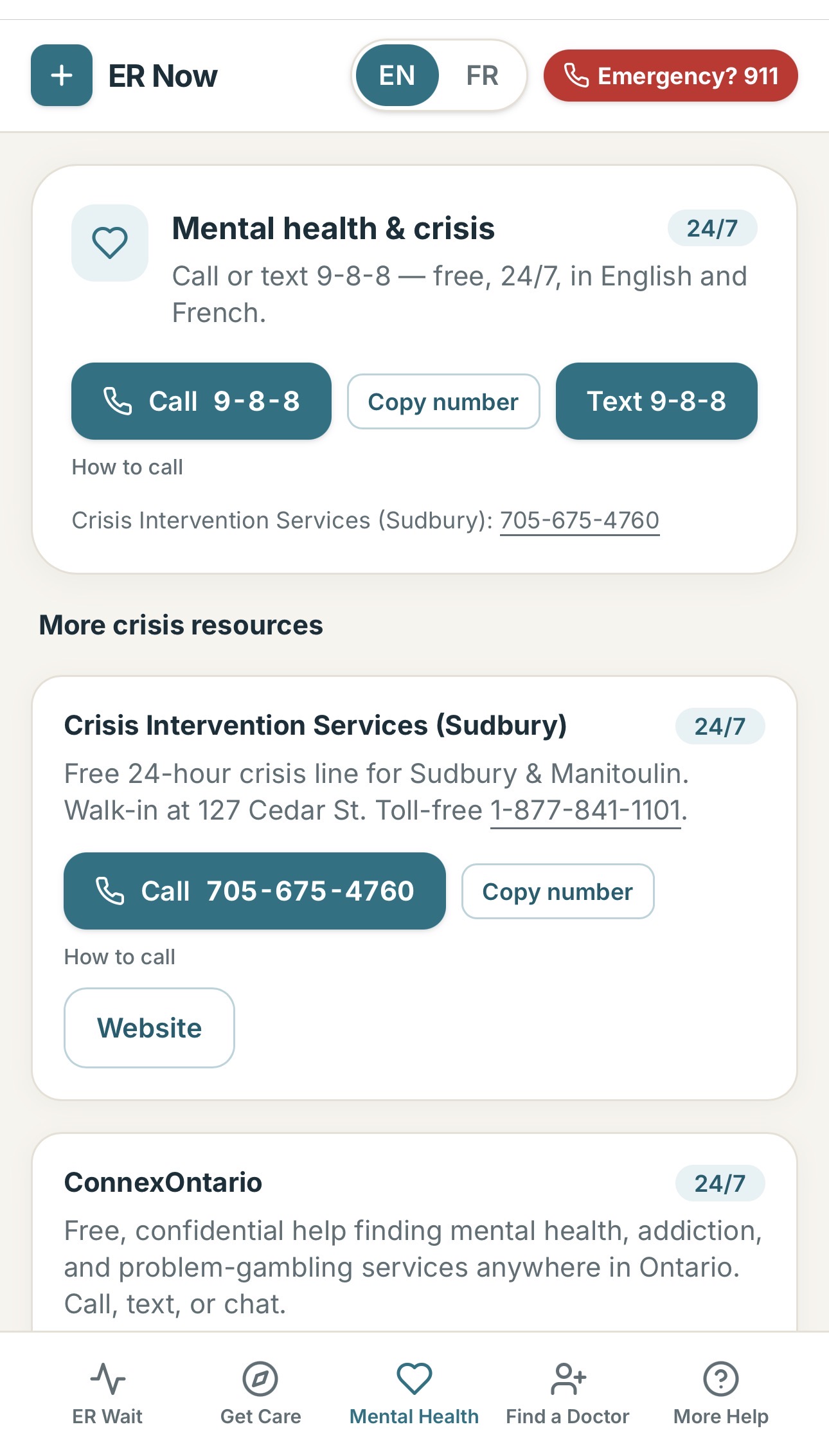
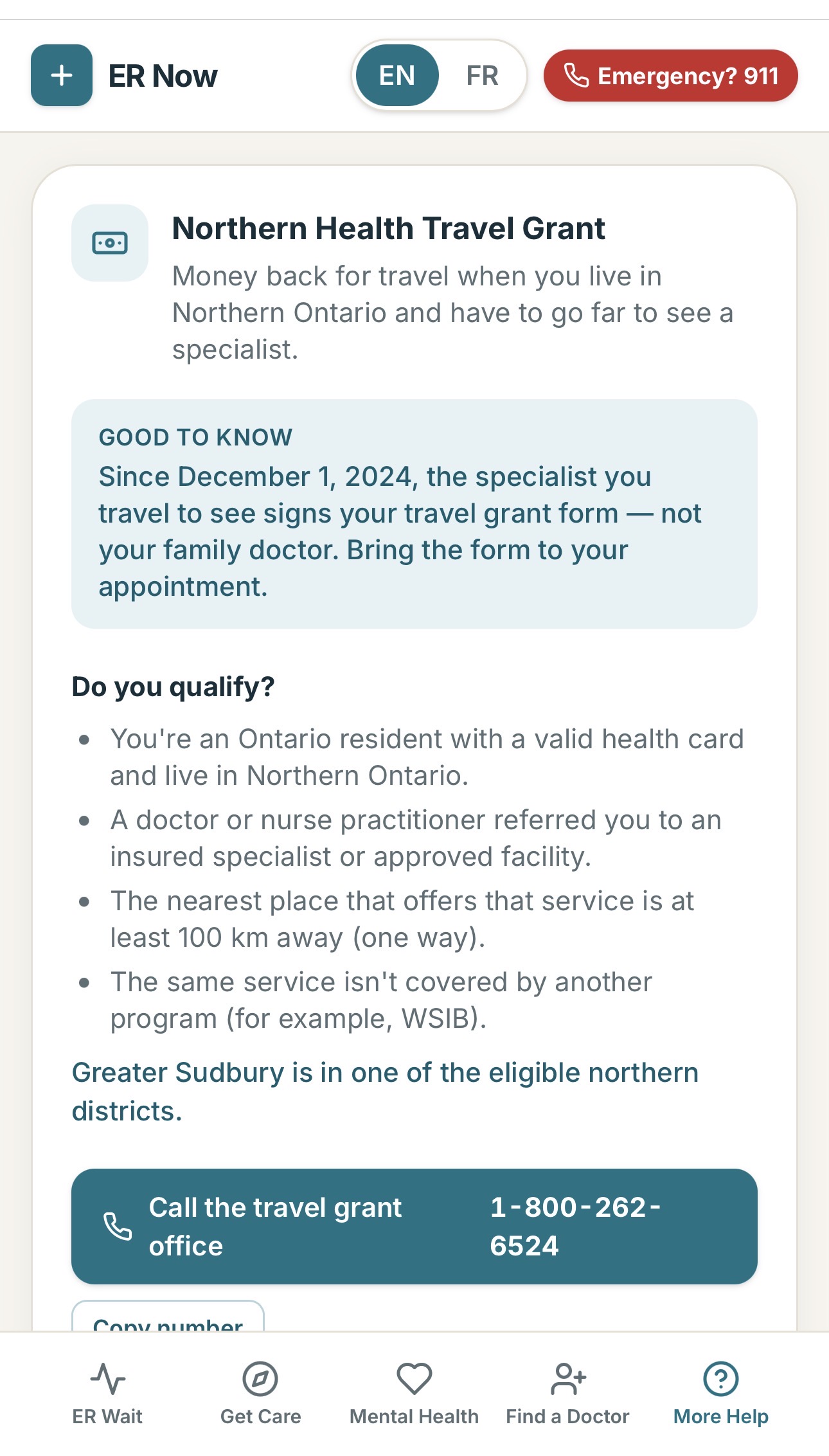
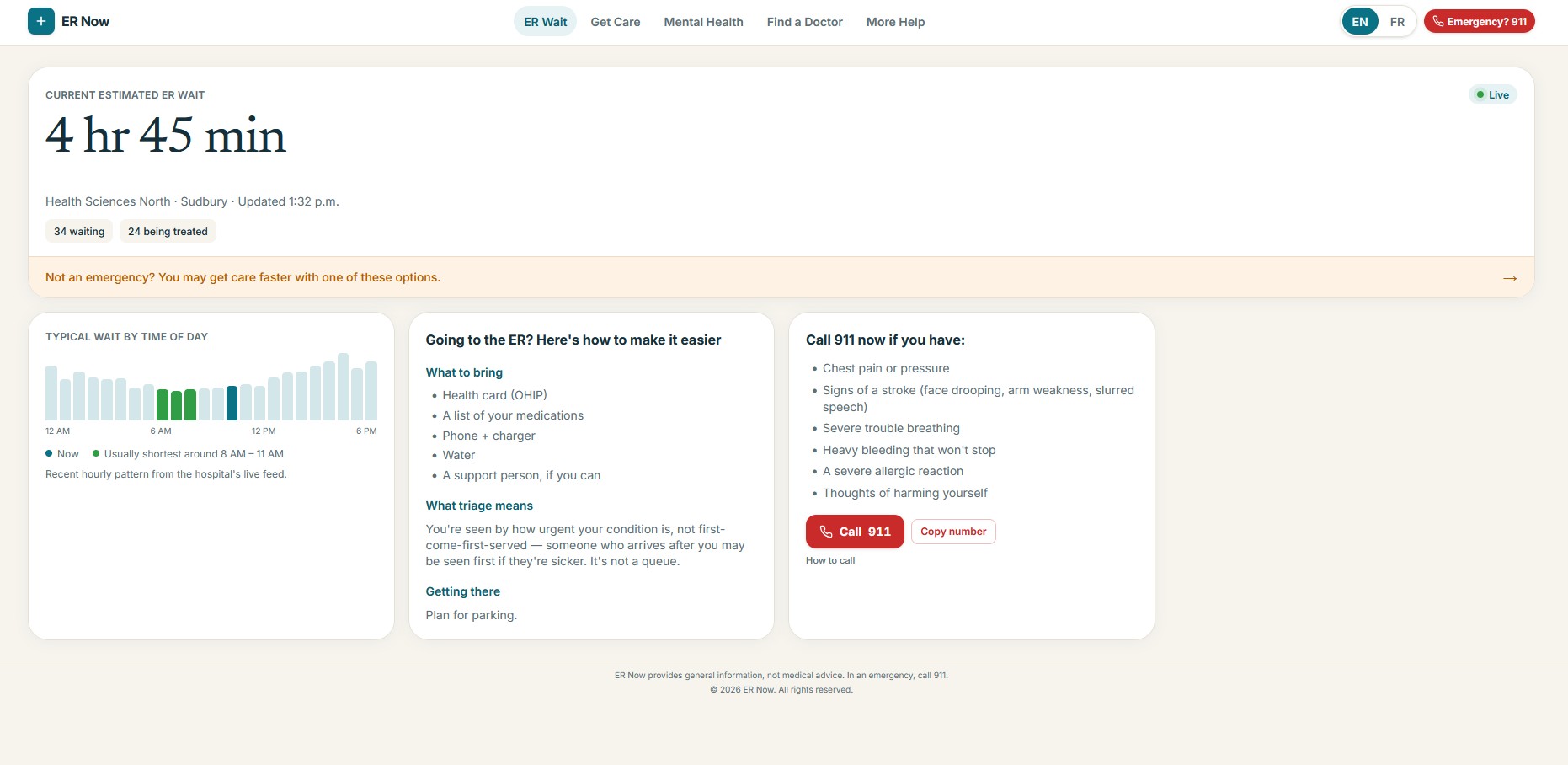
ER Now
Tagline: The front door to care — live ER wait times for Sudbury, and the faster way to get care when the ER isn't the answer.
Try it out: https://er-now-eta.vercel.app
Inspiration
The emergency room at Health Sciences North is where Sudbury goes when it doesn't know where else to go. The average wait there is about 7 hours — the provincial average is 4.5. And roughly 32,000 people in the area have no family doctor, a number projected to climb toward 62,900.
When you don't have a doctor and you're scared at 2am, the ER feels like the only door. A lot of the time it's the wrong one: the same care is often available faster from a pharmacist, virtual care, or a walk-in — if only people knew. Sudbury is also a major Franco-Ontarian city with a legal right to French-language health services, so any real solution has to work in French too.
We built ER Now to be that missing front door.
What it does
ER Now shows the live HSN emergency room wait, then routes you to the fastest appropriate care when the ER isn't the right call. No login, no typing, one tap deep — because the user is sick, stressed, or tired, and the app should do the work.
- Live ER wait card — current HSN wait pulled from the public feed, with a "last updated" timestamp and a graceful fallback if the feed is down.
- Pharmacy First — tap a symptom chip and see which conditions a pharmacist can assess and prescribe for free with an OHIP card, no appointment, plus where to go. Tied to Ontario's official pharmacist-scope list, including the July 1, 2026 expansion to 28 conditions.
- Mental Health door — a calm, separate path to call or text 9-8-8 (24/7, English and French) plus local crisis resources.
- Find a Doctor (DocAlert) — a family-doctor intake tracker with a Health Care Connect walkthrough.
- Northern Health Travel Grant helper — guidance on reimbursement for 100km+ medical travel, a real Northern Ontario need.
- Always-visible 911 button and a persistent "general information, not medical advice" disclaimer.
- Full English / French parity on every feature.
How we built it
Next.js (App Router) + TypeScript + Tailwind CSS, deployed on Vercel with auto-deploy from main.
Live wait data flows through a small pipeline: an Apify actor scrapes the public HSN / Oculys dashboard, and a server-side proxy inside the Next app calls the actor, caches the result, and falls back to a sensible value if the feed is unavailable. Every phone number, link, and clinic detail lives in verified data files that act as a single source of truth — the UI never invents a number or a URL.
We built it primarily through Cursor (feature work) and Claude Code (file edits and git).
Challenges we ran into
- Git author misconfiguration. Commits were landing under a different GitHub account, which Vercel was blocking from deploying. We traced it to the git author config and fixed it.
- AI tools fabricating data. Our coding assistants kept hardcoding plausible-but-fake phone numbers and URLs straight into components — dangerous in a health app. We solved it structurally: external links and numbers must come from a verified data file, and we leave a
// TODOrather than fabricate a value. - Deciding what not to build. The hardest call was resisting an AI symptom checker (more on that below).
Accomplishments that we're proud of
- It's live, deployed, and running on real HSN wait data — not a mockup.
- We route, we don't diagnose. The symptom chips map to Ontario's official pharmacist-scope list — that's routing to the right provider, not medical advice. We built a constrained AI routing copilot but deliberately kept it out of the live demo pending clinical review; the deterministic chips are the dependable core. That restraint is the feature.
- Trustworthy data — corrected crisis-line numbers, real Sudbury providers, verified government sources for travel and drug programs.
- Privacy by design — no accounts, no typing, nothing stored.
What we learned
- The most valuable feature was an information gap, not a technical feat: most Ontarians have no idea pharmacists can already treat ~19 minor ailments free with OHIP, expanding to 28 four days after our hackathon.
- Restraint reads as maturity. Saying "we route, we don't diagnose" earns more trust than an impressive-but-risky triage bot.
- In a health tool, data discipline beats cleverness — a single wrong phone number breaks everything.
What's next for ER Now
- Phone-verify every clinic status (currently marked unknown with TODOs).
- Enable the AI Care Copilot as a routing assistant — only after clinical review.
- Best Time to Go — we're logging the live wait feed to build a dataset of when waits are lowest, which nobody in Sudbury currently has.
- PWA install + offline caching for Northern Ontario dead zones.
- QR posters in pharmacies, clinics, and the ER waiting room: "Next time, check before you come."
- Partnership conversations with HSN / Health811.
Why ER Now holds up
We built ER Now to be judged honestly against the things that matter in a health project.
The problem is specific, local, and squarely a health problem: a seven-hour ER wait at Health Sciences North and 32,000 residents without a family doctor are not abstractions — they are measured realities that nearly everyone in Sudbury has lived. The solution responds to that problem directly and practically. It meets a real person at a real moment of stress and gets them to the right care setting in a single tap, with no account and no typing required.
It is a working product, not a concept. The live ER wait runs on real HSN data through a cached, fault-tolerant pipeline, and the rest of the app is deployed and usable today on any phone. Its impact is concrete and its limits are understood: it diverts avoidable ER visits toward pharmacists, virtual care, and walk-ins, and we are candid about what still needs phone verification and clinical review before it scales further.
Most importantly, it is built responsibly, and we can point to exactly how. It collects no accounts and stores no personal data (privacy). It routes rather than diagnoses, with a hard-coded red-flag check for emergencies and a conservative "call 811" fallback whenever it is unsure (safety). Every phone number and link comes from a verified data file rather than being invented, with a TODO left in place of any value we could not confirm (data integrity). It works in plain language, large text, and full French parity (accessibility). And it degrades gracefully when the live feed is down, never showing a blank or broken screen (operational resilience). The choice not to ship an AI symptom checker is deliberate, and we state it plainly — here, restraint is the responsible decision.
What makes it original is partly what it reveals. Most Ontarians have no idea pharmacists can already treat common ailments for free, and no one in Sudbury is tracking when ER waits are actually lowest — we are starting to. Built over three focused weeks and shipped to a live URL, ER Now is a small product that does one thing well, and intends to keep doing it long after the hackathon ends.
Built With
next.js · typescript · tailwindcss · vercel · apify · claude · cursor
Built With
- anthropic-api
- apify
- claude
- claude-code
- cursor
- github
- next.js
- react
- tailwind-css
- typescript
- vercel

Log in or sign up for Devpost to join the conversation.