Inspiration
Most legal AI tools assist only one person, but real disputes involve two sides, conflicting facts, private interests, and questions of trust. Formal legal proceedings can be expensive and intimidating, while unstructured negotiations often become emotional or unfair.
We built Settle to explore a harder question: can AI help two people negotiate without becoming a hidden judge?
What it does
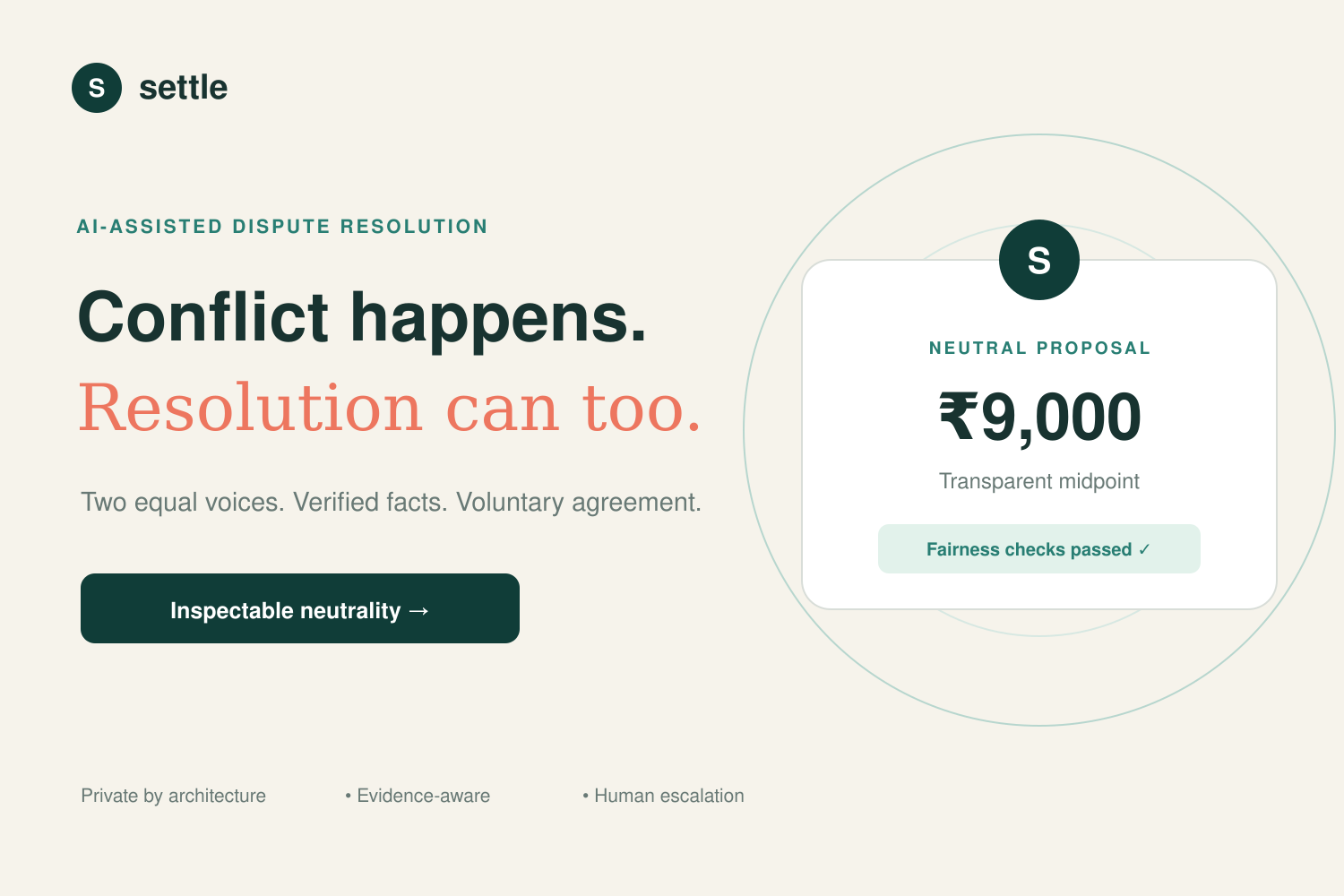
Settle is a neutral, AI-assisted mediation platform for everyday disputes.
A participant creates a mediation room and invites the other party. Settle then:
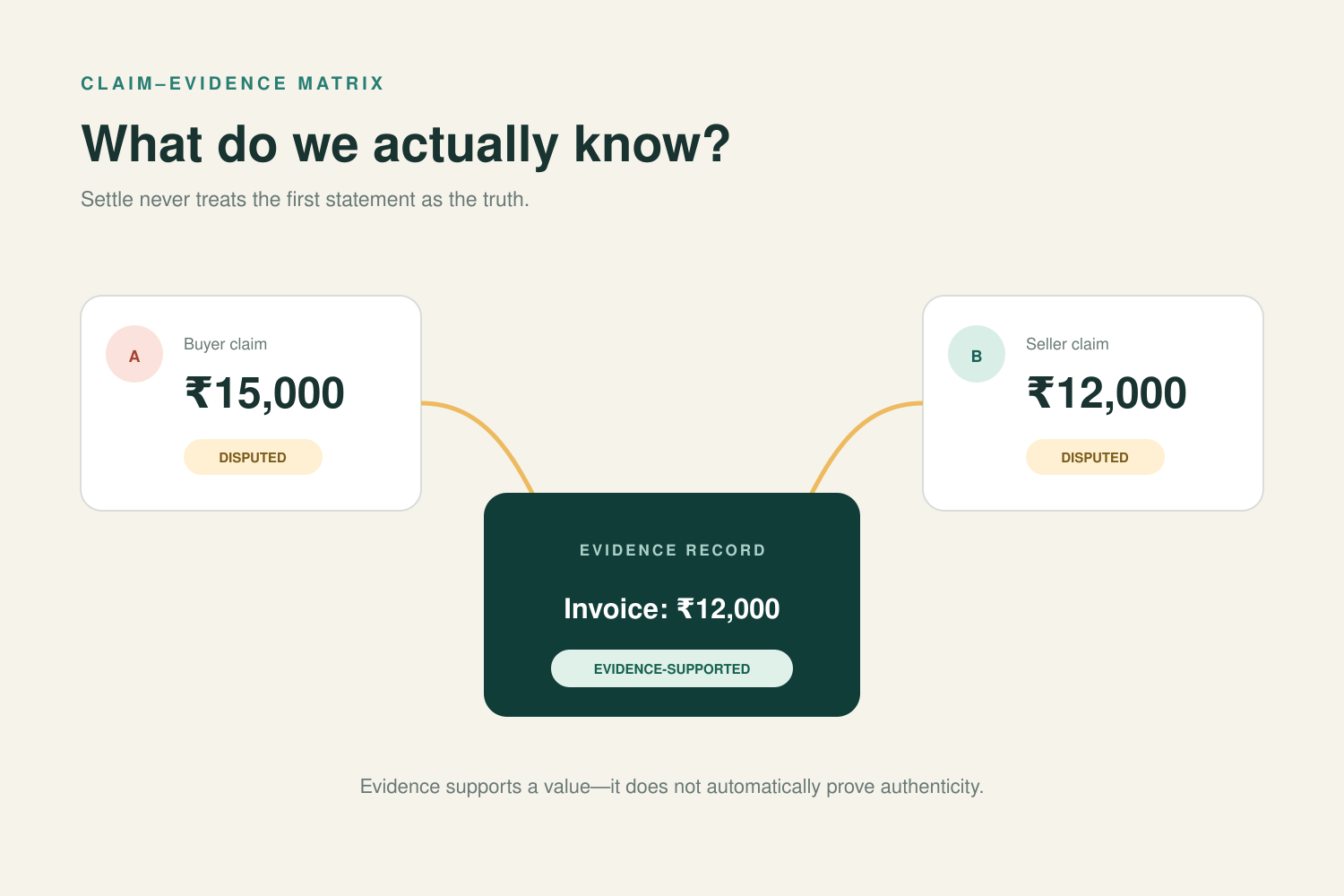
- Separates facts into unverified, agreed, disputed, or evidence-supported claims.
- Allows evidence such as invoices and receipts to be uploaded and analyzed using OCR.
- Protects each party’s private negotiation strategy.
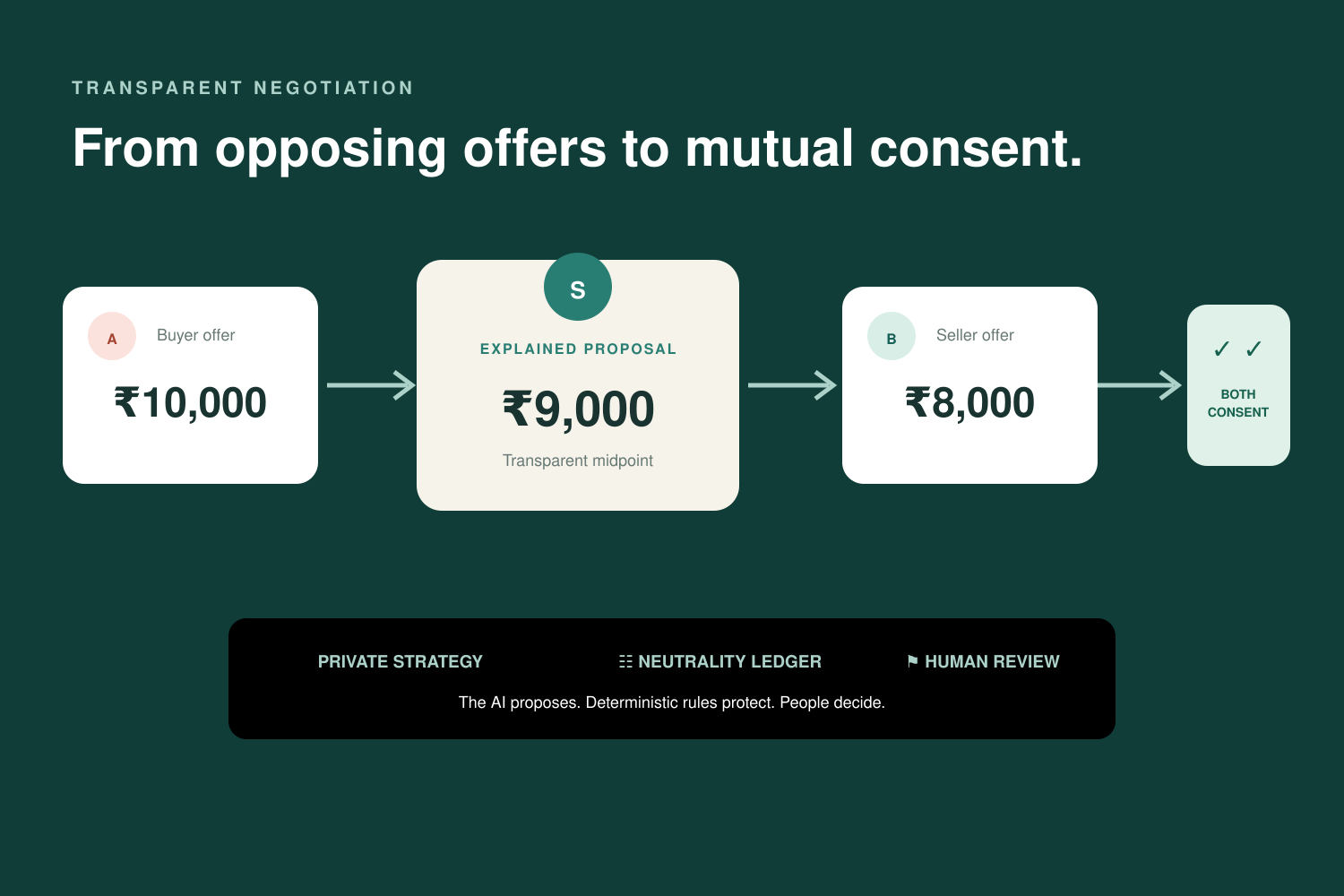
- Enforces alternating negotiation turns.
- Generates explainable settlement options using only shared information.
- Records offers, concessions, evidence, and fairness checks in a Neutrality Ledger.
- Allows either party to flag possible bias and request human review.
- Generates a settlement memorandum only after both parties independently consent.
For example, if a buyer claims that earphones cost ₹15,000 while the seller says ₹12,000, Settle does not automatically trust either person. It marks the amount as disputed and checks supporting evidence before using it during negotiation.
How we built it
Settle uses:
- HTML, CSS, and JavaScript for the responsive interface
- Node.js for the mediation API
- Supabase Auth and PostgreSQL for authentication and persistent storage
- Supabase Storage for private evidence files
- Supabase Realtime and server-sent events for multi-device updates
- OpenAI Responses API for structured mediation options
- Vision-based OCR for extracting facts from evidence
- AES-256-GCM encryption for sensitive mediation data
- HMAC-SHA256 records for auditable electronic consent
- Resend-compatible email invitations
- Jurisdiction packs for India, California, and England and Wales
The AI does not control privacy, turn order, evidence status, signatures, or final acceptance. Those decisions are enforced by deterministic backend rules.
Challenges we faced
The biggest challenge was neutrality. An AI response can sound fair while relying on an unverified claim, exposing private information, or pressuring one participant.
We addressed this by separating the generative AI layer from the governance layer. The AI receives only shared information, while deterministic code controls:
- Private-data boundaries
- Claim and evidence status
- Alternating turns
- Mutual consent
- Electronic-signature records
- Human escalation
Another challenge was conflicting evidence. Settle does not attempt to declare someone dishonest. It records each version separately and only marks a value as evidence-supported after connecting it to an uploaded record.
What we learned
We learned that responsible legal AI is not primarily about generating confident legal answers. It is about controlling what the system is allowed to assume, reveal, and decide.
Neutrality becomes more credible when users can inspect the process, challenge the AI, protect private information, and stop the automated workflow.
Accomplishments that we are proud of
- Built a complete two-party negotiation workflow
- Created an inspectable Neutrality Ledger and Neutrality Score
- Prevented party impersonation through server-side authorization
- Isolated private strategy notes at the API boundary
- Implemented evidence-aware claim reconciliation
- Added structured AI settlement options and OCR
- Required independent consent from both parties
- Added encrypted persistence and auditable signatures
- Created a human-mediator escalation process
- Passed ten automated privacy, security, and negotiation tests
What’s next for Settle
Next, we plan to add:
- More dispute categories and jurisdictions
- Multilingual mediation
- Independent legal and security audits
- Professional mediator partnerships
- Verified payment and merchant integrations
- Stronger document-authenticity checks
- Accessibility testing
- Evaluation datasets for bias, proposal symmetry, and private-data leakage
Settle does not replace lawyers, courts, or professional mediators. It creates a transparent and voluntary path between an informal disagreement and formal legal proceedings.
Built With
- aes-256
- ai
- artificial
- auth
- civic
- electronic
- encryption
- generative
- governance
- intelligence
- legal
- ocr
- postgresql
- realtime
- rest
- safety
- signatures
- storage
- supabase
- tech
