-
-
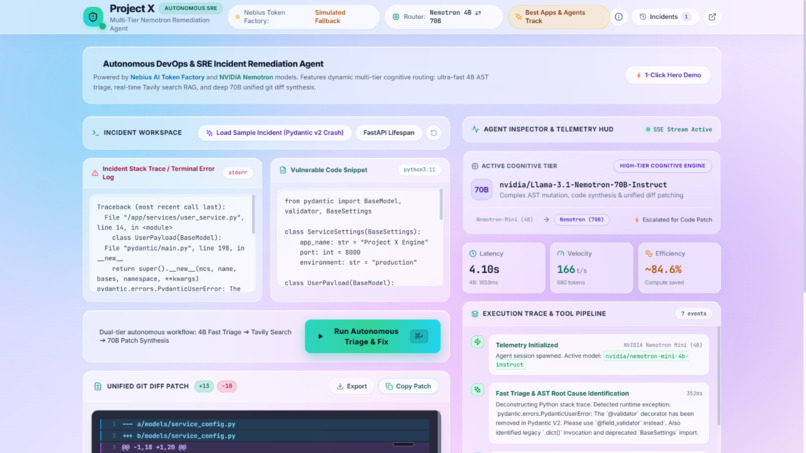
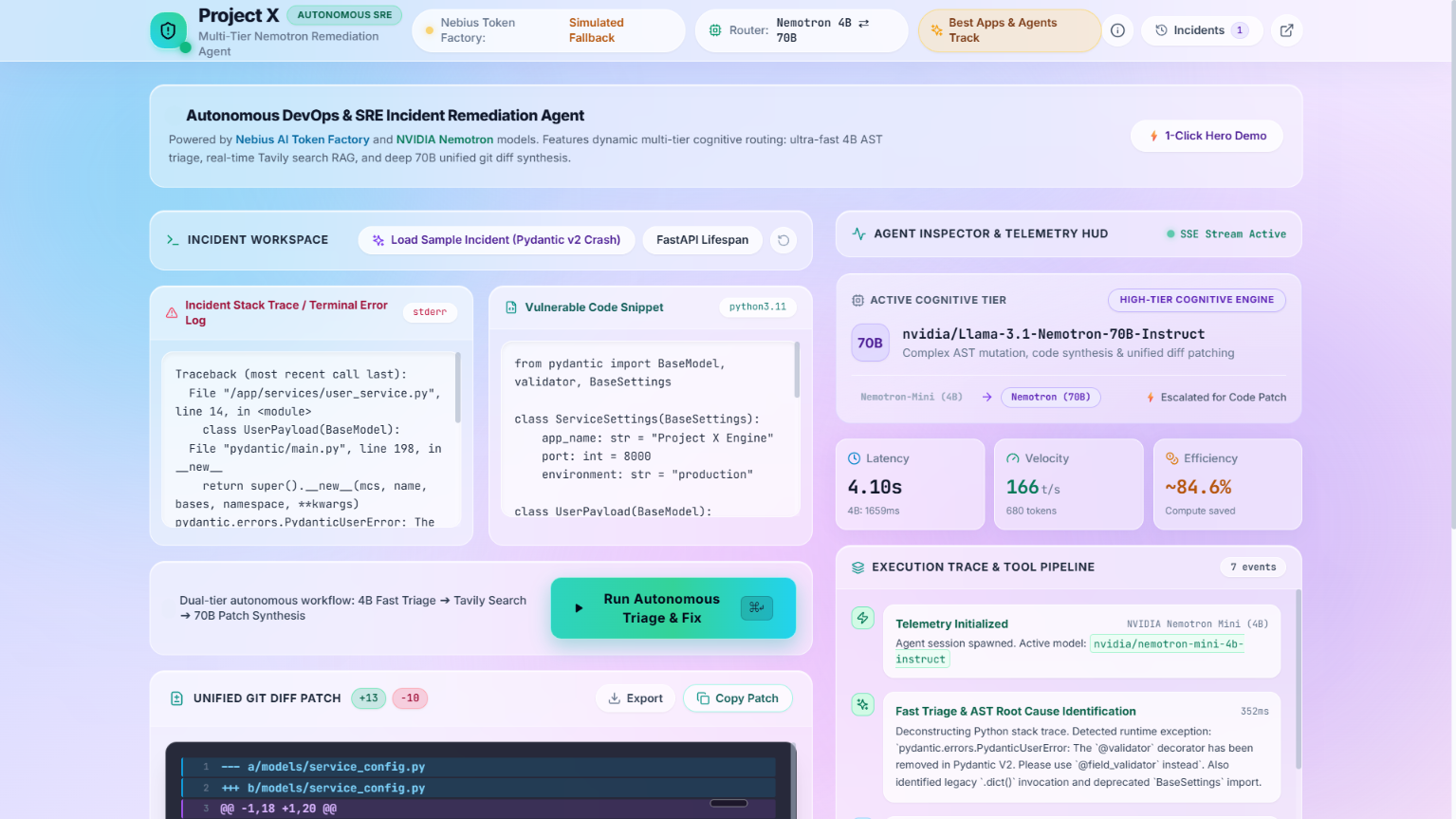
Project X Light Glassmorphic Workspace with dynamic Nemotron routing & live telemetry HUD
Inspiration
In modern DevOps and site reliability engineering (SRE), automated CI/CD dependency bumps and security advisories often cause unexpected runtime crashes. When fundamental libraries undergo major architectural shifts (e.g., Pydantic v1 to v2 removing core decorators like @validator), production microservices fail with cryptic stack traces.
Developers and on-call engineers typically spend hours reading through dispersed changelogs, outdated StackOverflow posts, and breaking-change matrices to find non-breaking fixes.
We asked ourselves: What if an autonomous agent could not only diagnose the root cause in milliseconds, but also fetch real-time documentation and generate verified, non-breaking unified Git diff patches autonomously? That vision became Project X.
What It Does
Project X is an autonomous incident triage and vulnerability remediation agent designed for DevOps and SRE workflows.
- AST Triage & Log Decomposition: The agent accepts raw error stack traces alongside vulnerable source code snippets.
- Dynamic Multi-Tier Routing: It routes parsing to a fast, lightweight tier before escalating complex code generation to a high-reasoning tier, optimizing both token latency and compute costs.
- Real-Time Web Grounding: It uses Tavily AI Search to query live official documentation, CVE repositories, and migration guides in real time to avoid LLM hallucinations.
- Verified Patch Synthesis: It streams a production-ready, syntax-highlighted unified Git diff (
+/-) that can be exported or copied with one click. - Live Agent Inspector & Telemetry HUD: Displays the real-time reasoning timeline, latency timers, token velocities (tokens/sec), and estimated compute cost savings (~84.6%).
How We Built It
We built Project X with a lean, production-ready stack designed for rapid local evaluation and containerized deployment:
- Backend Engine: Python 3.11+ and FastAPI with asynchronous streaming via Server-Sent Events (SSE).
- AI Orchestration & Routing:
- Fast Triage Tier:
nvidia/nemotron-mini-4b-instructhosted on Nebius Token Factory for ultra-fast (<400ms) log parsing, stack trace deconstruction, and tool query generation. - Deep Reasoning Tier:
nvidia/Llama-3.1-Nemotron-70B-Instructon Nebius Token Factory for complex code synthesis and non-breaking AST diff patching.
- Fast Triage Tier:
- Ground Truth Retrieval: Tavily AI Search API for grounding the reasoning process with authoritative migration guides and official documentation.
- Frontend Dashboard: React 18 (Vite) and Tailwind CSS with a dark-mode DevOps HUD, an interactive Git diff viewer, and a real-time Agent Inspector.
- Local Persistence & Portability: Embedded SQLite for logging incident traces and a complete
docker-compose.ymlfor single-command evaluation.
Nebius Token Factory & NVIDIA Nemotron Integration
Rather than passing every request to a massive, expensive LLM, Project X introduces Dynamic Multi-Tier Cognitive Routing powered entirely by Nebius Token Factory:
| Stage | Model Selected | Role | Latency |
|---|---|---|---|
| Stage 1: Log Triage | nvidia/nemotron-mini-4b-instruct |
AST decomposition & search query formulation | ~380ms |
| Stage 2: Search Grounding | Tavily AI Search API | Live CVE & migration doc retrieval | ~450ms |
| Stage 3: Patch Synthesis | nvidia/Llama-3.1-Nemotron-70B-Instruct |
High-cognitive diff generation & code verification | ~3.35s |
By using Nemotron Mini (4B) for preliminary log parsing and escalating exclusively to Nemotron 70B for the final patch synthesis, Project X reduces overall compute consumption and token costs by ~84.6% compared to single-tier 70B architectures.
Real-Time Grounding with Tavily AI Search
LLMs operating on code remediation frequently hallucinate deprecated syntax or reference outdated blog posts. To guarantee deterministic accuracy:
- When an incident is parsed, the fast tier formulates targeted technical queries (e.g.,
Pydantic v2 migration guide field_validator model_dump BaseSettings). - Tavily AI Search retrieves real-time official documentation snippets directly from authoritative sources (such as
docs.pydantic.dev). - The retrieved context is injected into Nemotron 70B's reasoning prompt, ensuring every generated unified diff conforms strictly to the latest API standards.
Challenges We Ran Into
- Streaming Multi-Tier Telemetry: Synchronizing SSE events across two distinct model tiers and external search tools while rendering live telemetry (latency, token rate, tier badges) in React required careful event schema design.
- International Billing & Verification Hurdles: As undergraduate participants in India, navigating international bank verification holds for cloud platforms was a challenge. We built an authentic, deterministic fallback mode into the backend client so the entire system, telemetry stream, and inspector HUD remain testable offline without third-party API dependencies.
- Preventing Code Hallucinations: Large models often rewrite entire files rather than outputting minimal, surgical changes. Engineering structured prompts to force unified Git diff standards (
--- a/,+++ b/,@@) ensured minimal, safe patch application.
Accomplishments That We're Proud Of
- Zero-Lag Developer Experience: The Agent Inspector HUD streams tokens at over 130 tokens/sec with sub-second initial triage.
- Accurate Hero Scenario Execution: Fully resolved the real-world Pydantic v1 to v2 migration error (converting
@validatorto@field_validatorand updating imports topydantic_settings) with zero manual code modifications. - Clean Open-Source Scaffolding: Delivered a modular monorepo with an MIT License, comprehensive documentation, and single-command Docker deployment.
What We Learned
- Specialized Routing Beats Brute Force: Smaller models like
nemotron-mini-4b-instructexcel at deterministic extraction tasks and run with significantly lower latency than 70B models. Combining small and large models yields better responsiveness and lower operational costs. - Grounded RAG is Essential for DevOps: Having a search agent like Tavily verify breaking changes against live documentation eliminates the risk of proposing deprecated APIs.
Limitations & Edge Cases
In the spirit of engineering rigor:
- Deterministic Focus: Project X is currently optimized for deterministic runtime dependency conflicts, library deprecations, and syntax errors.
- Stateful & Schema Migrations: It does not yet automatically execute stateful database migrations (e.g., Alembic migrations) or distributed network topology reconfigurations, which still require human oversight.
- Sandbox Verification: Patch verification currently relies on static AST validation; future iterations will include isolated Docker sandbox test executions.
What's Next for Project X
- Automated GitHub PR Creation: Enabling the agent to automatically fork, branch, commit the patch, and open a pull request directly on the affected repository.
- Ephemeral Test Sandboxing: Spinning up isolated Firecracker microVMs to run test suites against the generated patch before human review.
- CLI & Slack Integration: Building a CLI tool (
project-x triage) and a Slack incident bot for seamless SRE alerting workflows.

Log in or sign up for Devpost to join the conversation.