-
-
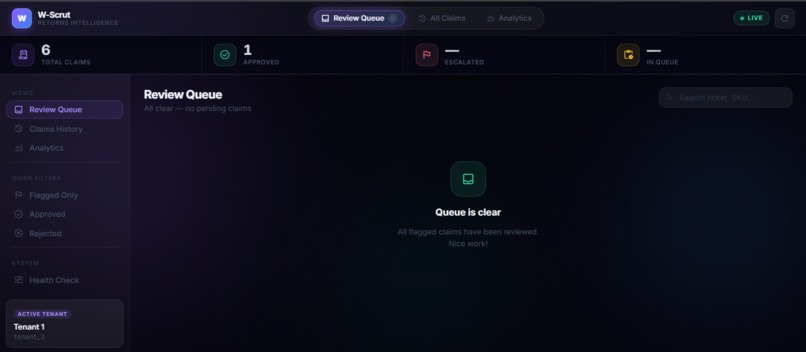
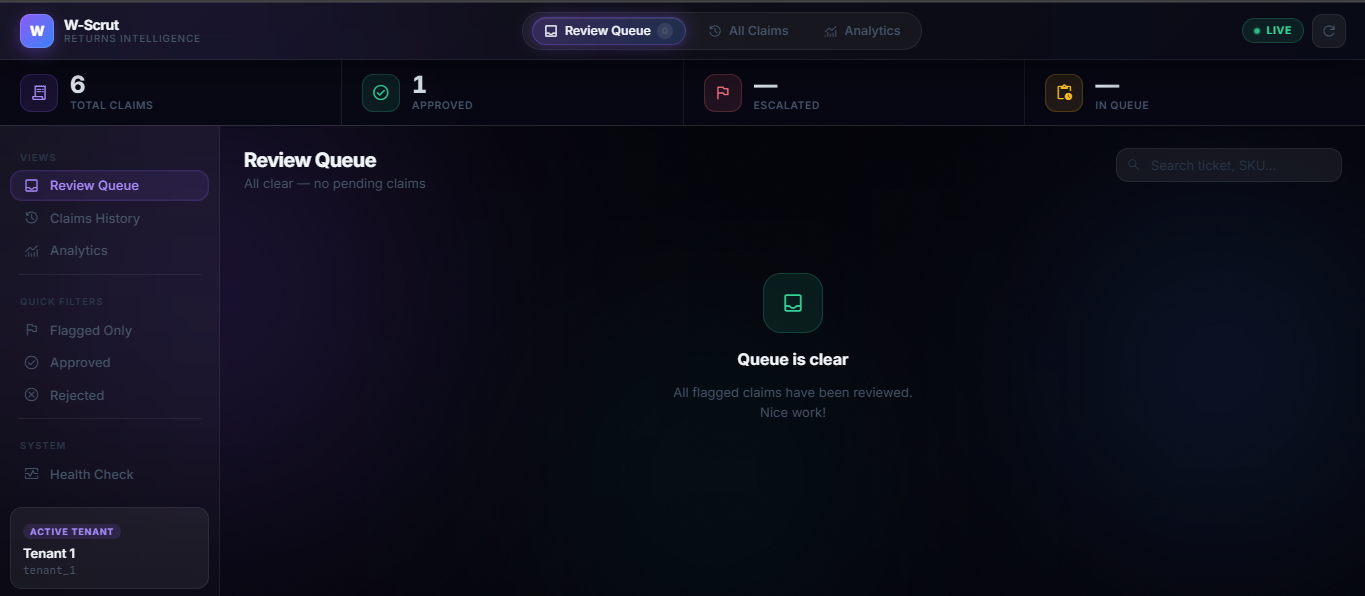
dashboard of the demo tenent
-
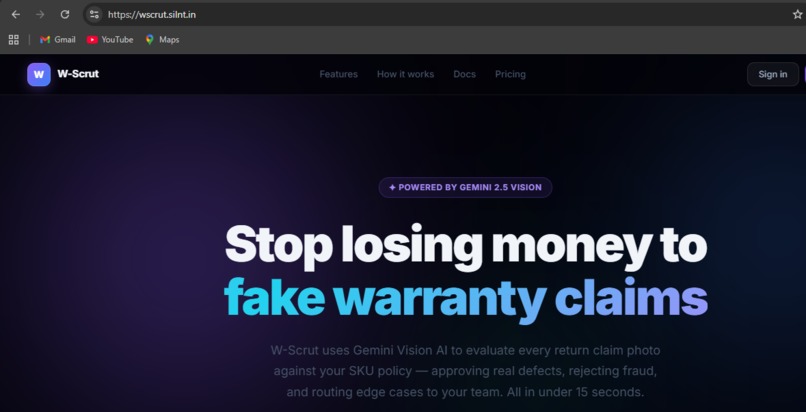
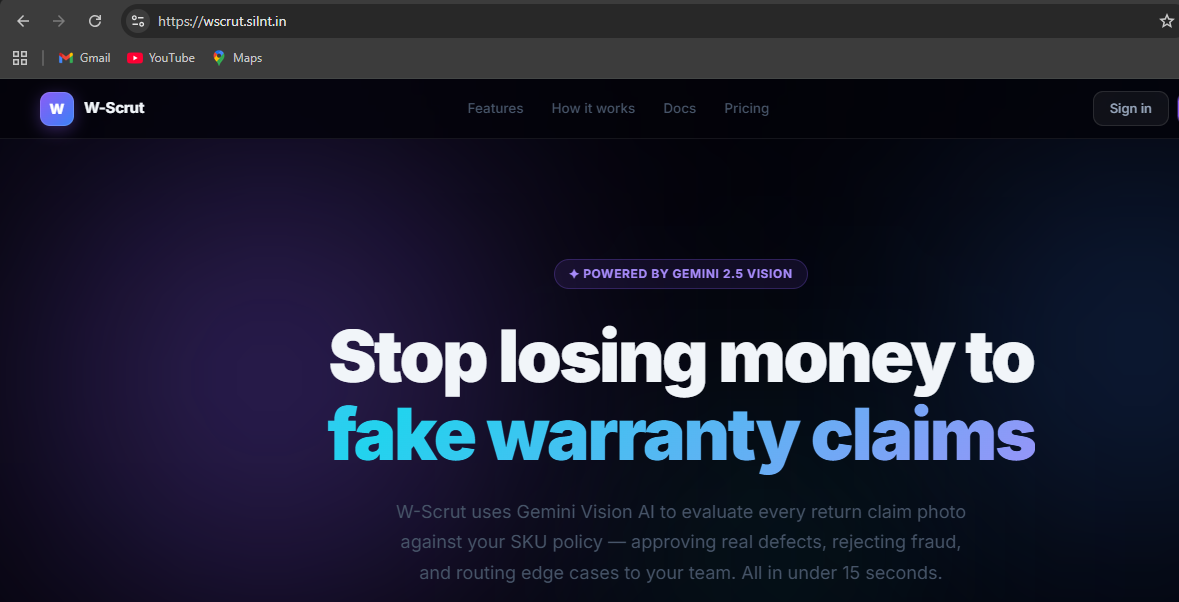
site "https://wscrut.silnt.in/"to register new users for tseting up the agent
Inspiration
Return fraud and unwarranted warranty claims directly reduce net margins for Direct-to-Consumer (DTC) brands. The standard industry approach relies on either expensive human labor or rigid, rules-based software that fails on edge cases. We identified the need for a scalable, autonomous system capable of evaluating multi-modal evidence with human-like inspection capabilities, but governed by strict, deterministic policy enforcement.
What it does
Project W-Scrut is an enterprise-grade SaaS platform engineered to automate warranty claim triage and return fraud detection.
It provides DTC brands with a comprehensive portal to configure return policies and monitor triage analytics. When a customer submits a claim, the system intercepts the request, uses multi-modal AI to evaluate visual evidence against the claimed defect, and applies the brand's specific warranty rules. The platform then automatically approves valid claims or escalates suspicious ones to human reviewers.
How we built it
We engineered W-Scrut using a scalable, event-driven microservices architecture deployed on Google Cloud Run.
- Secure Data Ingestion: To manage high inbound traffic efficiently, we built the primary ingestion gateway in Rust. This layer intercepts incoming webhooks and applies strict cryptographic verification before processing. Once authenticated, the data is standardized and securely queued via Google Cloud Pub/Sub.
- Intelligent Orchestration: A Python-based orchestrator manages the automated workflows. We integrated Google's Gemini models to analyze text and visual evidence. To ensure compliance, the AI acts strictly as an evaluation engine, comparing evidence against hardcoded brand policies dynamically retrieved from MongoDB Atlas.
- Enterprise Portal: The client-facing dashboard is developed with Next.js and Node.js. It features secure tenant session management using Firebase Authentication, providing brands with a reliable interface for onboarding and analytics.
Challenges we ran into
Mitigating AI Hallucination in Financial Workflows In financial and operational workflows, AI models cannot be allowed to estimate or guess policy details, such as warranty expirations. We engineered a zero-trust environment where the agent's internal memory is intentionally bypassed for policy decisions. The system must rely on deterministic database records, and if visual evidence is inconclusive or a policy bypass is attempted, the system is hardcoded to halt and escalate rather than guess.
Asynchronous Event Management Processing heavy multi-modal evaluations synchronously risks timing out webhook providers. We resolved this by decoupling the architecture: the Rust gateway immediately acknowledges the incoming request and offloads data to Google Cloud Pub/Sub. This allows the orchestration layer to process queues asynchronously without dropping requests during traffic spikes.
Accomplishments that we're proud of
We successfully deployed a production-ready, event-driven architecture that combines advanced AI with strict enterprise reliability. The integration of a decoupled Rust ingestion layer with Google Cloud Pub/Sub ensures our platform can scale securely under high load while maintaining deterministic decision-making.
What we learned
We validated that deploying agentic AI in financial contexts requires strict operational boundaries. Decoupling the ingestion and processing layers is essential for system stability. Furthermore, treating the AI strictly as a reasoning engine—rather than a source of factual policy truth—is the only viable path for reliable enterprise software.
What's next for Project W-Scrut
Our immediate roadmap involves expanding our integrations to push automated triage decisions directly back into major e-commerce platforms and enterprise ERP systems. We also plan to enhance the client portal with deeper predictive analytics to help brands identify emerging return fraud trends before they scale.
Try the Demo
You can try the live demo via our Telegram bot at t.me/wcrutBot. Send it a claim for a return of damaged shoes with a photo, and then check the dashboard to see how the system autonomously triages the claim.
Built With
- actix-web
- docker
- express.js
- firebase-auth
- google-cloud
- google-gemini
- mongodb
- mongodb-atlas
- next.js
- node.js
- python
- rust
- shopify-webhook
- tailwind
- telegrambot
- typescript


Log in or sign up for Devpost to join the conversation.